

CIF Freight Cost: Who Pays and How It Is Calculated
Under CIF the seller pays freight and minimum insurance to the named destination port, while the buyer pays destination charges, duty and onward transport. This guide maps every charge, the freight build and the insurance leg, with a worksheet to estimate the landed cost.
Short answer
Under CIF, the seller pays the main carriage and minimum cargo insurance to the named destination port, while the buyer pays destination charges, import clearance, duty and VAT, and onward transport. Risk passes to the buyer on loading on board at the port of shipment. Freight is built from a basic rate plus fuel, terminal handling and peak season surcharges. CIF is for sea and inland waterway transport only.
On this page
Key takeaways
Under CIF the seller pays main carriage and minimum insurance to the named destination port; the buyer pays destination charges, import clearance, duty and VAT, and onward transport.
Risk passes to the buyer on loading on board, while the seller keeps paying freight and insurance to the destination port; CIF is sea and inland waterway only.
Freight is built from a basic rate plus BAF, CAF, THC and peak season and security surcharges; for shared loads the charge follows the greater of weight and volume.
Default insurance is Institute Cargo Clauses (C) at 110 percent of the invoice value, and destination THC plus demurrage and detention free time are the hidden-cost traps to agree before sailing.
A CIF freight cost quotation answers only part of the price question. Under CIF, Cost, Insurance and Freight, the seller pays the main carriage and minimum cargo insurance to a named destination port, while the buyer pays destination charges, import clearance, duty and tax, and onward transport. The cif freight cost is therefore one bill inside a larger landed cost.
CIF is one of the 11 Incoterms 2020 rules, which allocate cost, risk and obligations between seller and buyer.1 It applies only to sea and inland waterway transport. This guide maps the cost across three zones, origin, transit and destination, so a buyer in the United States, the United Kingdom, the European Union or the United Arab Emirates can split any CIF quotation from Bangladesh into the seller-paid bill and the buyer-paid bill, and estimate the total before accepting the price.
The CIF cost map: three zones, two bills
Every charge belongs in one of three zones, each with a default payer. The seller-paid zone runs from the factory to the named destination port; the buyer-paid zone starts at that port. Insurance crosses the boundary: the seller pays the premium, but the buyer carries the risk from loading on board.2
Zone | Charges in the zone | Default payer |
|---|---|---|
Origin, before loading | Goods, packing, inland transport, export clearance, origin terminal handling | Seller |
Transit, port to port | Basic ocean freight, fuel and other surcharges, minimum cargo insurance | Seller |
Destination, after discharge | Destination handling, delivery order fees, clearance, duty and VAT, demurrage, detention, storage, onward transport | Buyer |
Risk does not follow the money: the seller pays freight and insurance to the destination port, but risk transfers to the buyer on loading on board at the port of shipment.2
Name both ports in full, and write the rule and edition with the price: "CIF [named destination port], Incoterms 2020". A quotation naming only one port cannot be compared with one naming both. The CIF meaning guide sets out what a CIF price includes and how customs uses CIF value, and the Incoterms guide for shipments from Bangladesh places CIF among the other rules.
How the CIF freight cost is calculated
The freight charge inside a CIF price is a build, not a single rate: a basic rate for the route, container type and size, plus surcharges.3 The surcharges most often seen are the bunker adjustment factor (BAF), following fuel prices and distance, the currency adjustment factor (CAF), following exchange rates, terminal handling charges (THC), per container at both ports, and peak season and security surcharges.3 Fuel surcharges are revised periodically,4 and a peak season surcharge applies in periods of high demand.4 Each surcharge has its own basis and date, so two quotations for the same route can differ because they were priced on different dates.
The shipment shape decides the unit of calculation. For a full container load (FCL), the charge follows the container: a 20-foot, 40-foot or 40-foot high cube unit carries its own rate, charged whether full or not.4 Special containers cost more than standard dry containers.3 For a less than container load (LCL), cargo shares a container, and the charge follows the greater of weight and volume: one cubic metre counts as one volume ton, one metric ton as one weight ton.3 LCL also carries consolidation charges, so its cost per unit is higher than FCL.4
Example figures: a shared load measures 6.4 cubic metres and weighs 4,800 kilograms, so the chargeable quantity is 6.4 revenue tons. At an example rate of USD 95 per revenue ton, basic LCL freight is USD 608, before surcharges and the premium. The figures show the method only; they are not a rate.
The insurance leg: what the seller-paid premium covers
CIF adds one leg that CFR does not: the seller must arrange cargo insurance for the buyer's benefit, at the default level of Institute Cargo Clauses (C), with the option to agree higher cover.1 Cover must be at least 110 percent of the invoice value, the seller pays the premium, and the buyer claims directly under the policy.2
Clause C is the narrowest standard cover, issued by the Lloyd's Market Association and the International Underwriting Association. It covers only listed risks, fewer than Clause B and far fewer than the all-risks cover of Clause A.5 It covers listed risks such as fire, explosion, grounding, collision and jettison, while certain natural disasters and water damage are not covered.5 A buyer who needs theft, water damage or handling cover must agree broader cover expressly before the goods sail.
Example figures: goods invoiced at USD 24,000 carry minimum cover of USD 26,400. At an example premium of USD 132, the CIF value below is USD 25,642. The premium illustrates the arithmetic, not a premium rate.
Step-by-step: reading a CIF quotation line by line
Read a CIF quotation as a worksheet:
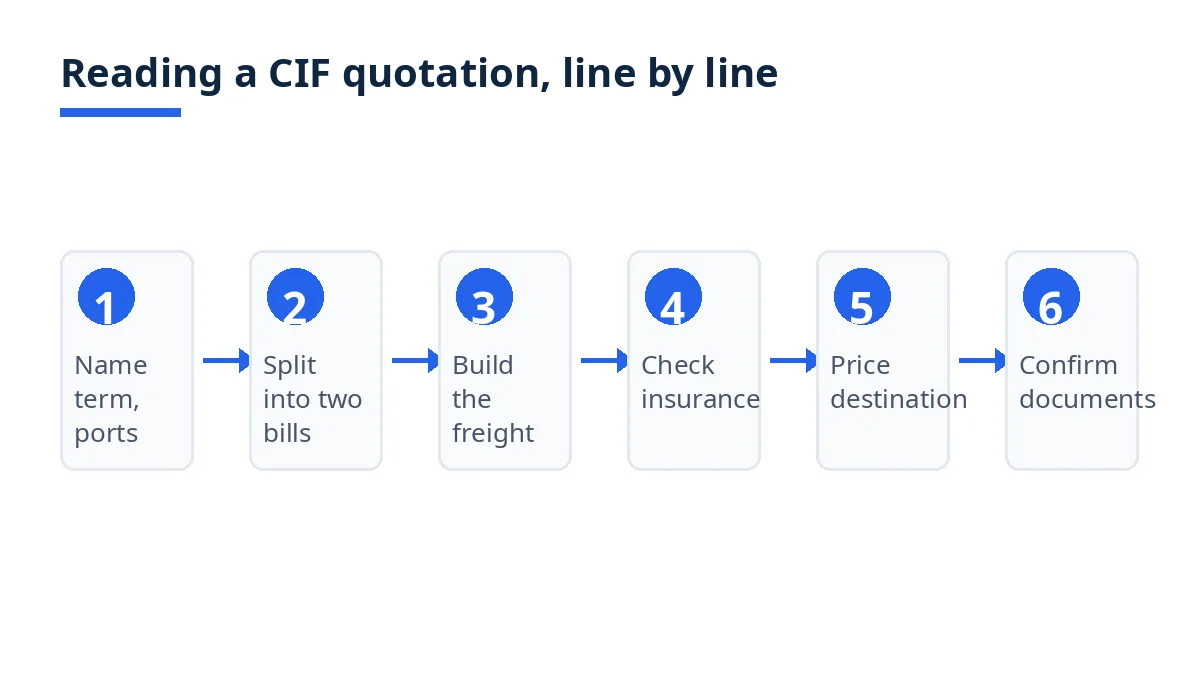
Name the term, both ports and the edition in full. Write "CIF [named destination port], Incoterms 2020", the port of shipment, and the country for each port.
Split the quotation into the two bills. Mark every line seller-paid or buyer-paid using the cost map above. Any unmarked line is a line to query.
Rebuild the freight from its parts. List the basic rate, BAF, CAF, origin THC, peak season and security surcharges, and documentation fees separately, with the calculation date and validity for each.3 4 For a shared load, show weight, volume and chargeable quantity.
Check the insurance leg on its own line. Record the clause letter, the insured value at 110 percent of the invoice value, the currency and the insured party.2 5 Note any broader cover agreed.
Price the destination zone before the goods sail. Ask the destination broker for destination THC, handling fees, clearance, duty, VAT and onward transport, in writing.
Confirm the documents and the free time. Check the transport and insurance documents, invoice, packing list and certificate of origin, and record the free time at destination, combined or separate.6
Estimating your landed cost beyond the CIF price
A CIF price is not a landed cost. The landed cost guide for imports from Bangladesh builds the full journey from the goods value to the warehouse door, and the worksheet below follows the same logic: the CIF value first, then the buyer-paid destination lines, then duty and tax, which only the destination tariff or broker schedule can confirm.
Example figures: one 40-foot container, Chattogram to Rotterdam, CIF Rotterdam. The figures illustrate the worksheet only and are not a quotation or rate.
Worksheet line | Example figure | Who pays |
|---|---|---|
Goods value | USD 24,000 | Buyer, to the seller |
Basic ocean freight, 40-foot container | USD 1,180 | Seller |
Bunker adjustment factor (BAF) | USD 195 | Seller |
Origin terminal handling charge | USD 135 | Seller |
Insurance premium, example, Clause C | USD 132 | Seller |
Example CIF value | USD 25,642 | Goods plus seller-paid build |
Destination terminal handling charge | USD 175 | Buyer |
Delivery order and handling fees | USD 60 | Buyer |
Destination broker fee | USD 140 | Buyer |
Onward transport to the warehouse | USD 310 | Buyer |
Duty and VAT at destination | Per broker schedule, not in the example total | Buyer |
Example buyer-paid lines before duty and tax | USD 685 | Buyer |
The seller-paid build is USD 1,642 and the buyer-paid destination lines are USD 685 before duty and tax. A buyer who budgets only the CIF value of USD 25,642 has under-budgeted the arrival by the full destination bill plus duty and tax.
What timelines and documents should the worksheet carry?
No standard transit time is stated in this guide, because sailing frequency, routing and congestion vary by sailing. Record the sailing date, expected arrival date and validity date of each quoted line. For documents, goods shall not be loaded or stuffed for export unless an export declaration, the Bill of Export or Shipping Bill, is submitted to Customs and approved.7 The buyer-side set is the transport document, insurance document, invoice, packing list and certificate of origin, checked against the contract before sailing.2 7
Bangladesh departure: export papers, ports and the loading point
Export clearance sits with the seller under CIF and gates the shipment. Once the declaration is approved, the goods are loaded and stuffed, and export is complete once the ship leaves and the officer signs the shipping bill as shipped on board.7 Ask for the approved declaration and that notation.
Name the port of shipment in full. Chattogram is the port most garment, textile, jute and light-engineering quotations will name, and Mongla serves cargo from the south-west. The port named decides the inland haul, origin THC and sailing schedule. Confirm the stuffing point as well: factory, inland container depot or port.
Containers are commonly handed to a carrier at a terminal before loading, and under CIF the seller normally retains risk until loading on board, so terminal handover alone does not transfer risk.2 Ask in writing where delivery and risk transfer are recorded. CIF and CFR share the on-board delivery point, so switching the price label does not fix the handover.2
Hidden-cost traps: destination charges, free time and prepaid freight
The first trap is destination terminal handling. THC is charged at both ports,4 and the destination THC is buyer-paid unless the carriage contract expressly includes it. Ask the broker, in writing, which destination lines the contract covers, and price the rest before sailing.
The second trap is free time. Demurrage is charged when a full container stays inside the terminal beyond free time, detention when it is outside the terminal beyond free time until the empty is returned, and storage pays separately for terminal space.6 Free time depends on the line, country, port, equipment type and contract, and it may be combined, covering discharge to empty return in one pool, or separate, with one allowance for each charge.6 Daily rates can rise in progressive bands,6 and Incoterms do not expressly cover these charges, so the contract and the forwarder's quote must state who bears them.6 Record the free time, band structure and empty-return depot before arrival.
Example figures: a container discharged on day zero, collected on day seven and returned empty on day nine. With combined free time of ten days, nothing is payable; with separate free time of five days each, two demurrage days are billable. At an example rate of USD 90 per day, the same nine days cost USD 180 under one structure and nothing under the other.
The third trap is prepaid freight read as all-in freight. "Prepaid" means the seller has paid the main carriage to the named destination port. It does not mean the seller has paid destination handling, clearance, duty or onward transport. Where a quotation uses the word prepaid without a line-by-line split, ask for the split. The same applies to any charge described only as "local charges": ask whether it is the origin charge or the destination charge, since the same phrase names both.
Checklist: before you accept a CIF price
Term, both ports and edition written in full: "CIF [named destination port], Incoterms 2020".
Every quotation line marked seller-paid or buyer-paid, with no unmarked lines.
Freight rebuild shown: basic rate, BAF, CAF, origin THC, surcharges, documentation fees, date and validity.3 4
Shipment shape confirmed: container type and size for FCL, or weight, volume and chargeable quantity for LCL, with the greater of weight and volume used.3
Insurance leg checked: clause letter, insured value at 110 percent of the invoice value, currency and insured party.2 5
Destination zone priced in writing: destination THC, handling fees, clearance, duty, VAT, onward transport, and lines the contract covers.
Free time recorded: combined or separate, band structure, rates, empty-return depot.6
Document set agreed: transport and insurance documents, invoice, packing list, certificate of origin, approved Bill of Export.2 7
Risk point understood: risk passes on loading on board, while the seller keeps paying freight and insurance to the destination port.2
How Exportain helps
On Exportain, post a request for quotation (RFQ) stating the goods, quantity, destination port and the term "CIF [named destination port], Incoterms 2020", and ask each reply to return the worksheet lines above: the freight build, the insurance clause and value, and the destination lines it does or does not cover. Comparing replies on the same worksheet makes two CIF quotations comparable. Read how to buy on Exportain for the steps from search through comparing and accepting quotations.8
Read badges for what they record. Verification on Exportain is a document and photo review by staff, not a factory inspection, it is free, and membership plans never grant a badge.9 A badge does not replace sample approval, the insurance check or the destination broker's pricing.
FAQs
What should I know first about CIF?
CIF stands for Cost, Insurance and Freight. The seller pays main carriage and minimum cargo insurance to a named destination port, and risk passes to the buyer on loading on board at the port of shipment.2 CIF applies only to sea and inland waterway transport, and the buyer pays destination charges, clearance, duty, tax and onward transport. Default insurance is Institute Cargo Clauses (C) at 110 percent of the invoice value.1 2
What are the typical costs and timelines?
There are no typical costs or timelines a guide can state as fact, because the freight build, surcharges and sailing dates move with route, container, date and contract.3 The structure is fixed: basic rate plus BAF, CAF, THC, peak season and security surcharges, plus the premium, on the seller-paid side, and destination THC, handling, clearance, duty, tax and onward transport on the buyer-paid side.3 4 Ask for every line with its calculation date and validity.
Which documents are needed?
The buyer needs the transport document, the insurance document showing clause, value and insured party, the invoice, the packing list and the certificate of origin.2 The Bangladesh export set enclosed with the Bill of Export includes the export letter of credit or contract, invoice, packing list, EXP form, certificate of origin, VAT certificate and Taxpayer Identification Number.7
What are the most common mistakes?
The most common mistakes are reading the CIF price as a delivered price, accepting "insurance included" without the clause letter and insured value, assuming destination THC is inside the prepaid freight, and leaving free time unagreed until the container is at the destination terminal.6
Next steps on Exportain
Post your RFQ with the term, both ports and the worksheet lines above, so replies arrive comparable. Then read the CIF meaning guide and the landed cost guide for imports from Bangladesh, and use how to buy on Exportain to compare quotations.
Sources
- Incoterms® 2020. International Chamber of Commerce (ICC) (accessed )
- CIF Incoterms (Cost, Insurance and Freight) Explained. iContainers (accessed )
- Ocean Freight Rates and Cost Composition: Key Insights. Hong Ocean (accessed )
- How to Calculate Ocean Freight Charges: A Comprehensive Guide. Wanhao Shipping (accessed )
- What are Institute Cargo Clauses (A, B, and C)?. Ship4WD (accessed )
- Demurrage and Detention: Definitions, Free Time, Calculation. OneChain TMS (accessed )
- Customs Clearance Procedures for Export. Bangladesh Customs, National Board of Revenue (accessed )
- How to source and buy from Bangladesh. Exportain (accessed )
- Supplier verification: Earn trust badges buyers can see. Exportain (accessed )
About the author
Sourcing from Bangladesh?
Post a request for quotation and suppliers on Exportain can send you their quotes directly.
Post an RFQ


