7 Costly CIF Mistakes Importers Make (and How to Avoid Them)
CIF mistakes cost importers after loading, not before: wrong port, minimum Clause (C) cover, duty left to the buyer, and charges outside the freight price. Seven mistakes, with the fix for each.
Short answer
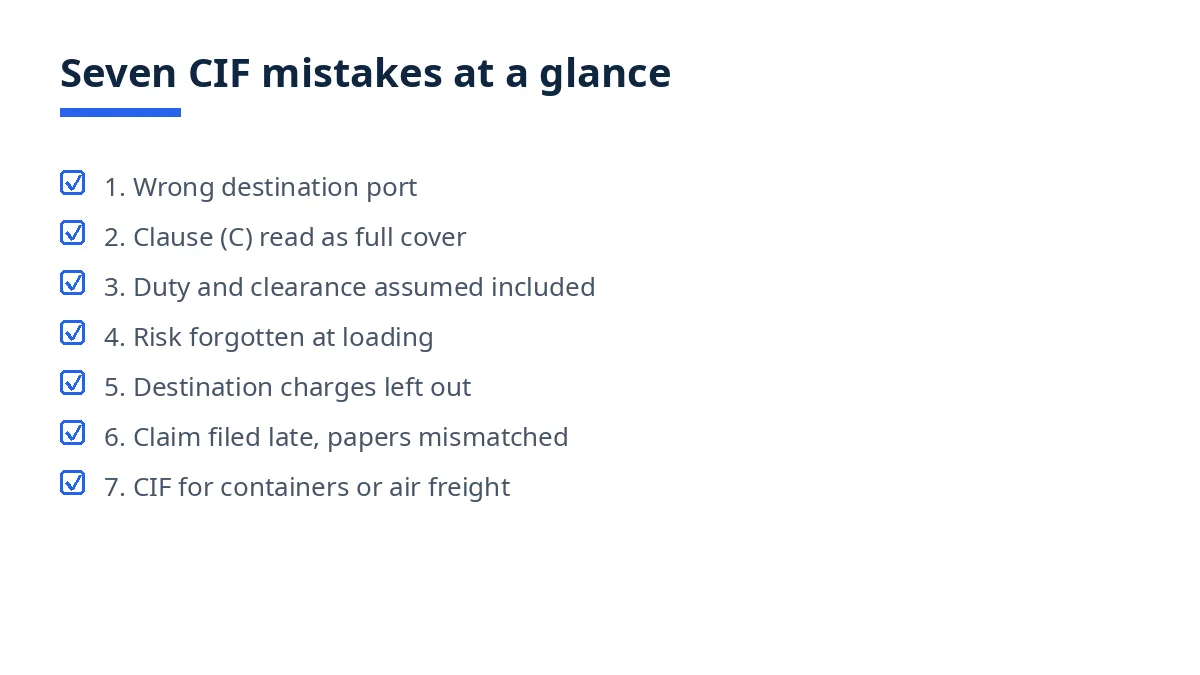
Under CIF, the seller pays freight and minimum Institute Cargo Clauses (C) insurance to the named destination port, but risk passes to the buyer when goods are loaded on board at the port of shipment. The seven costly cif common mistakes are naming the wrong destination port, treating Clause (C) as full cover, assuming CIF includes duty and clearance, forgetting risk passes at loading, omitting destination charges, missing the claim window, and using CIF for containers or air freight.
On this page
Key takeaways
Under CIF, risk passes to the buyer on loading on board at the port of shipment, even though the seller pays freight and minimum insurance to the named destination port.
The seller's insurance duty is minimum cover only: Institute Cargo Clauses (C), which leaves out several losses buyers assume are covered.
CIF never includes import clearance, duty or tax at destination. The buyer pays those, and destination charges outside the carriage contract.
Name one destination port in full, check the insurance certificate before sailing, and confirm every destination charge in writing before accepting the price.
CIF is for sea and inland-waterway transport only. Do not use it for air freight or container cargo handed to a carrier before loading.
Under CIF (Cost, Insurance and Freight), the seller pays the ocean freight and arranges minimum marine insurance to your named destination port, yet the risk passes to you when the goods are loaded on board at the port of shipment.1 The cif common mistakes in this guide share one pattern: the buyer reads a prepaid freight price and a seller-arranged insurance certificate as a door-to-door promise. They are not. CIF is a sea and inland-waterway rule, port to port, with import clearance and duty left to the buyer.1 2
This guide is for importers in the United States, the United Kingdom, the European Union and the United Arab Emirates who source from Bangladesh, where most export cargo loads at Chattogram.
Key points to take away
CIF divides the bargain in a way that surprises first-time importers: the seller arranges and pays for the main carriage and a basic insurance policy, yet the risk of loss or damage moves to the buyer the moment the goods are loaded on board. That gap between who pays and who bears the risk is where most of the seven mistakes below happen. Read the insurance certificate before the vessel sails, pin down every destination charge in writing, and remember that clearance, duty and tax at arrival are always the buyer's account — CIF never covers them. Used only for sea and inland-waterway shipments, CIF works well when both sides agree the same named port, the same cover level and the same cost split before the order is placed.
CIF common mistakes: the seven-item list
1. Naming the wrong destination port, or no port at all
What it is. The contract says "CIF UK", "CIF Europe" or an inland city, instead of one named seaport, or it names a port complex without saying which terminal the vessel serves. CIF is always written as "CIF [named port of destination]", the point to which the seller must arrange and pay for carriage.2
Why it costs money. The seller can book freight to a port that suits its own sailing schedule, and the buyer then pays the inland haul, extra handling and waiting time at a port it never planned to use. Vague port wording has led to exactly this dispute: a seller may choose the cheapest nearby port, while the buyer faces different land transport and storage costs at the port actually used.3
How to fix it. Write the term in full on the quotation, order, invoice and bill of lading, in the form "CIF Felixstowe, Incoterms® 2020" or "CIF Jebel Ali, Incoterms® 2020", using the port the seller's freight contract actually serves.
2. Treating Clause (C) cover as full insurance
What it is. The buyer sees an insurance certificate and assumes the cargo is fully insured. Under Incoterms® 2020, the seller's duty under CIF is narrower: insurance complying with Clauses (C), described as minimum cover, of the Institute Cargo Clauses.1 Clause (C) covers loss or damage reasonably attributable to fire or explosion, stranding, grounding, sinking or capsizing, overturning or derailment, collision or contact with an external object, discharge at a port of distress, general average sacrifice and jettison.4
Why it costs money. Clause (C) does not cover earthquake, volcanic eruption or lightning, washing overboard, or entry of sea, lake or river water, and it does not cover theft, pilferage, non-delivery, malicious damage or rough handling.4 Water entry and theft are common causes of loss for cartons and container cargo.
How to fix it. Ask for the certificate before loading, and read the clause letter, sum insured, currency and transit scope. The seller must purchase insurance with minimum coverage of 110% of the invoice value.5 Example figures: on an invoice value of USD 50,000, 110% gives a sum insured of USD 55,000. If your goods need broader cover, agree an upgrade to Clause (B) or Clause (A) in the sales contract, in writing.
3. Assuming CIF covers import clearance and duty
What it is. The buyer budgets the CIF price as the price of getting the goods to the warehouse, including customs. Under the "C" rules, the seller completes export formalities, and the buyer completes import formalities and any transit customs procedures.2 The buyer's obligations under CIF include arrival port charges, import clearance and payment of VAT, duties and taxes, and inland transport after the destination port.5
Why it costs money. The duty bill arrives separately, on a value that already includes the freight and insurance in the CIF price. In the EU, costs of transport and other related costs up to the point of entry are included in the customs value, while transport costs after the point of entry are not.6
How to fix it. Before accepting a CIF quotation, ask your destination broker for a written landed-cost schedule: duty, import tax, broker fees, destination port charges and inland transport. Keep the CIF price and the duty line separate in your budget, and read the landed cost guide for imports from Bangladesh to check that no line is missing.
4. Forgetting that risk passes at loading, while freight is prepaid
What it is. The buyer treats prepaid freight as proof that the seller remains responsible until arrival. Under CIF, the seller delivers by loading the goods on board at the port of shipment, and pays carriage and insurance to the named destination port.1 Under all "C" terms, delivery and transfer of risk occur at origin, while the seller includes transportation and, for CIF, insurance to the named destination.2 The seller must notify the buyer of delivery, but delivery and risk transfer take place regardless of when that notification is given.2
Why it costs money. Damage or loss during the sea leg is the buyer's risk, even though the buyer did not choose the vessel or pay the freight.
How to fix it. Treat the loading date as the date your risk starts. Confirm before loading that the certificate is in place, names the clause and sum insured you agreed, and enables you, or any party with an insurable interest, to claim directly from the insurer.2 Ask the seller to send the bill of lading details promptly.
5. Leaving destination terminal and demurrage charges out of the budget
What it is. The buyer assumes prepaid freight covers everything up to collection at the destination terminal. Under the "C" terms, the seller must pay charges for unloading at the agreed destination only if the contract of carriage stipulates that those charges are the seller's responsibility. Otherwise they are the buyer's responsibility.2 Terminal handling, storage, and charges for a container held beyond its free time can therefore fall to the buyer even on a fully prepaid CIF shipment.
Why it costs money. These charges are time-based, so a short delay becomes a daily charge. A container that cannot be collected because the broker, haulage booking or duty payment is not ready keeps accruing charges while the buyer catches up.
How to fix it. Ask the broker or carrier, before accepting the quotation, for a written list of destination charges: terminal handling, unloading, storage, and the free-time period and daily rate after it. Example figures: three days beyond free time at USD 120 per day add USD 360, and the daily rate must be confirmed for the actual port and carrier, since rates vary.
6. Missing the insurance claim window, or filing with documents that disagree
What it is. The buyer signs a clean delivery receipt, unpacks days later, and files a claim with papers that do not match: a different consignee name, quantity or value, or a certificate naming a different clause or port. On receipt, the consignment should be checked before signing, packages counted against the bill of lading, and damage noted on both copies of the freight document.7 Claim documents include the invoice, packing specification, bill of lading, notice of loss, discharge report, and a survey report with photos.7
Why it costs money. A clean signature is the first record the carrier and insurer read, and damage noted late is harder to attribute to the voyage. For transport by sea, claim guidance sets visible damage at once on receipt and concealed damage within three days from discharge.7
How to fix it. Check the document set before sailing: certificate, bill of lading, invoice and packing list must agree on names, marks, quantity, weight, ports, value and insurance clause. On arrival, count and inspect before signing, photograph damage in the container, write the damage, affected packages and date on the receipt, and send written notice of loss promptly.
7. Using CIF for containerised cargo or for air freight
What it is. The buyer agrees CIF for a container handed to the carrier at a terminal days before loading, or for goods flown by air. CIF can only be used where sea or inland waterway transport is used, and it applies to port-to-port shipments.1 CIF is the appropriate rule for bulk cargo moved from one port to another.1 Terminal handover alone does not transfer risk under CIF, because delivery and risk transfer occur on board.5 For air freight there is no vessel or port of shipment, so the CIF delivery point cannot happen at all.
Why it costs money. Damage in the terminal yard between gate-in and loading sits in a gap: the goods have left the seller's control, but risk has not yet passed to the buyer, and each side can point to a different date. For air freight, the parties must improvise a delivery point after the goods have flown. Switching to CFR does not fix the container gap, because CFR uses the same on-board delivery point.5
How to fix it. For air freight, use a rule made for any mode of transport, such as FCA where the buyer arranges the main carriage. For container cargo where the seller pays carriage and insurance, use CIP, which transfers risk when goods are handed to the carrier and requires the higher Clause (A) cover.1 For container cargo where the seller pays carriage without an insurance duty, use CPT. Name the handover point in the contract.
Summary table
Mistake | Where the money goes | The check that stops it |
|---|---|---|
Wrong destination port | Haulage and waiting time at the wrong port | One named port, identical on every document |
Clause (C) cover treated as full cover | Voyage damage the minimum policy does not answer | Certificate checked before loading, clause named |
CIF read as including duty and clearance | Duty, tax, broker and inland charges on arrival | Broker's landed-cost schedule before ordering |
Risk forgotten at loading | Voyage loss borne by the buyer | Insurance and inspection plan before loading |
Destination charges left out | Terminal, storage and time-based container charges | Destination-charge list and free-time diary |
Claim filed late, with mismatched papers | A claim queried or refused on wording and timing | Document check before sailing, notice on arrival |
CIF used for containers or air freight | A risk gap, or an inoperable term | CIP or CPT for containers, an any-mode rule for air |
How Exportain helps
Start from the wording, not from the price. Post a request for quotation (RFQ) on Exportain that states the quantity, the destination port in full, the Incoterm with the year, the insurance clause you require, and the deadline. Each quotation is versioned with unit price, MOQ, lead time, Incoterm, payment terms and validity, so a CIF quotation and a CIP quotation can be compared on the same fields.8
Use the supplier profile as a starting filter, not a conclusion. Each profile shows its verification level, location, main products and the certifications the supplier has declared, and badges record document and photo checks reviewed by the Exportain team, not factory inspections.8 Read what each badge covers, keep the agreed terms in the RFQ and message thread, and run the checks in this guide on the supplier you choose.
FAQs
What is the biggest mistake?
Treating a CIF price as a door-to-door, fully insured price. A CIF price is the goods plus freight and minimum insurance to the named destination port, with risk passing to the buyer at loading and import clearance and duty left to the buyer.1 2 The check that catches most of the cost is a repricing to the warehouse before ordering: CIF price, plus duty, tax, broker fees, destination charges and the insurance upgrade, each confirmed in writing.
How can I avoid it?
Work from one checklist before the order is confirmed. Name the destination port in full on every document. Check the insurance certificate, clause letter and sum insured before loading. Get the broker's written schedule of duty, tax and destination charges. Inspect, count and photograph before signing on arrival, and file the carrier and insurer notices promptly. Choose a rule that fits the journey: CIF for bulk cargo loaded on board, CIP or CPT for containers, and an any-mode rule for air freight.
Who is responsible?
The seller is responsible for export clearance, for delivering the goods loaded on board at the port of shipment, and for contracting and paying carriage and minimum insurance to the named destination port.1 The buyer is responsible for taking delivery at destination, for import clearance, duties and taxes, for destination charges outside the carriage contract, and for inland transport onward.2 Risk passes when the goods are loaded on board, and any different split must be written into the sales contract as a separate agreement.
Where can I get help?
Brief two advisers before the vessel sails: a customs broker at destination for classification, duty, tax, filing and destination charges, and an insurance broker or insurer for the clause, sum insured, transit wording and claim time limits. Give both the term, the named port, the goods and the value in writing. For sourcing, use the Exportain RFQ route and guides named below, and keep questions and answers in one thread.
Next steps on Exportain
Read the CIF guide, then compare CIF with the other ten rules in the Incoterms guide for shipments from Bangladesh. Before you accept a quotation, work through the landed cost guide and the buying steps in How to Source and Buy from Bangladesh, where you can post an RFQ with your port, Incoterm and insurance clause stated in full.
Sources
- CIF & CIP Incoterms 2020 explained: Key differences. ICC Academy, (accessed )
- Incoterms® 2020 C rules vs D rules: Risk transfer explained. ICC Academy (accessed )
- Place of delivery & risk transfer in trade contracts. ICC Academy (accessed )
- Institute Cargo Clauses (A), (B), (C) Explained. VoyageCover (accessed )
- CIF Incoterms (Cost, Insurance and Freight) Explained. iContainers (accessed )
- Customs Valuation. European Commission (accessed )
- Report cargo claim. If P&C Insurance (accessed )
- How to source and buy from Bangladesh. Exportain (accessed )
About the author
Sourcing from Bangladesh?
Post a request for quotation and suppliers on Exportain can send you their quotes directly.
Post an RFQ