CIF Charges in Shipping: Complete List of What Is and Is Not Included
CIF charges listed line by line for importers: what the seller price includes to your named port, and what you still pay on arrival.
Short answer
Under CIF, Cost, Insurance and Freight, the CIF price includes the goods, export packing and export clearance at origin, transport to the port of loading, ocean freight to your named destination port, and minimum marine insurance. It does not include destination handling, import clearance, duty and taxes, or delivery from the port to your premises, which stay in your budget.
On this page
Key takeaways
The CIF price includes the goods, export packing, export clearance, loading, ocean freight to the named port and minimum Clause C insurance.
Destination handling, import clearance, duty and taxes, and onward delivery sit outside the CIF price and stay in the buyer budget.
Unloading at destination follows the contract of carriage: the buyer pays unless that contract includes it for the seller.
CIF insurance is minimum Clause C cover at 110 percent of the invoice value; wider cover is agreed or bought separately.
A CIF quote gives you one price, but that price is a bundle, not a total. Which cif charges in shipping sit inside the bundle, and which wait at the destination port, decides your true landed cost. CIF is one of the eleven Incoterms rules published by the International Chamber of Commerce (ICC), standards that clarify the tasks, costs and risks in delivery from sellers to buyers.1
Quick answer
Under CIF, Cost, Insurance and Freight, the CIF price includes the goods, export packing and clearance at origin, transport to the port of loading, ocean freight to your named destination port, and minimum marine insurance. It does not include destination handling, import clearance, duty and taxes, or delivery from the port to your premises.
What CIF means in plain English
CIF is a port-to-port rule for sea and inland waterway transport only.2 A complete term names the destination port and the version, for example CIF Rotterdam, Incoterms 2020, the version that entered into force on 1 January 2020.1 On cost, the seller pays as far as the named port. On risk, the seller stops earlier: risk passes to you when the goods are loaded on board at the port of shipment.2 See also CIF: cost, insurance and freight.
Charges included in the CIF price
The commercial invoice amount under CIF includes the cost of the goods, the freight cost and the insurance cost, as well as export clearance costs and documentation requirements.2 Broken into lines:
Goods, packing, origin transport, export clearance and loading. The goods, packed and labelled for export, and moved to the port of shipment at seller cost. The seller must contract for and pay the costs and freight necessary to bring the goods to the named port of destination.3 The detailed list adds delivery on board the vessel, plus export clearance and departure costs.4
Ocean freight to the named destination port. The seller must arrange and pay for the maritime carriage up to the port of destination.2 That freight ends at the named port.
Minimum marine insurance. The seller must arrange insurance that complies with Clause C of the Institute Cargo Clauses, described as minimum cover, set at 110 percent of the invoice value.2 4
Charges not included in the CIF price
Each charge below stays with you, outside the seller price.
Destination handling and arrival fees. Arrival port charges, handling and fees, sit on the buyer list of obligations.4
Import clearance, duty and taxes. Import clearance and payment of value-added tax, duties and taxes sit with the buyer, and a destination broker fee is part of that cost.4 Duty on the seller side belongs to DDP, under which the seller clears goods for import and pays duty for both export and import.3 See also does CIF include import duty.
Extra insurance above the minimum. For wider protection than Clause C, you either agree it expressly with the seller or make your own extra arrangements, at your cost.3
Onward delivery to your premises. Inland transport to the final destination sits with the buyer.4
How it works step by step
Agree the term in full: CIF plus the named port plus Incoterms 2020, with goods, freight and insurance as separate lines.
The seller packs the goods, moves them to the port of loading and completes export clearance.4
The seller books the vessel, pays ocean freight to your port and arranges minimum Clause C insurance for your benefit.2
The goods are loaded on board. Risk passes to you here, even though the seller paid freight to destination.2
The vessel sails. Keep the insurance document with the shipment file, and add extra cover if Clause C is too narrow.
On arrival, you pay destination handling, clear import, pay duty and taxes, and arrange onward delivery.4
For a shipment leaving Bangladesh, step 2 has a fixed legal shape. Goods cannot be loaded unless an export declaration, the Bill of Export or Shipping Bill, has been submitted and approved by Customs, with the export contract or purchase order, commercial invoice and packing list enclosed.5
Who is responsible for what
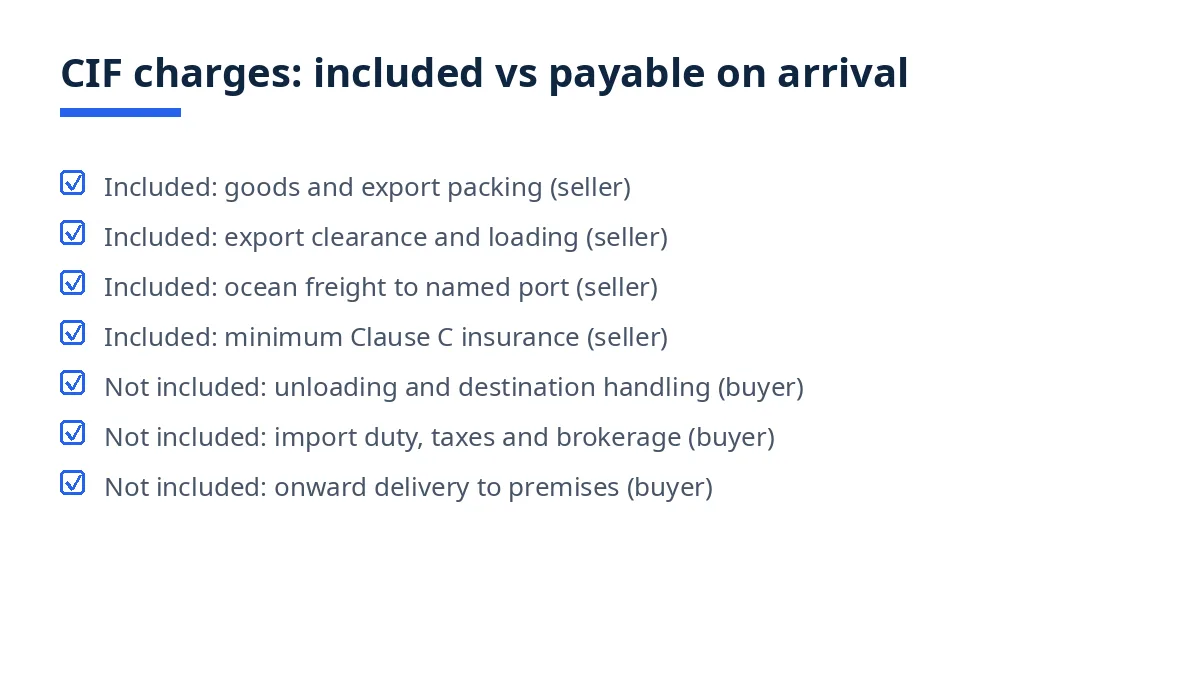
In this table, seller rows sit inside the CIF price and buyer rows sit outside it. The diagram below repeats the split as a checklist.
Charge or task | Paid by |
|---|---|
Goods, packing and origin transport | Seller |
Export clearance and loading | Seller |
Ocean freight to the named port | Seller |
Minimum Clause C insurance | Seller |
Unloading at destination | Buyer, unless the carriage contract includes it |
Destination handling and arrival fees | Buyer |
Import clearance, duty and taxes | Buyer |
Extra insurance above Clause C | Buyer |
Onward delivery to premises | Buyer |
Who pays for unloading at the destination port?
Unloading follows the contract of carriage, so settle it in writing first. As a rule, the buyer pays for unloading at the port of destination and for quay dues, unless otherwise specified.6 If the seller contract of carriage includes unloading, the seller bears that cost as part of that carriage.6 For a full arrival budget, read landed cost for imports from Bangladesh.
Worked example with numbers (Bangladesh shipment)
Example figures: a United States buyer orders knitwear from a Bangladeshi seller, shipped from Chattogram to Los Angeles as CIF Los Angeles, Incoterms 2020. The numbers are illustrative only, not a quotation.
Price element | Example figures (USD) | Paid by |
|---|---|---|
Goods and export packing | 25,000 | Seller |
Origin transport and export clearance | 450 | Seller |
Ocean freight to Los Angeles | 1,850 | Seller |
Marine insurance premium, Clause C | 140 | Seller |
CIF price | 27,440 | Buyer pays the seller |
Destination handling and brokerage | 500 | Buyer |
Import duty and taxes | 1,200 | Buyer |
Onward delivery to warehouse | 260 | Buyer |
Total cost to the warehouse | 29,400 |
You pay the seller 27,440. Your real cost is 29,400, because 1,960 of arrival charges sit outside the CIF price.
CIF vs related terms
CIF vs FOB. Under FOB, Free On Board, the seller delivers the goods on board and risk passes at that point, and the buyer bears all costs from that moment onwards.3 The risk point matches CIF. The difference is the charge list: under FOB you book and pay freight and any insurance yourself, while the seller pays both under CIF.
CIF vs CFR. CFR, Cost and Freight, also requires the seller to pay freight to the named port, with risk passing on board.3 Only insurance differs: CFR carries no seller duty to arrange it, while CIF adds the Clause C premium.
CIF vs CIP. CIP, Carriage and Insurance Paid To, works for any mode and a named place, not only a port, and the seller must obtain broader Clause A cover.2 Compare container handovers in Incoterms for shipments from Bangladesh.
Common mistakes to avoid
Treating the CIF price as the final cost. Destination handling, duty, taxes and onward delivery are extra.
Assuming unloading is settled. Unloading follows the contract of carriage, so confirm who pays.6
Accepting Clause C cover without reading it. For fragile or valuable goods, agree wider cover or buy extra cover before the vessel sails.3
Letting a destination agent set your arrival bill. A seller-side forwarder can present destination fees on arrival, outside the freight already paid.6 Agree the list in advance.
Leaving the port or version out of the term. Write CIF plus the named port plus Incoterms 2020. Import formalities are yours under CIF,2 so line up your broker while the vessel is at sea.
How Exportain helps
Exportain is a B2B export marketplace where buyers find Bangladeshi suppliers, post requests for quotation and place orders. In a CIF request, name your destination port and ask each supplier to quote goods, freight and insurance as separate lines. Exportain is not a party to the contract for goods, and it does not book freight, arrange insurance or clear customs.
FAQs
What is CIF?
CIF is Cost, Insurance and Freight, an Incoterms 2020 rule for sea and inland waterway transport.2 The seller pays for the goods, freight to the named port and minimum insurance, and risk passes to the buyer on board at the port of shipment.2
How does CIF work in practice?
The seller clears export, books and pays the main carriage, arranges minimum insurance and loads the goods on board.4 You then pay destination handling, clear import, pay duty and taxes, and arrange onward delivery.4
Is CIF used for shipments from Bangladesh?
Yes. A Bangladeshi seller, normally shipping through Chattogram, can quote CIF to a named port in the USA, UK, EU or UAE. Bangladesh Customs requires an approved Bill of Export before goods can be loaded.5
What are common mistakes with CIF?
Common mistakes are treating the CIF price as the delivered cost, assuming unloading is inside the freight, accepting Clause C cover unread, and leaving the port or version out of the term.
Next steps on Exportain
Read the walk-through in CIF shipping terms explained, build your arrival budget with landed cost for imports from Bangladesh, and browse Bangladeshi suppliers to compare offers. Post a free RFQ on Exportain and ask each supplier to quote CIF with goods, freight and insurance separate.
Sources
- Incoterms® rules. International Chamber of Commerce (ICC) (accessed )
- CIF & CIP Incoterms 2020 explained: Key differences. ICC Academy, (accessed )
- Customs valuation: Incoterms. HM Revenue & Customs (GOV.UK) (accessed )
- CIF Incoterms (Cost, Insurance and Freight) Explained. iContainers (accessed )
- Customs Clearance Procedures for Export. Bangladesh Customs, National Board of Revenue (accessed )
- CIF (Cost Insurance and Freight) | Incoterms 2020. Röhlig Logistics (accessed )
About the author
Sourcing from Bangladesh?
Post a request for quotation and suppliers on Exportain can send you their quotes directly.
Post an RFQ