

CIF Advantages and Disadvantages: When Should Importers Use It?
CIF suits some sea shipments and not others. This decision guide matches each advantage with its limit, names when CIF fits, and lists the checks to make before accepting a CIF price.
Short answer
CIF suits a buyer who wants the seller to pay ocean freight and minimum insurance to the destination port, accepts that risk passes on loading, and does not need control of the carrier. It does not suit air or container-terminal shipments, high-value or theft-prone cargo needing broader cover, or a buyer who needs risk to stay with the seller to destination. CIF is sea and inland waterway only, with Clause (C) minimum cover at 110 percent of the contract price.
On this page
Key takeaways
Under CIF the seller pays ocean freight and minimum insurance to the named destination port, while risk passes to the buyer on loading.
CIF is sea and inland waterway only, and the minimum insurance is Clause (C) cover for at least 110 percent of the contract price.
Clause (C) cover does not include theft, ordinary water entry, or handling damage, so high-value or fragile cargo may need broader cover agreed in writing.
For containerised cargo handed to a carrier at a terminal, the on-board delivery point does not match the handover, and CIP, CPT, or FCA may fit better.
State the exact destination port, the Incoterms 2020 version, and the insurance basis in writing, and price destination handling, duty, tax, and onward transport before comparing quotations.
The cif advantages and disadvantages turn on one split that many quotations hide: under CIF, which stands for cost, insurance and freight, the seller pays ocean freight and minimum insurance to a named destination port, while the buyer carries the risk from the moment the goods are loaded on board at the port of shipment.1 2 A CIF price is not door to door. It does not include import duty or the costs after the destination port unless the contract says so.
CIF applies only to sea and inland waterway transport under Incoterms® 2020.2 It is not an air freight term, and it is not the right label for a container handed to a carrier at a terminal before loading. This article matches each advantage with its limit and names where CIF fits, where it does not, and the checks to make before accepting a CIF price.
The decision test: five questions before you accept a CIF price
Is the cargo moving by sea, and will the seller load it directly on board? If the answer is air, road, rail, or a container handed over at a terminal, CIF is the wrong term. CIP, CPT, FCA, or a D term will usually match the handover.2
Is the named destination port stated exactly? "CIF USA" leaves unloading and quay dues open to dispute. Specify the exact point up to which the seller bears the costs at the destination port.1
Is the insurance cover enough for this cargo? The minimum is Institute Cargo Clauses (C) cover for at least 110 percent of the contract price.1 2 Clause (C) does not cover theft, ordinary water entry, or handling damage.3
Do you need control of the carrier or the schedule? Under CIF the seller chooses the carrier. A buyer who needs a named carrier or a fixed sailing should not accept CIF only because the price looks lower.
Have you priced the whole journey to your warehouse? Add destination handling, import clearance, duty and tax, and onward transport before comparing CIF with FOB, CFR, or CIP.
CIF advantages and disadvantages, matched pair by pair
Pair | Advantage | Disadvantage or limit |
|---|---|---|
Price | One price covers the goods, freight, and minimum insurance to the named destination port. | Destination handling, import clearance, duty and tax, and onward transport sit outside that price unless the contract adds them.1 |
Work | The seller arranges the vessel, books freight, and arranges insurance. | The buyer gives up choice of carrier and insurer, and has less influence over sailing and service quality.1 |
Insurance | Minimum insurance is included, with proof provided by the seller.1 | Clause (C) covers named perils such as fire, stranding, sinking, collision, and general average, with gaps including theft and water entry outside a listed peril.3 |
Risk and cost | Cost runs to the destination port, so the buyer is not asked to pay freight again at loading. | Risk passes on loading, while the vessel is still at the origin port.1 2 Voyage loss or damage is the buyer's risk, subject to the insurance arranged. |
Comparison | Prices compare easily when every supplier quotes the same port, version, and insurance basis. | Comparisons break down when a quotation names a different port, omits the insurance clause, or leaves unloading costs unclear.1 |
Familiarity | CIF suits bulk and non-containerised cargo loaded directly on board. | For containerised cargo handed to a carrier at a terminal, the on-board point does not match the handover, and CIP is often the better fit.1 2 |
When CIF is the right choice
A buyer without freight or insurance arrangements at origin. A first-time importer or a small buying team can benefit, because the seller books the vessel and places the minimum insurance.2 The buyer still needs import clearance, duty payment, and onward transport.
Bulk cargo loaded directly on board. Delivery, risk transfer, and loading happen at the same point when the seller loads bulk goods directly on board.1
One comparable price to the destination port. When suppliers quote the same port, version, and insurance basis, compare the port price directly, then add the same destination costs to each quotation. See the landed cost guide for the costs beyond the port.
When CIF is the wrong choice
Air, road, rail, or multimodal transport. CIF should only be used for sea and inland waterway transport.2 For air freight, use CIP where the seller should arrange carriage and insurance, or CPT, FCA, or a D term according to who should carry the risk.
Containerised cargo handed to a carrier at a terminal. Delivery under CIF is on board, so the terminal stage sits outside the delivery point.1 For such orders, CIP, CPT, or FCA usually matches the handover better.
High-value, fragile, or theft-prone cargo. Clause (C) cover is narrow.3 Theft is not covered, water damage is covered only in limited circumstances tied to a listed peril, and handling damage is not covered.3 Agree broader cover in writing, stating who pays the extra premium, or choose CIP, where the minimum is the broader Clause (A) cover.4
A buyer who needs carrier, schedule, or insurer control. With FOB, the buyer chooses the shipping company or forwarder and gains influence over the quality and speed of transport.1 A buyer with an annual freight contract or a required insurer should use FOB or FCA, where the buyer arranges the main carriage.
A buyer who needs the seller to carry risk to destination. Risk passes at loading, even though the seller pays freight and insurance to the port.1 2 Consider DAP or DPU, where delivery happens at the named destination place.2
How a CIF shipment moves, step by step
The six steps below follow the contract, from agreement to arrival.
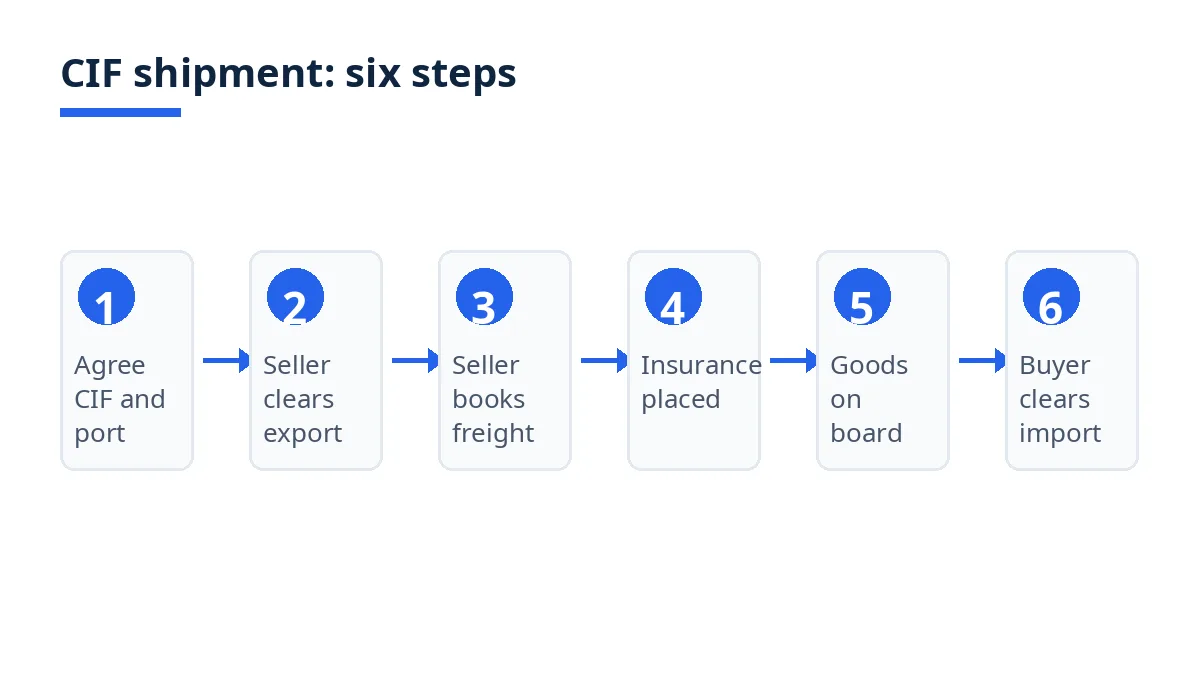
Agree the term, the port, and the version in writing. Write "CIF [named destination port], Incoterms® 2020" in the contract and the purchase order, with the exact port and cost point. State the insurance basis and who pays any extra premium for broader cover.
The seller prepares the goods and clears them for export. The seller pays for export clearance and getting the goods to the vessel.1
The seller books the vessel and pays the freight. The buyer should receive the vessel name, sailing schedule, and cut-off details in writing.
The seller arranges the minimum insurance. The seller procures Clause (C) insurance for at least 110 percent of the contract price, for the buyer's benefit, and provides the insurance document.1 2 Check the value, currency, insured party, and voyage before sailing.
The goods are loaded on board, and risk passes to the buyer. Delivery happens on board at the port of shipment, and risk transfers at that point.2 The seller's duty to pay freight and insurance to the destination port continues after risk has passed.
The vessel sails, and the buyer prepares for arrival. The seller tenders a bill of lading that enables the buyer to claim the goods from the carrier at the destination port.1 The buyer arranges import clearance, pays duty and tax, and books onward transport. Confirm who pays unloading and quay charges before arrival.1
Costs, timelines and documents
What the CIF price includes and what it leaves out
The CIF price includes the goods, getting them on board, ocean freight, and the minimum insurance premium. It excludes import duty, clearance, destination handling, and onward transport.
Cost line | Paid by | Check |
|---|---|---|
Goods and export clearance | Seller | Export clearance is the seller's duty.1 |
Ocean freight to the named port | Seller | Confirm the exact port and prepaid freight. |
Minimum insurance, Clause (C), at least 110 percent | Seller | Confirm the clause, insured value, and who pays for broader cover.1 2 |
Unloading and quay dues | Depends on the carriage contract | Unless otherwise specified, the buyer pays unloading and quay dues.1 |
Import clearance, duty, and tax | Buyer | Budget separately. CIF does not include import duty. |
Onward transport from the port | Buyer | Book before arrival. CIF ends at the port. |
Example figures: a contract price of USD 20,000, ocean freight of USD 1,850, and an insurance premium of USD 120 give a CIF price of USD 21,970. The minimum insured value is USD 22,000, which is 110 percent of the contract price. See the CIF meaning guide for how a CIF price is built. Ask for the sailing schedule, cut-off, and estimated arrival in writing, as transit time varies by route and schedule.
Which documents are needed
The buyer needs the commercial invoice, packing list, bill of lading, and insurance document, with matching names, quantities, values, and port details. The shipping bill set includes the export letter of credit, telegraphic transfer, purchase order, or LCA, the commercial invoice, the packing list, the EXP form certified by an authorized dealer, the certificate of origin issued by the Export Promotion Bureau or a Chamber of Commerce and Industry, the VAT registration certificate, the taxpayer identification number, and the Export Registration Certificate.5
Bangladesh-specific rules and tips
Name the port, not the country. Write the destination port in full, for example "CIF Jebel Ali, Incoterms® 2020", and state the cost point. A country name leaves the buyer to guess which port the freight was bought to.
Read the insurance document, not only the quotation. It shows the clause, insured value, currency, insured party, and voyage. Clause (C) cover for 110 percent of the contract price is the Incoterms® 2020 minimum.2 Agree broader cover and the extra premium in writing before loading if the cargo needs it.
Confirm the container handover point. If the container is delivered to a terminal before loading, the CIF delivery point does not match the handover, and the seller may still carry risk through the terminal stage.1 Ask whether CIP, CPT, or FCA matches the handover, and record the chosen term.
Confirm unloading and destination charges. Ask before arrival who pays unloading, quay dues, and destination terminal charges under the contract of carriage.1
Keep the version year in every document. Write "Incoterms® 2020" beside CIF in the contract, purchase order, proforma invoice, and letter of credit where one is used. CIF kept Clause (C) as its minimum in Incoterms® 2020, while CIP moved to the broader Clause (A) cover.4
Mistakes and red flags
What are the most common mistakes?
Reading CIF as door to door. CIF ends at the named destination port. Import clearance, duty, tax, destination handling, and onward transport are separate lines.
Assuming the insurance covers theft, water, or handling damage. Clause (C) is a short named-perils list. It does not cover theft, and it covers water and handling damage only in limited circumstances tied to a listed peril.3 Check the policy wording.
Using CIF for air or multimodal shipments. CIF is sea and inland waterway only.2 Change the term to CIP, CPT, or FCA, and restate the named place.
Accepting a vague named port. "CIF UK" does not name a port. State the port and the cost point in writing.
Comparing CIF with FOB without adding the missing lines. Add freight, insurance, destination handling, duty, tax, and onward transport to both prices, on the same basis, before choosing the cheaper offer.
Not checking the insurance document before sailing. Check the clause, the insured value at 110 percent of the contract price, the currency, and the beneficiary before sailing.2 A missing document is harder to repair after loading, when risk has passed.
Checklist: before you confirm CIF in writing
Sea transport confirmed, with direct loading on board, or a different term chosen for air, multimodal, or terminal-handover cargo.
"CIF [named destination port], Incoterms® 2020" in the contract and purchase order, with the exact port and cost point.
Insurance basis stated: Clause (C) minimum at 110 percent, or broader cover agreed, with who pays the extra premium named.2
Insurance document checked for clause, insured value, currency, insured party, and voyage, before sailing.
Sailing schedule, cut-off, vessel name, and notification contact received in writing.
Destination lines priced: unloading, quay dues, import clearance, duty, tax, and onward transport.
Export set confirmed: invoice, packing list, EXP form, certificate of origin, and Export Registration Certificate, with matching details.5
Bill of lading delivery agreed, naming who can claim the goods at the destination port.1
How Exportain helps
Post a request for quotation on Exportain with the term, the named destination port, and the Incoterms® 2020 version stated, so suppliers quote on the same basis. The how to buy guide states that an RFQ should state quantity, destination, Incoterm, required certifications, and deadline, and that every quotation is versioned with unit price, MOQ, lead time, Incoterm, payment terms, and validity.6 Compare CIF quotations only where the port, version, and insurance basis match, and ask each supplier to state the insurance clause and insured value in the quotation.
Exportain verification is a document and photo review, not a factory inspection, and membership plans never grant a trust badge.7 A badge does not change the CIF risk split or replace checking the insurance document, bill of lading, and export set.
Questions buyers ask before choosing CIF
What should I know first about CIF?
The seller pays the goods, ocean freight, and minimum insurance to a named destination port, while risk passes to the buyer on loading at the port of shipment.1 2 CIF is sea and inland waterway only, with Clause (C) minimum cover at 110 percent of the contract price.2 It excludes import duty and onward transport.
What are the typical costs and timelines?
There are no typical costs or timelines to rely on. Price each line from quotations for the actual route, and ask for the sailing schedule in writing. The example figures here are illustrative only.
Which documents are needed?
The commercial invoice, packing list, bill of lading, and insurance document. For Bangladesh, add the EXP form, certificate of origin, VAT certificate, taxpayer identification number, and Export Registration Certificate.5
What are the most common mistakes?
Reading CIF as door to door, assuming Clause (C) covers theft or water damage, using CIF for air or terminal-handover cargo, accepting a vague named port, and comparing CIF with FOB without adding the missing lines to both. Write the term, port, insurance basis, and destination answers into the contract before shipment.
Next steps on Exportain
Post an RFQ on Exportain through the how to buy route, stating "CIF [named destination port], Incoterms® 2020" and the insurance basis you require. Before you confirm, read the CIF meaning guide and the Incoterms guide for shipments from Bangladesh, and price the destination lines in the landed cost guide so the CIF price is compared as a full journey cost.
Sources
- CIF (Cost Insurance and Freight) | Incoterms 2020. Röhlig Logistics (accessed )
- Incoterms 2020 CIF: Spotlight on Cost, Insurance and Freight. Shipping Solutions (accessed )
- Institute Cargo Clauses Explained (A, B, C): What is Covered, What is Not, and Which You Need?. Insure24, (accessed )
- Incoterms® 2020. International Chamber of Commerce (ICC) (accessed )
- Bangladesh Trade Portal FAQ: Export Registration Certificate (ERC). Bangladesh Trade Portal (accessed )
- How to source and buy from Bangladesh. Exportain (accessed )
- Supplier verification: Earn trust badges buyers can see. Exportain (accessed )
About the author
Sourcing from Bangladesh?
Post a request for quotation and suppliers on Exportain can send you their quotes directly.
Post an RFQ


