Quality Control Checklist for Chili Powder From Bangladesh
A numbered QC checklist for chili powder from Bangladesh: colour, heat, fineness, stem and seed content, moisture, ash, Sudan dye and filler screens, aflatoxin and lead limits, microbial evidence, labels and loading, with fixes for common failures.
Short answer
Use this chili powder quality control checklist to check product identity, colour, heat, fineness, stem and seed content, moisture, ash, mould, adulteration screens for Sudan dyes and mineral fillers, aflatoxin, ochratoxin A, lead, microbial evidence, pack weight, labels, and loading for chili powder from Bangladesh before shipment. Agree heat range, fineness, screens, and contaminant limits in the purchase order.
On this page
Key takeaways
Judge colour against the sample and heat against a laboratory result: Codex sets pungency at 900 Scoville heat units or more for chili peppers, while its colour-value minima apply to paprika grades, not chili.
Put adulteration screens first for any lot brighter than the sample: Sudan I-IV, other non-permitted dyes, brick dust, sand, soapstone, sawdust, and starch fillers, with high acid-insoluble ash as the filler signal.
Record fineness, stem and seed content, and moisture at several points against the order, since Codex permits grinding with or without seeds and stalk and any particle size agreed between the parties.
Check EU contaminant evidence for Capsicum before loading: aflatoxin B1 5 and total aflatoxins 10 micrograms per kilogram, ochratoxin A 20 micrograms per kilogram, and lead 0.60 milligrams per kilogram for fruit spices.
If you buy chili powder from Bangladesh, check heat and colour together, not colour alone. A vivid red powder can hide weak heat, added dye, or mineral filler. Use this checklist at final inspection, with the approved sample beside you, and record each point as pass, fail, or not applicable. Ground chili pepper is obtained by grinding whole dried chili, with or without the placenta, seeds, calyx and stalk, and without any other added matter.1
Why this checklist matters
Chili powder is bought for colour and heat, and both can mislead on their own. Grinding hides the starting material: stems, seeds, spent chili, or mineral filler disappear into the powder, and a non-permitted dye can restore the red that a weak lot lost. A generic spice checklist that checks only weight and cleanliness misses those failures.
This checklist covers the attributes that decide a chili powder shipment: colour against the sample, heat by a named method, fineness and stem and seed content, moisture and ash, adulteration screens, and contaminant evidence. The Codex standard sets pungency at 900 Scoville heat units or more for chili peppers, while its colour-value minima apply to paprika grades, not to chili.1 That is why colour is judged against the sample here, and heat against a laboratory result.
Before you start
Assemble the references before any bag is opened: the approved sample, the purchase order naming pure ground chili or a seasoned blend, chili type or variety where agreed, heat range, fineness, moisture and ash limits, adulteration screens, and contaminant limits per destination, plus the packing specification. Agree the sampling plan and acceptance numbers in the order, and draw randomly across bags and cartons.
For spice sampling, ISO 948 describes taking increments from different positions in the lot and combining them into a bulk sample, with a laboratory sample removed from it.2 For acceptance decisions, ISO 2859-1 specifies a sampling system for inspection by attributes, indexed by the acceptance quality limit (AQL).3 See the AQL acceptance quality limit explainer before you set those numbers.
The full checklist (numbered, printable)
Identity and form
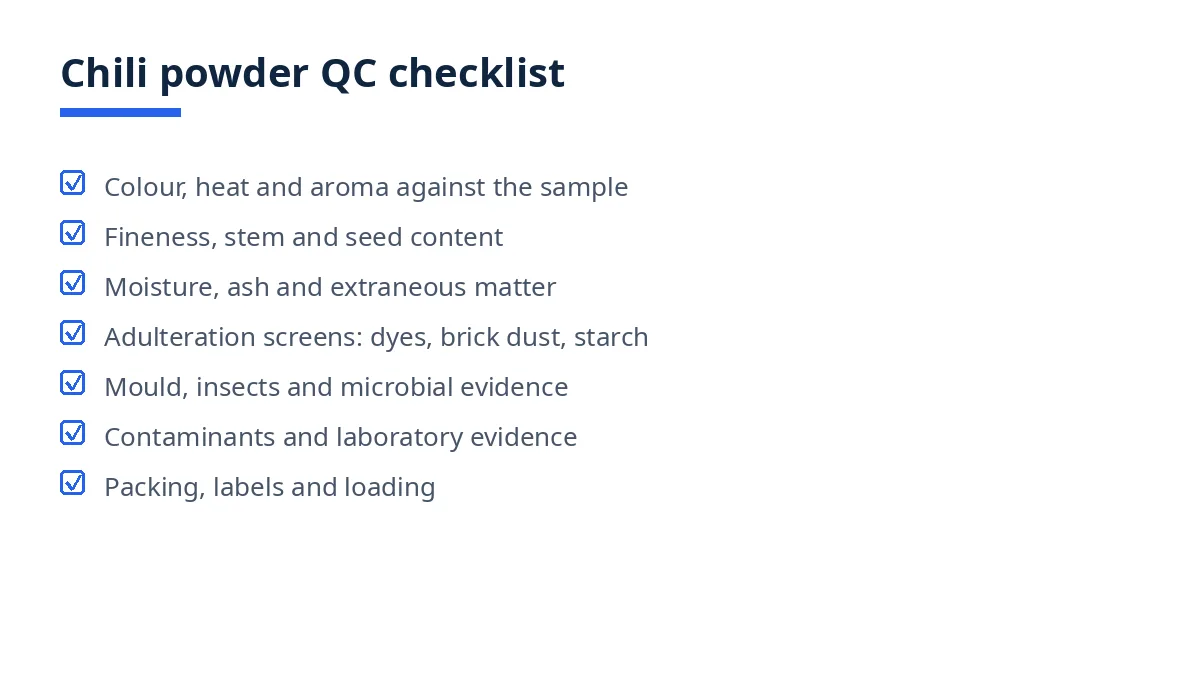
Confirm lot identity: product name, chili type or variety where named, lot number, and order number match the sample and documents.
Confirm the product ordered: pure ground chili, or a seasoned blend. In the United States, chili powder often means a blend with other spices and salt.
Confirm the powder is chili, not paprika or another Capsicum product sold under the wrong name, checking label, order, and sample profile.1
Colour, heat and aroma
Check colour against the sample under the same light for every sub-sample: an even, characteristic red, with no grey or patchy areas.
Treat unusual brightness as a test trigger, not a pass. A powder far brighter than the sample goes to the adulteration screens first.
Record heat by the method named in the order, such as capsaicinoid content by HPLC, against the sample and order range. CXS 353-2022 sets pungency at 900 Scoville heat units or more for chili peppers; the order range governs.1
Do not apply a paprika ASTA colour minimum to chili powder. The Codex colour-value minima are set for paprika grades, not chili.1
Check aroma against the sample: characteristic chili aroma, with no musty, sour, chemical, or fuel note.
Fineness, stem and seed content
Check fineness by the sieve method named in the order, recording the share retained on each named sieve. Particle size is as agreed between the parties.1
Spread a thin layer and check for lumps, coarse grit, and hard particles, plus stem fragments, seed pieces, and calyx bits beyond the sample.
Check stem and seed content against the order. Grinding with or without seeds and stalk is permitted, so the order must state what is allowed.1
Moisture, ash and extraneous matter
Measure moisture at more than one point in the lot, recording every value. ISO 939 specifies an entrainment method for moisture in spices.4 CXS 353-2022 sets moisture at 11 percent maximum for chili peppers; the order limit governs.1
Hold any lot over the order moisture limit rather than averaging a wet result away with dry bags. Wet powder cakes and invites mould.
Review total ash and acid-insoluble ash against the order limits. CXS 353-2022 sets total ash at 10 percent and acid-insoluble ash at 1.6 percent on a dry basis; the order limits govern.1
Treat high acid-insoluble ash as a filler signal. Sand, soil, and brick dust raise it, so a high result sends the lot to microscopy.
Separate extraneous matter: stones, sand, dust, foreign seeds, string, and metal, recording each class against the order limit.
Mould, insects and storage condition
Check for visible mould, webbing, and live or dead insects in the powder and bag seams. Treat live infestation as a failure unless the order states otherwise.
Check for foreign odours from storage or transport, such as damp, chemical, or fuel odours, in the dry powder.
Adulteration screening
Require a Sudan I, II, III, and IV screen on the laboratory report, with method and lot number named. EU decisions required Sudan testing for chili powder.5
Screen for other non-permitted colours the order names, such as metanil yellow and rhodamine B. Any detection is a hold, not a re-grade.
Screen for mineral and bulk fillers: brick powder, sand, soapstone, and sawdust are listed among the main adulterants in chili powder.6
Screen for starch fillers and spent chili material where the order requires it. Weak heat or microscopy unlike the sample means the lot is held.
Record every adulteration screen as a named test with a named method, a result, and a lot number.
Contaminants and laboratory evidence
For the EU, check aflatoxins against the Capsicum entry: aflatoxin B1 at 5 and total aflatoxins at 10 micrograms per kilogram, including chili powder.7
For the EU, check ochratoxin A against the Capsicum entry of 20 micrograms per kilogram, above the 15 set for other dried spices.7
For the EU, check lead against the fruit-spice entry of 0.60 milligrams per kilogram for dried spices.7 Record which limits were applied elsewhere.
Review the laboratory evidence pack before loading: moisture, ash, heat, colour where ordered, adulteration screens, and contaminant tests, with the lot number on each report.7
Microbial evidence
Ask for microbial evidence where the order requires it, including Salmonella testing and kill-step documentation. A validated spice treatment must achieve a 5-log Salmonella reduction.8
Packing, labels and loading
Weigh sampled packs against the declared net weight and the order tolerance, including pack weight where stated.
Check seals, liners, and pack interiors for tears, moisture damage, and earlier labels that could confuse lot identity.
Check labels: product name, pure chili or blend ingredients, net weight, lot number, and country of origin, which Codex requires to be declared.1 Any anti-caking agent must be the one the order allows, up to 2 percent.1
Check cartons and pallets: counts, stacking, wrapping, and damage. Check the container before loading: clean, dry, and odour-free, with moisture protection. Retain a sealed sample for later disputes.
Common failures and how to fix them
The most frequent failure is a bright powder with weak heat. Stop and compare the lot with the sample on chemistry, not colour: re-test heat, run the Sudan and filler screens, and check acid-insoluble ash. If a non-permitted dye is found, the lot is held, not blended away.
High moisture usually traces to uneven drying or damp storage. Re-dry and re-test at several points; do not blend wet and dry bags to reach an average. High acid-insoluble ash points to sand, soil, or brick dust: segregate the lot and run microscopy.
Heat that varies widely across bags points to blended lots or mixed chili types. Segregate those bags and re-test them as their own group. A label naming pure chili on a blend, or chili on a paprika lot, is corrected or rejected under the order. Above the order acceptance level, the options are re-inspection after sorting, documented partial acceptance, or rejection.
Downloadable template / summary table
Copy the checklist into your inspection sheet, add the order limits, and record a result per sample.
Section | Checks | Evidence |
|---|---|---|
Identity and form | Product, variety, lot, pure or blend | Sample comparison |
Colour and heat | Colour, heat result, aroma | Lab reports, sample |
Fineness | Sieve results, lumps, stem and seed | Sieve record |
Moisture and ash | Moisture at several points, ash | Lab reports per lot |
Mould and insects | Mould, webbing, insects, odour | Visual check |
Adulteration | Sudan I-IV, other dyes, fillers, starch | Named screens, methods |
Contaminants | Aflatoxins, ochratoxin A, lead, residues | Reports, limits applied |
Microbial | Salmonella evidence, kill step if required | Reports per lot |
Packing and labels | Weight, seals, origin, lot marks, loading | Packing list, photos |
How Exportain helps
Exportain is a B2B marketplace connecting buyers with Bangladeshi suppliers of chili powder and other spices, so product form, heat range, fineness, adulteration screens, and the sampling plan can be agreed at the enquiry stage. See inspection services when you plan the check, and read the pre-shipment inspection guide. Supplier profiles show which document and photo checks have been recorded, not factory inspections. Exportain is not a party to the goods contract and does not inspect goods.
FAQs
When should this checklist be used?
Use it at final inspection, when the chili powder is ground, packed, and ready for loading. For first orders and large lots, also use the colour, heat, moisture, and adulteration sections during processing.
Who should complete it?
The buyer, a local agent, or an independent inspector can complete it, using the approved sample, the order limits, and samples from different bags.
What are the most common failures?
Bright powder with weak heat, high moisture, high acid-insoluble ash from mineral filler, Sudan dye detection, mixed lots with varying heat, and a label naming the wrong product are the failures found most often.
Can a third party do it?
Yes, if you share the approved sample, product form, heat range, fineness, adulteration screens, sampling plan, and destination contaminant limits first, and require lot numbers on lab reports.
Next steps on Exportain
Agree product form, heat range, fineness, adulteration screens, and sampling plan in the order before production starts, then read the AQL acceptance quality limit explainer and the pre-shipment inspection guide, and plan the check with inspection services.
Sources
- CXS 353-2022 - Standard for Dried or Dehydrated Chilli Pepper and Paprika. Codex Alimentarius Commission (accessed )
- ISO 948:1980 - Spices and condiments - Sampling. International Organization for Standardization (accessed )
- ISO 2859-1:1999 - Sampling procedures for inspection by attributes — Part 1: Sampling schemes indexed by acceptance quality limit (AQL) for lot-by-lot inspection. International Organization for Standardization (accessed )
- ISO 939:1980 - Spices and condiments - Determination of moisture content - Entrainment method. International Organization for Standardization (accessed )
- Rapid Analysis of Sudan and Other Prohibited Dyes in Chili Powder Using the ACQUITY UPLC H-Class System with Xevo TQD. Waters Corporation (accessed )
- Testing for Spice Adulteration. Cotecna (accessed )
- Commission Regulation (EU) 2023/915 on maximum levels for certain contaminants in food. European Union, (accessed )
- Microbial Loads in Spices and Dried Seasonings. Institute of Food Technologists (accessed )
- pre-shipment inspection
- quality control
- importing from Bangladesh
- Bangladesh sourcing
- aql inspection
- Processed food
About the author
Sourcing from Bangladesh?
Post a request for quotation and suppliers on Exportain can send you their quotes directly.
Post an RFQ