

CFR Pros and Cons: When Should Importers Use It?
CFR suits bulk sea shipments where the buyer insures the voyage and the seller books freight. It fits badly for containers, air freight, and buyers who need seller-bought insurance.
Short answer
Under CFR, the seller pays ocean freight to your named destination port, but risk passes to you when the goods are loaded on board at the port of shipment, and the seller has no obligation to insure them. CFR suits bulk and break-bulk sea cargo when you arrange marine insurance from loading. It fits badly for container cargo, air freight, and buyers who need the seller to buy insurance.
On this page
Key takeaways
Freight is prepaid by the seller to the named destination port, but risk passes to the buyer on loading on board, long before arrival.
CFR imposes no insurance obligation on the seller, so the buyer must arrange marine cover from the loading date.
CFR is sea and inland-waterway only and suits bulk and break-bulk cargo; container cargo handed to a terminal fits CPT or CIP better.
Destination charges, import clearance, duty, and onward transport stay with the buyer unless the freight contract says otherwise.
Decide the term from the situation: cargo type, insurance in place, and who should control the carrier, before accepting the quotation.
If a supplier quotes CFR, the price looks simple: the goods plus freight to your port, in one figure. The cfr advantages and disadvantages sit underneath that headline, in the split between who pays for the voyage and who carries the risk while it is under way. Under CFR (Cost and Freight), the seller pays ocean freight to your named destination port, but risk passes to you when the goods are loaded on board. This guide weighs that trade-off situation by situation.
Why the CFR decision matters
A CFR price answers one question: who pays for carriage to the destination port. It does not answer who insures the goods, who pays destination charges, or who bears the loss if cargo is damaged at sea. The Incoterms 2020 rules give a clear allocation of cost, risk, and obligations for each rule, and CFR separates cost from risk in a way that surprises first-time buyers.1 CFR works when you can live with the risk point and arrange your own insurance. It works badly when you need the seller to insure the voyage, when cargo moves in a container handed over days before loading, or when any leg travels by air, road, or rail.
The advantages of CFR, one by one
Freight prepaid by the seller
Under CFR, the seller arranges and pays for carriage to the agreed destination port, delivers the goods, clears them for export, loads them on board, and provides the documents you need to obtain the goods from the carrier.2 You receive one price that already contains the ocean freight element. That removes one contract for a buyer with no forwarder in Bangladesh. A CFR price contains more of the journey than an FOB price, so compare the two only after adding your own freight and insurance to the FOB figure.
One freight negotiation instead of two
With CFR, the freight negotiation sits with the seller for the ocean leg and with you for the onward leg. You do not negotiate the same voyage twice. The seller books the vessel, and the freight cost is fixed inside the CFR price. This matters most on repeat bulk shipments. It matters least when you hold strong freight rates, or want to choose the carrier and sailing date. Then the single negotiation is a loss of control, and FOB may suit you better.
The seller's carrier network and sailing choice
A seller that ships the same product regularly usually has a working routine with carriers at Chattogram or Mongla for bulk or break-bulk cargo. Under CFR, that routine works for you: the seller clears the goods for export, loads them, and tenders the transport document.2 Bangladesh Customs requires an approved Bill of Export before goods may be loaded for export, with the commercial invoice, packing list, EXP form, and certificate of origin enclosed.3 Ask which carrier and sailing the seller intends to use, and whether the freight contract includes unloading at destination.
The disadvantages of CFR, one by one
No insurance obligation on the seller
CFR imposes no obligation on the seller to insure the goods, and the buyer must arrange cover from the point where risk passes.2 If you buy on CFR terms and arrange no insurance, an ocean loss is your loss, even though the seller paid the freight. CIF carries the same freight and risk split, with one exception: the seller must take out marine insurance to protect the buyer, at the minimum level of the Institute Cargo Clauses (C) by default.2 The Incoterms 2020 rules keep that default for CIF and require the wider Clauses (A) level for CIP.1 Under CFR there is no default cover at any level. If you want the seller to arrange insurance, write it into the contract as a separate agreement.
Risk passes at loading, long before arrival
Risk passes to you as soon as the goods are on board at the port of shipment, even though the seller keeps paying freight to the destination port.4 The named place is the destination port, but the risk transfer point is the load port, and the two are not the same.4 Damage during the voyage is a matter for your insurance. You need cover in force from loading, not from arrival, so confirm the start date of your policy against the loading date, in writing, before the vessel sails.
Destination charges can still surprise you
Freight paid to the destination port does not automatically pay every charge at that port. Unloading costs fall to the buyer unless they are included in the seller's contract of carriage, and import clearance, duty, and onward transport remain the buyer's responsibility. Ask in writing which terminal handling, unloading, storage, and demurrage charges the freight contract includes. A lower CFR price that excludes unloading can cost more at the port than a higher one that includes it.
Container cargo fits CFR badly
CFR is only suitable for bulk and break-bulk commodities, where the main carriage is purely a port-to-port shipment by sea or inland waterway.4 It is not suitable where the main carriage is wholly or partly by road, rail, or air, including warehouse-to-warehouse transportation in containers or trailers, even if there is a sea crossing.4 For containerised goods, the guidance points to CPT instead, where risk passes when the goods are handed to the first carrier.4 The reason is the handover gap: a container is handed to a carrier at a terminal days before loading, and under CFR risk still passes only on board. In Bangladesh, goods loaded into containers at private depots or exporters' premises may be checked by Customs before they proceed to the port area, which lengthens that gap.3 Reserve CFR for cargo loaded directly on board, and use CPT or CIP for containers.
Decision situations: weighing CFR advantages and disadvantages
The question is whether your shipment, insurance, and freight capability fit the CFR split.
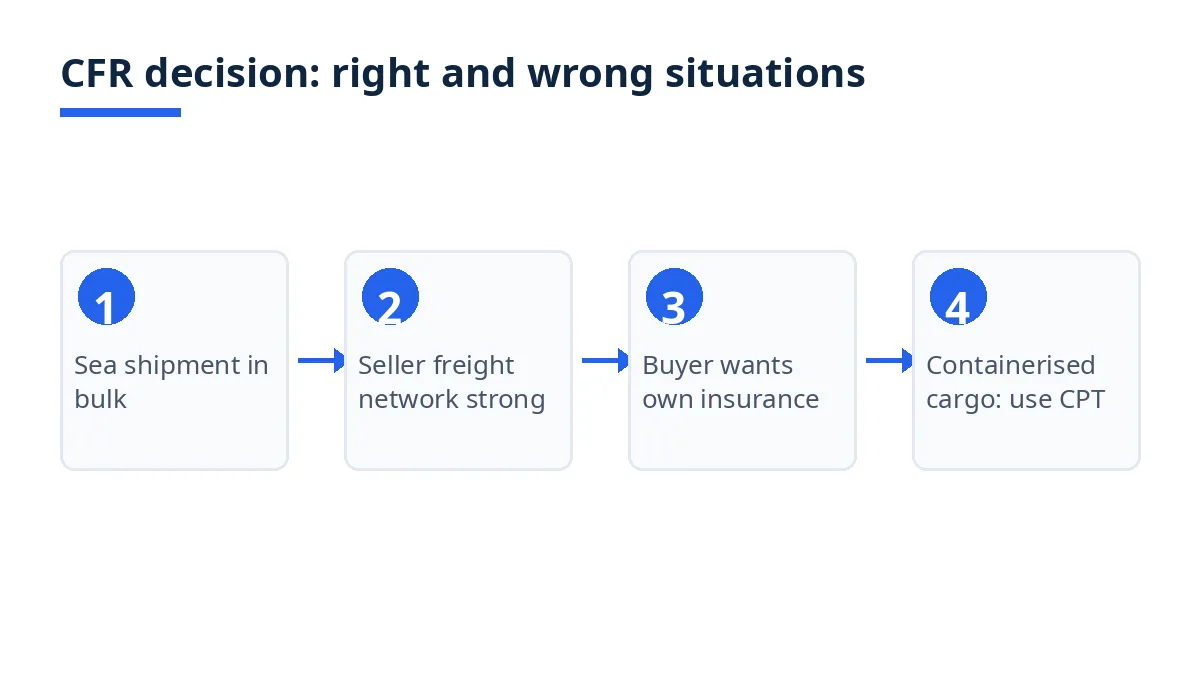
Situation | CFR fits | Consider instead | Why |
|---|---|---|---|
Bulk or break-bulk cargo loaded directly on board, and you hold marine insurance from loading | Yes | CFR | Risk point matches loading |
You hold an annual marine policy and have no forwarder in Bangladesh | Yes | CFR | Seller handles export carriage |
The seller ships the same route often and names the carrier, sailing, and destination charges | Yes | CFR | Stated terms let you check it |
Containerised cartons handed to a terminal days before loading | No | CPT or CIP | Gap after handover |
Any leg by air, road, or rail, or a door-to-door movement | No | CPT, CIP, or a D rule | CFR covers sea and inland waterway transport only |
You want the seller to buy insurance for your benefit | No | CIF for sea cargo, CIP for containers | No seller insurance obligation |
You want to choose the carrier, sailing, and freight rate yourself | No | FOB or FCA | Seller contracts carriage |
First order, no insurance broker, and no forwarder of your own | No, without help | CIF or CIP, with a forwarder | Insurance is entirely yours |
A wrong choice costs more than the freight difference: CFR without insurance risks the full value of the cargo, and CFR for a container risks an uninsured gap between handover and loading. Decide the term before you accept the quotation.
Example figures: goods USD 24,000 plus ocean freight USD 2,100 give a CFR price of USD 26,100. The buyer adds insurance of USD 180 and destination charges of USD 1,150, for USD 27,430 before import duty. Duty is extra. The example shows the arithmetic only; rates must come from live quotations.
CFR compared with FOB, CIF, CPT and CIP
Term | Who pays freight | Risk passes to buyer | Insurance the seller must buy | Mode | Suits |
|---|---|---|---|---|---|
CFR | Seller, to the named destination port | On board at the port of shipment | None | Sea and inland waterway only | Bulk sea cargo; buyer insures |
FOB | Buyer | On board at the port of shipment | None | Sea and inland waterway only | Buyer controls freight |
CIF | Seller, to the named destination port | On board at the port of shipment | Yes, minimum cover, Institute Cargo Clauses (C) by default | Sea and inland waterway only | Bulk sea cargo; seller insures |
CPT | Seller, to the named place of destination | When handed to the first carrier | None | Any mode | Container cargo; seller pays carriage |
CIP | Seller, to the named place of destination | When handed to the first carrier | Yes, wide cover, Institute Cargo Clauses (A) or similar | Any mode | Container cargo; seller insures |
The comparison turns on two checks: who pays for carriage, and where risk passes. In all four C rules, the seller pays carriage to destination while risk passes at origin, so a C price is never a delivered price.1 FOB differs because the buyer pays freight, while CPT and CIP differ because risk passes at handover to the carrier. For the full set of 11 rules, see the Incoterms guide for shipments from Bangladesh, and for the insurance difference, see the CIF guide.
Bangladesh-specific notes
Name the exact port on both ends: "CFR Chattogram, Incoterms 2020" with the named destination port in full, rather than "CFR Bangladesh". Under CFR, the seller clears the goods for export and provides the transport document, while you clear the import and pay duty and taxes at destination.2 In Bangladesh, the Bill of Export must be approved before loading, with the export contract or purchase order, commercial invoice, packing list, certified EXP form, and certificate of origin enclosed.3 Ask the seller to confirm that the declaration names your company, and that the transport document shows freight prepaid to your named port. If your goods travel in a container, ask where it is handed to the carrier, and discuss CPT or CIP if the answer is a terminal handover.
Mistakes and red flags
What are the most common mistakes?
Reading CFR as a delivered price. CFR ends at the destination port; import clearance, duty, and onward transport are yours.
Assuming insurance is included. CFR has no seller insurance obligation.2 Confirm in writing who arranges it and from which date.
Naming a country instead of a port. The contract must name the port of shipment and the port of destination, with the Incoterms 2020 edition stated.
Using CFR for air freight or containers. CFR covers sea and inland waterway transport only.4 Air shipments and container handovers need CPT or CIP.
Comparing CFR and FOB headline prices. A CFR price contains freight; an FOB price does not. Reprice both to the same point, adding freight and insurance to FOB, before you rank them. The CFR quotation comparison guide sets out the same-point method.
Accepting a freight-paid document without reading it. Check that it covers carriage to your named port. If it is silent on unloading, assume you will pay it.
Red flags include a seller who will not name the destination port, a price that claims to include insurance without stating the level of cover, and a refusal to state which destination charges the freight contract includes.
Checklist: deciding on CFR before you sign
The cargo is bulk or break-bulk, loaded directly on board.
The contract states "CFR [named destination port], Incoterms 2020" with the port of shipment named as well.
Marine insurance is arranged from the loading date, at a stated level of cover.
The seller has named the carrier and sailing window.
The freight contract position on destination charges is stated in writing.
Import clearance, duty, and onward transport are budgeted by you.
The transport document is agreed: carriage to the named port, freight prepaid.
The export set is confirmed with the seller: Bill of Export, commercial invoice, packing list, EXP form, and certificate of origin.3
If the cargo moves in a container, CPT or CIP has been considered.
How Exportain helps
On Exportain, state the term and the destination port in your request for quotation, so suppliers on Exportain quote on the same basis. The how to buy guide sets out the buying steps, including stating the Incoterm in an RFQ and comparing versioned quotations. Ask each reply for the freight element, the carrier and sailing, the destination charges included, and the insurance position. For detail, read the CFR risk transfer guide, the CFR price guide, and the CFR documents checklist. A badge records checks reviewed, not a guarantee of capacity or delivery.5 Exportain does not book freight or clear customs.
FAQs
What should I know first about CFR?
CFR means the seller pays ocean freight to your named destination port, while risk passes to you on loading on board, and the seller has no obligation to insure the goods.2 CFR covers sea and inland waterway transport only, and suits bulk and break-bulk cargo loaded directly on board.4 Arrange insurance from loading.
What are the typical costs and timelines?
There are no typical CFR costs or timelines a guide can state as fact, because freight, insurance, and destination charges move with the route and the market. A CFR price contains the goods and freight to the named port only. Build the landed figure by adding insurance, the destination charges the freight contract does not include, duty, and onward transport, using live quotations. Ask for the sailing window and expected arrival range in writing.
Which documents are needed?
The seller provides the commercial invoice, packing list, and the transport document for carriage to the named port, and clears the goods for export.2 In Bangladesh, clearance requires an approved Bill of Export with the export contract or purchase order, commercial invoice, packing list, certified EXP form, and certificate of origin enclosed.3 You need the transport document to claim the goods, plus your import declaration. The full split is in the CFR documents checklist.
What are the most common mistakes?
The most common mistakes are assuming the seller insures the voyage, reading CFR as a delivered price, naming a country instead of a port, using CFR for containers or air freight, and comparing CFR and FOB headline prices without repricing both to the same point.
Next steps on Exportain
Post an RFQ stating "CFR [your destination port], Incoterms 2020" and your cargo type, so suppliers on Exportain quote on the same basis. Before you accept, read the Incoterms guide for shipments from Bangladesh and the CIF guide to confirm CFR is the right term, then follow the how to buy guide to compare quotations on the same landed-cost basis.
Sources
- Incoterms® 2020. International Chamber of Commerce (ICC) (accessed )
- Incoterms 2020: Group C rule explained. Export Development Canada, (accessed )
- Customs Clearance Procedures for Export. Bangladesh Customs, National Board of Revenue (accessed )
- Incoterms Rules. Munich Re (accessed )
- How to source and buy from Bangladesh. Exportain (accessed )
About the author
Sourcing from Bangladesh?
Post a request for quotation and suppliers on Exportain can send you their quotes directly.
Post an RFQ


