Ceiling Fans Price in Bangladesh: FOB Cost Breakdown for Buyers
FOB ceiling fan prices from Bangladesh bundle the fan, packing, transport, port handling, loading, clearance and testing. See what sits inside the price, what sits outside it, and how to compare itemized quotes on the same term and port.
Short answer
An FOB ceiling fan price from Bangladesh covers every cost up to loading on board the buyer's nominated vessel at the named port of shipment: the fan, export packing, inland transport, origin port handling, loading, export clearance and documentation, and agreed inspection or testing. Ocean freight, insurance, destination charges and import duties sit outside it. Compare quotes only as itemized lines on the same term and port, and confirm the standard and test values behind each fan.

On this page
Key takeaways
An FOB price covers every cost up to loading on board the buyer's nominated vessel at the named port; ocean freight, insurance, destination charges and import duties sit outside it.
Compare FOB quotes only as itemized lines on the same term and port, because a lump sum hides which cost lines are included.
For containerised cargo handed over at a terminal, FCA may match the physical handover better than FOB; record the risk point in the contract.
Judge a fan by its test values: rated power, air delivery and service value under BDS IEC 60335-2-80:2022 and ISO 5801:2017, not by a star claim alone.
Exportain verification is a document and photo review, not a factory inspection, and membership plans never grant a trust badge.
A ceiling fan FOB quote from Bangladesh is a bundle of cost lines, not a single factory price. Two suppliers can quote for the same sweep size and motor type and still land far apart, because one quote carries packing, transport, port handling, loading and clearance inside the price, while the other leaves lines out. Compare quotes only after pulling the bundle apart on the same term and port.
FOB stands for Free On Board. Under the Incoterms 2020 rules, the seller delivers the goods loaded on board the vessel nominated by the buyer at the named port of shipment, and risk of loss or damage transfers to the buyer at that point.1 The seller covers transport to the port, loading, and export formalities; the buyer contracts the carrier, pays freight, and handles import formalities.1
Why this matters for buyers and sellers
For the buyer, the FOB price is the most useful comparison point, because it is the last price fully in the seller's control. Once the fans are on board, ocean freight, marine insurance, destination port charges, import duties and taxes, and delivery to your warehouse are costs you arrange or approve. None of them sit inside an FOB price.
For the seller, the FOB price must absorb every cost up to loading: the fan, export packing, transport to the port, terminal handling, loading, clearance, and any inspection or testing. A low figure that leaves transport or loading out is not cheaper; the missing lines surface later as extra charges.
The risk point matters as much as the price point. Under FOB, the buyer must inform the seller in time of the vessel name and the loading place and point within the port, and if the buyer fails to do so and the goods cannot be loaded, risk and additional costs pass to the buyer.1 If the nominated vessel is delayed, the buyer bears the risk and cost of storage at the port until the vessel arrives.1 Name the port and vessel window, and confirm who pays storage if the vessel slips, in the purchase order.
One structural warning applies to every ceiling fan negotiation. When goods are containerised, the seller typically delivers to a container terminal, where containers may wait days before loading.1 The ICC Academy guidance states FCA is then the more appropriate rule.1 Ask whether the quote prices delivery to the terminal or on board, and when risk transfers for a waiting container. If the answer is terminal handover, price the order on FCA terms, so the risk point matches the handover.
Step-by-step: how it works
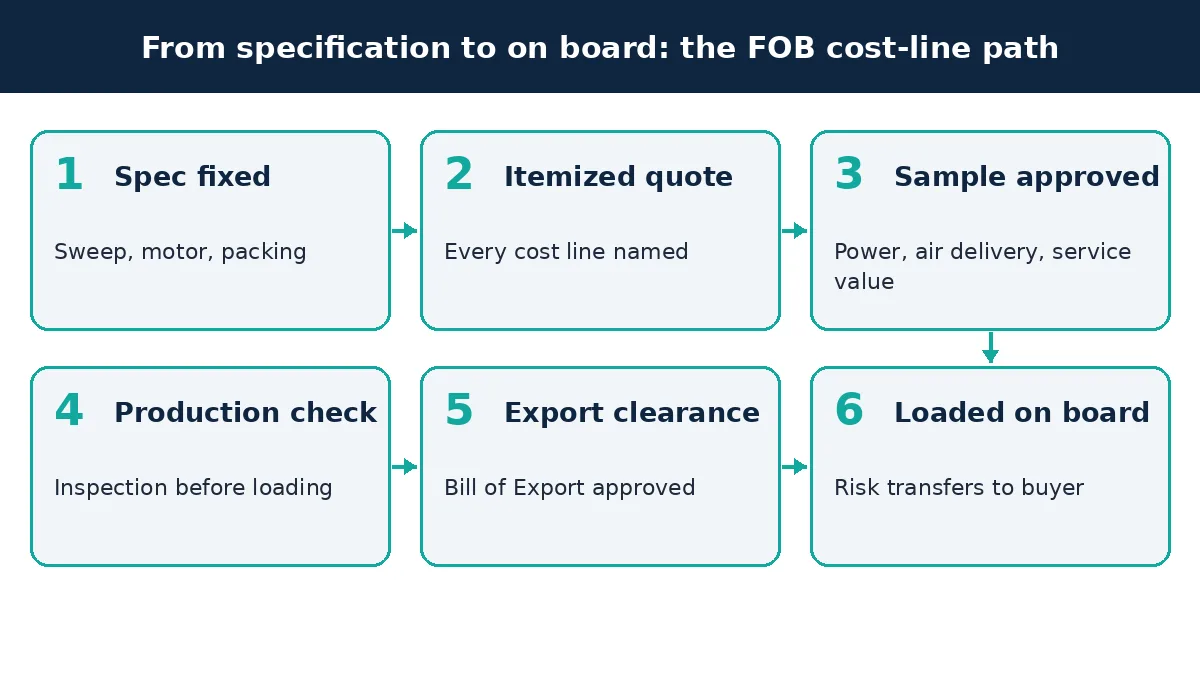
Fix the specification before you ask for a price. State sweep size, motor type, rated power and air delivery, voltage and frequency, blade material, control type, finish, and packing per carton.
Ask for an itemized FOB quote, not a lump sum. Request one line each for the fan unit, packing, inland transport, port handling, loading, clearance and documentation, and inspection or testing.
Compare quotes on the same term and the same port. Compare FOB with FOB only, on the same named port. Quotes for different ports are different offers, even at the same unit price.
Approve a sample and its test values in writing. Ask for rated power, air delivery and service value for the sample, and keep the approved values with the purchase order. Service value is air delivery in cubic meters per minute divided by electrical power input in watts, under specified test conditions.2
Agree inspection and packing checks before production ends. Confirm what will be checked, who checks it, and what happens to a failed carton or a failed test value.
Confirm the export set and the vessel nomination. Confirm the Bill of Export, invoice, packing list, EXP form and certificate of origin, and give the vessel name and loading point in time.1 3
Take the on-board evidence and reconcile the invoice. Ask for the on-board bill of lading as delivery evidence, then check the final invoice against the itemized quotation before payment.
Costs, timelines and documents
What are the typical costs and timelines?
No typical FOB costs for ceiling fans can be stated as fact, because each supplier prices your specification, packing, port and quantity. This guide shows the structure of the price, so you can see which line moved when a quote changes. Every figure in this section is labelled as example figures, and none of it is market data.
Example figures: the table uses an index of 100 for the total FOB price, so each line is a share of the bundle, not a price in any currency.
FOB cost line | What it covers | Example figures: share of an indexed FOB price of 100 |
|---|---|---|
Fan unit | Motor, blades, canopy, controls, assembly, testing | 62 |
Export packing and cartons | Export cartons, inner packing, marking, palletising | 6 |
Inland transport to the port | Moving packed cartons to the named port | 5 |
Origin port handling and loading | Origin terminal handling and loading on board | 7 |
Export clearance and documentation | Bill of Export, invoice, packing list, EXP form, certificate of origin | 3 |
Inspection and testing | Pre-shipment inspection and agreed testing | 4 |
Other supplier costs and margin | Order handling, financing, margin | 13 |
Example figures: if a supplier re-quotes after a specification change, ask which lines moved and by how much. A motor change moves the fan unit line and can move the testing line, because rated power and air delivery change with it. A packing change moves the packing line and can move transport and port handling, because carton size and weight change.
Ocean freight, marine insurance, destination port charges, import duties and taxes, and inland delivery from the destination port all sit outside FOB.1 No duty rate is stated here, because destination tariff schedules differ and change. Ask your customs broker for the duty and tax treatment of your exact fan classification before you confirm, and keep that advice separate from the FOB quote.
Timelines follow the same rule as costs: there are no typical lead times to rely on. Sampling depends on whether the motor and blade combination is already in production, production on component availability and line time, and shipment on the vessel schedule and clearance sequence. Ask for sampling, production, inspection, clearance and vessel cut-off dates as separate lines, not a single delivery week.
Which documents are needed?
The commercial set is the specification sheet, the itemized quotation, the purchase order that repeats the itemized lines, and the proforma invoice. If a cost line is not on the purchase order, do not assume it is included in the price.
For export clearance in Bangladesh, the C and F agent submits the Bill of Export online through the ASYCUDA World system, with the export letter of credit or, without one, the approved export contract, purchase order or export guarantee, the commercial invoice, the packing list and detailed packing list, the EXP form certified by an authorized dealer, the certificate of origin from the Export Promotion Bureau or a Chamber, and the VAT and BIN certificate.3 The document processing fee is BDT 30.00 per Bill of Export.3 Goods are not loaded until the Bill of Export is approved, so confirm who prepares each document and pays each fee before the goods reach the port.
Bangladesh-specific rules and tips
Start with the fan standard, not the fan price. The Sustainable and Renewable Energy Development Authority (SREDA) energy labelling guideline covers electric ceiling fans powered by induction or brushless direct current (BLDC) motors, for general air circulation, on single-phase AC supply up to 250V at 50Hz, manufactured, imported or sold in Bangladesh.2 To qualify as a SREDA star labelled product, a fan must meet the safety requirements of BDS IEC 60335-2-80:2022 and the performance requirements of that standard and ISO 5801:2017.2
Judge the fan by its test values, because the label follows the values. SREDA defines service value as air delivery divided by power input, and sets star bands by sweep size.2 For fans of 1200 mm sweep or more, the table valid from 1 July 2025 to 30 June 2027 sets 5 stars at 6.0 cubic meters per minute per watt or more, and 4 stars from 5.0 to below 6.0.2 If a supplier claims a star level, ask for the rated power, air delivery and service value behind it, and check that the sweep size band matches your fan.
Classification is the second Bangladesh-specific check. Ceiling fans with a self-contained motor sit under heading 8414, and those with motor output not exceeding 125 watts fall under subheading 8414.51.4 Confirm the full code for your exact fan, including motor output and any integrated light or control, with your customs broker and the destination tariff schedule. See the HS code for ceiling fans guide, and keep the confirmed code on the invoice and packing list.
First, confirm the port in writing: transport and handling are priced to a named port. Second, confirm packing per carton: fans per carton, dimensions, weight and marking. Third, confirm who holds the export documentation role, supplier or C and F agent, with each document named.
Mistakes and red flags
What are the most common mistakes?
Comparing FOB with EXW or CIF as if they were the same price. An EXW price stops at the factory gate, an FOB price runs to on board the vessel, and a CIF price runs to the destination port with freight and minimum insurance.1
Accepting a lump-sum FOB figure. A single number hides which lines are included. Treat any line the supplier cannot itemize as one to confirm in writing before payment.
Using FOB for containerised cargo without discussing FCA. If fans are handed over at a container terminal and wait before loading, the handover and the FOB risk point do not match.1 Price the order on the term that matches the handover.
Assuming FOB includes ocean freight or insurance. It includes neither: the buyer contracts the carrier, pays freight, and arranges insurance.1 Budget the ocean leg from the first quotation, not after the order is placed.
Treating a star claim, a badge or a profile as test evidence. A star level is only as good as the test values behind it,2 and a profile is a starting point. Ask for test reports, sample approval and inspection results.
Leaving port charges and storage to chance. Confirm which origin charges are inside the FOB price, who pays storage if the vessel is delayed, and who pays if the vessel closes before the goods arrive.1
Checklist
Before you confirm a ceiling fan FOB order, every line should be answered in writing.
Specification sheet agreed: sweep, motor type, rated power and air delivery, voltage and frequency, controls, finish, packing per carton.
Itemized FOB quotation received, with each cost line named and each excluded cost named.
Named port of shipment and delivery term confirmed on every quotation compared.
Sample approved in writing, with rated power, air delivery and service value recorded.2
Standard confirmed: BDS IEC 60335-2-80:2022 safety and ISO 5801:2017 performance, with the test report on file.2
Full HS code confirmed with your customs broker for your exact fan.4
Inspection scope and failed-goods procedure agreed before production ends.
Export document owners named: Bill of Export, invoice, packing list, EXP form, certificate of origin.3
Vessel nomination agreed: vessel name and loading point given in time, storage cost owner named.1
On-board bill of lading requested, final invoice checked against the itemized quotation.
How Exportain helps
On Exportain, browse suppliers and post a request for quotation on the RFQ board with your specification sheet, named port and itemized-line request, so suppliers quote against the same lines. Ask each reply to name its included and excluded lines, packing per carton, and standard and test values. On acceptance, Exportain creates one order and one proforma invoice from the accepted terms.
Read the badges for what they record. Verification is free and staff-reviewed, and it is a document and photo review, not a factory inspection.5 Membership plans never grant a trust badge.5 Sample approval, test reports and inspection stay with you. See how supplier verification works on Exportain and the MOQ definition guide.
FAQs
What should I know first about ceiling fans?
Under FOB, the seller delivers the goods loaded on board the vessel nominated by the buyer at the named port of shipment, and risk transfers to the buyer at that point.1 The specification, itemized lines, named port and test values decide whether a quote is comparable.
What are the typical costs and timelines?
There are no typical FOB costs or timelines to rely on, because each supplier prices your specification, packing, port and quantity. Example figures in this guide use an indexed price of 100 to show shares of the bundle, not prices in any currency. Ask for sampling, production, inspection, clearance and vessel cut-off dates as separate lines.
Which documents are needed?
The commercial set is the specification sheet, itemized quotation, purchase order and proforma invoice. The export set includes the export letter of credit or approved contract or purchase order, commercial invoice, packing list and detailed packing list, EXP form certified by an authorized dealer, certificate of origin from the Export Promotion Bureau or a Chamber, and VAT and BIN certificate.3 The Bill of Export goes through ASYCUDA World, and the document processing fee is BDT 30.00 per Bill of Export.3
What are the most common mistakes?
The most common mistakes are comparing FOB with EXW or CIF prices, accepting a lump sum without itemized lines, using FOB for containerised handover without discussing FCA, assuming freight or insurance is included, and treating a star claim as test evidence.1 2 Confirm the named port, included and excluded lines, storage cost owner for a delayed vessel, and on-board delivery evidence in writing before you confirm.
Next steps on Exportain
Browse suppliers, then post your specification sheet, named port and itemized-line request on the RFQ board so suppliers quote FOB on the same lines. Before you confirm, read how to import ceiling fans from Bangladesh and the ceiling fans quality control checklist.
Sources
- FOB & FAS Incoterms® 2020 explained: Key differences. ICC Academy (accessed )
- Ceiling Fans — Test Parameters and Standards. Sustainable and Renewable Energy Development Authority (SREDA) (accessed )
- Customs Clearance Procedures for Export. Bangladesh Customs, National Board of Revenue (accessed )
- HS Code for Ceiling Fan: Find Accurate Classification. Accio (accessed )
- Supplier verification: Earn trust badges buyers can see. Exportain (accessed )
About the author
Sourcing from Bangladesh?
Post a request for quotation and suppliers on Exportain can send you their quotes directly.
Post an RFQ