Top Ceiling Fans Manufacturers in Bangladesh: How to Find and Verify Them
Eight checks for finding ceiling fans manufacturers in Bangladesh: export documents, factory identity, safety standards, a production sample, inspection rules, HS code, and order terms tied to inspection, before you pay a deposit.
Short answer
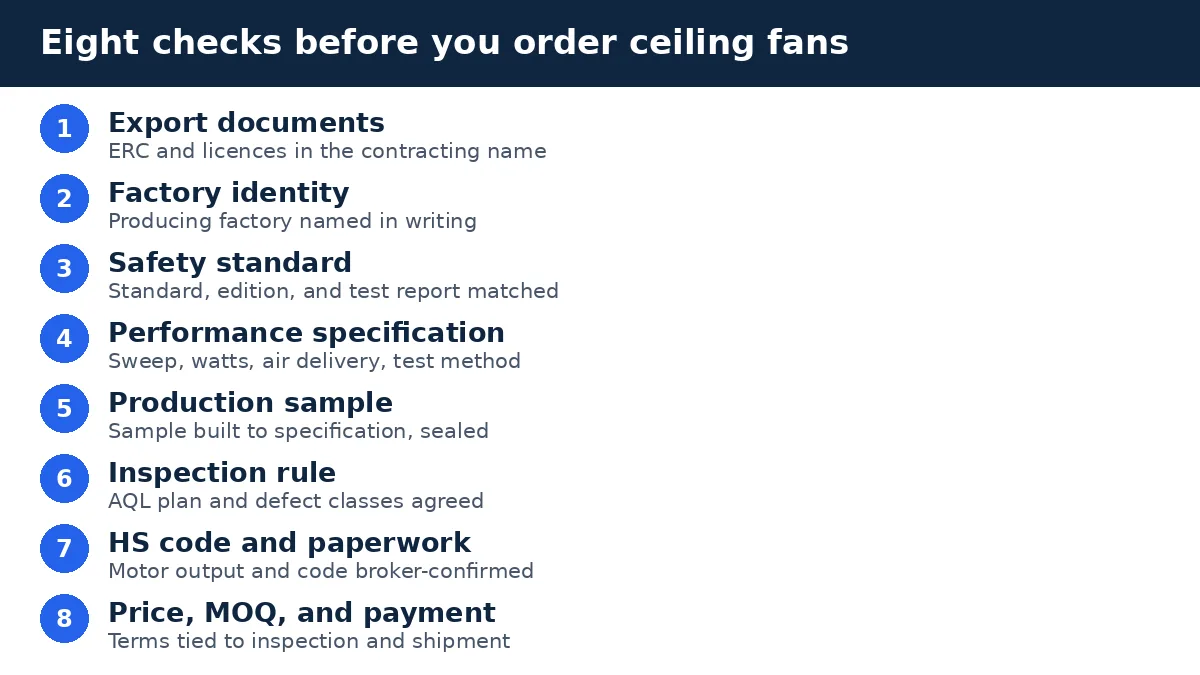
Ceiling fans manufacturers in Bangladesh should be chosen by eight checks, not by catalogue or price: export documents in the contracting name, the producing factory named in writing, a safety standard and test report matched to the exact model, a measurable performance specification, a production sample, an agreed inspection rule, a broker-confirmed HS code, and order terms tied to inspection. Run the checks in that order before paying a deposit.

On this page
Catalogues for ceiling fans from Bangladesh look wide and prices look close, yet the listings rarely show who builds the fan, which safety standard it was tested against, or what happens when a shipment fails inspection. That gap is the real buying risk, and it is closed by checking the supplier, not by comparing photographs. Electrical products are a growing part of Bangladesh's export trade: exports of electrical products rose 23.82 per cent to US$206.19 million in fiscal 2025-26, according to Export Promotion Bureau data reported by The Business Standard.1
Key takeaways
Do not choose a ceiling fan supplier from a catalogue or a price alone. Check export documents, factory identity, safety standards, a production sample, inspection rules, classification, and order terms, in that order.
A trading company is not a factory, and a factory that assembles fans is not necessarily the factory that makes the motor. Ask who makes each part of the fan you are buying.
Safety and performance are only as good as the written specification and the test report behind them. Ask the supplier to name the exact standard, edition, and test method for your market.
A sample made from catalogue parts proves nothing. Approve a sample built to your specification, test it yourself, and keep one sealed sample as the reference for inspection.
Put the inspection rule, the defect classes, the HS code, the MOQ per model, and the payment conditions in writing before production starts.
The list: eight checks before you order ceiling fans from Bangladesh
The eight checks below are written as criteria, not as company names. Work through them in order for every shortlisted supplier, and keep the answers in the same message thread or RFQ so that what was promised can be checked against what arrives.
1. Confirm the supplier can legally export
What to check. Whether the company holds the documents an exporter in Bangladesh needs, and whether those documents belong to the company you are contracting with. Ask for a copy of the trade licence, the tax identification number, the VAT or business identification number, and the Export Registration Certificate (ERC).
Why it matters. The ERC is issued by the Office of the Chief Controller of Imports and Exports, and exporters must hold one before beginning cross-border export, under the export registration framework described in published guides to the process.2
How to verify and fix it. Ask for the documents before you discuss price in detail, and check that the company name, address, and business activity match across all of them. Keep copies of the set with the order file, so that a later change of bank account or company name can be spotted against the original documents.
2. Establish who actually makes the fan
What to check. Whether the supplier manufactures ceiling fans itself, assembles them from bought-in parts, or buys finished fans from another factory and resells them. Ask which factory makes the motor, the blades, and the controller, and where each of those steps happens.
Why it matters.
How to verify and fix it. Ask for the producing factory to be named in writing, and ask whether any stage is subcontracted. A supplier that assembles fans from bought-in motors should say so plainly, because motor quality and spare-parts supply then depend on its parts supplier rather than on its own line. Record the answer in the order terms, not only in an email that can be lost. On Exportain, seller verification reviews identity documents, business registration, the ERC, and factory or office photos submitted by the seller.3
3. Match the safety standard to your destination market
What to check. Which safety standard the fan is built and tested to, which edition of that standard applies, and whether the test report covers the exact model, motor, and controller you are ordering.
Why it matters. Ceiling fans are electrical appliances, and the safety rules that apply to them differ by market. The international fan safety standard IEC 60335-2-80 covers the safety of electric fans for household and similar purposes, and its scope expressly includes ceiling fans, along with duct, partition, pedestal, and table fans.4 A Bangladeshi test document for ceiling fans lists BDS IEC 60335-2-80:2022 among the test parameters and standards applied, showing that the IEC fan standard has a Bangladesh-adopted form.5
How to verify and fix it. Ask the supplier to state the standard and edition in writing, and to provide the test report for the exact model you are ordering. Check the report date, the laboratory named on it, and whether the model, motor, and controller listed on the report match your specification exactly. A report for a different model, or for a fan with a different controller, does not cover your order. Check that the report names the same motor type, blade size, and controller as your specification. For the Bangladesh domestic market, note that published BSTI licensing lists give BDS 817 for electric fans (ceiling and table), and that AC electric ventilating fans and regulators have been brought under the mandatory BSTI mark system, with producers required to hold a BSTI licence and use the mark.6 7
4. Get the performance specification in measurable terms
What to check. The full performance specification for each model: blade sweep, rated voltage and frequency, power consumption in watts, air delivery, speed settings, noise level, and the motor type, whether induction or brushless direct current (BLDC).
Why it matters. Two fans with the same blade size and the same catalogue photograph can move very different amounts of air and use very different amounts of power.
How to verify and fix it. Write the specification as a table with one row per model, and require the supplier to fill in every cell for the exact model quoted, including the test method used for air delivery and noise. Add the mounting type, down-rod length options, and controller type to the same table, because a fan ordered without those details can arrive with parts that do not fit the intended ceiling or control system.
5. Approve a sample built to your specification
What to check. A pre-production sample made with the production motor, blades, controller, and finish, rather than a showroom sample or a sample of a similar model.
Why it matters.
How to verify and fix it. Order the sample only after the specification table in check 4 is agreed, and inspect the sample against that table, line by line. Photograph the sample, including the motor label and controller, and keep those photographs with the approval record. If the supplier later claims a different motor was always intended, the photographs settle the point. Run the fan at each speed, listen for vibration and noise, and check the suspension, canopy, and down-rod assembly for fit and finish.
6. Agree the inspection rule and the defect classes before production
What to check. The inspection plan for the finished lot: who inspects, when, against which sample, under which sampling rule, and what counts as a critical, major, or minor defect.
**Why it matters.**Under ISO 2859-1, the acceptance quality limit is the quality level that is the worst tolerable process average when a continuing series of lots is submitted for acceptance sampling, which means it is a limit, not a target to aim at.8 Setting the rule in advance lets an inspector accept or reject a lot against a published method instead of negotiating after the goods are packed.
How to verify and fix it. Write the inspection plan into the order: the inspection level, the acceptance quality limit for major and minor defects, zero tolerance for critical safety defects such as exposed wiring or a faulty suspension, and the right to reject a lot that fails. State who appoints the inspector and who pays for the inspection, and require the inspection report to list defects by class so that the accept or reject decision follows from the report rather than from a discussion. Name the defects that matter for fans in advance, including motor failure, incorrect blade size, wrong controller, damaged finish, missing mounting parts, and incorrect labelling.
7. Confirm the HS code and the destination paperwork
What to check. The HS code for your exact fan, the motor output that determines it, and the documents your destination customs authority will require.
**Why it matters.**Table, floor, wall, window, ceiling, and roof fans with a self-contained electric motor of an output not exceeding 125 watts fall under HS subheading 8414.51, while other fans fall under 8414.59, and parts of fans fall under 8414.90.9 A ceiling fan with a motor above the 125-watt threshold therefore sits in a different subheading from a smaller household fan, and quoting the wrong one misstates the duty and the declaration.
How to verify and fix it. Ask the supplier to state the motor output and the HS code it will declare, and confirm both with your customs broker or freight forwarder in the destination market before the order ships. Ask the broker what else the destination requires for electrical goods, such as a conformity certificate or a marking rule, and build those documents into the order timetable so that they are ready before the container is loaded.
8. Tie price, MOQ, and payment to the checks above
What to check. Whether the quotation states the MOQ per model and per colour, the price basis, the lead time, the packing, the warranty and spare-parts terms, and the payment conditions, and whether those terms are linked to inspection and shipment.
Why it matters.
How to verify and fix it. Ask every shortlisted supplier to quote the same specification table, the same packing, and the same delivery term, so that the prices can be compared line by line. State the carton contents, the marking on each carton, and the number of fans per carton in the quotation request, because packing differences alone can explain a price gap that looks like a bargain.
Summary table
Check | What to ask for | Main warning sign |
|---|---|---|
1. Export documents | Trade licence, TIN, VAT or BIN, current ERC in the contracting name | Names or addresses that differ across documents |
2. Factory identity | Producing factory named, each production stage disclosed | A supplier who will not name the maker |
3. Safety standard | Standard, edition, and test report for the exact model | A standard number with no report or model match |
4. Performance specification | Sweep, watts, air delivery, noise, motor type, test method | Figures with no test method or no model match |
5. Production sample | Sample built to specification, sealed reference kept | A showroom sample offered as proof |
6. Inspection rule | AQL plan, defect classes, rejection and rework terms | No written rule before production |
7. HS code and paperwork | Motor output, HS code, broker-confirmed declaration | A code chosen by the supplier alone |
8. Price, MOQ, and payment | MOQ per model, packing, warranty, spares, payment tied to inspection | A price with no stated terms behind it |
How Exportain helps
Exportain is a B2B marketplace for sourcing from Bangladesh. Buyers search published products by keyword and category, and supplier profiles show the verification level, location, main products, and certifications the supplier has declared. Seller verification on Exportain reviews identity documents, business registration, the ERC, and factory or office photos submitted by the seller, with each check reviewed by the Exportain team.3
When you are ready to compare suppliers, post a request for quotation stating the specification table from check 4, the quantity per model and colour, the destination, the delivery term, the inspection plan from check 6, and the HS code from check 7.
FAQs
What is the biggest mistake buyers make when sourcing ceiling fans from Bangladesh?
Choosing a supplier by catalogue appearance or by the lowest unit price before checking who makes the fan and which standard it meets.
How can I avoid it?
Work through the eight checks in order, and do not pay a deposit until the documents, the factory identity, the standard and test report, and the sample are all confirmed. Write one specification table, send the identical table to every supplier, name the producing factory in the order terms, approve a sample built to that table, and set the inspection rule in writing before production starts.
Who is responsible for quality, the factory or the buyer?
Both, at different points. The factory is responsible for building fans to the agreed specification and the approved sample. The buyer is responsible for making that specification complete and measurable, and for inspecting the finished lot against it before shipment. When a dispute starts, the side with the written specification, the sealed sample, the test report, and the inspection report is the side whose version can be checked.
Where can I get help verifying a supplier?
Start with the records that exist: the export registration and business documents for the company, the test laboratory or standard body behind any safety claim, and an inspection provider for the pre-shipment check.2 4 On Exportain, read what each profile badge covers before relying on it, and message the supplier through its profile so that your questions and the answers stay in one thread.3 For the ordering and shipping steps that follow verification, the guide to importing ceiling fans from Bangladesh covers the process, and the ceiling fans quality control checklist turns the inspection plan into fan-level checks.
Next steps on Exportain
Browse Bangladeshi suppliers and filter the electrical listings by badge, MOQ, and capability. Before you order, read how supplier verification works on Exportain so that you know what each badge covers. Then post a free RFQ with your fan specification table, quantities per model and colour, destination, and delivery term, and compare the quotations that come back on the same fields.
Sources
- Electrical, electronics exports hit record growth amid rising EU compliance hurdles. The Business Standard, (accessed )
- Export Registration Certificate (ERC) In Bangladesh: How To Apply. Bizmend, (accessed )
- Sell Bangladeshi Products to Global Buyers | Exportain. Exportain (accessed )
- IEC 60335-2-80:2015 — Household and similar electrical appliances — Safety — Part 2-80: Particular requirements for fans. International Electrotechnical Commission (IEC) (accessed )
- Ceiling Fans — Test Parameters and Standards. Sustainable and Renewable Energy Development Authority (SREDA) (accessed )
- How to Obtain BSTI License in Bangladesh. LegalSeba LLP, (accessed )
- 43 more goods come under mandatory BSTI mark. New Age (accessed )
- Understanding Acceptable Quality Level (AQL) in Quality Control. Investopedia (accessed )
- HS Code for Bathroom Ceiling Exhaust Fans 2025 Guide. FreightAmigo (accessed )
About the author
Sourcing from Bangladesh?
Post a request for quotation and suppliers on Exportain can send you their quotes directly.
Post an RFQ