

Top Batteries Manufacturers in Bangladesh: How to Find and Verify Them
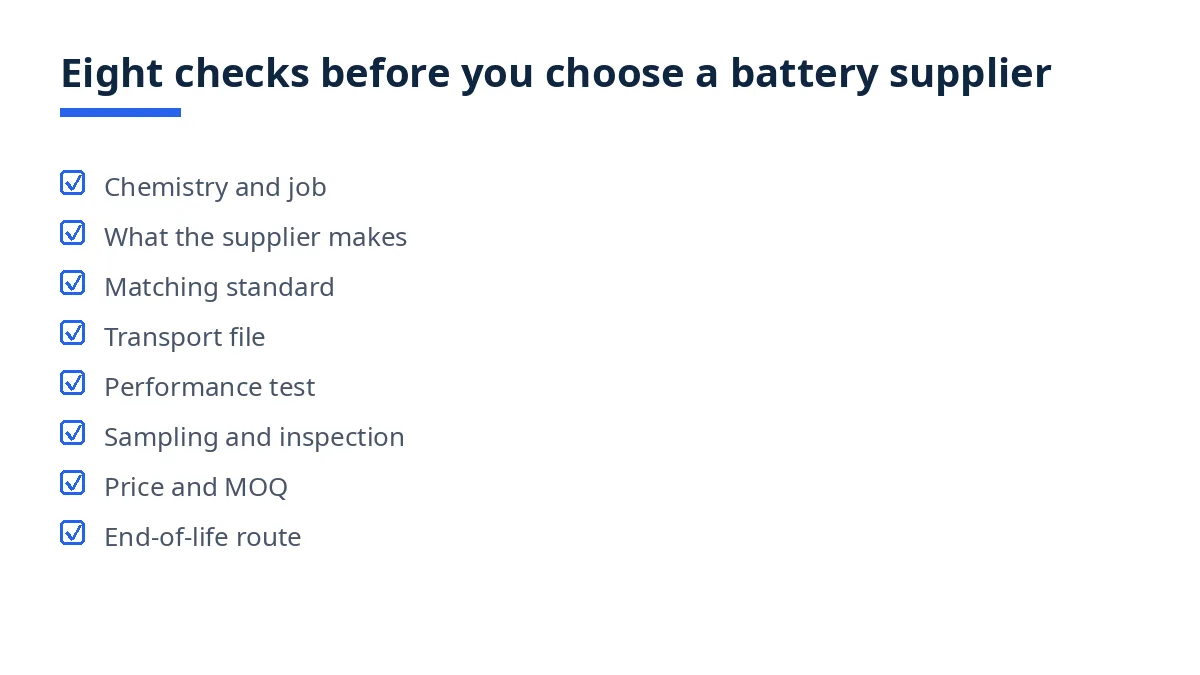
Eight checks for choosing a battery supplier in Bangladesh: match the chemistry to the job, confirm what the supplier makes, check the standard and transport file, test performance, agree inspection, compare price and MOQ, and settle recycling.
Short answer
Battery suppliers in Bangladesh should be chosen by eight checks, not by a company name: fix the chemistry and the job, confirm what the supplier makes, match the standard to that chemistry, obtain the UN 38.3 transport summary for lithium batteries, test performance against your specification, agree AQL sampling and inspection before production, compare price and MOQ on one identical specification, and settle the recycling route in writing.
On this page
Buyers who search for batteries manufacturers in Bangladesh usually want a shortlist of factory names. A shortlist is the wrong starting point for this product. Batteries differ by chemistry, and chemistry decides the applicable standard, the transport file, the test report and the recycling route. A supplier strong on lead-acid starter batteries may have no standing at all on lithium packs, and a lithium pack that passes a performance test can still be refused by a carrier if its transport file is incomplete.
Demand for lead-acid batteries in Bangladesh is growing on the back of three-wheeler e-rickshaws and renewable energy generation, which keeps formal factories and informal recyclers active in the same market.1 That mix is why a checklist matters here: the same product description can hide very different levels of control over materials, testing and paperwork.
Key takeaways
Start from chemistry, not from a company name: lead-acid, lithium-ion, lithium-metal and primary dry-cell batteries follow different standards and transport rules.
For portable lithium batteries, IEC 62133-2 covers safety requirements for portable sealed secondary lithium cells and batteries in portable applications.2
For lithium batteries offered for transport, ask for the UN 38.3 test summary that manufacturers and subsequent distributors must make available.3
Agree the sampling plan before production: the acceptance quality limit (AQL) is the worst tolerable process average for a continuing series of lots submitted for acceptance sampling.4
For lead-acid batteries, ask about the recycling route in writing: informal recycling of used lead-acid batteries is the main source of urban lead exposure in Bangladesh today.5
The list: eight checks before you choose a battery supplier in Bangladesh
Run the eight checks in order, keep the answers in writing, and treat a supplier that cannot answer a check as not yet verified, whatever its brochure says.
1. Pin down the chemistry and the job first
What to check. The chemistry, the format and the job: lead-acid for starting, standby or traction use; lithium-ion or lithium-metal for portable or energy-storage use; or a primary dry cell that is not rechargeable. Record the nominal voltage, rated capacity, size, terminal type and operating temperature range your application needs.
Why it matters. Every later check depends on this one. A test report for one chemistry says nothing about another, and a lithium transport rule does not transfer to lead-acid or dry-cell shipments.
How to verify or fix. Write a one-page specification before you contact any supplier, and send the identical document to each one. If a supplier answers with a different chemistry or a different capacity than you specified, ask it to re-quote against your specification or remove it from the shortlist.
2. Establish what the supplier actually makes
What to check. Whether the supplier manufactures the battery, assembles it from bought-in cells, or trades batteries made by another factory. For an assembler, ask where the cells come from and who makes the battery management system, if one is fitted. For a trader, ask which factory makes each model.
Why it matters. The answer decides what the supplier can actually guarantee. A trader's export record does not describe the factory that makes your batteries, and an assembler's quality claim is only as strong as its cell source and its incoming inspection. Formal and informal activity sit side by side in this market: one industry review counts more than 1,000 informal recyclers in the country, with smelting in open fire pits without environmental protection.1
How to verify or fix. Ask for the producing factory to be named in the order terms, and ask what is made in-house and what is bought in. If the supplier will not name it, do not pay a deposit until it is closed.
3. Match the standard to the chemistry, in writing
What to check. The standard claimed for your exact battery, with its edition and scope. For portable sealed secondary lithium cells and batteries, IEC 62133-2 sets safety requirements for portable applications, with tests covering overcharge, external short circuit, thermal abuse, shock and vibration, and drop and crush resistance.2 Ask whether the claim covers the cell, the battery pack, or both, and whether the report names your model.
Why it matters. A standard name on a profile is a claim, not a check. IEC 62133-2 is written for portable sealed secondary lithium products; it does not certify a lead-acid traction battery or a primary dry cell, and a report for a different model does not cover yours.
How to verify or fix. Ask for the test report from the issuing laboratory, and confirm the model number, edition and scope on the report itself. Also ask whether the product holds a Bangladesh Standards and Testing Institution (BSTI) Certification Mark licence: BSTI is the national standards body, and use of its certification mark is restricted to licensed manufacturers.6 If the supplier claims a standard you cannot match to your chemistry, ask it to confirm in writing which standard applies instead.
4. Get the transport file right for lithium, and ask the carrier for the rest
What to check. For lithium batteries, the UN 38.3 transport test file. UN 38.3 is the section of the UN Manual of Tests and Criteria written for lithium batteries, covering altitude simulation, thermal cycling, vibration, shock, external short circuit, impact, overcharge and forced discharge.7 IATA guidance states that manufacturers and subsequent distributors of cells or batteries made after 30 June 2003 must make available the test summary specified in that section.3
Why it matters. Lithium batteries are carried as dangerous goods, and the carrier, not the supplier, decides whether a shipment is accepted. The test summary shows the battery type passed the transport tests, and a missing or mismatched summary can stop a shipment after production is finished. This rule is specific to lithium: do not present it as applying to lead-acid or dry-cell batteries, and do not accept a lithium transport file as evidence for a different chemistry.
How to verify or fix. Ask for the UN 38.3 test summary before you confirm the order, and check that the model, the laboratory and the test results on it match the battery you are buying. Ask your freight forwarder, in writing, which additional documents the chosen route and carrier require.3 For lead-acid and dry-cell shipments, ask the carrier the same question directly instead of assuming the lithium file covers them. The guide to how to import batteries from Bangladesh and the HS code for batteries cover the related packing and classification checks.
5. Test performance against your own specification
What to check. Capacity, discharge behavior and cycle or storage performance measured on the battery you specified, not on a catalog sample of a different model. Ask which tests run in-house, which go to an outside laboratory, and what happens to a failed batch.
Why it matters. A battery that meets a safety standard can still miss your performance requirement: a starter battery that turns over slowly in cold weather, a standby battery that fades early, or a pack whose usable capacity is lower than its label. Such claims belong in the test plan, not in the sales conversation.
How to verify or fix. Put the performance tests, pass limits and test method in the order terms, and approve a pre-production sample made to the final specification. If the supplier cannot produce a test report for your model, test a sample independently before you commit to volume.
6. Agree sampling and inspection before production
What to check. The inspection plan for the shipment lot: inspection level, sample size, defect classes and acceptance and rejection numbers. ISO 2859-1 provides sampling schemes indexed by AQL for lot-by-lot inspection, so an inspector can accept or reject a shipment against a published rule instead of an opinion.4
Why it matters. Without an agreed plan, every inspection becomes a negotiation. The supplier will call a defect minor, you will call it major, and the shipment will sit while the argument runs. An agreed plan also protects the supplier: a lot that passes the plan is accepted on the rule you both signed.
How to verify or fix. Write the plan into the order terms, including what counts as a critical, major and minor defect, such as leakage, terminal damage or wrong labeling. Agree who inspects and who pays for re-inspection after a failed lot. The batteries quality control checklist turns this plan into battery-level checks you can hand to an inspector.
7. Compare price and MOQ on one identical specification
What to check. Unit price, minimum order quantity (MOQ), lead time, Incoterm, payment terms and validity, quoted against the same specification by every supplier. Ask what the price includes: cells or plates, battery management system, terminals, labels, packing, testing and freight.
Why it matters. A cheap quote usually leaves something out: a lower-capacity cell, a thinner plate, no battery management system, lighter packing or a different delivery term. Because battery prices move with materials and order size, two quotes for different specifications are not comparable at any price.
How to verify or fix. Send the identical specification to every supplier, ask for the same Incoterm and the same packing, and question any line that differs. For how MOQ works across a range, read the guide to MOQ.
8. Settle the end-of-life route before you order
What to check. What happens to the battery at the end of its life, and who takes responsibility for it. For lead-acid batteries, ask whether used batteries go back through a formal recycling channel. Formal capacity is limited: one market review notes only eight formal smelters serving an annual flow of about 180,000 tonnes of scrap.8
Why it matters. Lead-acid recycling in Bangladesh is largely informal: used lead-acid batteries are broken apart and melted in workshops inside densely populated residential areas, often without emission controls or protective equipment, and children living nearby are exposed through contaminated soil and dust.5 A buyer that ignores this question inherits the risk of the cheapest recycling route.
How to verify or fix. Ask the supplier to state its take-back or recycling route in the order terms, and ask what evidence it can provide for it, such as a contract with a formal recycler or a documented collection scheme. If the supplier cannot describe any route, record that gap in your supplier file and weigh it alongside price.
Summary table
Check | What good looks like | Document to ask for |
|---|---|---|
Chemistry and job | One specification to every supplier | Specification sheet |
What the supplier makes | Producing factory named | Factory statement in order terms |
Matching standard | Standard and scope match your chemistry | Test report for your model |
Transport file | UN 38.3 summary matches the lithium model | UN 38.3 summary, carrier requirements |
Performance | Tests and limits agreed before ordering | Test report or sample test |
Sampling and inspection | AQL plan agreed in advance | Inspection plan in order terms |
Price and MOQ | Identical specification, same Incoterm | Itemised quotation with validity |
End-of-life route | Recycling route in writing | Take-back or recycler evidence |
How Exportain helps
Exportain is a B2B marketplace for sourcing from Bangladesh. Supplier profiles show the badges the supplier holds, its location, its main products and the certifications it has declared. Profile badges record the document and photo checks the Exportain team has reviewed and approved; they are not factory inspections or quality guarantees, so use them as a starting filter and run the eight checks above on your shortlist.9
Buyers then post a request for quotation (RFQ) stating quantity, target price, destination, Incoterm, required certifications and deadline. Put your specification, required test reports, transport file requirement and inspection plan into the RFQ itself, so the quotations you compare answer the same questions. The guide to how supplier verification works on Exportain sets out what each badge covers and does not cover.
FAQs
What is the biggest mistake buyers make when sourcing batteries from Bangladesh?
Choosing a supplier by price or by a familiar name before fixing the chemistry, the standard and the transport file. A lead-acid offer, a lithium offer and a dry-cell offer are different products under different rules, and a low price usually means a thinner specification, a missing test report or a different delivery term.
How can I avoid it?
Write one specification covering chemistry, capacity, size, terminals, required standards and test reports, transport file and inspection plan, and send the identical document to every supplier you quote. Name the producing factory in the order terms, approve a sample made to the final specification, and set the inspection plan in writing before production starts.
Who is responsible for quality, the factory or the buyer?
Both, at different points. The supplier is responsible for making batteries to the agreed specification, for holding the test reports and transport files it claims, and for describing its recycling route honestly. The buyer is responsible for making that specification complete and checkable, and for inspecting against it before shipment. The carrier is responsible for accepting the shipment under the dangerous-goods rules that apply to its route. When a dispute starts, the side with the written specification, the sealed sample, the test summary and the inspection report is the side whose version counts.
Where can I get help verifying a supplier?
Start with the records that exist: BSTI for the certification mark position, the laboratory or issuing body behind any test report or certificate claim, and an inspection provider for the pre-shipment check.6 For lithium shipments, ask your freight forwarder which documents the carrier requires beyond the UN 38.3 test summary.3 On Exportain, read what each profile badge covers before relying on it.9
Next steps on Exportain
Browse Bangladeshi suppliers and filter the listings by badge, MOQ and product category. Before you order, read how supplier verification works on Exportain so you know what each badge covers. Then post a free RFQ with your battery specification, quantity, destination and Incoterm, and compare the quotations against the eight checks in this guide.
Sources
- Used Lead Acid Battery Solutions: Business Model Solutions for Lead Acid Batteries in the e-mobility sector in Bangladesh. SMEP Programme (accessed )
- IEC 62133 Certification Explained for Lithium Batteries. UFine Battery (accessed )
- IATA Lithium Battery Guidance Document – 2023. International Air Transport Association (IATA) (accessed )
- SIST ISO 2859-1:2003 - Sampling procedures for inspection by attributes, Part 1: Sampling schemes indexed by acceptance quality limit (AQL). International Organization for Standardization, (accessed )
- Bangladesh's children are growing up with lead in their blood. The Business Standard (accessed )
- Bangladesh Standards and Testing Institution. Wikipedia (accessed )
- Battery safety standards and testing. EEWorld Online (accessed )
- Bangladesh Lead Acid Battery Market Size Report 2031. Mordor Intelligence (accessed )
- How Supplier Verification Works on Exportain. Exportain, (accessed )
About the author
Sourcing from Bangladesh?
Post a request for quotation and suppliers on Exportain can send you their quotes directly.
Post an RFQ


