For Wholesalers & Distributors: Woven Garments & Denim
Wholesale woven garments and denim from Bangladesh: range planning, volume tiers, territory and restock terms, container consolidation, costs, documents and checks for wholesalers and distributors.
Short answer
Wholesalers and distributors buying woven garments and denim from Bangladesh should buy in depth on repeatable styles, with a written range plan, volume tier per style, territory terms and restock rule agreed before sampling. Compare quotations only on the same specification and delivery term, inspect per colour and style, and hold shade and wash standards across drops so repeats match the first delivery.
On this page
Key takeaways
Buy in depth on repeatable styles, with a written range plan and a volume tier per style, not breadth on untested styles.
Price the split, not only the container: landed cost, duty, warehouse handling and stock holding decide the distributor margin.
Put territory, channels, exclusivity and the end-of-arrangement stock rule in writing before the first drop.
Hold shade, wash and measurement standards from the first drop and compare every restock against them.
Verification on Exportain is a document and photo review, not a factory inspection, and a badge is not a guarantee.
Wholesale and distribution buying from Bangladesh differs from buying one range for one store. A wholesaler or distributor buys in depth, holds stock for other sellers, and repeats the same styles across a season. The order has to survive that chain: sizes and colours that sell through at the next level, cartons that split across warehouses or customers, and a restock that matches the first delivery in fabric, wash and shade.
Woven garments and denim suit that model when the range is planned around repeatable styles rather than one-off fashion. The Bangladesh Garment Manufacturers and Exporters Association (BGMEA) states that it has around 4,500 member factories, that around 60 percent of them are woven garment manufacturers, and that its member factories account for 100 percent of woven garment exports from the country.1 That depth supports repeat orders of the same woven shirt, trouser, jacket or denim style, but it does not remove the wholesale risks: a size curve built for one market, a shade that drifts between drops, or a container that cannot be split without breaking assortments.
Why this matters for buyers and sellers
For a wholesaler, the margin sits between landed cost per unit and the price the next seller will pay, less the cost of holding stock that does not move. A distributor who stocks only the middle sizes will lose the sale when a retail customer needs the full range, and one who stocks every size in every colour will tie up cash in slow lines. The buying decision is therefore an assortment decision first and a price decision second: which styles earn depth, which colours earn a second drop, and which sizes can be cut back without breaking the range.
For a seller, a wholesale order changes production planning. A distributor order is usually fewer styles at higher volume per style, with a defined size ratio and colour split, in cartons that match the warehouse or customer split. That is easier to plan than many small mixed orders, but it concentrates risk: one rejected shade or one failed wash test affects a whole container. Sellers therefore price on the full specification, including fabric, wash, trims, labels, carton marking and the delivery term, and protect the repeat by keeping the same inputs.
Three written controls keep both sides aligned: a range plan with styles, colours, sizes, ratios and a tier per style; a restock rule stating the trigger, the repeat price basis and how long fabric and trim inputs are held; and a quality rule agreed before production, so a dispute about shade, wash or measurement is settled against an accepted standard.
Step-by-step: how it works
The wholesale flow below runs from range planning to replenishment.
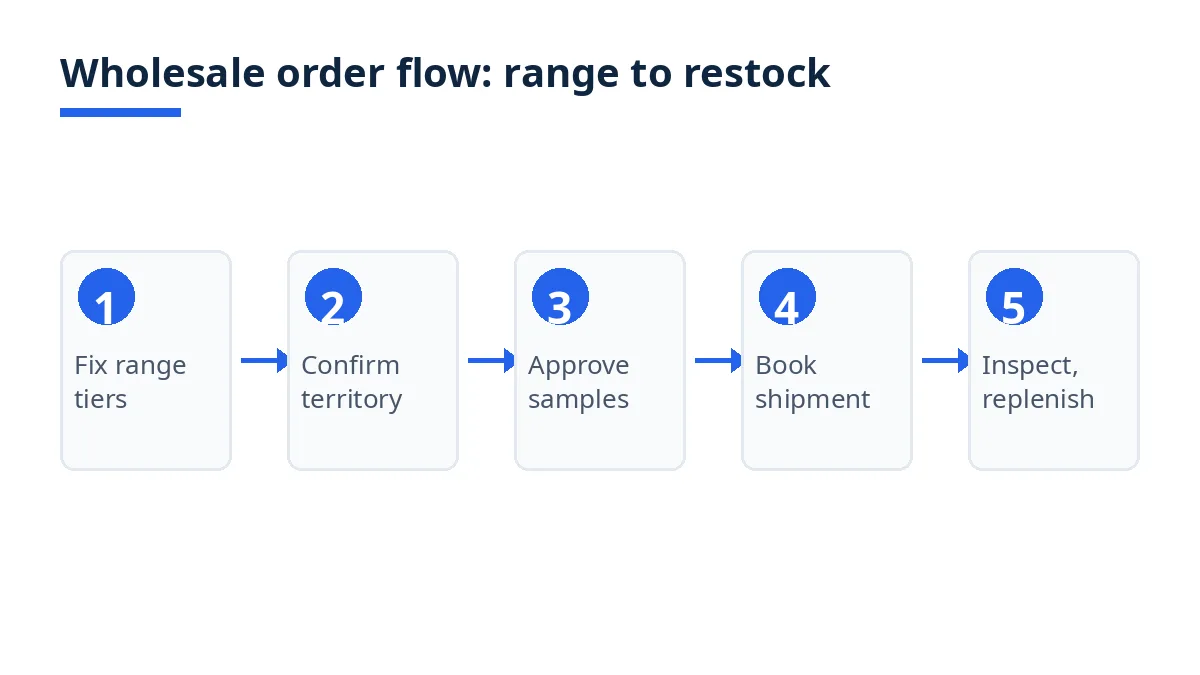
Fix the range and the volume tiers. List each woven or denim style, its colours, its size range and the ratio per size. Assign each style to a tier: core styles carried in depth, seasonal styles in one drop, and test styles in a small first quantity with a written repeat rule.
Agree territory and channel terms in writing. State where the distributor may sell, whether the arrangement is exclusive, which channels are covered, what happens to stock if it ends, and whether the seller may sell the same styles direct there.
Confirm the distributor margin structure before sampling. Work from landed cost to distributor selling price, including freight, duty, warehouse handling and stock holding cost. If the margin does not work at the quoted tier, change the tier, the style mix or the delivery term before samples are made.
Approve samples against the wholesale specification. Approve a proto sample, then a pre-production sample in the actual fabric, wash, trims and labels. Measure it, wash it to the agreed method, and approve or list corrections in writing.
Confirm packing for splitting. Agree carton quantities, inner packs, carton marking, barcodes where used, and how a container splits across warehouses or customers.
Book one consolidated shipment per drop where possible. Combine styles so the container fills without mixing incompatible carton marks, and confirm the delivery term for every quotation before comparing prices.
Inspect, ship and record the drop. Inspect against the agreed sampling plan before shipment, record shade and wash results per colour, and file the report with the shipment papers so the restock can be compared with the first drop.
Replenish on the written rule. Reorder core styles when stock hits the agreed trigger, in the same specification, and compare the repeat against the first drop's measurements, shade and wash results.
The Incoterms 2020 rules set out 11 rules with a clear allocation of cost, risk and obligations.2 Compare every wholesale quotation on the same rule and named place, because a lower unit price on a different term is a different offer.
Costs, timelines and documents
Volume tiers and distributor margin
Wholesale pricing moves with volume per style, not with the order total alone. A container of one style in three colours costs less per unit to make and handle than the same container split across twelve styles, because fabric, wash, trim and cutting runs are set per style and colour. Ask for the price at each tier in writing, defined by quantity per style and per colour.
Example figures: the table below shows structure only, not typical prices, MOQs or lead times.
Tier | What changes | Distributor check |
|---|---|---|
Test | Small quantity, one colour, limited sizes | Repeat price and input hold agreed in writing |
Seasonal | One drop, full size range, set colours | Sell-through date and end-of-drop stock rule agreed |
Core | Depth per style, repeat drops, held inputs | Restock trigger, shade and wash match to first drop |
For margin, build the chain from quoted price to distributor selling price: unit price, freight and insurance where they sit with the buyer, duty and import charges at destination, warehouse handling, and stock held between drops.
Timelines
There are no standard timelines for wholesale woven and denim orders. Sampling depends on fabric availability and correction rounds, bulk production on fabric, wash, trim delivery and line capacity, and shipping on the route and delivery term. Ask for sampling, fabric ready, production, inspection and shipment dates as separate lines, and ask which date moves if a fabric or trim delivery slips, and how long held inputs remain available for a restock.
Documents
For export clearance in Bangladesh, goods may not be loaded unless an export declaration, the Bill of Export or Shipping Bill, is submitted to Customs and approved.3 The documents enclosed with the Bill of Export for all export consignments include the export letter of credit or, where there is no export letter of credit, the export contract, purchase order or export guarantee approved by the negotiating bank, the commercial invoice, the packing list, the EXP form certified by an authorized dealer, and a certificate of origin issued by the Export Promotion Bureau (EPB) or a Chamber of Commerce and Industry.3 A Utilization Declaration for export of ready-made garments under bonded warehouse is listed among the product-wise additional documents.3
For the wholesale file, keep the same discipline: range plan, itemized quotation, purchase order with tier, territory and restock terms, approved sample record, inspection report, commercial invoice, packing list with carton split, and the transport document. The name on the trade licence, quotation, proforma invoice and payment account should match, because the export declaration names the exporter and the foreign buyer.3
Bangladesh-specific rules and tips
Confirm association claims at the source. If a seller claims BGMEA membership, confirm it with the association itself. BGMEA states that around 60 percent of its member factories are woven garment manufacturers and that its members account for 100 percent of woven garment exports.1 Membership signals an active woven business, not capacity for your volume or shade control across drops.
Classify by garment type, then confirm nationally. Woven garments are not one classification. Heading 6203 covers suits, ensembles, jackets, blazers, trousers, bib and brace overalls, breeches and shorts, other than swimwear, for men or boys, not knitted or crocheted.4 Other garments sit under their own headings, and each destination adds national digits and its own duty treatment. Confirm the full code for each style with your customs broker before the purchase order, and put the code on the invoice and packing list so the shipment papers agree.
Plan labelling for each destination market. Regulation (EU) No 1007/2011 covers textile fibre names and related labelling and marking of the fibre composition of textile products.5 A distributor selling into several markets needs fibre composition, care and origin marking for each destination checked before production, because a label printed for one market cannot be fixed at the warehouse without cost and delay.
Hold shade and wash standards across drops. Denim wash and woven dye shade drift between lots. Keep a sealed approved swatch and a washed sample from the first drop, and require the restock to be compared with them before shipment, because the distributor's customers will compare the second drop with the first on the rail.
Agree inspection before the container is loaded. ISO 2859-1 defines a system of acceptance sampling plans for inspection by attributes, indexed by acceptance quality limit (AQL) for lot-by-lot inspection.6 AQL is the maximum average percentage of defective items considered acceptable during random sampling, and it determines sample sizes and acceptance or rejection thresholds.6 Write the inspection level and AQL values into the purchase order, and inspect per colour and per style, because a pass on one colour does not prove the next.
Mistakes and red flags
What are the most common mistakes?
Buying depth before the range is proven. Placing a core-tier quantity on an untested style turns a range decision into a warehouse problem. Carry test styles in a small first quantity with a written repeat rule, and promote only styles that sell through at the next level.
Pricing the container, not the split. A price that works for a full container to one warehouse may fail when the same goods split across three customers, because handling, re-marking and part-shipments add cost. Price the split, not only the container.
Leaving territory vague. An exclusive territory that is not written down, with no channel definition and no end-of-arrangement stock rule, creates a dispute the first time a retail customer buys direct.
Accepting a restock promise without an input hold. A repeat price means little if the fabric, wash recipe or trim has to be remade. Record which inputs are held, for how long, and what changes if they are reordered.
Comparing quotations on different terms. A lower unit price on a different delivery term, with different packing or a different inspection scope, is a different offer. Compare only replies to the same range plan on the same Incoterm.2
Treating a profile or a badge as capacity proof. A profile is a starting point for enquiries. Verification on Exportain is a document and photo review, not a factory inspection, and membership plans never grant a trust badge.7
Checklist
Before you confirm a wholesale drop, every line should be answered in writing.
Range plan agreed: styles, colours, sizes, ratios, and a tier per style.
Territory, channels, exclusivity and end-of-arrangement stock rule in writing.
Price per tier stated per style and per colour, on one delivery term.2
Margin checked from landed cost to distributor selling price, including the split cost.
Samples approved in writing: proto, then pre-production in actual fabric, wash, trims and labels.
Packing agreed for splitting: carton quantities, inner packs, marking, and warehouse split.
Inspection level and AQL values in the purchase order.6
Classification confirmed per style, with the code on invoice and packing list.4
Labelling checked for each destination market before production.5
Export set agreed: invoice, packing list, EXP form, certificate of origin, Bill of Export.3
Restock rule agreed: trigger, held inputs, hold period, and repeat price basis.
How Exportain helps
On Exportain, browse suppliers and post a request for quotation (RFQ) on the RFQ board with your range plan, volume tier per style, territory note and delivery term, so suppliers quote against the same wholesale specification. An RFQ states quantity and unit, target price, destination, Incoterm, required certifications and deadline, and every quotation is versioned with unit price, MOQ, lead time, Incoterm, payment terms and validity.8 Accept only when the tier, territory note and restock rule are in the accepted terms.
Read the badges for what they record. Verification is a document and photo review, not a factory inspection, and membership plans are a separate product that never grant a trust badge.7 A badge is not a capacity or quality guarantee.8 For the wider process, see the woven garments sourcing guide and how to import from Bangladesh, and check the landed cost guide before you fix distributor prices.
FAQs
What should I know first about Woven Garments & Denim Sourcing From Bangladesh for Wholesalers and Distributors?
Buy in depth on repeatable styles, not in breadth on untested ones. Fix the range plan, the volume tier per style, the territory terms and the restock rule before sampling, and compare quotations only on the same specification and delivery term.2 BGMEA states that around 60 percent of its member factories are woven garment manufacturers and that its members account for 100 percent of woven garment exports.1
What are the typical costs and timelines?
There are no typical costs or timelines for wholesale woven and denim orders, because each seller prices your fabric, wash, trims, packing and delivery term, and each timeline depends on fabric, wash, trim delivery and line capacity. Build the margin from landed cost to selling price, and ask for sampling, production, inspection and shipment dates as separate lines.
Which documents are needed?
The order documents are the range plan, itemized quotation and purchase order with tier, territory and restock terms, the approved sample record and the inspection report. The export set is the Bill of Export, commercial invoice, packing list, EXP form certified by an authorized dealer, and a certificate of origin issued by the EPB or a Chamber of Commerce and Industry.3
What are the most common mistakes?
The most common mistakes are buying depth before a style is proven, pricing the container instead of the split, leaving territory vague, accepting a restock promise without an input hold, and comparing quotations on different delivery terms.2 A badge is not a guarantee of capacity or quality.7
Next steps on Exportain
Browse suppliers, then post your range plan, volume tier per style and delivery term on the RFQ board so suppliers quote on the same specification. Before you confirm, read the woven garments sourcing guide and the landed cost guide, and check the Incoterms guide so every quotation is compared on one term.
Sources
- BGMEA at a glance. Bangladesh Garment Manufacturers and Exporters Association (BGMEA) (accessed )
- Incoterms® 2020. International Chamber of Commerce (ICC) (accessed )
- Customs Clearance Procedures for Export. Bangladesh Customs, National Board of Revenue (accessed )
- Classification Detail — HS Code 6203. United Nations Statistics Division (accessed )
- Regulation (EU) No 1007/2011 on textile fibre names and related labelling and marking of the fibre composition of textile products. European Union, (accessed )
- ISO 2859-1:2026 - Sampling procedures for inspection by attributes — Part 1: Sampling schemes indexed by acceptance quality limit (AQL) for lot-by-lot inspection. ISO (accessed )
- Supplier verification: Earn trust badges buyers can see. Exportain (accessed )
- How to source and buy from Bangladesh. Exportain (accessed )
About the author
Sourcing from Bangladesh?
Post a request for quotation and suppliers on Exportain can send you their quotes directly.
Post an RFQ