Frozen Seafood & Fish Sourcing for Startup Brands From Bangladesh
One-SKU frozen seafood launch from Bangladesh for startup brands: first-order sizing, low-MOQ negotiation, cash-flow payment stages, brand-story specification and small-batch cold chain.
Short answer
A startup should launch with one frozen seafood SKU from Bangladesh: a one-page specification, a first-order minimum asked per grade and per pack size, samples and labels approved in writing, payment tied to documents and inspection, and destination cold storage booked before freight. Repeat the same specification only after the first batch sells.
On this page
Key takeaways
Launch with one SKU: a single product form, size grade and pack size, so the first order tests the product, the supplier and the route at the same time.
Ask for the first-order minimum per grade and per pack size in writing, and discuss a shared run, a stocked grade or a smaller pack for the launch quantity.
Tie payment to verifiable stages: sample and label approval, shipment documents and inspection results, and never pay the full balance before documents are checked.
Book destination cold-storage intake, free period and daily charge before freight, and require a temperature record for the full journey from plant to cold store.
Write the brand story from the specification sheet, so origin, catch or farm method, grade, glaze and pack match the carton label exactly.
A startup brand does not need a container of frozen seafood to start. It needs one product that sells, in a quantity it can store, move and sell before quality or cash flow becomes a problem. Bangladesh frozen seafood for startups works best as a small first order: one launch SKU, one clear specification, one cold chain you can check at each handover, and a repeat order only after the first batch has sold.
That order of operations is the difference between a startup launch and a warehouse problem. A first order that is too wide or too large ties up the launch budget in stock, labels and freight before the brand knows which product its customers buy. A narrow first order tests the product, the supplier and the route at the same time.
Why this matters for buyers and sellers
For a startup buyer, the first order sets the cash-flow pattern for the brand. Every extra SKU multiplies specifications, labels, storage slots and inspection points, while the budget stays fixed. A single-SKU launch keeps the specification sheet short, the label approval simple and the cold-storage bill visible. It also makes the supplier conversation honest: the buyer can say exactly how many cartons it can sell in a season, and the supplier can say whether that quantity can run.
For a Bangladeshi seller, a small first order is still a real order when it is specified properly. A processor that freezes, grades and packs shrimp or fish runs set-up work for each product form, size grade and pack size, and that work does not shrink just because the buyer is new. A startup that asks for the first-order minimum per size grade and per pack size, rather than a single total, helps the seller price the run without guessing. A repeat of the same specification earns an easier second-order conversation than a changed product every time.
The brand story must match the specification sheet: wild-caught or farmed, size grade, glaze percentage, pack form and processing plant. If the story says one thing and the carton label says another, the first customer complaint undoes the launch. Write the story from the specification, not the other way around.
Step-by-step: how it works
Start with the product your customers will buy first, not the full range you hope to sell in year two. Black tiger shrimp, a single white fish fillet, or one cut of a familiar species gives the launch a clear test. Ask for the first-order minimum for that exact form, grade and pack.
Write a one-page specification before you ask for prices. State the species, product form, size grade, glaze, pack weight, carton count, labelling language and storage temperature. State the quantity per grade and per pack size, not only the order total, because a total that looks workable can still fall below the minimum for one grade. Price comparisons are only meaningful on the same specification and the same delivery term.
Then run the startup sequence below, in order. Do not skip sample approval to save a week, and do not confirm a shipment before payment terms, cold chain and destination handling are written down.
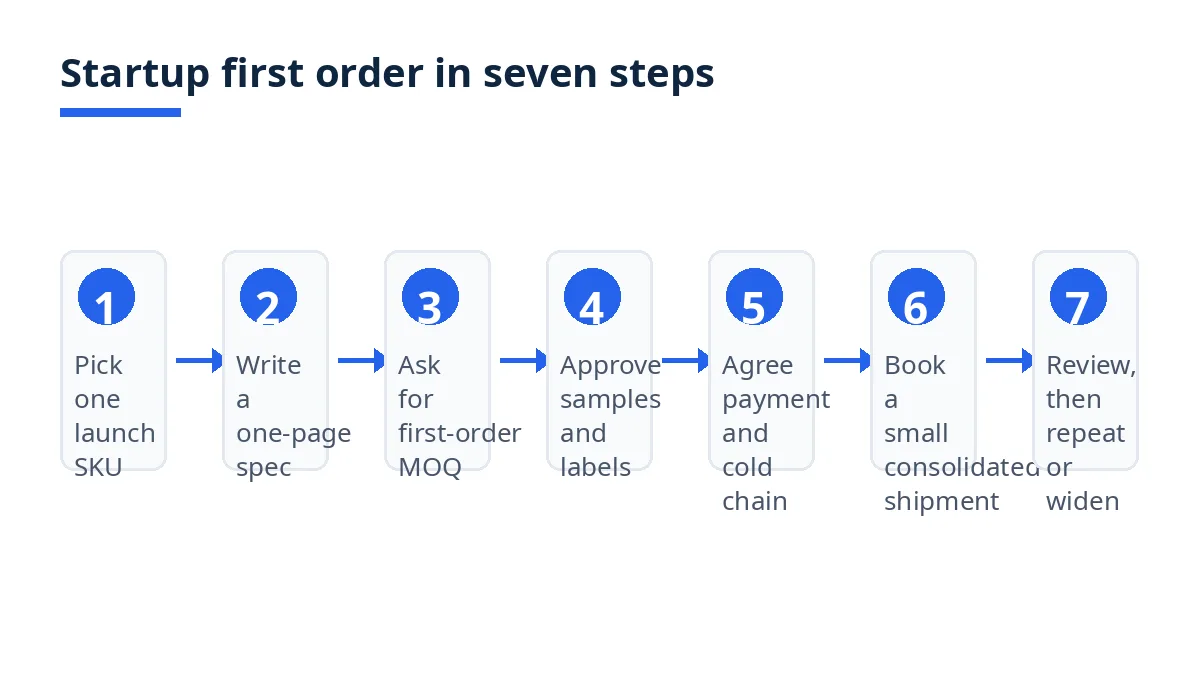
Pick one launch SKU. Choose the product form, size grade and pack your first customers will buy, and park the rest of the range for the second order.
Write a one-page specification. Species, form, grade, glaze, pack weight, carton count, label text and storage temperature, all on one page every supplier quotes against.
Ask for the first-order minimum. Ask for the minimum per grade and per pack size, and what the supplier can offer for a first order: a shared run, a stocked grade, or a smaller pack.
Approve samples and labels. Taste and test the sample, check the carton and retail label against your specification, and approve both in writing before production.
Agree payment and cold chain in writing. Deposit, balance timing, delivery term, reefer booking, and who handles destination cold storage and onward delivery.
Book a small consolidated shipment. Where a full container is too much, ask about consolidation with other cargo on the same route, and confirm the temperature record for the whole journey.
Review, then repeat or widen. Sell the first batch, record what customers asked for, and only then add a grade, a pack size or a second product.
A note on the delivery term: the Incoterms 2020 rules set out 11 rules with a clear allocation of cost, risk and obligations.1 Compare supplier quotes only on the same rule and named place, or a cheaper quote may simply be a quote that leaves more of the cold chain to you. The best Incoterm for importing frozen seafood from Bangladesh guide explains the choice for this product group.
Costs, timelines and documents
What are the typical costs and timelines?
There are no typical costs or timelines a guide can state as fact for a startup first order, because each supplier prices your species, grade, glaze, pack and delivery term separately, and each route prices reefer space separately. What a startup can control is the structure of the quote: ask for the product price, the packing and labelling lines, the inspection or testing lines, the freight and insurance lines, and the destination handling lines as separate figures. A single lump sum hides the line that will hurt later, usually destination cold storage or a label reprint.
For timelines, ask for sampling, label approval, production, inspection, booking and sailing dates as separate lines, not a single delivery week. A startup launch date should be set from the last of those lines, plus destination clearance and cold-storage intake, not from the production date alone. Build the launch announcement around the date the stock is in your cold store, not the date it leaves the plant.
Cash-flow-friendly payment terms are negotiated before the order, not after it. Options include a deposit with the balance against shipping documents, staged payments tied to sample approval and shipment, or a letter of credit for a larger repeat. Match the structure to the order size and to what you have already checked. Never pay the full balance before the shipment documents, temperature record and inspection result are in hand unless the contract gives a clear remedy if they are not.
Which documents are needed?
For export clearance in Bangladesh, goods may not be loaded unless an export declaration, the Bill of Export or Shipping Bill, is submitted to Customs and approved.2 Enclosed documents include the export contract or purchase order where there is no export letter of credit, the commercial invoice, the packing list, the EXP form certified by an authorized dealer, and a certificate of origin issued by the EPB or a Chamber of Commerce and Industry.2 A startup should check that the names on the contract, invoice and payment account match, and that the species, grade and quantities match across the invoice, packing list and labels.
Destination documents depend on the market. For the European Union, imports of most fishery products from non-EU countries must be accompanied by documents such as health certificates and catch certificates, with health certificates issued by inspection bodies in approved non-EU countries and catch certificates showing the product did not come from illegal, unreported and unregulated fishing.3 The model official certificates for entry into the Union from third countries are based on the model laid down in Annex I of Commission Implementing Regulation (EU) 2019/628.4 For the United States, every importer of fish or fishery products must either source from a country with an active memorandum of understanding covering the product, or have and implement written verification procedures, including product specifications and affirmative steps such as obtaining HACCP and sanitation monitoring records for the specific lot.5
On classification, heading 0306 covers crustaceans, whether in shell or not, live, fresh, chilled, frozen, dried, salted or in brine.6 Confirm the full code for your exact product form with your customs broker, because the code drives duty, health-certificate boxes and the label. See the HS code for frozen shrimp guide and the export documents from Bangladesh guide.
Bangladesh-specific rules and tips
Ask for the plant, not only the company. A trading name and a processing plant are different things. Ask which plant will process your lot, whether that plant is listed for your destination market, and for the health-certificate and inspection route that plant uses. A startup that learns this after production has no way to fix it before shipment.
Keep the specification in one language across all papers. The species name, grade, glaze and pack size should read identically on the specification sheet, the proforma invoice, the packing list, the carton label and the health certificate. Differences between papers are the most common reason a small shipment is held, and a startup has less buffer than a large importer to absorb a hold in a cold store.
Treat glaze, grade and count as money. Glaze is frozen water added during processing, and the grade and count per pack decide how many saleable units each carton holds. A lower headline price on a higher-glaze or smaller-grade product is not a lower cost per saleable unit. Ask for the drained weight basis in writing and compare quotes on that basis.
Plan destination cold storage before you book freight. A startup rarely owns cold storage. Confirm who receives the reefer, the free period, and the daily charge after it. A shipment cleared on a Friday with no intake booked until Monday can cost more in storage than the freight saving that chose the route.
Mistakes and red flags
What are the most common mistakes?
Ordering the full range first. Five grades and three pack sizes in one first order multiply the minimums, the labels and the storage, and hide which product customers want. Launch one SKU, learn, then widen.
Quoting on totals instead of splits. A supplier minimum is usually per grade and per pack size. An order total can clear the headline minimum while one grade inside it falls below its own minimum, which then draws a surcharge or a dropped grade.
Approving a sample that is not the production specification. A sample in a different glaze, grade or pack is not an approval of your product. Approve the sample in the exact form, grade, glaze and label that production will use, in writing.
Leaving the cold chain to the freight quote. A reefer booking without a named handover at destination, a booked cold-storage intake and a temperature record is an incomplete plan. Ask who holds the product at each handover and what record proves the temperature.
Paying in full before documents are checked. Full prepayment removes your leverage over document corrections. Tie payments to verifiable stages: sample approval, shipment documents, and inspection results.
Red flags: a supplier who will not name the processing plant, who quotes without a specification sheet, who cannot explain the glaze or grade basis, who promises destination clearance without naming the certificate route, or who asks for full payment before any document exists. Any one of these is a reason to pause, not a reason to hurry.
Checklist
One launch SKU chosen, with the second product parked for the repeat order
One-page specification: species, form, grade, glaze, pack weight, carton count, label text, storage temperature
First-order minimum asked per grade and per pack size, in writing
Sample and retail label approved in writing in the exact production form
Delivery term and named place agreed, and all quotes compared on the same term
Payment stages tied to sample approval, shipment documents and inspection results
Destination cold-storage intake booked, with free period and daily charge confirmed
Health certificate and catch certificate route confirmed for the destination market
Names, species, grades and quantities matched across contract, invoice, packing list and labels
Temperature record requested for the full journey, plant to cold store
Launch date set from the date stock reaches your cold store, not the sailing date
How Exportain helps
Exportain is a marketplace where a startup can post a request for quotation describing its launch SKU, specification and first-order quantity, and receive quotations from Bangladeshi suppliers to compare on the same terms. The how to import frozen shrimp guide and the frozen shrimp quality control checklist give a startup a practical way to frame the specification and the inspection points before it posts. Exportain's own checks are document and photo reviews, not factory inspections, so a badge on a profile is not a substitute for the sample approval, document checks and temperature record described above. Exportain states what its trust checks cover on its Trust Center7 and seller-verification pages.8 Read both before relying on any profile claim, and keep the checks in this guide as your own. The general frozen seafood sourcing guide covers the wider product group for the stage when the brand is ready to widen its range.
FAQs
What should I know first about Frozen Seafood & Fish Sourcing From Bangladesh for Startup Brands?
Start with one launch SKU and a one-page specification, and ask for the first-order minimum per grade and per pack size. Confirm the processing plant, the destination certificate route and the destination cold-storage intake before you confirm the order. Keep the first order narrow enough to learn from and small enough to sell through.
What are the typical costs and timelines?
There are no typical figures a guide can state as fact, because each supplier prices species, grade, glaze, pack and delivery term separately. Ask for product, packing, labelling, inspection, freight, insurance and destination handling as separate lines, and for sampling, label approval, production, inspection, booking and sailing as separate dates. Set the launch date from the date stock reaches your cold store.
Which documents are needed?
From Bangladesh, the Bill of Export or Shipping Bill with the contract or purchase order, commercial invoice, packing list, EXP form certified by an authorized dealer, and certificate of origin.2 For the EU, health certificates and, for most fishery products, catch certificates.3 For the US, importer verification under 21 CFR 123.12, either through an active memorandum of understanding or through written verification procedures.5
What are the most common mistakes?
Ordering the full range first, quoting on totals instead of per-grade splits, approving a sample that does not match production, leaving destination cold storage unbooked, and paying in full before documents are checked. The red flags are a supplier who will not name the plant, quotes without a specification, cannot explain glaze or grade, or asks for full payment before any document exists.
Next steps on Exportain
Start with one launch SKU and post it as a request for quotation: Post an RFQ on Exportain. Compare the quotations on the same specification and delivery term, then read how to buy on Exportain and browse suppliers on Exportain before you confirm a first order.
Sources
- Incoterms® 2020. International Chamber of Commerce (ICC) (accessed )
- Customs Clearance Procedures for Export. Bangladesh Customs, National Board of Revenue (accessed )
- Importing fishery products. Netherlands Chamber of Commerce (KVK) (accessed )
- Commission Implementing Regulation (EU) 2019/628 - model official certificates. European Union (accessed )
- 21 CFR 123.12 — Special requirements for imported products. GovRegs (accessed )
- HS Code 0306 - Crustaceans, whether in shell or not. EximGuru (accessed )
- Trust & Safety Center. Exportain (accessed )
- Supplier verification: Earn trust badges buyers can see. Exportain (accessed )
About the author
Sourcing from Bangladesh?
Post a request for quotation and suppliers on Exportain can send you their quotes directly.
Post an RFQ