

Wholesale Televisions From Bangladesh: Prices, MOQ and Reliable Suppliers
A wholesale television order is an assortment order. This guide shows how to build a size ladder, read per-model and per-size MOQs, compare quotations on price drivers, and check suppliers before you confirm a lot.
Short answer
A wholesale television order from Bangladesh is an assortment order, not a single-model order. Build a size ladder, state the quantity per model and per screen size, and ask for the minimum per model and per size in writing. Compare quotations on the same specification and delivery term, approve a sample per model, and record repeat minimums and lead times in the first order.

On this page
Key takeaways
A wholesale television order is an assortment order: the size ladder and the size mix decide whether the lot works, not the headline total.
There is no single typical wholesale price or minimum for televisions from Bangladesh; each supplier sets its minimum per model and usually per screen size.
Compare quotations only on the same specification and delivery term, and read each price for what it assumes about panel grade, board set, tuner and smart platform.
Approve a sample per model, check the range together for consistency, and write inspection and acceptance quality limit values into the purchase order.
Record repeat minimums, repeat price basis and lead times in the first order, and plan reorders from the warehouse date, not the shipment date.
A wholesale television order from Bangladesh is an assortment order, not a single-model order. A wholesaler, distributor or retailer buys a range of screen sizes to resell, and the range itself decides whether the order works: which sizes sell through, and which sizes the supplier will accept in one lot.
There is no single typical wholesale price or minimum order quantity for televisions from Bangladesh. Each supplier sets its minimum per model and usually per screen size, and each quotation prices your panel, board set, tuner standard, smart platform, packing and delivery term.
The wholesale channel adds one more constraint that a one-off import order does not carry. A wholesaler must be able to reorder the sizes that sell, in quantities that match the next selling period, without re-approving the whole range. The first order should therefore be written so that a repeat order is a short document, not a new negotiation.
Why this matters for buyers and sellers
For the buyer, the assortment is where margin is made or lost. A size that moves slowly ties up the same warehouse space and cash as a size that moves quickly, and a size missing from the range sends a retail customer to a competing supplier. For the seller, the assortment decides whether the lot can run: panels are bought in size batches, boards are configured per tuner standard and smart platform, and a packing line is set up per carton size.
Three buying roles sit inside the wholesale channel, and they are different purchases. An own-brand order puts your brand, labels and packing on the set. A factory-brand distribution order resells the factory brand under a distribution arrangement. A mixed stock order combines models from more than one supplier to fill gaps in your range. Settle which role each model plays before you compare quotations, because the same screen size carries different obligations under each role. Ask each supplier, in writing, what after-sales support it offers for wholesale stock, and record the answer on the quotation.
What should I know first about televisions?
Start with classification and market rules, because both shape what you can resell and where. In the Harmonized System, heading 8528 covers monitors and projectors not incorporating television reception apparatus, and reception apparatus for television.1 A colour television set with a display falls under subheading 8528.72, reception apparatus incorporating a colour video display or screen.1 Confirm the full national code for each model with your customs broker before you price the range for resale, and ask the broker for the duty and tax treatment that applies to each code on your entry date, since this guide states no duty rate.
On safety, IEC 62368-1:2018 is applicable to the safety of electrical and electronic equipment within the field of audio, video, information and communication technology, and business and office machines with a rated voltage not exceeding 600 V.2 It classifies energy sources and prescribes safeguards against those energy sources.2 Ask for the report and certificate for your exact model, and check the model number, panel and power board covered, the issuing body and the date, because a report for a different size or board set does not cover your set.
For resale into the European Union, a television is an electronic display for product rules. Commission Regulation (EU) 2019/2021 lays down ecodesign requirements for electronic displays, covering on-mode energy efficiency, standby and off-mode power, and requirements that facilitate repair and the availability of spare parts.3 Agree at sampling stage which party prepares the label and product information for each model.
Step-by-step: how it works
The wholesale buying sequence runs from assortment to reorder. Each step produces a written record that the next step relies on.
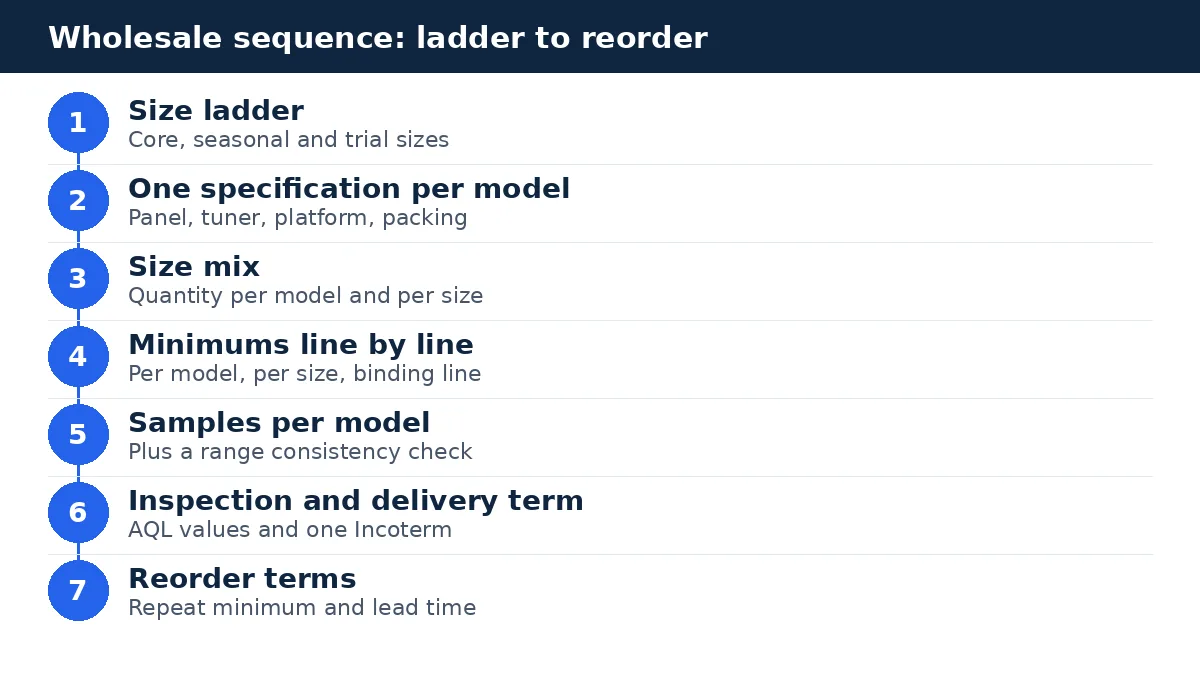
Build the size ladder first. List every screen size you will carry, from the smallest to the largest, and mark each size as a core line you will always stock, a seasonal line or a trial line.
Write one specification per model. State screen size and panel type, resolution, tuner standard for your market, voltage, frequency and plug, smart platform where specified, ports, audio output, remote control, stand or wall-mount provision, labelling and packing.
Send the size mix, not only the total. State the quantity per model and per screen size, with the carton count per size. A total without a mix cannot be answered with a usable minimum.
Ask for the minimums line by line. Ask for the minimum per model, per screen size, per tuner standard and per smart platform, and which line is binding for your mix.
Approve samples per model, then approve the range as a set. Approve a pre-production sample for each model in its actual panel, board set, tuner, firmware and packing. Then check the range together for consistent remote controls, stands, carton markings and manuals.
Agree inspection and delivery term before you confirm. Write the inspection level and acceptance quality limit values into the purchase order. ISO 2859-1:2026 defines a system of acceptance sampling plans for inspection by attributes, and AQL stands for acceptance quality limit, the maximum average percentage of defective items considered acceptable during random sampling.4 State one Incoterm and named place for every quotation. The Incoterms 2020 rules provide 11 rules with a clear allocation of cost, risk and obligations.5
Write the reorder terms into the first order. Record the repeat price basis, the repeat minimum per model and size, the lead time for a repeat lot, and which set-ups and approvals carry over.
Example figures: a wholesaler plans a first lot of 900 sets across five sizes: 300, 200, 150, 150 and 100 sets. If the binding minimum per size is above 100 sets, the largest size fails the lot even though the 900-set total looks large. The same 900 sets across three sizes at 300 sets each can clear every per-size line. The example shows structure only, not a typical minimum, price or lead time.
Assortment decision | What it changes | State in your enquiry |
|---|---|---|
Size ladder | Which sizes you stock and reorder | Core, seasonal and trial sizes |
Size mix | Whether each size clears its minimum | Quantity per model and per size |
Smart or standard | Board, tuner and software cost | Platform per model |
Packing | Carton size and damage risk | Sets per carton, carton markings |
Delivery term | Who carries cost and risk, and where | One Incoterm and named place |
Reorder terms | Whether a repeat is a short order | Repeat minimum and lead time |
Costs, timelines and documents
What are the typical costs and timelines?
There are no typical wholesale costs or timelines a guide can state as fact, because each supplier prices your panel grade, board set, tuner, smart platform, carton and delivery term, and each lot follows its own panel supply, production and shipping schedule.
The price drivers for a wholesale television lot, in the order a buyer should check them, are the display panel and its grade, the main board and tuner, the power board and backlight components, the cabinet, stand and remote control, assembly and testing, software or licence costs where a smart platform carries one, packing, and the delivery term. Two quotations for the same screen size can still be quotations for different goods: one may assume a lower panel grade, a standard instead of a smart board, or a narrower tuner. Ask what each price is based on, in writing.
For timelines, ask for sampling, panel ready, production, inspection and shipment dates as separate lines, not a single delivery week. A wholesale lot also needs a warehouse date: the date the sets are available for your retail customers, after import clearance and local delivery.
Which documents are needed?
For export clearance in Bangladesh, goods may not be loaded unless an export declaration, the Bill of Export or Shipping Bill, is submitted to Customs and approved.6 Enclosed documents include the export contract or purchase order where there is no export letter of credit, the commercial invoice, the packing list, the EXP form certified by an authorized dealer, and a certificate of origin issued by the EPB or a Chamber of Commerce and Industry.6
Bangladesh-specific rules and tips
Keep one legal name across every paper. The export declaration names the exporter and the foreign buyer,6 so the name on the trade licence, quotation, proforma invoice and payment account should match.
Ask which inputs are bought in for your range. Panels, boards and tuners may be bought in for your specification, and a bought-in input can set both the minimum and the earliest production date for a size. Confirm such a size first, and give it the longest lead time in your reorder plan.
Confirm market paperwork per model, not per order. Safety reports, energy labels and product information attach to a model, so a new size added to a later lot needs its own paperwork check.
Protect the screens in the carton plan. Confirm sets per carton, carton dimensions and gross weight in the specification, and agree how cartons are protected and stacked, because screens are damaged by point loads and stacking pressure. Also agree the carton marking per size.
Mistakes and red flags
What are the most common mistakes?
Ordering a total instead of a mix. The binding minimum is usually per model or per size. A lot can clear the total and still fall below the minimum for one size.
Comparing quotations on different ranges. A lower price on a narrower tuner, a lower panel grade, a standard board instead of a smart board, or a different delivery term is a different offer. Compare only replies to the same specification and term.5
Adding a size late without a minimum check. A size added after the first quotation may carry its own minimum, its own panel supply and its own sample approval. Price and approve the addition as its own line.
Treating a profile or a badge as verification of the range. A profile is a starting point for enquiries, and a badge is not a guarantee of capacity, quality or delivery.7
Skipping the range check at sample stage. Approving each model alone misses mismatched remote controls, stands, manuals and carton markings across sizes.
Planning reorders from the shipment date. A size that sells out while its repeat lot is in transit is a stockout, not a delay. Plan from the warehouse date, and set the reorder point per core size.
Accepting a verbal repeat price. A repeat price, repeat minimum and lead time agreed verbally can change with the next panel purchase. Record them on the first purchase order.
Checklist
Before you confirm a wholesale lot, every line should be answered in writing.
Size ladder set: core, seasonal and trial sizes named.
Specification written per model: panel, resolution, tuner, voltage, plug, smart platform, ports, stand, labelling, packing.
Size mix stated per model and per screen size, with carton counts.
Minimum confirmed per model and per size; binding line named.
Quotations compared on the same specification and delivery term.5
Sample approved per model, and the range checked together.
Inspection level and acceptance quality limit values in the purchase order.4
Safety report checked for each exact model.2
Market labels assigned per model before shipment.3
Export set agreed: invoice, packing list, EXP form, certificate of origin, Bill of Export.6
Reorder terms recorded: repeat minimum and lead time per size.
Warehouse date and reorder point set per core size.
How Exportain helps
On Exportain, browse suppliers and post a request for quotation (RFQ) on the RFQ board with your size ladder, size mix and delivery term, so suppliers quote against the same range. Ask each reply for its per-model and per-size minimums, and for what after-sales support it offers for wholesale stock. When you accept a quotation, Exportain creates one order and issues one proforma invoice from the accepted terms.7
Read the badges for what they record. Exportain Verified means Exportain has checked identity, phone, email and business registration, and Export Verified means it has checked the Export Registration Certificate (ERC).7 Factory Verified means it has reviewed photos of the manufacturer factory, while Trading Company Verified means it has reviewed photos of the trading company office or warehouse.7 Verification is a document and photo review by staff, free, and never granted by membership plans.8 It is not a factory inspection,7 8 so sample approval and inspection stay with you. See how supplier verification works on Exportain and the MOQ definition guide.
FAQs
What should I know first about televisions?
Know your size ladder, your market rules and your classification before you ask for prices. Televisions fall under heading 8528, with colour sets under subheading 8528.72,1 safety is covered by IEC 62368-1 for audio and video equipment,2 and electronic displays sold into the European Union carry ecodesign requirements.3
What are the typical costs and timelines?
There are no typical figures a buyer can rely on, because each supplier sets its price, minimum and lead time for your panel, board set, tuner, smart platform, size mix and delivery term.5 Ask for sampling, panel ready, production, inspection, shipment and warehouse dates as separate lines.
Which documents are needed?
The order documents are the per-model specification, the itemized quotation with the size mix, the purchase order with the inspection plan and delivery term, and the sample approval per model. The export set is the Bill of Export, commercial invoice, packing list, EXP form certified by an authorized dealer, and a certificate of origin issued by the EPB or a Chamber of Commerce and Industry.6
What are the most common mistakes?
The most common mistakes are ordering a total instead of a size mix, comparing quotations on different specifications or terms,5 adding a size late without a minimum check, reading a badge as a guarantee,7 and planning reorders from the shipment date instead of the warehouse date.
Next steps on Exportain
Browse suppliers, then post your size ladder and size mix on the RFQ board so suppliers state their minimum per model and per size. Before you confirm, read how to import televisions from Bangladesh, the HS code for televisions guide and the televisions quality control checklist.
Sources
- Classification Detail: HS Code 8528. United Nations Statistics Division (accessed )
- IEC 62368-1:2018 - Audio/video, information and communication technology equipment, Part 1: Safety requirements. International Electrotechnical Commission, (accessed )
- Commission Regulation (EU) 2019/2021 of 1 October 2019 laying down ecodesign requirements for electronic displays. legislation.gov.uk (accessed )
- ISO 2859-1:2026 - Sampling procedures for inspection by attributes — Part 1: Sampling schemes indexed by acceptance quality limit (AQL) for lot-by-lot inspection. ISO (accessed )
- Incoterms® 2020. International Chamber of Commerce (ICC) (accessed )
- Customs Clearance Procedures for Export. Bangladesh Customs, National Board of Revenue (accessed )
- Trust & Safety Center. Exportain (accessed )
- Supplier verification: Earn trust badges buyers can see. Exportain (accessed )
- MOQ
- supplier verification
- buyer guide
- importing from Bangladesh
- Bangladesh sourcing
- Wholesale sourcing
- Electronics
About the author
Sourcing from Bangladesh?
Post a request for quotation and suppliers on Exportain can send you their quotes directly.
Post an RFQ


