

Wholesale Switchgear From Bangladesh: Prices, MOQ and Reliable Suppliers
Wholesale switchgear buying from Bangladesh, from the distributor side: bulk tiers and MOQ per rating, assortment and replenishment terms, per-model verification checks, and the documents behind a wholesale order.
Short answer
Wholesale switchgear from Bangladesh means buying an assortment for resale, not a single project order. Compare tiered prices per rating, confirm the MOQ per rating and the replenishment terms, and check the rated voltage, current, short-circuit rating and test report for each model before stocking it. Put tiers, spares and repeat-order terms in writing.
On this page
Key takeaways
Wholesale switchgear buying is assortment economics: the MOQ per rating, not the order total, decides how wide a resale range can be.
Sort the range first by voltage class and form, using headings 8535, 8536 and 8537, then confirm ratings and standards model by model.
Compare tiered prices only per rating on the same Incoterms rule, and put MOQ, price validity, spares and repeat-order tiers in writing.
A range stocked without spares and without a replenishment cycle turns a small customer fault into a lost account.
Exportain verification is a document and photo review, not a factory inspection, and a badge is not a guarantee.
A wholesale switchgear order from Bangladesh is a different kind of purchase from a one-off project order. A wholesaler, distributor or stockist buys an assortment for resale: several ratings, several configurations, and repeat replenishment over months, not a single panel for a single site. That changes what matters in the quotation. The tier price, the minimum per rating, the spares holding and the replenishment terms decide whether the range can be sold at a margin, long after the first shipment arrives.
Bangladesh's electrical products exports reached $206.19 million in FY2025-26, up 23.82 percent from $166.52 million a year earlier, according to Export Promotion Bureau (EPB) data reported by The Business Standard, making electrical products the largest earner among engineering products.1 The same report lists switches, sockets and circuit breakers among the electrical equipment in the export basket.1 A wholesale buyer is therefore buying into a growing export category, but growth in the category says nothing about any single supplier's range, ratings or delivery record. Those have to be checked model by model.
Why this matters for buyers and sellers
For the buyer, the wholesale question is assortment economics. A range that is too narrow leaves customers unserved; a range that is too wide ties up cash in slow-moving ratings. The minimum order quantity (MOQ) per rating, not the order total, sets how wide the range can be. For the seller, a wholesale account is repeat business: a distributor who reorders the same ratings on a cycle is worth more than a single large order that never repeats, which is why sellers price in tiers and offer replenishment terms to accounts that commit to a range.
The wholesale channel also changes the risk. A project buyer inspects one delivery against one specification. A wholesaler's customers will install, operate and claim warranty on units over years, so a rating error or a missing test report in the first shipment repeats across every unit sold from that stock.
What should I know first about switchgear?
Switchgear is the equipment that switches, protects and controls the distribution of electricity: circuit breakers, switches, fuses, relays and the panels and boards that house them. In the Harmonized System, heading 8535 covers electrical apparatus for switching or protecting electrical circuits for a voltage exceeding 1,000 volts, heading 8536 covers the same kind of apparatus for a voltage not exceeding 1,000 volts, and heading 8537 covers boards, panels, consoles and similar bases equipped with two or more apparatus of heading 8535 or 8536.2 That split is the first sorting step for a wholesale range: low-voltage devices, higher-voltage apparatus and assembled panels are different products with different minimums, tests and documents.
Two standard families frame the verification questions for a wholesale range. IEC 61439-1 lays down the definitions, service conditions, construction requirements, technical characteristics and verification requirements for low-voltage switchgear and controlgear assemblies.3 IEC 62271-200 specifies requirements for prefabricated metal-enclosed switchgear and controlgear for alternating current of rated voltages above 1 kV and up to and including 52 kV, for indoor and outdoor installation.4 Treat rated voltage, rated current, short-circuit rating and the applicable standard as verification items to confirm for each model in the range, never as claims to accept from a catalogue line. A rating that is right for one model says nothing about the next model on the same price list.
Step-by-step: how it works
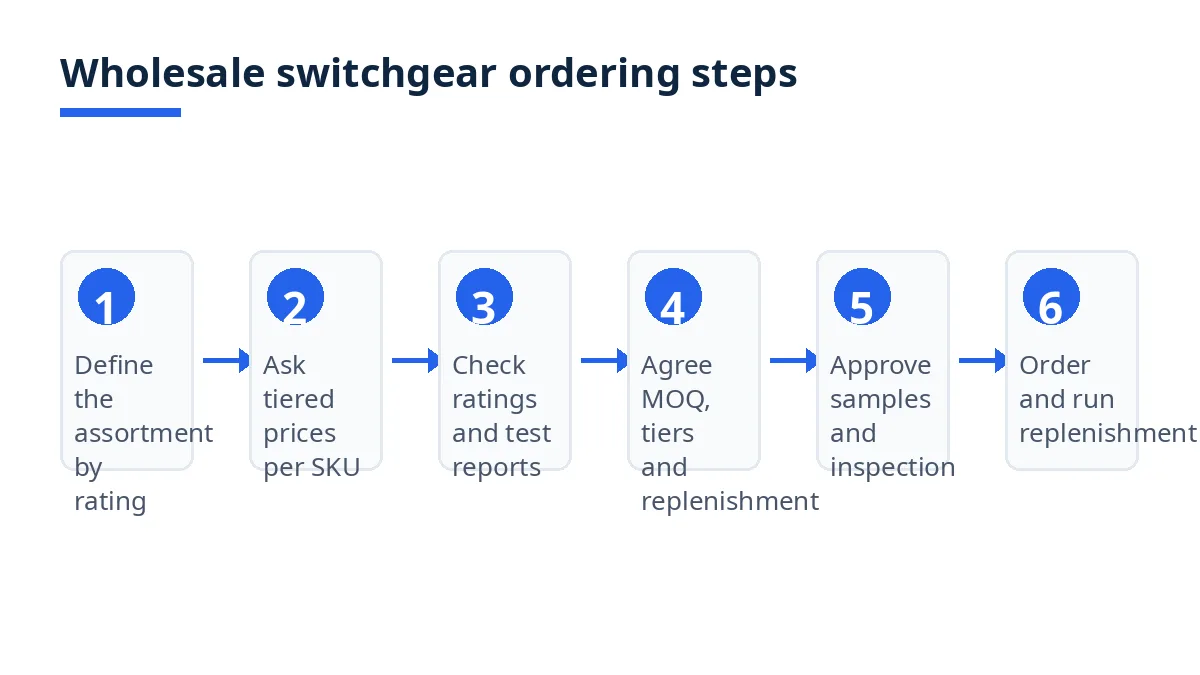
Define the assortment before asking for prices. List each device and panel by type, voltage class, rated current and configuration, with the quantity you expect to sell per rating per quarter. A price list without an assortment is a list of parts, not a wholesale offer.
Ask for tiered quotations per SKU, not per order. Request the unit price at each quantity tier for each rating, and ask which tier each rating sits in at your planned quantity. A tier that applies to the order total hides the ratings that are actually expensive at your volume.
Check the per-model verification items. For each model, ask for the rated voltage and current, the short-circuit rating, the applicable standard (IEC 61439 for low-voltage assemblies3 or IEC 62271-200 for metal-enclosed apparatus above 1 kV4), and the test report that supports them. Record which items are confirmed and which are still open.
Agree the wholesale terms in writing. Set the MOQ per rating, the price tiers, the payment terms, the replenishment cycle, the spares holding and the warranty route for units already sold. Terms agreed for the first order should state whether they carry to repeat orders.
Approve samples and inspection before the bulk run. Order samples of the ratings you will stock, check markings, dimensions and operation, and agree the inspection plan for the bulk shipment. See the switchgear quality control checklist for inspection points to agree in advance.
Place the order, then run the replenishment cycle. Confirm the order against the tiered price list, check the export documents, and set the reorder point per rating so the next order is placed before stock runs out, not after.
Costs, timelines and documents
What are the typical costs and timelines?
There are no typical wholesale prices or lead times a guide can state as fact. Each supplier prices your assortment, ratings, panel configurations, packing and delivery term, and each panel assembly or device line has its own production and testing schedule. The Incoterms 2020 rules set out 11 rules with a clear allocation of cost, risk and obligations,5 so compare tier prices only on the same rule and named place.
The cost structure of a wholesale order has more lines than a single purchase. Unit prices by tier, panel assembly or configuration charges, spares, packing for resale (individual cartons, labels and barcodes where your market needs them), inland transport, freight and insurance under the chosen term,5 and the cost of holding stock between shipments all sit in the landed cost of the range. Timelines split the same way: ask for component availability, assembly, testing, inspection and shipment as separate lines, not a single delivery week.
Example figures: the table below shows how a tier structure works, using illustrative numbers only. It is not a market price, a typical MOQ or a supplier offer.
Tier per rating | Example unit price | When it fits |
|---|---|---|
50 units | 100 | Opening stock of a new rating |
200 units | 92 | Established rating with steady sales |
500 units | 85 | Fast-moving rating on a repeat cycle |
Example figures: a distributor stocking 10 ratings at 50 units each holds 500 units in total, but no rating reaches the 200-unit tier. The same 500 units across 3 ratings at higher quantities per rating can reach a lower tier on each rating stocked. The example shows structure only, not a price or MOQ any supplier will offer.
Which documents are needed?
For export clearance in Bangladesh, goods may not be loaded unless an export declaration, the Bill of Export or Shipping Bill, is submitted to Customs and approved.6 Enclosed documents include the export contract or purchase order where there is no export letter of credit, the commercial invoice, the packing list, the EXP form certified by an authorized dealer, and a certificate of origin issued by the EPB or a Chamber of Commerce and Industry.6
A wholesale order needs documents beyond the export set. Keep the tiered price list with the tier each rating was bought at, the per-model rating and test report references, the warranty terms for units sold onward, and the spares list with prices. When a customer claims on a unit two years later, those four papers decide whether the claim can be answered. See the HS code for switchgear guide for classification detail per heading.
Bangladesh-specific rules and tips
Confirm the range, not the category. Electrical exports from Bangladesh span consumer electronics, appliances and equipment including power transformers, cables, switches, sockets, circuit breakers and lighting solutions.1 A supplier strong in one of those lines is not automatically strong in switchgear panels. Ask for the switchgear range specifically, with ratings and test reports per model, rather than accepting a general electrical catalogue as evidence.
Ask which inputs are imported for your range. Many Bangladeshi electrical manufacturers source components and raw materials from China and Vietnam, which makes supply-chain traceability harder, according to the Bangladesh Electrical Merchandise Manufacturers Association (BEMMA) as reported by The Business Standard.1 For a wholesaler, the practical question is lead time and continuity: which breakers, contacts, enclosures or busbars are imported, what happens to your replenishment cycle if an input shipment slips, and which ratings can be assembled from stock.
Keep one legal name across every paper. The export declaration names the exporter and the foreign buyer,6 so the name on the trade licence, quotation, proforma invoice and payment account should match. A mismatch discovered at the bank or at customs delays the shipment, and a wholesaler with customers waiting feels that delay twice.
Plan for destination-market requirements from the first order. The same report notes that manufacturers are upgrading systems for European standards and that traceability and product-compliance demands are rising.1 If your market needs a particular marking, test report or declaration, put it in the first enquiry. Adding a compliance requirement after the range is stocked means re-testing or re-labelling units already on your shelves.
Mistakes and red flags
What are the most common mistakes?
Comparing tier prices on different ratings. A lower unit price on a lower short-circuit rating, a different enclosure or a different standard is a different product. Compare only replies to the same assortment, rating and Incoterms rule.5
Treating the order total as the MOQ. The binding minimum is usually per rating or per configuration. An order can clear the total and still fall below the minimum for three slow ratings, which then carry a surcharge or drop out of the range.
Stocking the range without spares. Breakers, contacts and operating mechanisms wear and fail. A range with no spares holding turns a small customer fault into a lost account. Price spares with the first order, not after the first claim.
Accepting replenishment terms verbally. Record the reorder MOQ, the tier that applies to repeat orders, the price validity period and the lead time for a repeat run. A first-order tier that does not carry to repeats changes the economics of the whole range.
Reading a profile or a badge as a guarantee. A profile is a starting point for enquiries. It does not test whether a supplier can build your panels to the ratings you need, and a badge is not a guarantee of capacity, quality or delivery.7
Red flags in a reply. A supplier who will not name the standard per model, who quotes one price for every rating, who cannot show a test report for the rating you will stock, or who changes the tier structure after the order is placed is a supplier to check further before committing stock money.
Checklist
Before you confirm a wholesale order, every line should be answered in writing.
Assortment defined per rating: type, voltage class, rated current, configuration, quarterly quantity.
Tiered price list received per SKU, with the tier each rating sits in at your quantity.
Per-model verification items recorded: rated voltage and current, short-circuit rating, applicable standard, test report reference.3 4
MOQ confirmed per rating and per panel configuration; binding line named.
Payment terms, price validity and repeat-order tiers agreed in writing.
Spares list priced, with the spares holding for the first stock.
Warranty route agreed for units already sold onward.
Samples approved and the bulk inspection plan agreed.
Export set agreed: invoice, packing list, EXP form, certificate of origin, Bill of Export.6
Reorder point set per rating, with a replenishment cycle and lead time.
How Exportain helps
On Exportain, browse suppliers and post a request for quotation (RFQ) on the RFQ board with your assortment list, quantities per rating and delivery term, so suppliers quote against the same range. Ask each reply for its tiered prices per rating and its per-model verification items, and compare replies on the same Incoterms rule.5
Read the badges for what they record. Exportain verification is a document and photo review, not a factory inspection, and membership plans are a separate product that never grant a trust badge.7 Verification therefore tells you a supplier completed the document checks; it does not test whether a panel meets its stated rating. That check stays with you, through samples, test reports and inspection. See how supplier verification works on Exportain and the electrical products sourcing guide for the wider electrical range.
FAQs
What should I know first about switchgear?
Switchgear is the equipment that switches, protects and controls electricity distribution. For a wholesale range, sort first by voltage class and form: apparatus above 1,000 volts under heading 8535, apparatus up to 1,000 volts under heading 8536, and assembled boards and panels under heading 8537.2 Then confirm the rating and standard for each model you will stock, using IEC 61439 for low-voltage assemblies3 and IEC 62271-200 for metal-enclosed apparatus above 1 kV.4
What are the typical costs and timelines?
There are no typical figures a buyer can rely on, because each supplier sets tier prices, MOQs and lead times for your assortment and ratings. The price structure runs from unit prices by tier through panel configuration charges, spares, packing and freight under the chosen Incoterms rule,5 and timelines split across component availability, assembly, testing, inspection and shipment. Ask for each line separately.
Which documents are needed?
The order documents are the assortment list, the tiered price list, the per-model rating and test report references, the warranty terms and the spares list. The export set is the Bill of Export, commercial invoice, packing list, EXP form certified by an authorized dealer, and a certificate of origin issued by the EPB or a Chamber of Commerce and Industry.6
What are the most common mistakes?
The most common mistakes are comparing tier prices on different ratings or terms,5 treating the order total as the MOQ, stocking a range without spares, accepting replenishment terms verbally, and reading a badge as a guarantee. A badge is a document and photo review, not a factory inspection.7
Next steps on Exportain
Browse suppliers, then post your assortment list, quantities per rating and delivery term on the RFQ board so suppliers return tiered prices per rating. Before you confirm, read the HS code for switchgear guide and the switchgear quality control checklist to set the verification items for each model you will stock.
Sources
- Electrical, electronics exports hit record growth amid rising EU compliance hurdles. The Business Standard, (accessed )
- Bangladesh Customs Tariff Schedule — Chapter 85. National Board of Revenue (NBR) (accessed )
- IEC 61439-1: Low-voltage switchgear and controlgear assemblies - Part 1: General rules. International Electrotechnical Commission (accessed )
- IEC 62271-200: High-voltage switchgear and controlgear - Part 200: AC metal-enclosed switchgear and controlgear for rated voltages above 1 kV and up to and including 52 kV. International Electrotechnical Commission (accessed )
- Incoterms® 2020. International Chamber of Commerce (ICC) (accessed )
- Customs Clearance Procedures for Export. Bangladesh Customs, National Board of Revenue (accessed )
- Supplier verification: Earn trust badges buyers can see. Exportain (accessed )
About the author
Sourcing from Bangladesh?
Post a request for quotation and suppliers on Exportain can send you their quotes directly.
Post an RFQ


