Quality Control Checklist for Switchgear From Bangladesh
A numbered QC checklist for switchgear from Bangladesh: ratings and documents, enclosure and IP checks, busbar and wiring, operation and interlocks, routine test reports, marking and packing, with fixes for common failures.
Short answer
Use this switchgear quality control checklist to check ratings and documents, enclosure dimensions and ingress protection, busbar and wiring, component identity, mechanical operation and interlocks, routine test reports, marking and packing on switchgear from Bangladesh before shipment. Agree the assembly standard, test methods, limits and acceptance numbers in the purchase order, and have energized tests carried out only by qualified persons.
On this page
Key takeaways
Agree the assembly standard, ratings, test methods, limits and acceptance numbers before inspection, and draw the sample randomly across panel types and configurations.
Split the order by voltage level first: IEC 61439 covers low-voltage assemblies, while IEC 62271-200 covers metal-enclosed switchgear above 1 kV and up to and including 52 kV.
Check the routine test file against the panels in hand: report identifiers, ratings and configuration must match the assemblies shipped, not another build.
Treat test limits as contract values: dielectric and other test evidence comes from the named standard and purchase order, not from a generic checklist figure.
Use this switchgear quality control checklist to check an order before it leaves Bangladesh. A wrong rating plate, a loose busbar joint, or a failed interlock may not show until the panel is energized. Use an agreed sampling plan rather than panels the factory selects. ISO 2859-1 specifies an acceptance sampling system for inspection by attributes, indexed in terms of the acceptance quality limit (AQL), applicable to end items, components and raw materials.1
Why this checklist matters
Switchgear concentrates risk in an assembled product: the enclosure and busbar carry the circuit, switching devices interrupt it, and wiring, interlocks and marking decide whether the panel can be operated and maintained as intended. A fault hidden inside a closed cubicle, such as a substituted breaker, is costly to find after shipment.
A written checklist removes interpretation. Each point is checked against the approved drawings, single-line diagram and purchase specification, and recorded as pass, fail or not applicable. Set acceptance numbers per defect class in the purchase order.1 See the AQL acceptance quality limit explainer.
Split the order by voltage level before you inspect. For low-voltage assemblies, IEC 61439-1 lays down definitions, service conditions, construction requirements, technical characteristics and verification requirements, with conformity determined together with the relevant part from Part 2 onward.2 For higher voltages, IEC 62271-200 applies to prefabricated metal-enclosed assemblies for alternating current, rated voltages above 1 kV and up to and including 52 kV, and service frequencies up to and including 60 Hz.3
Before you start
Do not begin until the references are complete: approved drawings and single-line diagram, purchase order and specification, bill of materials per panel type, and the routine test file. The specification names each assembly separately: rated voltage, rated current, short-circuit rating as specified, frequency, protection degree, and the assembly standard. Agree the sampling plan in advance,1 and draw the sample randomly.
Fix the low-voltage reference first where it applies. IEC 61439-2 defines the specific requirements for power switchgear and controlgear assemblies, for assemblies for which the rated voltage does not exceed 1 000 V in case of AC or 1 500 V in case of DC.4
Fix the destination-market file before inspection. For the European Union, Directive 2014/35/EU applies to electrical equipment designed for use with a voltage rating of between 50 and 1,000 V for alternating current and between 75 and 1,500 V for direct current, and importers must check whether manufacturers have carried out the conformity assessment correctly.5
Agree who may open panels and who may carry out energized tests, and record those names in the plan. Every test value here is a contract value: the limit is the one in the purchase specification and the named standard.
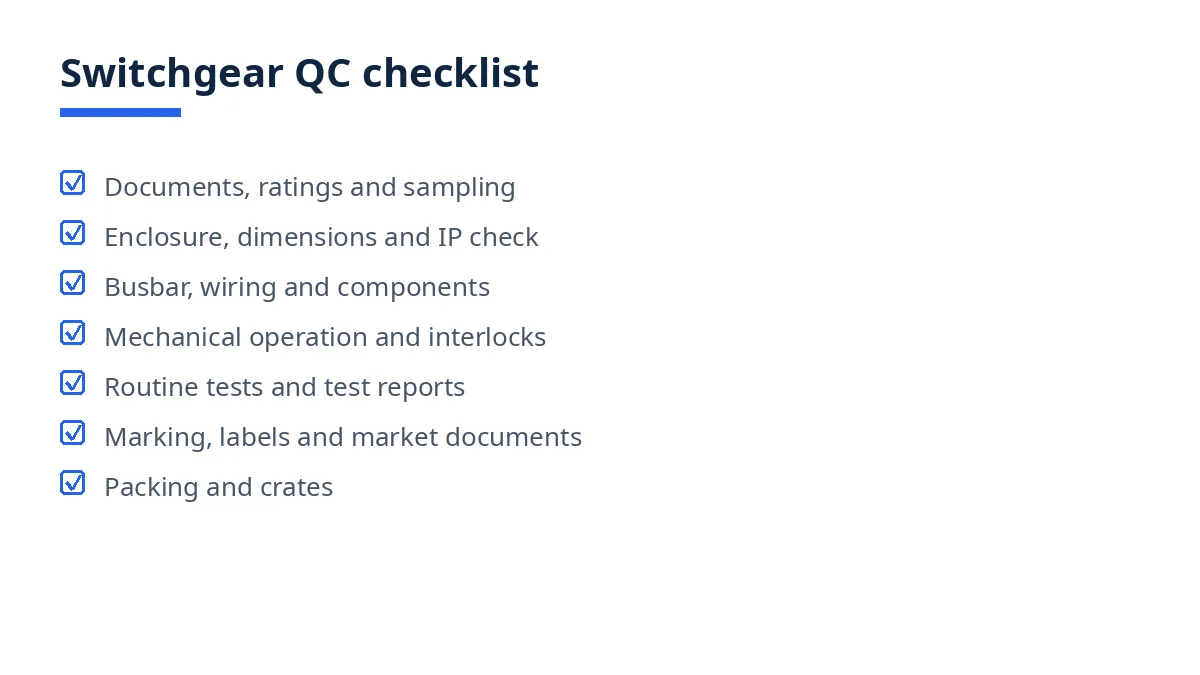
The full checklist (numbered, printable)
Documents, ratings and sampling
Draw the sample randomly across panel types and configurations under the agreed plan, recording serial numbers of panels opened.1
Check each sampled panel against the single-line diagram and bill of materials: panel type, incomer and outgoing arrangement, and device count must agree.
Read each rating plate and compare rated voltage, current, frequency and short-circuit rating as specified with the purchase order.
Confirm the assembly standard each panel type is bought to: IEC 61439 for low-voltage assemblies,2 or the IEC 62271 part named in the order.3
Check the test file for the exact build: report identifiers, serial numbers, ratings and configuration must match the assemblies in hand.
Enclosure, dimensions and ingress protection
Measure each sampled panel against the approved drawing, and check plinth, mounting and cable-entry positions.
Check doors, covers and gland plates for fit, alignment and complete fasteners, with hinges and locks operating freely.
Check the enclosure finish for scratches, dents, corrosion and coating damage, inside and outside.
Check the protection degree marked on the panel against the order. IEC 60529 gives the degrees of protection provided by enclosures (IP Code), covering protection of persons against access to hazardous parts and of equipment against ingress of solid foreign objects and harmful effects due to ingress of water.6
Check gaskets, seals and ventilation openings against the marked protection degree, and record any damaged seal as a failure.
Busbar, wiring and components
Where the plan requires an internal check, compare busbar material, cross-section and phase arrangement with the drawing.
Check busbar joints and cable terminations for complete bolts, washers and lugs as drawn, with no damaged strands or trapped insulation.
Check internal wiring against the diagram: sizes and colors as drawn, ferrules and terminal numbers legible, no chafed cables.
Check each device against the bill of materials: maker, type, rating and quantity as ordered, with no substitution on verbal assurance.
Check transformers, meters, relays and auxiliary devices named in the order for type and rating, and confirm settings as specified.
Check earthing: earth bar present and continuous, doors and covers bonded as drawn, and earth terminals marked.
Mechanical operation and interlocks
Operate each sampled breaker or switch through its full travel by its normal mechanism: opening, closing and indication must agree.
Check mechanical interlocks named in the specification by attempting the blocked operation: the interlock must prevent it without force.
Check shutters, padlocking points and racking where fitted, through the sequence shown on the drawing.
Check nameplates, mimic diagrams and circuit labels against the diagram: names, ratings and circuit numbers must match.
Repeat the sequence after covers are refitted: a panel that only works with covers off has not passed.
Routine tests and test reports
Review the routine verification file for each sampled panel, and confirm a result per serial number.2
Where dielectric tests are in the plan, confirm method, value and result come from the specification and named standard, and the report names the panel tested.4
Where temperature-rise or short-circuit evidence is required, confirm it covers the rating and configuration shipped, not a different assembly.2
Check functional test records for circuits named in the order: each circuit tested, result recorded, retests recorded against the same serial number.
For high-voltage assemblies, confirm the routine test file follows the IEC 62271 part named in the order.3
Hold any panel whose report is missing or matched to a different serial number until the file is corrected.
Marking, labels and market documents
Check rating plate, maker name and serial number on every panel against the packing list, and photograph sampled plates.
For European Union low-voltage orders, check the CE marking and EU declaration of conformity against the order file. Under Directive 2014/35/EU, equipment on sale in the EU must bear the CE marking, the manufacturer must conduct a safety and conformity assessment and issue a declaration, and the declaration and technical documentation must be kept for 10 years.5
Check instructions and safety information supplied against the destination-market language and content specified.5
Confirm any certificate supporting a product claim names this maker, assembly type and rating; record unsupported claims as failures.
Packing and cartons
Check each panel is protected as specified: bracing, moisture protection and covering complete, loose parts listed and secured.
Check lifting points, handling and orientation marks on each crate or pallet against the packing specification.
Check spares, keys, handles and documentation packs listed are packed with their panels, and counted.
Weigh and measure sample crates, and check markings, panel count and serials against the packing list.
Common failures and how to fix them
The most frequent failure is a device substitution inside a closed cubicle, usually a breaker or relay of a different type or rating fitted after drawing approval. Stop, compare every device in the affected panel type against the bill of materials, and hold the lot until the build matches the approved list. Next is a rating plate that does not match the order: re-check plates panel by panel.
Loose busbar joints point to the assembly stage: re-check joints on affected panels and record the result per serial number. Interlocks that can be forced point to adjustment or a missing part: adjust or replace, then repeat the blocked-operation check. Enclosure damage and broken seals usually start at handling: repair the finish and replace the seal.
Above the agreed acceptance level, options are re-inspection after sorting or rework, documented partial acceptance, or rejection.
Downloadable template / summary table
Copy the checklist into your inspection sheet, add drawings, ratings and acceptance numbers, and record a result per serial number.
Section | Checks | Evidence |
|---|---|---|
Documents and ratings | Diagram, materials list, rating plate | Order, serials |
Enclosure and protection | Dimensions, doors, finish, IP marking | Measurements, photos |
Busbar and wiring | Joints, terminations, devices, earthing | Internal record |
Operation and interlocks | Travel, indication, blocked operations | Operation record |
Routine tests | Dielectric, functional, verification file | Reports per serial |
Marking and documents | Plates, labels, market file | Declaration, reports |
Packing | Bracing, moisture protection, crates | Packing list |
How Exportain helps
Exportain is a B2B marketplace connecting buyers with Bangladeshi suppliers of switchgear and electrical equipment, so drawings, ratings and test files can be agreed at the enquiry stage. Browse suppliers, see the electrical equipment category and use inspection services when you plan the check. Read how to import switchgear from Bangladesh alongside this checklist. Supplier profiles show which document and photo checks have been recorded, not factory inspections. Exportain is not a party to the goods contract and does not inspect goods.
FAQs
When should this checklist be used?
Use it at final inspection, when panels are complete, tested and largely packed. For larger and first orders, also use the document, device and wiring blocks during production.
Who should complete it?
The buyer, a local agent or an independent inspector can complete it, using the approved drawings, single-line diagram and a randomly drawn sample. Energized tests should be carried out only by persons named in the plan.
What are the most common failures?
Device substitutions, rating plates that do not match the order, loose busbar joints, interlocks that can be forced, and damaged enclosure seals are the failures found most often.
Can a third party do it?
Yes, if you share approved drawings, ratings, test methods and acceptance levels first, and the inspector records a result per serial number.
Next steps on Exportain
Before production starts, agree drawings, ratings, test methods and market documents, then read the AQL acceptance quality limit explainer and the pre-shipment inspection guide, and plan the check with inspection services. You can also post a free RFQ via RFQs and compare quotes.
Sources
- ISO 2859-1:1999 - Sampling procedures for inspection by attributes — Part 1: Sampling schemes indexed by acceptance quality limit (AQL) for lot-by-lot inspection. International Organization for Standardization (accessed )
- IEC 61439-1:2020 - Low-voltage switchgear and controlgear assemblies - Part 1: General rules. International Electrotechnical Commission, (accessed )
- IEC 62271-200:2021+AMD1:2024 CSV - High-voltage switchgear and controlgear - Part 200: AC metal-enclosed switchgear and controlgear for rated voltages above 1 kV and up to and including 52 kV. International Electrotechnical Commission, (accessed )
- IEC 61439-2:2020 - Low-voltage switchgear and controlgear assemblies - Part 2: Power switchgear and controlgear assemblies. International Electrotechnical Commission (accessed )
- Directive 2014/35/EU on the harmonisation of the laws of the Member States relating to the making available on the market of electrical equipment designed for use within certain voltage limits. European Union (accessed )
- IEC 60529:1989 - Degrees of protection provided by enclosures (IP Code). International Electrotechnical Commission (accessed )
- pre-shipment inspection
- quality control
- buyer guide
- Bangladesh sourcing
- Electrical equipment
- Electronics and electrical
About the author
Sourcing from Bangladesh?
Post a request for quotation and suppliers on Exportain can send you their quotes directly.
Post an RFQ