

Wholesale Switches and Sockets From Bangladesh: Prices, MOQ and Reliable Suppliers
Wholesale switches and sockets from Bangladesh means buying an assortment, not one model: what sets the price and minimum per model, which standards and documents to confirm, and how to check a supplier before you commit.
Short answer
There is no single wholesale price or minimum for switches and sockets from Bangladesh, because a wholesale order is an assortment of models, gang combinations and finishes, each with its own mould, plate and carton costs. Ask suppliers for an itemised quotation per model, with set-up charges shown apart from unit prices, confirm the standard and rating for each model in writing, and compare quotations only on the same delivery term.
On this page
Key takeaways
A wholesale order is an assortment of models, gang combinations and finishes, not one large order for one product, and each model carries its own mould, plate and carton costs.
There is no single wholesale price or minimum: ask for an itemised quotation per model, with set-up charges shown apart from unit prices.
Confirm the standard, rated voltage and current, and test report reference for each model in writing, since standards references differ for switches and for socket outlets.
Compare quotations only on the same assortment, specification and delivery term, and agree the sampling plan and inspection stage before you confirm.
Exportain verification is a document and photo review, not a factory inspection, and a badge is not a guarantee of capacity, quality or delivery.
A wholesale order for switches and sockets from Bangladesh is not one large order for one product. It is an assortment: several switch and socket models, in several gang combinations and finishes, packed in cartons that a distributor or retailer can sell onward. That assortment changes every part of the negotiation, from the minimum order to the price structure and the inspection plan.
This guide covers the wholesale channel specifically: how an assortment is built, what sets the price and the minimum, which standards and documents to confirm, and how to check a supplier before you commit.
What wholesale buying changes for switches and sockets
What should I know first about switches and sockets?
Start with the product range, not the price. A wholesale range typically spans one-gang, two-gang and three-gang switches, socket outlets, combined switch-and-socket units, and the matching plates and boxes. Each model is a separate production line item with its own mould, plate print and carton, so a supplier quotes an assortment line by line rather than as one blended price.
Classification comes first in the paperwork. Heading 8536 covers electrical apparatus for switching or protecting electrical circuits, or for making connections to or in electrical circuits, including switches, plugs, sockets, lamp holders and other connectors and junction boxes, for a voltage not exceeding 1,000 volts.1 Confirm the heading and subheading for each model with your customs broker, because a switch, a socket outlet and a combined unit can sit under different subheadings even when they share a plate.
Standards are the second check, and they must be named per model. IEC 60669-1 applies to manually operated general purpose switches, for alternating current only, with a rated voltage not exceeding 440 V and a rated current not exceeding 63 A, intended for household and similar fixed electrical installations.2 That scope does not prove that a particular supplier model complies with it. Ask for the test report for the exact model and rating you are buying, and check that the rating on the report matches the rating on the quotation.
Bangladesh standards add a local layer. Published BSTI licence guides list switches for domestic use under BDS 377 and socket outlets and plugs under BDS 378.3 A published BSTI product list also records switches for household and similar fixed electrical installations, Part 1, as BDS IEC 60669-1:07.4 Ask the supplier to confirm in writing which Bangladesh Standard applies to each model and what mark or licence position that model currently holds, rather than assuming one standard covers the whole range.
Destination rules are the third check. The European Low Voltage Directive covers electrical equipment designed for use with a voltage rating of between 50 and 1,000 V for alternating current and between 75 and 1,500 V for direct current.5 Its scope also excludes some equipment types, so confirm whether your exact switch or socket type falls inside the scope for your destination market before you finalise the assortment.6 A model that is correct for one market can be the wrong configuration, gang size or socket type for another, and that error is cheapest to catch at this stage.
Why this matters for buyers and sellers
For a wholesale buyer, the assortment decides how much cash sits in stock and how fast it turns. A range with too many slow models ties up capital in cartons that move slowly. For the seller, the assortment decides whether the run is workable: each model needs its own mould set-up, plate run and carton print, and a model ordered in a very small quantity can cost more to set up than it earns.
The wholesale channel also changes who carries risk. A distributor buys stock before end customers order it, so the distributor needs consistent quality across repeat orders, not only on the first shipment. A project supplier buys to a fixed specification and schedule, so the binding questions are delivery dates and batch consistency.
Two controls keep the channel honest. The first is one delivery term for every quotation: the Incoterms 2020 rules set out 11 rules with a clear allocation of cost, risk and obligations, so compare wholesale prices only on the same rule and named place.7 The second is an inspection plan agreed before production: ISO 2859-1 specifies an acceptance sampling system for inspection by attributes, indexed by acceptance quality limit (AQL), which sets sample sizes and accept or reject decisions for a lot.8 A sampling plan does not check every unit, so it must sit beside a sealed sample and a written specification for each model.
Step-by-step: how it works
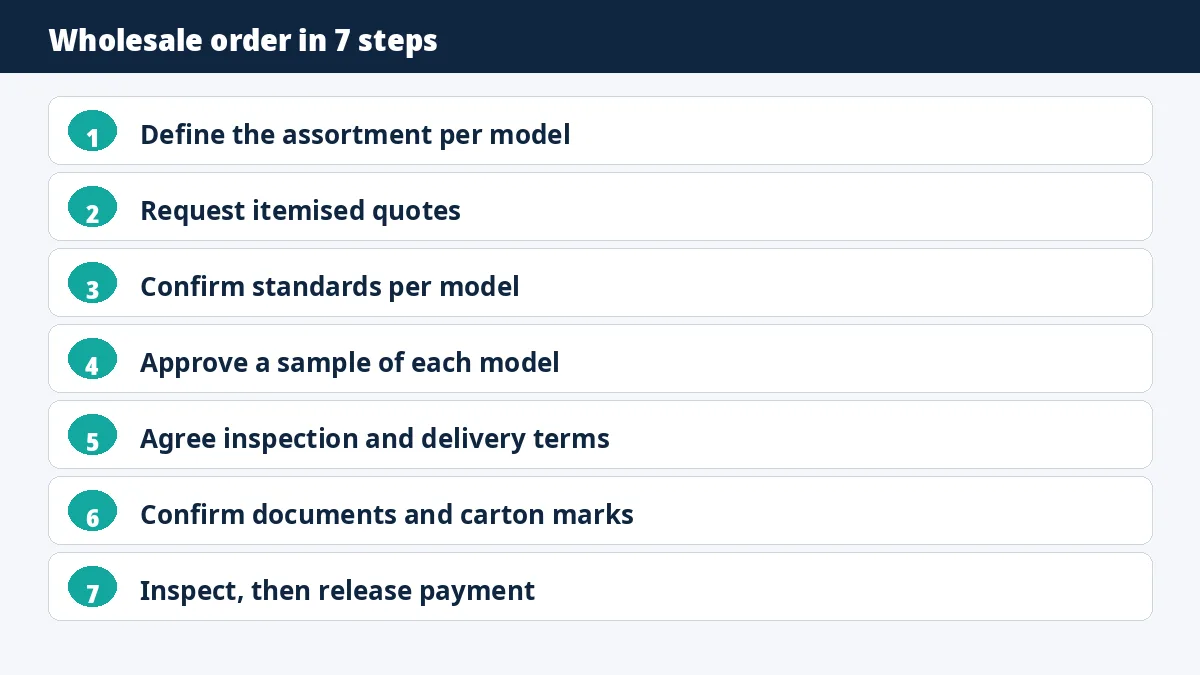
Define the assortment before you ask for prices. List each model, gang combination, finish and socket type, with the quantity per model and the carton quantity you can sell.
Ask for an itemised quotation. Request the unit price per model, the carton quantity, any mould or plate set-up charge shown apart from the unit price, packing, and the delivery term with its named place.7 A single blended price hides which model carries the cost.
Confirm standards and ratings model by model. Record the applicable standard, rated voltage and current, and the test report reference for each model, using IEC 60669-1 for household switches where it applies2 and the Bangladesh Standard position the supplier confirms.3 4
Approve a sample of each model, not only the range leader. Check plate fit, gang alignment, terminal access, marking and carton packing, then approve or list corrections in writing for each model.
Agree inspection and delivery terms before you confirm. Write the sampling plan, the AQL values and the inspection stage into the purchase order,8 and state one Incoterm and named place for every quotation.7
Confirm the export document set and the packing marks. Agree carton marks, model codes and quantities per carton before production, so the packing list matches the cartons your warehouse will receive.
Inspect, then release payment on the agreed terms. Compare the inspection result against the sealed samples and the purchase order before the balance is released, and keep the test reports with the shipment file.
Costs, timelines and documents
What are the typical costs and timelines?
There are no typical wholesale costs or timelines a guide can state as fact, because each assortment prices differently. The drivers are the number of models, the quantity per model, mould and plate set-up, the finish and material for each plate, carton quantities, packing, and the delivery term you choose.7 A wide assortment with small quantities per model carries more set-up cost per unit than a narrow assortment with large quantities per model.
Example figures: 12 models at 200 pieces each total 2,400 pieces, as does one model at 2,400 pieces. The first order carries 12 mould and plate set-ups and 12 carton runs, the second carries one. The example shows structure only, not a typical price, minimum or lead time. Ask suppliers to show set-up charges apart from unit prices. Timelines follow the same logic: sampling depends on moulds and plate prints, production on the longest model run, and inspection on the sampling plan.8 Ask for sampling, production, inspection and shipment dates as separate lines, and ask which model sets the critical path.
Which documents are needed?
For export clearance in Bangladesh, the C and F agent submits the Bill of Export online to the ASYCUDA World system, with the printed Bill of Export and supporting documents submitted to Customs, including the export contract or purchase order where there is no export letter of credit, the commercial invoice, the packing list, the EXP form certified by an authorized dealer, and a certificate of origin issued by the EPB or a Chamber of Commerce and Industry.9 Keep one legal name for the supplier across the trade licence, quotation, proforma invoice and payment account.9
Bangladesh Bank has also provided an electronic option for EXP form submission, under which authorized dealers accept EXP forms submitted electronically through the Bangladesh Bank online reporting portal before customs formalities.10 Ask which route your shipment will use, and confirm that the EXP details match the invoice and packing list before the Bill of Export is filed.
Bangladesh-specific rules and tips
Confirm the standard per model, not per supplier. A supplier can hold a licence or test report for one model and not for another. Record the standard, rating and report reference on the purchase order for each model, and ask what changes if a model is substituted.
Check who makes what. Some suppliers manufacture plates and assemblies in-house, while others assemble bought-in mechanisms or trade finished stock. Ask which parts of your assortment are made in-house and which are bought in, and get the answer in writing.
Agree carton discipline early. Wholesale value is lost when cartons mix models, when model codes are missing, or when packing list counts differ from the cartons. Agree the model code, quantity per carton and carton marks before production, and check the first cartons against the packing list at inspection.
Confirm destination configuration before production. Gang sizes, box depths, socket types and finishes vary by market. Send the destination box and socket requirements with the enquiry, and ask the supplier to confirm fit in writing against the sample.
Mistakes and red flags
What are the most common mistakes?
Ordering a total instead of an assortment. A wholesale order stated only as a total piece count cannot be produced, because the factory needs quantities per model, per gang combination and per finish. State the split first.
Comparing prices on different terms or specifications. A lower price on a different Incoterm,7 a different plate material, a different carton quantity or a different standard is a different offer. Compare only replies to the same assortment on the same term, with set-up charges shown the same way.
Accepting a standard claim without a model report. A claim that a range meets IEC 60669 means little until the report names your model and rating.2 Ask for the report reference, and check the rating and the model code against the quotation.
Skipping the per-model sample. Approving one switch plate does not approve the socket outlet, the dimmer or the two-gang combination beside it. Sample each model, and record the approval per model.
Treating a profile or a badge as a guarantee. A profile is a starting point for enquiries. It does not test whether a supplier can deliver your assortment, and a badge is not a guarantee of capacity, quality or delivery.
Paying set-up twice. Keep the paid mould and plate set-up lines from the first purchase order and attach them to the repeat enquiry, with the models they cover.
Ignoring the slow model. A wholesale range lives or dies on its slowest carton. Review the per-model quantity against your sales rate before you confirm, and ask whether slow models can be cut or ordered on a longer cycle.
Checklist
Before you confirm, every line should be answered in writing.
Assortment listed per model, gang combination, finish and socket type, with quantity per model.
Carton quantity and carton marks agreed per model.
Itemised quotation received: unit price per model, set-up charges apart, packing, delivery term and named place.7
Standard, rating and test report reference recorded per model.2 3 4
Destination configuration confirmed: gang size, box fit, socket type and conformity documents.5 6
Sample of each model approved in writing, with corrections closed.
Sampling plan, AQL values and inspection stage in the purchase order.8
Export set agreed: invoice, packing list, EXP form, certificate of origin, Bill of Export.9 10
Paid set-up lines recorded for repeat orders.
Quotations compared on the same assortment, specification and delivery term.7
How Exportain helps
On Exportain, browse suppliers and post your assortment on the RFQ board with the quantity per model, carton requirements and delivery term, so suppliers quote against the same wholesale split. Ask each reply for its per-model minimums and set-up charges, shown apart from unit prices.
Read the badges for what they record. Exportain Verified means Exportain has checked identity, phone, email and business registration, and Export Verified means it has checked the Export Registration Certificate (ERC). Factory Verified means it has reviewed photos of the manufacturer factory, while Trading Company Verified means it has reviewed photos of the trading company office or warehouse.11 Verification is a document and photo review, not a factory inspection, so sample approval and inspection stay with you. See how supplier verification works on Exportain and the MOQ definition guide.
FAQs
What should I know first about switches and sockets?
Know the assortment before the price: the models, gang combinations, finishes and socket types, with quantities per model. Heading 8536 covers switches, plugs, sockets and related apparatus for a voltage not exceeding 1,000 volts.1 IEC 60669-1 covers manually operated general purpose household switches within its stated voltage and current limits,2 and Bangladesh Standards references differ for switches and for socket outlets.3 Confirm the standard and rating per model in writing.
What are the typical costs and timelines?
There are no typical figures a buyer can rely on, because each assortment prices differently by model count, quantity per model, set-up, finish, packing and delivery term.7 Example figures in this guide show structure only. Ask for set-up charges apart from unit prices, and for sampling, production, inspection and shipment dates as separate lines.
Which documents are needed?
The order documents are the assortment list, itemised quotation and purchase order, with per-model quantities, carton counts, standards and inspection terms. The export set is the Bill of Export, commercial invoice, packing list, EXP form certified by an authorized dealer, and a certificate of origin issued by the EPB or a Chamber of Commerce and Industry.9 An electronic EXP option also exists through the Bangladesh Bank portal.10
What are the most common mistakes?
The most common mistakes are ordering a total instead of an assortment, comparing prices on different specifications or terms,7 accepting a standard claim without a model report,2 skipping the per-model sample, and reading a badge as a guarantee. A badge records a document and photo review, not a factory inspection, so sample approval and inspection stay with you.
Next steps on Exportain
Browse suppliers, then post your assortment, quantities per model and delivery term on the RFQ board so suppliers quote the same wholesale split. Before you confirm, read the HS code for switches and sockets guide and the switches and sockets quality control checklist.
Sources
- Heading 8536 — Electrical apparatus for switching or protecting electrical circuits. GOV.UK (accessed )
- IEC 60669-1:1998 — Switches for household and similar fixed electrical installations — Part 1: General requirements. International Electrotechnical Commission (accessed )
- How to Obtain BSTI License in Bangladesh. LegalSeba LLP, (accessed )
- BSTI product list: products brought under the mandatory certification marks scheme. Bangladesh Standards and Testing Institution (BSTI) (accessed )
- Low Voltage Directive Compliance: Complete Guide. QIMA (accessed )
- Low Voltage Directive. Wikipedia (accessed )
- Incoterms® 2020. International Chamber of Commerce (ICC) (accessed )
- SIST ISO 2859-1:2003 - Sampling procedures for inspection by attributes, Part 1: Sampling schemes indexed by acceptance quality limit (AQL). International Organization for Standardization, (accessed )
- Customs Clearance Procedures for Export. Bangladesh Customs, National Board of Revenue (accessed )
- FE Circular No. 17: Introduction of electronic option of EXP Form submission for export of goods from Bangladesh. Bangladesh Bank, (accessed )
- Sell Bangladeshi Products to Global Buyers | Exportain. Exportain (accessed )
About the author
Sourcing from Bangladesh?
Post a request for quotation and suppliers on Exportain can send you their quotes directly.
Post an RFQ


