Quality Control Checklist for Switches and Sockets From Bangladesh
A numbered QC checklist for switches and sockets from Bangladesh: ratings and markings, terminals, contacts and shutters, dimensions, IP code, function and temperature-rise evidence, labels and packing, with fixes for common failures.
Short answer
Use this switches and sockets quality control checklist to check rated voltage and current, markings, screwless terminal limits, dimensions and plug fit, terminal clamping and earthing, socket contact grip and shutters, switch action, electrical test evidence, IP code claims, labels and packing on switches and sockets from Bangladesh before shipment. Agree tolerances, test methods and acceptance numbers in the purchase order.
On this page
Key takeaways
Agree the sample, rating specification, tolerances, test methods and acceptance numbers before inspection, and draw the sample randomly across models, finishes and cartons.
Check marked current against terminal type: IEC 60669-1 and IEC 60884-1 both limit screwless terminals to 16 A.
Work through terminals, earthing, socket grip and shutters by function, not appearance, and hold shipment when test reports do not match the exact model and rating.
Treat an IP code as a claim to verify against IEC 60529 evidence for the same cover, gasket and cable entries as the bulk product.
This switches and sockets quality control checklist helps buyers check a shipment before it leaves Bangladesh. A switch or socket is judged in the wall: a loose terminal, a shutter that does not close, or a wrong rating is a safety fault, not cosmetic. Use an agreed sampling plan, not factory-selected pieces. ISO 2859-1 specifies an acceptance sampling system for inspection by attributes, indexed by the acceptance quality limit (AQL), applicable to end items.1
Why this checklist matters
Switches and sockets carry mains current daily in a small product. Dimensions decide whether the plate sits flat, terminals decide whether conductors stay clamped, and markings let an installer identify the rating before fitting.
A written checklist removes interpretation. Check each point against the sample and specifications, and record pass, fail or not applicable. Set acceptance numbers per defect class in the order, using ISO 2859-1.1 See the AQL acceptance quality limit explainer.
Scope limits show why the sample rating matters. IEC 60669-1 applies to manually operated general purpose switches for AC only, rated not exceeding 440 V and 63 A, for household and similar fixed installations.2 IEC 60884-1 applies to plugs and fixed or portable socket-outlets for AC only, with or without earthing contact, rated greater than 50 V but not exceeding 440 V and 32 A, for household and similar purposes.3
Before you start
Do not begin until references are complete: an approved sample per model and finish, the purchase order, rating and dimension specifications, the destination plug system and earthing arrangement, and the packing specification. Agree the sampling plan in advance,1 and draw the sample randomly across models, finishes and cartons.
Check ratings before bulk marking starts. For switches with screwless terminals, IEC 60669-1 limits rated current to 16 A.2 IEC 60884-1 limits rated current to 16 A maximum for accessories with screwless-type terminals.3 A sample marked above those limits is a stop point.
Check the destination framework too. Directive 2014/35/EU applies to equipment rated between 50 and 1,000 V AC and 75 and 1,500 V DC, and covers health and safety risks so equipment is used safely for its intended applications.4 Confirm the conformity route before labels are printed.
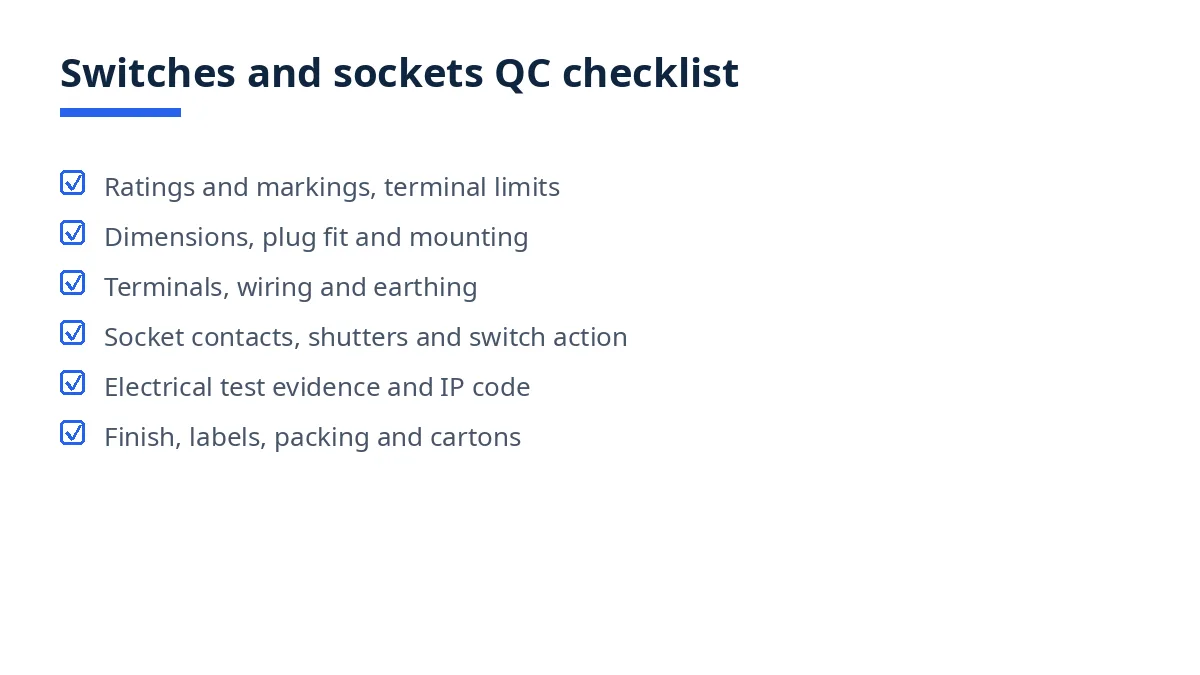
The full checklist (numbered, printable)
Ratings, markings and identification
Check rated voltage, rated current, frequency where marked, and model on each unit against the order and sample.
Check the rating falls inside the named standard scope: IEC 60669-1 covers switches up to 440 V and 63 A,2 IEC 60884-1 covers plugs and socket-outlets above 50 V up to 440 V and up to 32 A.3
Check terminal type against rating: for screwless terminals, confirm marked current does not exceed the 16 A limit in IEC 60669-12 and IEC 60884-1.3
Rub markings by hand: maker, model, rating, terminal identification and symbols must remain readable and match the sample.
Check any claimed IP code. Under IEC 60529, the IP Code indicates protection against access to hazardous parts and ingress of solids and water, with a first numeral 0 to 6 and a second 0 to 8.5
Record any unapproved marking or changed model code as a failure, and photograph face and rear of each unit.
Dimensions, fit and mounting
Measure faceplate length, width and fixing-hole spacing, and compare each value with the tolerance.
Check units sit flat in the mounting box or test wall named in the specification, with no rocking or edge gap.
Insert and withdraw the destination plug in each socket: entry straight, grip firm, and withdrawal must not pull the socket forward.
Check rockers, toggles and push buttons for full travel, positive feel and return, with no sticking.
Check multi-gang plates: units in a row must sit level, with even gaps and no twisted modules.
Check screw holes, clips and fixing lugs for cracks, burrs and stripped threads, including on the rear housing.
Terminals, wiring and internal construction
Open sampled units as agreed and check terminal screws, clamps and screwless springs for size, full movement and no damaged threads.
Fit the conductor sizes named in the specification, clamp as directed, and pull each conductor by hand to confirm it is held.
Check no strands escape the terminal, insulation is not trapped under the clamp, and terminal identification matches the wiring diagram.
Check internal links, bridges and earth connections for routing, secure fixing and no contact with moving parts.
Check the earthing path on earthed sockets: earth terminal, contacts and any metal faceplate parts named in the specification must connect as on the sample.
Check housings for cracks, voids, flash and thin sections, and that live parts cannot be touched through openings with the plate fitted.
Socket contacts, shutters and switch action
Check socket grip by inserting the test plug repeatedly: contacts must hold evenly on each pin, with no splayed or burnt faces.
Where shutters are fitted, check they open only on correct plug entry, cover the apertures on removal, and are not defeated by pressing a single aperture.
Operate each switch through repeated on and off cycles: action crisp, indicated position matching circuit state, no buzzing or half-on position.
Check indicators and pilot lights where fitted for color, position and operation in both switch states.
Check dimmer, fan-control and other combined functions named in the order through their full range, against the sample.
Check child-safety, cover and locking features named in the order by function, not appearance, and record the result per feature.
Electrical test evidence
Review type-test and routine-test reports for the exact model and rating, and confirm laboratory, standard edition and date are named.
Check reports for switches name IEC 60669-1 and reports for plugs and socket-outlets name IEC 60884-1, matching the product supplied.2 3
Review temperature-rise evidence where required: IEC 60884-1:2022 includes a rewritten temperature rise clause, so the report should show which edition was used.3
Review dielectric, insulation and earthing continuity evidence where the order requires it, and confirm reports name this lot or model run.
Where an IP rating is claimed, review evidence against IEC 60529 and check the tested sample had the same cover, gasket and cable entries as bulk.5
Record missing or mismatched reports as a hold on shipment, not a minor defect.
Finish, labels and product claims
Check faceplate color, finish and texture against the sample under the same light, across all gangs and models.
Check for scratches, molding marks, discoloration, sharp edges and loose trims on face and sides.
If a claim such as an IP rating, load type or material claim appears on product or pack, check the agreed evidence supports that exact claim.5
Check instructions, wiring diagrams and safety information are present where required, in the destination language.
Packing and cartons
Verify rating, model, brand and origin labels are present, legible and correctly positioned on unit and inner pack.
Check barcode and model stickers scan and match the order, and mixed-model cartons follow the specified ratio.
Confirm units are packed as directed, with film or bags where specified, so faceplates cannot rub in transit.
Check cartons carry required markings, including model, quantity and destination, and no carton rating conflicts with the product rating.
Weigh and measure sample cartons, and check markings and carton count against the packing list.
Open one packed unit and reseal it: screws, fixings and instructions named in the pack must all be inside.
Common failures and how to fix them
The most frequent failure is a rating or terminal mismatch, where bulk carries a higher marked current than its screwless design supports. Stop, compare the rating with the limits in IEC 60669-12 and IEC 60884-1,3 and rework only under a written correction agreed before packing resumes.
Loose conductors trace to damaged screws, undersized clamps or strands outside the clamp. Refit the specified conductor, replace damaged terminals, and re-check a fresh sample. Weak grip and open shutters point to bent contacts or a misfitted shutter spring: segregate that group and re-inspect it alone.
Cracked housings and plates that will not sit flat point to a fault in one tool cavity: hold those pieces apart. Finish differences across a set usually mean more than one material batch: re-sort complete sets before packing.
Above the agreed acceptance level, options are re-inspection after sorting or rework, documented partial acceptance, or rejection. Follow the plan agreed under ISO 2859-1.1 See the pre-shipment inspection guide.
Downloadable template / summary table
Copy the checklist into your inspection sheet, add rating, tolerances and acceptance numbers, and record a result per model.
Section | Checks | Evidence |
|---|---|---|
Ratings and markings | Voltage, current, terminal limit, IP code | Photos, rating sheet |
Dimensions and fit | Plate size, fixing spacing, plug entry | Measurements, fit check |
Terminals and wiring | Clamping, conductor pull, earth path | Opened-unit photos |
Contacts and action | Grip, shutters, switch travel | Function checks |
Electrical evidence | Type tests, temperature rise, IP tests | Reports per model |
Packing | Labels, ratios, carton marks | Packing list |
How Exportain helps
Exportain is a B2B marketplace connecting buyers with Bangladeshi suppliers of switches, sockets and other electrical accessories, so specifications can be agreed at the enquiry stage. Browse suppliers, see inspection services when you plan the check, and compare rating specifications in each quotation. Supplier profiles show which document and photo checks have been recorded, not factory inspections. Exportain is not a party to the goods contract and does not inspect goods.
FAQs
When should this checklist be used?
Use it at final inspection, when goods are finished and largely packed. For larger and first orders, also use it in production, while terminals and markings can still be corrected.
Who should complete it?
The buyer, a local agent or an independent inspector can complete it, using the approved sample and a randomly drawn sample.
What are the most common failures?
A rating that does not match the terminal type, loose conductors, weak grip, shutters that do not close and cracked housings are the failures buyers find most often.
Can a third party do it?
Yes, if you share the approved references, tolerances, test reports and acceptance levels first.
Next steps on Exportain
Before production starts, agree rating, plug system, tolerances and test evidence, then read the AQL acceptance quality limit explainer and the pre-shipment inspection guide, and plan the check with inspection services. You can also post a free RFQ via RFQs and compare quotes.
Sources
- ISO 2859-1:1999 - Sampling procedures for inspection by attributes — Part 1: Sampling schemes indexed by acceptance quality limit (AQL) for lot-by-lot inspection. International Organization for Standardization (accessed )
- IEC 60669-1:2017 - Switches for household and similar fixed-electrical installations - Part 1: General requirements. International Electrotechnical Commission (accessed )
- IEC 60884-1:2022 - Plugs and socket-outlets for household and similar purposes, Part 1: General requirements. International Electrotechnical Commission (accessed )
- Directive 2014/35/EU on the harmonisation of the laws of the Member States relating to the making available on the market of electrical equipment designed for use within certain voltage limits. European Union (accessed )
- IEC 60529:1989 - Degrees of protection provided by enclosures (IP Code). International Electrotechnical Commission (accessed )
- pre-shipment inspection
- quality control
- Switches and sockets
- Electrical accessories
- Bangladesh electronics
- IEC 60669
- IEC 60884
About the author
Sourcing from Bangladesh?
Post a request for quotation and suppliers on Exportain can send you their quotes directly.
Post an RFQ