HS Code for Switches and Sockets: Classification Guide for Importers
Switches sit in 8536.50 and plugs and sockets in 8536.69, inside heading 8536 for apparatus up to 1,000 V, and national codes extend the six digits to eight or ten.
Short answer
Switches and sockets are classified in heading 8536, which covers electrical apparatus for switching, protecting or making connections in electrical circuits for a voltage not exceeding 1,000 V. Switches take subheading 8536.50 and plugs and sockets take 8536.69, while lamp holders sit at 8536.61. The six-digit codes are indicative: your entry uses the national extension, which runs to eight or ten digits and turns on function, voltage, current rating and construction.
On this page
Key takeaways
Switches are classified at 8536.50 and plugs and sockets at 8536.69, both inside heading 8536 for electrical apparatus for switching, protecting or making connections in electrical circuits for a voltage not exceeding 1,000 V.
Lamp holders are not sockets for classification purposes: they are split out at 8536.61, and connectors for optical fibres sit at 8536.70.
The first six digits are the same in every HS country, but the national extension to eight or ten digits differs between the United States, the European Union and the United Kingdom.
Function, rated voltage, rated current and construction decide the national line: the tariffs split switches by type and current band, and plugs and sockets by connection type.
An assembled control panel is not declared as loose switches: the United States schedule places motor control centers and fitted boards and panels in 8537.10.
If you import switches or sockets from Bangladesh, the HS code for switches and sockets is the line your customs entry, duty calculation and origin claim all depend on. The Harmonised System is an international commodity classification of approximately 5,000 six-digit product categories, organised by chapters (2 digits), headings (4 digits) and sub-headings (6 digits), and countries subdivide the six-digit categories further for their own tariffs.1 For wiring accessories, the classification turns on what the device does — switch, connect or protect — and on its voltage and current ratings, not on the trade name in a supplier catalogue. This guide covers classification only; the ordering steps are in how to import switches and sockets from Bangladesh and the inspection points in the switches and sockets quality control checklist.
Quick answer: the indicative HS code for switches and sockets
Switches and sockets sit in heading 8536: electrical apparatus for switching or protecting electrical circuits, or for making connections to or in electrical circuits, for a voltage not exceeding 1,000 V.2 Within the heading, switches fall in subheading 8536.50, "Other switches", and plugs and sockets fall in 8536.69, within the group "Lamp holders, plugs and sockets".2 3 Lamp holders themselves are split out separately at 8536.61, and connectors for optical fibres sit at 8536.70.2
Treat 8536.50 and 8536.69 as the indicative six-digit starting points, not as finished codes. Your customs entry uses your destination country's national code, which extends the six digits to eight or ten, and the correct extension depends on the exact device: its function, voltage, current rating and construction. Confirm the full national code officially before you price or ship, using the method in the confirmation section below.
How HS codes are structured
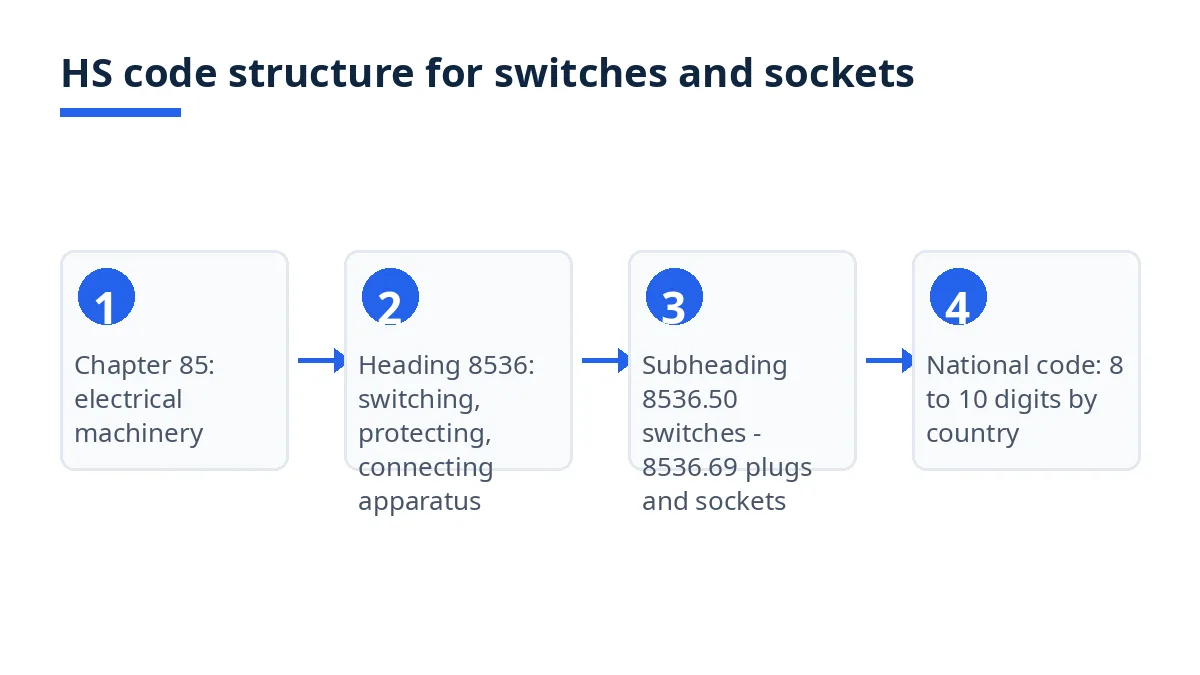
The first two digits are the chapter: chapter 85 covers electrical machinery and equipment and parts thereof. The next two digits give the heading, the four-digit level at which 8536 groups the switching, protecting and connecting apparatus of this product family. The fifth and sixth digits give the subheading, the deepest level that is harmonised internationally: 8536.50 for switches and 8536.69 for plugs and sockets are the same in every country that uses the HS.1 2
Below six digits, each tariff goes its own way. The European Union extends the code to eight digits in the Combined Nomenclature and to ten in TARIC, the United Kingdom uses a ten-digit commodity code, and the United States uses a ten-digit HTS code whose last digits can be statistical.1 3 The six-digit code is therefore never the whole answer: two countries can agree on 8536.69 and still split the national lines differently underneath it.
Factors that decide the code for switches and sockets
Function is the first split. Heading 8536 separates apparatus by what it does: fuses at 8536.10, automatic circuit breakers at 8536.20, other apparatus for protecting electrical circuits at 8536.30, relays at 8536.41 and 8536.49, other switches at 8536.50, lamp holders, plugs and sockets at 8536.61 and 8536.69, and other apparatus at 8536.90.2 A switch with a protective function built in, or a socket outlet with a switch, has to be read against this structure, not filed under whichever word appears largest on the box.
Voltage is the heading boundary. Heading 8536 covers apparatus for a voltage not exceeding 1,000 V.2 Apparatus rated above that boundary leaves this heading entirely, so the rated voltage on the datasheet is a classification fact, not a marketing detail. Within the heading, voltage and current bands drive the national splits: the tariff listing separates switches for a voltage not exceeding 60 V from the rest, and separates electromechanical snap-action switches for a current not exceeding 11 A as their own line.2
Construction decides between near neighbours. The listing separates electronic AC switches and electronic switches built on a transistor and logic chip from electromechanical types, separates push-button switches from rotary switches, and splits plugs and sockets by their connection type, with lines for coaxial cables and for printed circuits before the residual "other" line.2 A lamp holder is not a socket for classification purposes: lamp holders sit at 8536.61, including Edison lamp holders, while other plugs and sockets sit at 8536.69.2
Assembly state can move the whole product out of the heading. Loose switches and sockets are 8536 apparatus, but the United States schedule places motor control centers and other boards and panels fitted with switching apparatus in 8537.10, the line for boards, panels and bases for electric control or distribution, for a voltage not exceeding 1,000 V.3 A supplier who ships a fitted control panel declared as loose switches has misclassified the goods, however accurate the code is for the components inside.
National codes: US HTS, EU CN/TARIC, UK commodity code
In the United States schedule, subheading 8536.50 splits into 8536.50.40 for motor starters, 8536.50.70 for electronic AC switches consisting of optically coupled input and output circuits, and 8536.50.90 for other switches.3 Plugs and sockets at 8536.69 split into 8536.69.40, which covers coaxial connectors and cylindrical multicontact connectors among others, and 8536.69.80 for other plugs and sockets.3 The full entry code is ten digits, so confirm the last digits on the current schedule for your exact device.
In the EU Combined Nomenclature and the UK commodity code, the eight-digit listing for this heading separates electronic AC switches, electronic switches on chip-on-chip technology, and electromechanical snap-action switches for a current not exceeding 11 A, then splits the remaining switches by voltage and operating type, with push-button switches and rotary switches named separately.2 Lamp holders split into Edison lamp holders and other lamp holders, and other plugs and sockets split into lines for coaxial cables, for printed circuits, and a residual line for the rest.2 The UK commodity code runs to ten digits, so a wall socket that is 8536.69 at six digits carries a longer code on a UK entry, and the same applies in the EU through TARIC.
The lesson across all three tariffs is the same: suppliers quote the six-digit code because it is the international layer, but your broker declares the national layer. Record both in your product file, per model, so a repeat order does not restart the classification work.
How to confirm the code officially
Start from the product, not from a code list. Write down the function, rated voltage, rated current, operating type and construction of each model, from the datasheet and the rating plate. Then work the official tariff service of your destination: the USITC publishes the current United States schedule,3 the UK Trade Tariff service publishes the heading 8536 listing with its notes,2 and the European Commission's Access2Markets portal explains the HS structure and hosts the EU tariff tools.1
Give your customs broker the full specification and the indicative six-digit code, and have the broker confirm the national extension against the current schedule. For a model you will import repeatedly, ask the destination customs administration for a binding classification decision where its system offers one, and keep the decision with the product file: it fixes the code for that product in that country, which a supplier's catalogue never does. Re-check the code when the product changes — a different contact arrangement, rating or added electronics can move the national line even when the six-digit code stays the same. Read HS codes: how to classify your product for the general method.
Common classification mistakes
Copying the supplier's code without checking it against the product is the most common mistake. The supplier's code reflects the supplier's reading, often for a different destination tariff, and the importer carries the liability for the entry. Lumping a mixed shipment onto one line is the second: a carton programme of switches, sockets and lamp holders covers at least three subheadings, 8536.50, 8536.69 and 8536.61.2
Calling a lamp holder a socket, or a socket a connector, misfiles the product in the same way: the heading names them separately, and the optical fibre connectors at 8536.70 are not electrical sockets at all.2 Ignoring the 1,000 V boundary is the fourth mistake: the heading text itself sets the limit,2 so a higher-rated device declared under 8536 is wrong at heading level, not just at national level. Finally, declaring an assembled control panel under the component codes ignores the separate provision for boards and panels at 8537.10.3
Related duties and documents
This guide states no duty rates, because the rate is charged on the confirmed national code, the origin of the goods and the entry date, and it changes independently of the classification method set out here. Once the national code is fixed, your broker can price the duty from the current schedule, and test any preference claim: a preference depends on the goods meeting the origin rules of the scheme, which is a separate question from the code.
Keep the classification evidence with the shipping documents. The commercial invoice should describe each model in terms customs can match to the code — function, voltage and current rating, and type — with switches, sockets and lamp holders on separate lines matching their subheadings. Keep the datasheet and rating-plate photograph for each model in the same file, so the declared code can be defended at clearance and reused on the next shipment.
FAQs
What is the HS code for switches and sockets?
The indicative six-digit codes are 8536.50 for switches and 8536.69 for plugs and sockets, both inside heading 8536, which covers electrical apparatus for switching, protecting or making connections in electrical circuits for a voltage not exceeding 1,000 V.2 Lamp holders are classified separately at 8536.61.2 Your customs entry uses the national extension of these codes in your destination country, which runs to eight or ten digits.
Is the HS code the same in every country?
The first six digits are harmonised internationally, so 8536.50 and 8536.69 mean the same in the United States, the European Union and the United Kingdom.1 The national digits below them differ: the United States splits 8536.50 into motor starters, electronic AC switches and other switches,3 while the EU and UK listings split by switch type, voltage and current.2 Always declare the full national code of the destination.
How do I confirm the correct code?
Work from the product specification, then check the official tariff service of your destination — the USITC schedule for the United States,3 the UK Trade Tariff service for the United Kingdom,2 and Access2Markets for the European Union1 — and have your broker confirm the national extension. For repeat imports of the same model, a binding classification decision from the destination customs administration fixes the code; keep it with the product file.
What happens if I use the wrong code?
A wrong code can mean the wrong duty is paid, the entry is queried or held at clearance, and a preference claim fails because it was tested against the wrong line. Because classification follows the product, the correction can also reach back over earlier entries of the same goods. Confirming the code per model before the first shipment, and recording the evidence, is cheaper than correcting a series of entries afterwards.
Next steps on Exportain
Read what the Harmonized System is for the background to the code structure, then browse suppliers for Bangladeshi electrical accessories manufacturers. When you request quotes, give each supplier your confirmed national code per model, so the prices you compare are for the same classified product.
Sources
- Harmonised System. European Commission (accessed )
- Heading 8536: Electrical apparatus for switching or protecting electrical circuits, or for making connections to or in electrical circuits - UK Integrated Online Tariff. UK Government (accessed )
- Harmonized Tariff Schedule of the United States, Chapter 85: Electrical machinery and equipment and parts thereof (Revision 9, 2026). United States International Trade Commission (accessed )
- HS Codes
- Customs Classification
- importing from Bangladesh
- tariff codes
- Switches and sockets
- Electrical accessories
About the author
Sourcing from Bangladesh?
Post a request for quotation and suppliers on Exportain can send you their quotes directly.
Post an RFQ