

Wholesale Solar Panels From Bangladesh: Prices, MOQ and Reliable Suppliers
Wholesale solar panels from Bangladesh, bought for resale or installation: how the channel works, what sets the minimum order and price, and what to confirm in writing before ordering.
Short answer
Wholesale solar panels from Bangladesh are bought for resale or installation, not for a single roof. Compare offers on total watts, module count, watt-peak per module and exact model, and ask each supplier to state in writing whether it manufactures, assembles or trades the modules. Confirm the minimum order, itemized price, delivery term, sample approval, inspection plan and export documents before you confirm an order.
On this page
Key takeaways
Wholesale solar panels are bought for resale or installation, so compare offers on total watts, module count, watt-peak per module and exact model, not on price per panel alone.
Ask every supplier to state in writing whether it manufactures, assembles or trades the modules, who holds stock, and who handles warranty claims.
A minimum order may be set per model, per watt total, per pallet or per container, so ask which figure is binding and get it on the quotation.
Compare quotations only on the same model, quantity and delivery term, with price, packing, transport, freight and insurance itemized separately.
Exportain verification is a document and photo review, not a factory inspection, and a badge is not proof of wholesale capacity or stock.
Buying solar panels at wholesale means buying for resale or for installation work, not buying one system for one roof. The wholesale question is therefore different: which channel, quantity and paper trail let a distributor, installer or project buyer restock at a workable margin, with stock that can be sold on, installed and supported after delivery. This guide explains that channel for Bangladesh: how wholesale supply is structured, what sets the minimum order and the price, and what to confirm in writing before money moves.
Why this matters for buyers and sellers
A wholesale buyer carries risks a retail buyer never sees. Stock bought in bulk ties up cash, takes warehouse space and must match what installers and end customers will accept. A wrong wattage, a connector type local installers do not stock, or a warranty route that runs only through an overseas office can leave pallets unsold or installed systems unsupported. For the seller, a wholesale order must be held or assembled in one specification, packed for repeated handling, and supported by documentation the buyer will show to its own customers, installers and, where relevant, customs and grid authorities.
The wholesale channel can take several forms, and the form changes what you are actually buying. A manufacturer sells its own production. A trading company buys from one or more manufacturers and resells, sometimes adding inspection, repacking or local stock. A distributor holds stock for a territory or customer segment and sells onward in smaller lots. What matters is knowing which form your counterpart occupies, because it decides who holds stock, who answers a warranty claim, and who can change a specification mid-order. Ask every supplier to state in writing whether it manufactures, assembles or trades the modules on offer, and where the cells and finished modules originate.
Wholesale buying also changes how quantity is counted. Panels are sold by the piece, but priced and compared by the watt. Two quotations for the same number of panels can describe very different amounts of power if the watt-peak rating per module differs. Compare offers on total watts, module count, watt-peak per module and the exact model, and keep all four figures on the quotation.
What should I know first about solar panels?
Start with the product class, not the brand name. Photovoltaic modules, commonly called solar panels, are classified under HS heading 8541.43, while PV inverters fall under 8504.40, so panels and inverters are separate customs lines with separate documentation even when they ship together.1 A mixed shipment needs its component lines itemized, and a single blended price cannot be checked against either line.
Next, understand what a module standard does and does not prove. Crystalline photovoltaic modules are tested for design qualification and type approval under IEC 61215, which covers terrestrial crystalline silicon modules.2 A certificate speaks to the tested design, not to every pallet in a wholesale order, so ask which certificate covers the exact model, which laboratory issued it, and whether it remains current.
Finally, know the end use before you negotiate quantity. Resale stock must suit more than one installer. Project stock must match one design exactly. Stock bought without a buyer in mind must be the most widely usable specification you can defend, and you should be able to say in one sentence who will buy it and for what kind of installation.
Step-by-step: how it works
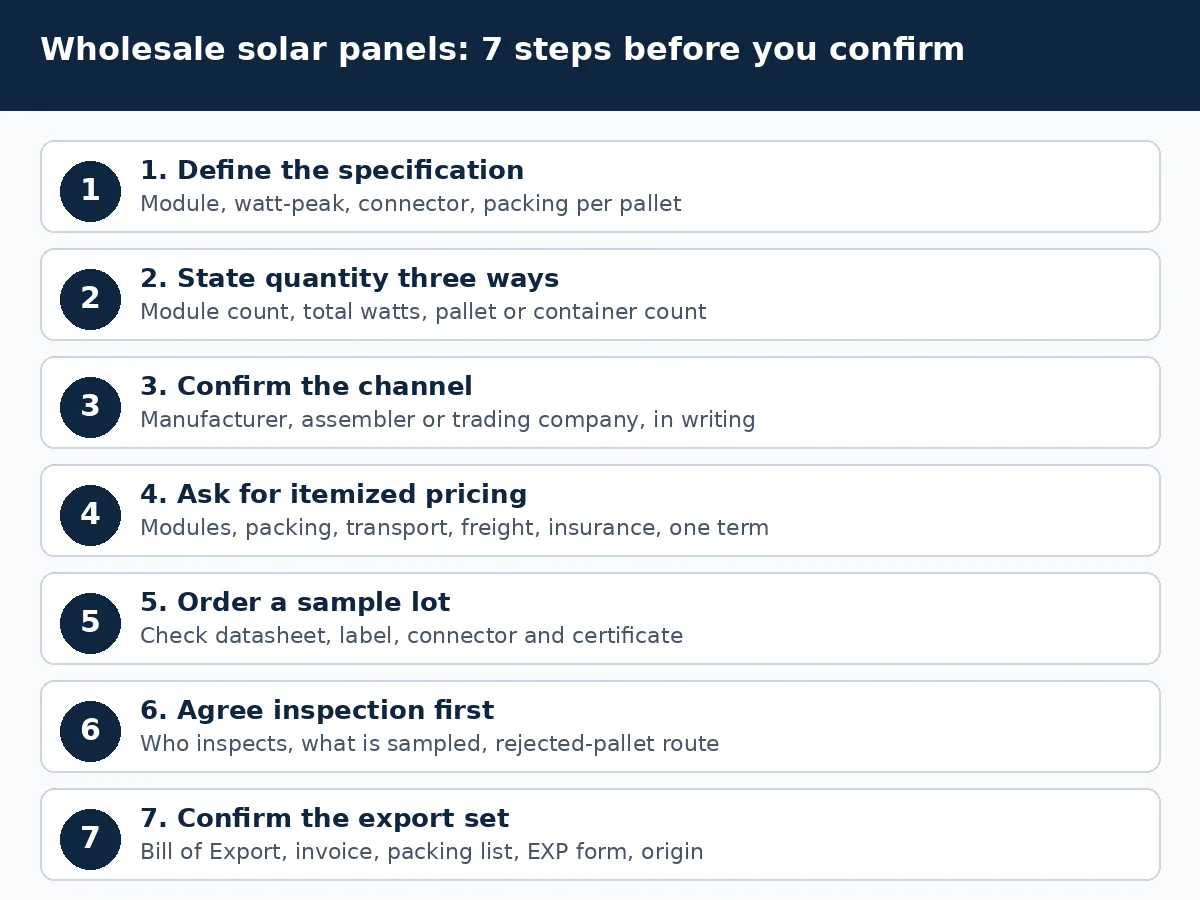
Define the wholesale specification in one document. State module type, watt-peak per module, cell type as the supplier describes it, frame and glass requirements, connector type, cable length, and packing per pallet. State whether inverters, mounting or batteries are included or excluded, since each is a separate line.1
State the quantity three ways. Give the number of modules, the total watts, and the pallet or container count you expect. Ask the supplier to confirm all three, and to state which figure its minimum order is set on.
Ask for the channel in writing. Ask whether the seller manufactures, assembles or trades the modules, who holds stock, and who handles warranty claims. Record the answer on the quotation.
Request itemized pricing. Ask for the module price, packing, inland transport, export handling and freight as separate lines, and state one delivery term for every quotation. The Incoterms 2020 rules set out 11 rules with a clear allocation of cost, risk and obligations.3
Order a sample lot before the bulk order. Check the sample against the datasheet, the label, the connector and the certificate for the exact model. Measure and photograph the sample, and approve or list corrections in writing.
Agree inspection before production or dispatch. State who inspects, what is checked on a sample of cartons and pallets, and what happens to rejected pallets. A wholesale order is too large to inspect fully at arrival, so the sampling plan is the control.
Confirm the export set and the delivery term together. Confirm the documents, the named place under the chosen delivery term, and the party responsible for each leg of transport before you confirm the order.3 4
See the solar panels quality control checklist for carton, label and visual checks to use on the sample lot.
Costs, timelines and documents
What are the typical costs and timelines?
There is no typical wholesale price or timeline that a guide can state as a market fact, because each supplier prices your exact model, wattage, quantity, packing and delivery term. Price drivers include the specification, the quantity per model, whether stock is held or made to order, packing, inspection, transport, export handling, freight and insurance, and the delivery term chosen.3 Ask for the lines separately and compare only quotations for the same model, quantity and delivery term.
Timelines follow the same logic. A held-stock order moves on packing and dispatch, while a made-to-order quantity depends on component availability, production scheduling and inspection. Ask for sampling, stock confirmation, production or dispatch, inspection and shipment dates as separate lines, not a single delivery week.
Example figures: a buyer compares two quotations for the same model at 100 kilowatts in total. One quotation prices held stock in full pallets, while the other prices a made-to-order run in a different packing count. The totals differ because the packing, stock position and delivery term differ, not because one supplier is simply cheaper. The example shows structure only, not a typical price, minimum order or lead time.
Which documents are needed?
For export clearance in Bangladesh, goods may not be loaded unless an export declaration, the Bill of Export or Shipping Bill, is submitted to Customs and approved.4 Enclosed documents include the export contract or purchase order where there is no export letter of credit, the commercial invoice, the packing list, the EXP form certified by an authorized dealer, and a certificate of origin issued by the EPB or a Chamber of Commerce and Industry.4 Also hold the quotation, the datasheet and certificate for the exact model, the packing list by pallet, and the inspection record. Keep the seller legal name identical across the quotation, invoice, packing list and payment account, since the export declaration names the exporter and the foreign buyer.4
Ask the supplier to confirm in writing which destination documents it will provide and which remain the buyer's responsibility. Conformity, labelling and grid-connection requirements differ by destination, and classification should be verified against the product technical specifications and the destination customs requirements.1
Bangladesh-specific rules and tips
Check the destination market rules before you fix the specification. Bangladesh's net metering framework changed in 2025: the government approved new guidelines under which 100 percent of the sanctioned load is now allowed for net-metered rooftop solar, compared with 70 percent in the past, and single-phase consumers became eligible alongside an online application system.5 That change concerns rooftop systems connected in Bangladesh, not panels exported for use elsewhere, but it illustrates the point for every market: grid and connection rules change. Ask your customers or installers which connection rules apply in the destination market before you commit to a wattage or system size.
Confirm the export set early, not at dispatch. The Bill of Export set, including the EXP form certified by an authorized dealer and the certificate of origin, takes coordination between the seller, its bank and the issuing body.4 Agree who prepares each document and by what date, and check a draft packing list against the quotation before goods are packed.
Treat association or membership claims as a starting point, not as proof of supply. If a supplier claims membership of a trade body, confirm it with that body itself. Membership signals an affiliation, not the capacity to deliver your quantity, the stock position for your model, or the warranty route for your buyers.
Plan for breakage and replacement stock. Wholesale panels pass through warehouse loading, pallet moves, container loading and onward distribution. Agree in writing how damaged modules are identified, photographed and reported, who bears the cost under the chosen delivery term, and how replacements are supplied.3
Mistakes and red flags
What are the most common mistakes?
Comparing prices per panel instead of per watt. Two panels at the same piece price can deliver different total watts. Compare total watts, module count and watt-peak per module together, and only then compare the price.
Accepting a blended price for a mixed shipment. Panels, inverters and mounting are separate lines.1 A blended total hides which component carries the margin and which carries the risk, and it cannot be checked against the packing list or the customs lines.
Comparing quotations on different delivery terms. The Incoterms 2020 rules allocate cost, risk and obligations differently under each rule.3 A quotation that includes freight and insurance cannot be compared with one that excludes them.
Taking a certificate for the wrong model. IEC 61215 qualification applies to the tested crystalline module design.2 A certificate for another model or wattage class does not evidence the stock on offer. Check the model name character by character.
Treating a profile or a badge as proof of wholesale capacity. A profile is a starting point for enquiries. It does not test whether a seller holds your quantity, can pack it to your standard, or will honour a warranty claim through your channel. Verification on Exportain is a document and photo review, not a factory inspection, and membership plans are a separate product that never grant a trust badge.6
Skipping the sample lot to save time. In a wholesale order, a specification error multiplies across every pallet. The sample lot is where a wrong connector or mismatched label is cheapest to find.
Paying for the whole order before inspection terms are written. Agree the inspection plan, the rejection route for damaged or non-conforming pallets, and the replacement route before payment terms are fixed.
Ordering a specification with no identified buyer. Before ordering, name the installer, distributor or project that will take the stock, and the connection or installation standard it must meet.
Checklist
Before you confirm, every line should be answered in writing.
Wholesale specification in one document: module type, watt-peak per module, connector type, cable length, packing per pallet.
Quantity stated three ways: module count, total watts, pallet or container count, with the binding minimum named.
Channel confirmed: manufacturer, assembler or trading company, stock holder and warranty handler named.
Certificate for the exact model checked, including issuing laboratory and current status.2
Quotations compared on the same model, quantity and delivery term.3
Price itemized: modules, packing, inland transport, export handling, freight and insurance as separate lines.
Sample lot checked against datasheet, label, connector and certificate, and approved in writing.
Inspection plan agreed: who inspects, what is sampled, and what happens to rejected pallets.
Export set agreed: Bill of Export, invoice, packing list, EXP form, certificate of origin.4
Damage and replacement route agreed, including reporting, photographs and cost bearer under the delivery term.3
Destination documents confirmed: which papers the seller provides and which remain the buyer's responsibility.1
How Exportain helps
On Exportain, browse suppliers and post a request for quotation (RFQ) on the RFQ board with your wholesale specification, quantity in modules and total watts, and delivery term, so suppliers quote against the same model and term. Ask each reply to state its channel, stock position, and minimum order with the figure the minimum is set on.
Read badges for what they record. Verification on Exportain is a document and photo review by staff, not a factory inspection, and it is free, with membership plans kept separate so that a plan never grants a badge.6 A badge is a starting point for enquiries, not a substitute for a sample lot, an inspection plan or a written warranty route. See how supplier verification works on Exportain and the MOQ definition guide.
FAQs
What should I know first about solar panels?
Know the product class, the standard and the end use before you negotiate. Photovoltaic modules fall under HS heading 8541.43, separate from inverters under 8504.40,1 and crystalline modules are qualified under IEC 61215 for the tested design.2
What are the typical costs and timelines?
There are no typical wholesale figures a guide can state as fact, because each supplier prices your exact model, wattage, quantity, packing and delivery term. Price drivers include specification, quantity, stock position, packing, inspection, transport, freight and insurance, and the delivery term, which allocates cost, risk and obligations under the Incoterms 2020 rules.3
Which documents are needed?
The order documents are the wholesale specification, the itemized quotation and the purchase order, with the model, wattage, quantity and delivery term on each. The export set is the Bill of Export, commercial invoice, packing list, EXP form certified by an authorized dealer, and a certificate of origin issued by the EPB or a Chamber of Commerce and Industry.4 Add the datasheet and certificate for the exact model and the inspection record.
What are the most common mistakes?
The most common mistakes are comparing prices per panel instead of per watt, accepting a blended price for panels plus inverters, comparing quotations on different delivery terms,3 and accepting a certificate for the wrong model.2 Verification is a document and photo review, not a factory inspection.6
Next steps on Exportain
Browse suppliers, then post your wholesale specification, quantity in modules and total watts, and delivery term on the RFQ board so suppliers state their minimum order on the same basis. Before you confirm, read how to import solar panels from Bangladesh and the HS code for solar panels guide.
Sources
- Solar Products in Egypt: Know Your HS Code Before You Ship. SGS (accessed )
- Standards for the PV Generator. energypedia (accessed )
- Incoterms® 2020. International Chamber of Commerce (ICC) (accessed )
- Customs Clearance Procedures for Export. Bangladesh Customs, National Board of Revenue (accessed )
- Bangladesh revises net metering rules to expand solar. pv magazine (accessed )
- Supplier verification: Earn trust badges buyers can see. Exportain (accessed )
About the author
Sourcing from Bangladesh?
Post a request for quotation and suppliers on Exportain can send you their quotes directly.
Post an RFQ


