

Wholesale Refrigerators From Bangladesh: Prices, MOQ and Reliable Suppliers
Wholesale refrigerators from Bangladesh: how to plan an assortment, split a minimum order by model, compare quotations on one term, and agree packing, documents and resale support before confirming.
Short answer
A wholesale refrigerator order from Bangladesh should be built as an assortment, not a single quantity. Plan models, capacity bands and order shares first, request split quotations per model on one delivery term, compare replies model by model, approve a sample per model, and agree spare parts and warranty handling before confirming.
On this page
Key takeaways
Build a wholesale order as an assortment: models, capacity bands and order shares first, with a minimum and a sample approval per model.
Heading 8418 separates household, freezer and display lines, so each line needs its own description, quantity and unit price.
Compare quotations only on the same specification, model split and Incoterms 2020 term, and ask your customs broker for the duty position per subheading.
Agree spare parts, warranty handling and service information before confirming, and check the refrigerant position per model and destination.
Exportain verification is a document and photo review, not a factory inspection, and a badge is not a guarantee of capacity, quality or delivery.
Wholesale buying of refrigerators from Bangladesh differs from buying one model for one shipment. A wholesale buyer builds an assortment that must sell through shops or trade customers, arrive in a workable mix, and keep running after the sale with spare parts and service information. The question is wider than one unit price: which models can be supplied together, how a minimum is split, how the load is packed, and what happens when a unit needs attention.
This guide takes that wholesale-channel angle. It does not repeat a general import walkthrough, a manufacturer list, or a quality-control checklist. Those questions are covered by the how to import refrigerators from Bangladesh guide, the HS code for refrigerators guide and the refrigerators quality control checklist. Here the focus is the wholesale decision: assortment, order mix, price structure, resale support and the checks that protect a repeat order.
A wholesale order usually combines models for different buyers. A household buyer, a small shop owner and a food business do not buy the same unit. The first document in a wholesale enquiry is therefore an assortment plan: models, capacity bands, destination-market features, and each model share of the order.
Classification sits underneath the assortment. Heading 8418 covers refrigerators, freezers and other refrigerating or freezing equipment, electric or other, and heat pumps other than air conditioning machines of heading 8415.1 Its subheadings separate combined refrigerator-freezers, household compression-type refrigerators, other household refrigerators, chest freezers, upright freezers and display furniture.1 A mix of household units and display cabinets therefore crosses subheadings, and each line needs its own description, quantity and unit price.
Why this matters for buyers and sellers
For a wholesale buyer, the assortment decision controls cash, warehouse space and markdown risk at once. Too many slow models tie up capital and floor space, while too few leave gaps competitors fill. A balanced order tests demand before price: which capacities sell, which features local rules require, and which models can share spare parts.
For a seller, a wholesale order moves volume in one run, but it is more demanding than a single-model order. Different models may need different cartons, fittings and test records, and a seller who accepts a mixed order without confirming each line can end up short on one model or late on another.
The relationship also lasts longer than the shipment. Trade customers will return with questions about installation, voltage, refrigerant and spare parts, so agree who answers them, and who holds parts, before the order.
What should I know first about refrigerators?
Start with the market you will resell into, not the catalogue. Confirm voltage and plug type, capacity bands, and destination rules on labelling, refrigerant or safety marking, and ask your broker which documents and markings each subheading requires.
Separate household, display and freezer lines in every document. They sit in different subheadings under heading 8418,1 and they are stored, sold and serviced differently. A plan that treats them as one product produces a quotation that cannot be compared, packed or resold cleanly.
Treat refrigerant as a compliance line. The Kigali Amendment to the Montreal Protocol is a legally binding global agreement that aims to phase down hydrofluorocarbons, which are widely used in refrigeration and air conditioning.2 By 2047, global hydrofluorocarbon use is expected to fall by 80 to 85 percent under that agreement.2 Ask each supplier to state the refrigerant per model, and ask your broker whether it is accepted in your destination market.
Step-by-step: how it works
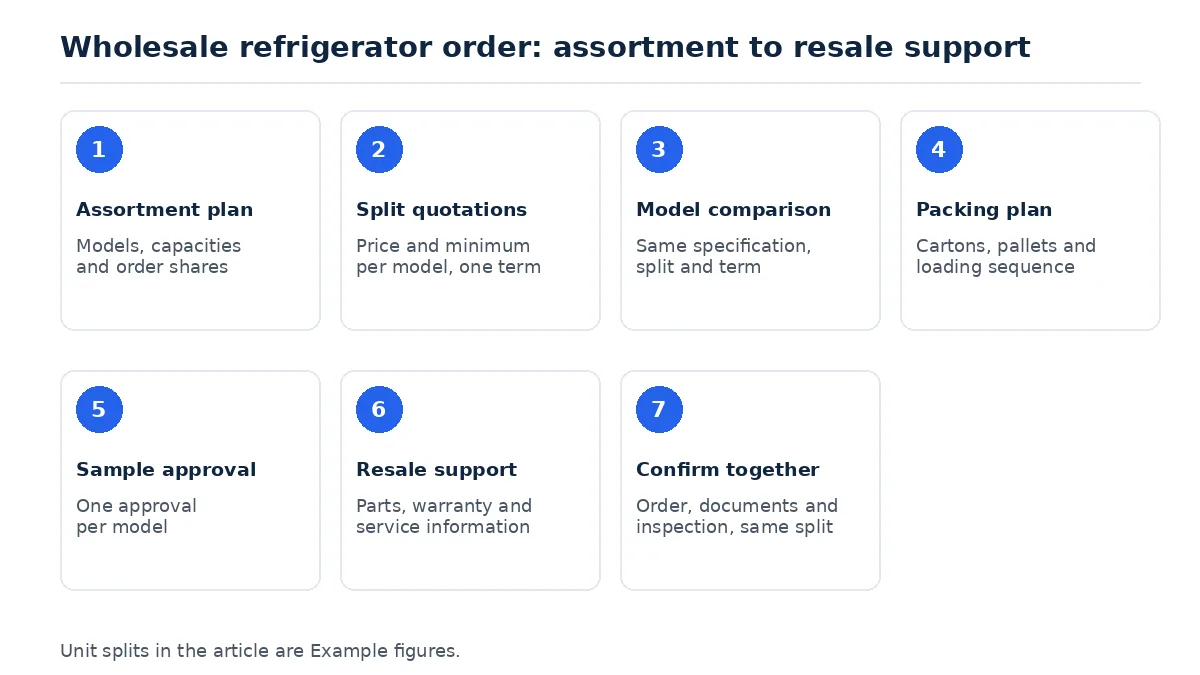
Write the assortment plan. List each model by type, capacity band, features and intended customer, with its share of the order and whether it may be substituted.
Request split quotations. Ask for unit price, minimum quantity and lead-time inputs per model, on one delivery term at one named place, and which models can share a container.
Compare model by model. Use one row per model and one column per supplier, comparing only replies with the same specification, split and term. The Incoterms 2020 rules give a clear allocation of cost, risk and obligations for each rule,3 so a comparison across terms is not a comparison.
Check the packing plan. Ask for units per carton, pallet use where agreed, and the container load by model, so the load unloads in the order your warehouse needs.
Approve samples per model. A sample for one model does not approve the others. Check capacity, fittings, controls, seals, labelling and the refrigerant statement per model, in writing.
Agree resale support before confirming. Put spare-parts availability, warranty handling, service information and who answers trade-customer questions into the purchase order, with a parts list per model.
Confirm order, documents and inspection together. All four should describe the same assortment. If one shows a different split, reconcile it before production starts.
Costs, timelines and documents
What are the typical costs and timelines?
There are no typical wholesale costs or timelines that a guide can state as fact, because each supplier prices each model for your specification, split and term. The Incoterms 2020 rules allocate cost, risk and obligations differently under each rule,3 so ask each supplier to price every line below.
Cost and time line | What to ask for, per model |
|---|---|
Unit price | Price per model and capacity band, on the stated term |
Minimum quantity | Minimum per model, per variant and for the order |
Packing | Carton specification, units per carton, pallet use |
Freight and insurance | Who arranges and pays each leg, under the stated term3 |
Inspection | Scope, sample basis and who pays, agreed before production |
Spare parts | Parts list, price basis and availability period |
Dates | Sample, approval, production and loading dates |
Example figures: an order split across three models, with the largest model taking the largest share and the smallest taking the smallest share, shows how a split works. The example shows structure only, not a typical order size, price, minimum or lead time. No destination duty rate is stated here, because duty depends on the destination tariff and each line classification. Ask your customs broker for the duty position per subheading before setting resale prices.
For timelines, ask for sampling, production, inspection and loading as separate dates per model. A single delivery week hides the model that is late.
Which documents are needed?
For export clearance in Bangladesh, goods may not be loaded unless an export declaration, the Bill of Export or Shipping Bill, is submitted to Customs and approved.4 Documents enclosed for all export consignments include the export letter of credit, or where there is none, the approved export contract, purchase order or guarantee, the commercial invoice, packing list, EXP form certified by authorized dealers, certificate of origin, VAT registration certificate and taxpayer identification number.4
Also hold the resale file: model-level quotation and purchase order, assortment and packing plan, sample approvals, inspection records, refrigerant statements, and spare-parts and warranty terms, kept one file per model.
Bangladesh-specific rules and tips
Match every paper to the same assortment. The export declaration names the exporter and foreign buyer and describes the goods and value.4 Names on the trade licence, quotation, proforma invoice, packing list and payment account should match, and the packing-list split should match the purchase order.
Confirm refrigerant per model and destination. The Kigali Amendment phases down hydrofluorocarbons globally, with differentiated timelines for developed and developing nations.2 A model acceptable in one destination may face a different position in another, so do not carry a statement from one market into a new market without a broker check.
Ask what the supplier actually holds. A catalogue can list more models than a supplier can produce and pack together. Ask which are in current production, which are made to order, and which need a separate run, and accept no capacity, location or certification claim without a document you have seen.
Plan the container around the assortment. Household units, chest freezers and display cabinets differ in size, weight and handling, so ask for the loading sequence by model, matching your unloading plan.
Keep electrical and labelling questions destination-specific. Voltage, plug type, energy labelling and safety marking vary by destination, so put each model requirements into the purchase order for supplier confirmation.
Mistakes and red flags
What are the most common mistakes?
Ordering a total instead of an assortment. A quantity with no model split lets the supplier fill the order with the easiest models, leaving stock in the wrong mix and shortages in wanted models. Always order by model, with a share and minimum per model.
Comparing prices across terms or mixes. A lower price on a different term, model, carton or refrigerant is a different offer. The Incoterms 2020 rules allocate cost, risk and obligations for each rule,3 so compare only on the same term, specification and split.
Approving one sample for a whole assortment. Each model needs its own approval. A household approval says nothing about a display cabinet or chest freezer in the same order.
Leaving resale support out of the order. Spare parts, warranty handling and service information agreed after delivery are harder to obtain and price. Put them in the order, with a parts list per model.
Treating a profile or badge as a guarantee. A profile is a starting point, and a badge records a document and photo review, not a guarantee of capacity, quality or delivery.5
Ignoring the refrigerant check. A model ordered without a refrigerant statement and broker check can arrive where it cannot be sold as configured. The Kigali phase-down makes this a moving position,2 so check it per destination and model.
Accepting a verbal change to the mix. Record any substitution or quantity change on the quotation and purchase order.
Checklist
Before confirming, every line should be answered in writing, per model where stated.
Assortment plan: model, type, capacity band, features and customer per line.
Order split per model, with a minimum per model and for the order.
Quotations compared on the same specification, split and term.3
Packing plan: units per carton, pallet use and loading sequence by model.
Samples approved in writing per model, including labelling and refrigerant statement.
Refrigerant stated per model, with a broker check for the destination.2
Spare-parts list, warranty handling and service information agreed per model.
Inspection scope agreed before production, with records kept per model.
Export set agreed: Bill of Export, invoice, packing list, EXP form, certificate of origin, VAT registration and taxpayer identification number.4
Packing-list split matched to the purchase order before loading.
Duty position checked with a broker per subheading; no duty rate assumed here.
How Exportain helps
On Exportain, browse suppliers and post your assortment plan on the RFQ board, with the model split, destination requirements and delivery term, so suppliers quote against the same plan. Ask each reply for the minimum per model, packing plan and spare-parts position, and compare replies model by model.
Read badges for what they record. Exportain verification is a document review by staff, not a factory inspection and not a check against a government database.5 Exportain Verified means it has checked identity, phone, email and business registration; Export Verified means it has checked the Export Registration Certificate; Factory Verified means it has reviewed factory photos; Trading Company Verified means it has reviewed office or warehouse photos.5 A badge is not a guarantee of capacity, quality or delivery.5 Verification is free and never granted by membership plans.6
When you accept a quotation, Exportain creates one order and issues one proforma invoice from the accepted terms.5
FAQs
What should I know first about refrigerators?
Know your resale market first, then your assortment. Confirm voltage, plug type, capacity bands and destination rules per model, separate household, display and freezer lines under heading 8418,1 and get a refrigerant statement per model with a broker check.2
What are the typical costs and timelines?
There are no typical costs or timelines to rely on, because each supplier prices each model for your specification, split and term.3 Ask for every cost and date line per model, compare only on the same term, and ask your broker for the duty position per subheading.
Which documents are needed?
The export set is the Bill of Export, invoice, packing list, EXP form, certificate of origin, VAT registration and taxpayer identification number, with the export letter of credit or approved contract, purchase order or guarantee.4 The wholesale file adds the assortment plan, sample approvals, inspection records, refrigerant statements and spare-parts terms.
What are the most common mistakes?
Ordering a total instead of an assortment, comparing prices across terms or mixes,3 approving one sample for several models, leaving resale support out of the order, and reading a badge as a guarantee when it records a document and photo review.5
Next steps on Exportain
Browse suppliers, then post your assortment plan, model split and delivery term on the RFQ board so suppliers quote model by model. Before confirming, read the landed cost guide for how to structure quotation cost lines.
Sources
- Classification Detail — HS Code 8418. United Nations Statistics Division (accessed )
- Kigali Amendment Overview. UNEP Ozone Secretariat (accessed )
- Incoterms® 2020. International Chamber of Commerce (ICC) (accessed )
- Customs Clearance Procedures for Export. Bangladesh Customs, National Board of Revenue (accessed )
- Trust & Safety Center. Exportain (accessed )
- Supplier verification: Earn trust badges buyers can see. Exportain (accessed )
About the author
Sourcing from Bangladesh?
Post a request for quotation and suppliers on Exportain can send you their quotes directly.
Post an RFQ


