Quality Control Checklist for Refrigerators From Bangladesh
A numbered QC checklist for refrigerators from Bangladesh: dimensions and volume, doors and seals, interior fittings, cooling and freezing tests, safety and controls, energy and rating labels, and packing, with fixes for common failures.
Short answer
Use this refrigerators quality control checklist to check external and internal dimensions and volume, door alignment and seal contact, shelves and drawers, cooling and freezing performance, electrical safety, controls, energy and rating labels, and packing on refrigerators from Bangladesh before shipment. Agree test methods, tolerances and acceptance limits in the purchase order.

On this page
Key takeaways
Agree the approved sample, specification, test methods, tolerances and acceptance limits before inspection, and draw the sample randomly across models and cartons.
Check door alignment and seal contact on every sampled unit, because a leaking seal raises energy use and hides cooling faults found later in testing.
Treat cooling, freezing and energy results as type-test evidence under IEC 62552 unless the purchase order names a lot test, and check the report names this model.
Match the rating plate, energy label, manual and carton marks to the destination market and model, and record actual measurements rather than pass marks alone.
If you import refrigerators, this checklist gives you a practical way to check a shipment before it leaves Bangladesh. A door that does not seal, a compartment that does not hold its temperature, or a label for the wrong market creates cost after arrival. Use an agreed sampling plan rather than units the factory selects. ISO 2859-1 specifies an acceptance sampling system for inspection by attributes, indexed in terms of the acceptance quality limit (AQL), applicable to end items.1
Why this checklist matters
Refrigerators combine a cabinet, a sealed cooling system and electrical controls in one bulky product, so one fault can affect safety, energy use and food storage. A weak seal shows only when the unit is run.
A written checklist removes interpretation. Each point is checked against the sample and specification, and recorded as pass, fail or not applicable. Set inspection level and acceptance limits per defect class in the purchase order, as ISO 2859-1 is indexed by AQL.1 See the AQL acceptance quality limit explainer.
Before you start
Do not begin until the references are complete: a signed specification per model, the purchase order, the dimension sheet with tolerances, label artwork for the destination market, and the packing specification. Agree the sampling plan in advance,1 and draw the sample randomly across models and cartons.
Check the safety references for this model before labels are printed. IEC 60335-2-24 deals with the safety of refrigerating appliances for household and similar use, and with compression-type appliances using flammable refrigerants.2 IEC 62552-1 specifies the essential characteristics of household refrigerating appliances and establishes test methods for checking them; its tests are type tests for declaration, not a regime for production sampling.3
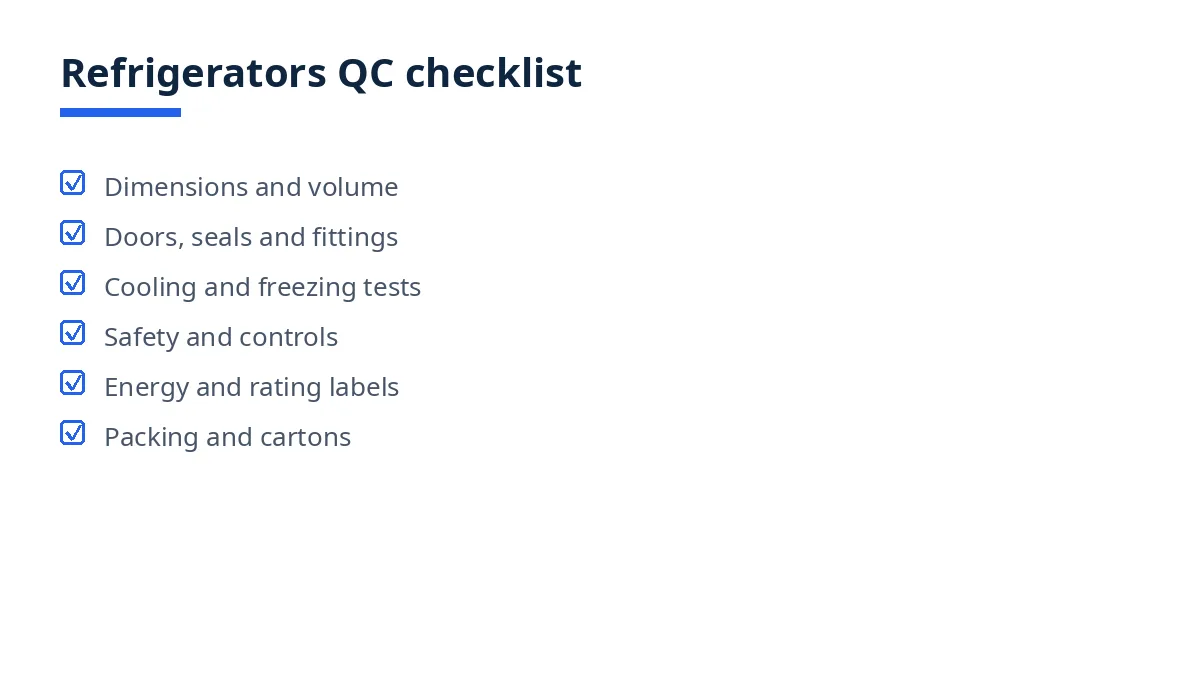
The full checklist (numbered, printable)
Dimensions, volume and fit
Select units across all models and colors and measure external height, width and depth, with doors and handles fitted as directed.
Measure internal dimensions per compartment and compare each result with the dimension sheet, recording actual values, not pass marks alone.
Check stated total and compartment volumes against the method named in the purchase order, and record any difference from the declared volume.
Check door swing, hinge side and clearance where the model is sold for a named space, and confirm reversible doors operate as directed.
Check the unit stands level and stable, with feet adjustable as specified and no rocking that could strain the hinges.
For mixed-model shipments, confirm each model label matches the measured unit and its carton contents.
Cabinet, doors and seals
Check the cabinet for dents, scratches, rust, sharp edges and uneven finish, including the back and top.
Check door alignment: doors sit square, handles are firm and level, and doors close without catching or sagging.
Check the door seal around its full length for cuts, twisting and gaps, and close each door on a sheet of paper at several points to check grip.
Check hinges, door stops and any door alarm named in the specification, and confirm doors stay closed when the unit is moved a short distance.
Check the rear panel, compressor cover and drain fittings for damage, loose screws and signs of oil or refrigerant leakage.
Check that protective film, tape and transit spacers required by the packing specification are present.
Interior fittings and finish
Check shelves, drawers, door bins and bottle racks for type, count and finish against the sample, with no cracks or loose fixings.
Check that shelves sit level, drawers slide without sticking, and removable parts refit without force.
Check the interior liner for cracks, discoloration, odour and loose covers, and check light fittings where fitted.
Check temperature controls, displays and mode buttons named in the specification for correct labelling and response when powered.
Check accessories, ice trays or makers, fittings, keys and manuals against the pack list for this model and market.
Cooling and freezing performance
Run each sampled unit as directed and listen for abnormal compressor, fan or vibration noise and pipe or panel rattles.
Review storage temperature evidence where required. IEC 62552-2 covers storage, cooling capacity and freezing capacity tests for refrigerating appliances.4
Review cooling and freezing capacity evidence where a four-star or capacity claim will appear on the product, and confirm method and limits were agreed in advance.4
Review other evidence named in the purchase order, such as pull-down, temperature rise and water vapour condensation, which IEC 62552-2 places in its annexes.4
Confirm every report names this model, the refrigerant and control setting used, and the test conditions, and is not for a different cabinet.
Check surfaces during running for heavy condensation and hot spots beyond the areas named in the specification, and compartments for unexpected frost build-up.
Electrical safety and controls
Check the power cord, plug and strain relief for the destination market, with no cuts or exposed conductors, and confirm rating plate voltage and frequency match the order.
Confirm the safety evidence covers this model. IEC 60335-2-24 states its scope by rated voltage: not more than 250 V for single-phase appliances and 480 V for other appliances.2
Where the model uses a flammable refrigerant, check the warning marks and handling instructions required for that refrigerant are present and legible.2
Check earthing, insulation and leakage test records where the purchase order requires them, and match serial numbers to the shipment where records are unit-specific.
Check defrost, fan, light and door-switch functions through a full operating cycle where the design allows it, and record any intermittent fault as a failure.
Check that no internal wiring, capillary tube or pipework is pinched or chafed where panels are removed under the agreed method.
Energy, noise and rating labels
Check the rating plate for model, voltage, frequency, refrigerant type and charge, climate class and maker details against the specification, with no over-stickers unless agreed.
For the EU, check the energy label against the destination rules. Regulation (EU) 2019/2019 sets ecodesign requirements for electric mains-operated refrigerating appliances with a capacity between 10 and 1,500 litres, and Delegated Regulation (EU) 2019/2016 lays down their labelling rules.5
Check that the unit label shows the items the EU format requires, including energy efficiency class on the A to G scale, annual energy consumption, compartment volumes and noise emissions.6
Check that energy, volume and noise values on the label, product information sheet, manual and carton match each other and the test evidence.
Check care, safety and installation instructions are in the languages required for the destination market, and that warning symbols are legible.
Check that no energy, star rating, capacity or refrigerant claim appears on the product or carton that is not supported by the evidence agreed for this lot.
Packing and cartons
Verify that each unit is packed as directed, with corner, door and surface protection and accessories secured, and no loose part that can damage the liner.
Check that carton marks show model, quantity, weight, handling marks and destination, and that barcode stickers scan and match the order.
Weigh and measure sample cartons, and check markings and carton count against the packing list.
Check stacking and palletising, where used, against the packing specification, with no carton crushed or leaning in a way that could bend doors.
Photograph sampled units, seals, labels and cartons, and attach photographs and measurement records to the inspection report.
Common failures and how to fix them
The most frequent failure is a door that looks closed but does not seal, usually because the door is out of square, the seal was deformed in storage, or the unit is not level. Stop, level the unit, check seal grip around the full door, and only then continue packing. Next is a compartment that runs warm, which can trace to a blocked air path, a control error or a faulty fan: separate a unit that fails to cool from a paperwork error before more units are packed.
Dents and crushed carton corners usually start at handling or stacking: change the protection or stacking pattern and re-check a packed unit. Wrong rating or energy labels point to artwork mix-ups: hold the lot, match every label version to the destination, and re-inspect labelled units as their own group.
Above the agreed acceptance level, options are re-inspection after sorting or rework, documented partial acceptance, or rejection.
Downloadable template / summary table
Copy the checklist into your inspection sheet, add tolerances, test methods and acceptance limits, and record a result per unit.
Section | Checks | Evidence |
|---|---|---|
Dimensions and volume | Height, width, depth, volume | Measurements per model |
Doors and seals | Alignment, seal grip, hinges | Paper grip check, photos |
Interior fittings | Shelves, drawers, bins, controls | Sample comparison |
Cooling performance | Storage, cooling, freezing | Type-test reports |
Safety and controls | Cord, rating, refrigerant marks | Test records, rating plate |
Energy and labels | Energy class, volumes, noise | Label and information sheet |
Packing | Protection, cartons, stacking | Packing list, photos |
How Exportain helps
Exportain is a B2B marketplace connecting buyers with Bangladeshi suppliers of refrigerators and other electrical products, so the specifications behind this checklist can be agreed at the enquiry stage. Browse suppliers, see the electronics and electrical category and use inspection services when you plan the check. Supplier profiles show which document and photo checks have been recorded, not factory inspections. Exportain is not a party to the goods contract and does not inspect goods.
FAQs
When should this checklist be used?
Use it at final inspection, when units are finished and largely packed. For larger and first orders, also use it in production, while doors, seals and artwork can still be corrected.
Who should complete it?
The buyer, a local agent or an independent inspector can complete it, using the specification, dimension sheet and a randomly drawn sample.
What are the most common failures?
A leaking door seal, a door out of square, a compartment that runs warm, cabinet dents and labels for the wrong market are the failures buyers find most often.
Can a third party do it?
Yes, if you share the references, test methods, tolerances and acceptance limits first. See also the pre-shipment inspection guide.
Next steps on Exportain
Before production starts, agree your specification, dimension sheet, test methods and label artwork, then read how to import refrigerators from Bangladesh and the pre-shipment inspection guide, and plan the check with inspection services. You can also post a free RFQ via RFQs.
Sources
- ISO 2859-1:1999 - Sampling procedures for inspection by attributes — Part 1: Sampling schemes indexed by acceptance quality limit (AQL) for lot-by-lot inspection. International Organization for Standardization (accessed )
- IEC 60335-2-24:2025 - Household and similar electrical appliances - Safety - Part 2-24: Particular requirements for refrigerating appliances, ice-cream appliances and ice makers. International Electrotechnical Commission, (accessed )
- IEC 62552-1:2015+AMD1:2020 - Household refrigerating appliances - Characteristics and test methods - Part 1: General requirements. International Electrotechnical Commission, (accessed )
- IEC 62552-2:2015 - Household refrigerating appliances - Characteristics and test methods - Part 2: Performance requirements. International Electrotechnical Commission (accessed )
- Ecodesign and energy labelling requirements — household refrigerators: Regulation (EU) 2019/2019 and Delegated Regulation (EU) 2019/2016. European Union (accessed )
- Commission Delegated Regulation (EU) 2019/2016 of 11 March 2019 with regard to energy labelling of refrigerating appliances. legislation.gov.uk, (accessed )
- pre-shipment inspection
- quality control
- aql inspection
- Electrical products
- Bangladesh electrical products
- Refrigerators
About the author
Sourcing from Bangladesh?
Post a request for quotation and suppliers on Exportain can send you their quotes directly.
Post an RFQ