

Wholesale Power Transformers From Bangladesh: Prices, MOQ and Reliable Suppliers
Wholesale power transformers from Bangladesh: buy by assortment, not by total. How per-rating MOQ, quantity tiers and price structure work, and how to check a supplier before you confirm an order.
Short answer
Wholesale power transformers from Bangladesh are bought by assortment, not by total unit count. Each supplier sets a minimum order quantity and a price structure per rating, shaped by quantity tiers, stock status, packing and the delivery term. Send every candidate the same assortment split by rating, ask for the per-rating minimum and tier prices in writing, and check badges, test reports and inspection terms before you confirm.

On this page
Key takeaways
A wholesale order is an assortment: the minimum and the price are set per rating, not for the order total.
State the split by rating, the stock status per rating and one delivery term, so quotations can be compared line by line.
A wholesale price is a structure: a unit price per rating, quantity tiers per rating, and separate packing, testing and transport lines.
No typical MOQ, price or lead time can be stated as fact, and no destination duty rate is given: ask your customs broker.
Exportain verification is a document and photo review, not a factory inspection, and a badge is not a guarantee.
A wholesale order for power transformers is not a single purchase. It is an assortment: several units, often across more than one rating and type, bought to stock, to resell, or to supply a run of projects. That assortment is what makes wholesale buying different from buying one unit for one site, and it is why no single wholesale price or minimum order quantity applies across suppliers.
Each supplier sets its minimum and price structure for your specification: the ratings in the order, the quantity of each rating, whether each rating is stocked or made to order, and the delivery term. A buyer who sends only a total unit count gets answers that cannot be compared, because two suppliers may be pricing different assortments.
In the Harmonized System, heading 8504 covers electric transformers, static converters and inductors.1 Its subheadings split liquid dielectric transformers by power handling capacity, from not exceeding 650 kVA to exceeding 10,000 kVA, which is one reason the rating split matters from the first enquiry.1 See the HS code for power transformers guide for the classification detail.
What should I know first about power transformers?
Start with the assortment, not the total. State each rating and type you need, the quantity of each, and whether you need all ratings at once or in staggered deliveries. A supplier can then answer which ratings it can supply, what minimum applies to each, and what changes if you consolidate ratings or stagger delivery.
Second, separate stocked units from made-to-order units. A stocked rating ships from existing stock, while a made-to-order rating is produced against your order on its own schedule. Mixing the two without labeling them produces one delivery date that fits neither group.
Third, treat the delivery term as part of the price. The Incoterms 2020 rules set out 11 rules with a clear allocation of cost, risk and obligations.2 Compare quotations only on the same rule and named place, or the cheaper quote may simply be the one that stops earlier.
Why this matters for buyers and sellers
For the wholesale buyer, the assortment decides how much capital sits in stock and whether customers or projects can be served without waiting for a fresh production run. A narrow assortment with deep quantity per rating is simpler to manage but serves fewer needs, while a wide assortment serves more needs but ties up more capital and needs more warehouse space and handling care.
For the seller, the assortment decides how the order is planned. Materials and production time are planned per rating, so a confirmed split lets the supplier schedule production and packing with fewer changes. A vague total invites requotes, since every correction to the split can move the price, the minimum or the delivery date.
Step-by-step: how it works
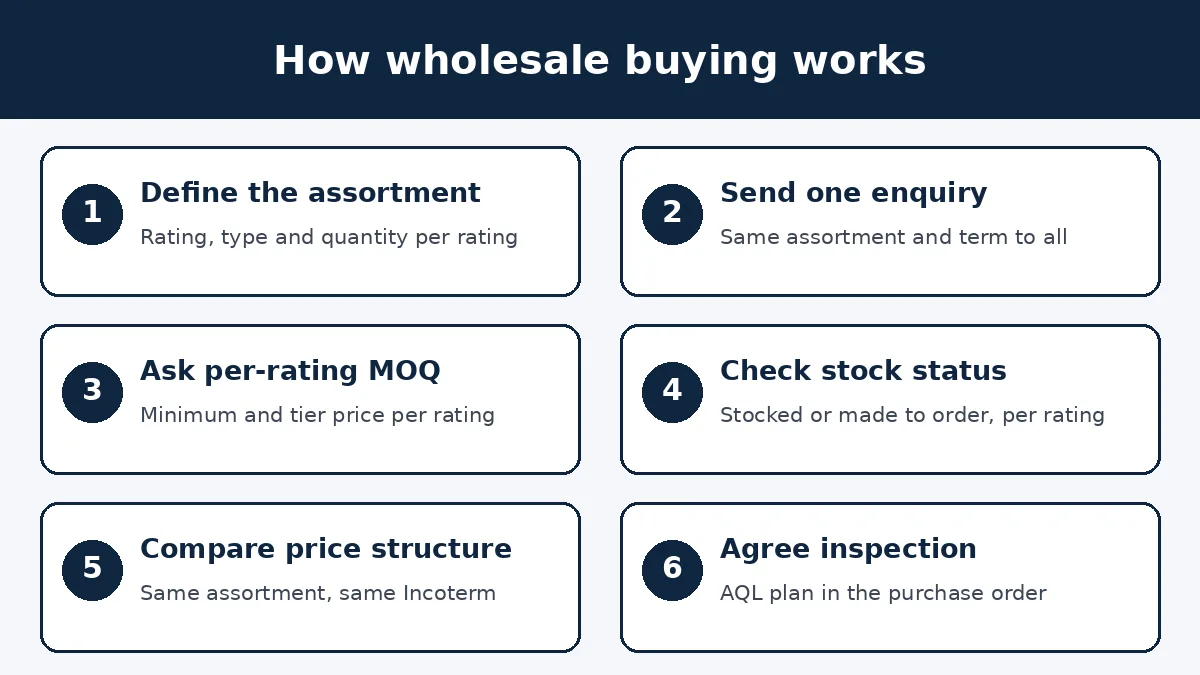
Define the assortment. List each rating and type, the quantity of each, and whether you need delivery in one lot or in staggered lots. Note which ratings are urgent and which can wait for a production run.
Send one enquiry to every candidate. Send the same assortment, specification summary and delivery term to each supplier, so replies can be compared line by line.
Ask for the minimum per rating. Ask for the minimum order quantity for each rating separately, and whether a mixed-rating order can meet a combined minimum. Ask what changes if you drop or consolidate a rating.
Ask what is stocked and what is made to order. Record the status per rating. For made-to-order ratings, ask for the schedule as separate lines: production, testing and packing, and readiness for shipment.
Ask for the price structure, not one lump figure. Ask how the unit price moves across quantity tiers per rating, and which cost lines sit outside the unit price, such as packing, crating, testing reports and transport under the chosen delivery term.2
Check documents and test reports before you confirm. Ask which test reports and product documents the supplier provides for your ratings, and have your own engineer review them. Do not accept a rating claim you cannot trace to a document for that rating.
Agree inspection and the delivery term in writing. Write the inspection plan and AQL values into the purchase order, following ISO 2859-1, which defines acceptance sampling plans for inspection by attributes, indexed by acceptance quality limit (AQL) for lot-by-lot inspection.3 State one Incoterm and named place for every quotation.2
Driver | What it changes | State in your enquiry |
|---|---|---|
Rating mix | Minimum and price per rating | Quantity per rating and type |
Stock status | Delivery timing | Stocked or made to order, per rating |
Quantity tier | Unit price per rating | Tier quantities you can commit to |
Packing and transport | Cost and handling risk | Packing, crating and delivery term |
Test reports | Acceptance of the units | Reports required, per rating |
Delivery term | Where cost and risk pass | One Incoterm and named place |
Example figures: a distributor orders 30 units split across three ratings at 10 units each, and one rating sits below its per-rating minimum while the total clears the order minimum. The same 30 units split as 15 and 15 across two ratings can clear both per-rating lines. Consolidating four slow-moving ratings into two raises the quantity per remaining rating at the same total. Both examples show structure only, not a typical MOQ, price or lead time.
Costs, timelines and documents
What are the typical costs and timelines?
There are no typical costs or timelines a guide can state as fact. Each supplier prices your ratings, quantities, packing, testing reports and delivery term, and schedules production against its own order book. A wholesale price is a structure: a unit price per rating, quantity tiers per rating, and separate lines for packing, transport and testing reports. Ask for that structure in writing, and compare suppliers on the same assortment and delivery term.2
For timelines, ask for separate dates rather than a single delivery week: assortment confirmation, production or stock readiness per rating, testing and packing, and readiness for shipment. A staggered delivery suits a wholesale buyer well when the stagger is written into the order with a date per lot.
Destination duty is not stated here, because no tariff schedule was opened for this guide. Ask your customs broker for the duty and import charges for your ratings, and confirm the classification with the broker before you commit to a landed-cost estimate.
Which documents are needed?
For export clearance in Bangladesh, goods may not be loaded unless an export declaration, the Bill of Export or Shipping Bill, is submitted to Customs and approved.4 Enclosed documents include the export contract or purchase order where there is no export letter of credit, the commercial invoice, the packing list, the EXP form certified by an authorized dealer, and a certificate of origin issued by the EPB or a Chamber of Commerce and Industry.4 The export set also includes the VAT registration certificate and the Taxpayer Identification Number.4
Your order documents sit alongside that export set: the assortment enquiry, the itemized quotation, the purchase order with the inspection plan and delivery term, and the test reports for your ratings. Keep one legal name for the buyer across all of them, because the export declaration names the exporter and the foreign buyer.4
Bangladesh-specific rules and tips
Keep one legal name across every paper. The export declaration specifies the goods, value, exporter, foreign buyer and transport operator.4 A name mismatch between the trade licence, quotation, proforma invoice and payment account can stall clearance, so check the names before the order ships.
Confirm badge claims at the source. If a supplier points to a badge, read what that badge records rather than assuming it covers capacity or delivery. Exportain Verified means Exportain has checked identity, phone, email and business registration, and Export Verified means it has checked the Export Registration Certificate (ERC).5 Factory Verified means it has reviewed photos of the manufacturer factory, while Trading Company Verified means it has reviewed photos of the trading company office or warehouse.5 Verification is a document review by staff, free, and never granted by membership plans.6
Ask which inputs are bought in for your order. Some components for your ratings may be bought in rather than held in stock, and a bought-in component can set both the minimum and the earliest production date. Ask per rating, and agree the delivery stagger around the slowest rating.
Check whether extra documents apply to your ratings. For some categories, product-wise additional certification or documents are necessary for export.4 Ask the supplier and your customs broker early which additional documents, if any, apply to your ratings and destination, so they are ready before shipment.
Mistakes and red flags
What are the most common mistakes?
Asking for a total MOQ only. The binding minimum is usually per rating. An order can clear the total and still fall below the per-rating minimum for one rating, which then carries a surcharge, a removal or a delayed lot.
Comparing quotations on different assortments or terms. A lower unit price on a different rating mix, quantity tier or delivery term is a different offer. Compare only replies to the same assortment on the same Incoterm.2
Accepting tier prices verbally. Record the quantity tiers, per-rating minimums and packing lines on the quotation and purchase order, with the assortment split they apply to. A tier that lives only in a chat message will not survive a requote.
Treating a profile or a badge as a guarantee. A badge is not a guarantee of production capacity, product quality or delivery.5 Verification is a document and photo review, not a factory inspection.6 Sample review, test reports and inspection stay with you.
Skipping inspection to save time. Sampling under ISO 2859-1 checks a lot against an agreed AQL,3 the last control before the units become your stock. One unchecked lot can affect every customer or project downstream.
Leaving packing and transport vague. If the quotation does not state the packing and bracing plan for the transport leg, ask for it before you confirm, not after the units are crated.
Checklist
Before you confirm, every line should be answered in writing.
Assortment defined: rating, type and quantity per rating, with delivery in one lot or staggered lots.
MOQ confirmed per rating; binding line named; mixed-rating rules confirmed.
Stock status per rating recorded: stocked or made to order.
Quantity tiers per rating itemized, with packing, testing reports and transport lines stated apart from the unit price.
Test reports and product documents requested per rating, for your engineer to review.
Inspection level and AQL values in the purchase order.3
Quotations compared on the same assortment and Incoterm.2
Export set agreed: invoice, packing list, EXP form, certificate of origin, Bill of Export.4
Destination duty and import charges confirmed with your customs broker.
Packing, crating and bracing plan agreed for each rating.
How Exportain helps
On Exportain, browse suppliers and post a request for quotation (RFQ) on the RFQ board with your assortment split by rating, your delivery term and your packing expectation, so suppliers quote against the same specification. Ask each reply for its per-rating minimum, quantity tiers and stocked or made-to-order status per rating. When you accept a quotation, Exportain creates one order and issues one proforma invoice from the accepted terms.5
Read the badges for what they record, as set out above: Exportain Verified, Export Verified, Factory Verified and Trading Company Verified each record a specific document or photo check.5 Verification is a document review by Exportain staff, and it is not a factory inspection.6 See how supplier verification works on Exportain and the MOQ definition guide.
For the wider import process, see how to import power transformers from Bangladesh, and for inspection points, see the power transformers quality control checklist.
FAQs
What should I know first about power transformers?
Know your assortment before you ask for a price: the rating and type of each unit, the quantity of each, and whether each rating is stocked or made to order. Heading 8504 covers electric transformers, static converters and inductors, with liquid dielectric transformers split by power handling capacity.1 The minimum and price are set per rating, so a total unit count alone cannot produce a comparable quotation.
What are the typical costs and timelines?
There are no typical figures a buyer can rely on, because each supplier sets its price structure and schedule for your assortment. The unit price per rating, quantity tiers, packing lines and delivery term drive the price,2 and stock status, production, testing and packing drive the timeline. Ask for each date as a separate line, and ask your customs broker for destination duty.
Which documents are needed?
The order documents are the assortment enquiry, the itemized quotation, the purchase order with the inspection plan and delivery term, and the test reports for your ratings. The export set is the Bill of Export, commercial invoice, packing list, EXP form certified by an authorized dealer, and a certificate of origin.4
What are the most common mistakes?
The most common mistakes are asking only for a total MOQ, comparing quotations on different assortments or delivery terms,2 accepting tier prices verbally, and reading a badge as a guarantee. A badge is not a guarantee of production capacity, product quality or delivery.5
Next steps on Exportain
Browse suppliers, then post your assortment split by rating and your delivery term on the RFQ board so suppliers state their per-rating minimum and quantity tiers. Before you confirm, read how supplier verification works on Exportain to see exactly what each badge records.
Sources
- Classification Detail — HS Code 8504. United Nations Statistics Division (accessed )
- Incoterms® 2020. International Chamber of Commerce (ICC) (accessed )
- ISO 2859-1:2026 - Sampling procedures for inspection by attributes — Part 1: Sampling schemes indexed by acceptance quality limit (AQL) for lot-by-lot inspection. ISO (accessed )
- Customs Clearance Procedures for Export. Bangladesh Customs, National Board of Revenue (accessed )
- Trust & Safety Center. Exportain (accessed )
- Supplier verification: Earn trust badges buyers can see. Exportain (accessed )
About the author
Sourcing from Bangladesh?
Post a request for quotation and suppliers on Exportain can send you their quotes directly.
Post an RFQ


