Wholesale Pajamas and Sleepwear From Bangladesh: Prices, MOQ and Reliable Suppliers
No single wholesale pajamas and sleepwear price or MOQ exists in Bangladesh. Learn how fabric hand, wash durability, relaxed-fit grading and set-versus-separates quoting shape the quote, and what to check before you confirm.
Short answer
There is no single wholesale price or MOQ for pajamas and sleepwear from Bangladesh. Each factory quotes your specification, with minimums per set, per top, per bottom and per colour. Before you ask for a price, fix the fabric family and hand, the wash-durability standard, the grading rule for the relaxed fit, and whether you are buying sets, separates or both, then compare quotations on the same specification and delivery term.
On this page
Key takeaways
There is no single wholesale price or MOQ for pajamas and sleepwear from Bangladesh: each factory sets minimums per set, per top, per bottom and per colour for your specification.
Fix fabric family and hand, the wash-durability standard, the relaxed-fit grading rule, and sets versus separates before you ask for a price, because each changes the quotation and the minimum.
Wash the pre-production sample to the agreed standard and measure both pieces of each set after washing, checking that the set still matches.
For children's sleepwear sold in the United States, settle the tight-fitting or flame-resistant route at the tech-pack stage, because it fixes the pattern block, measurements and labelling.
Verification is a document and photo review, not a factory inspection, and a badge is not a guarantee of capacity, quality or delivery.
A wholesale sleepwear order fails in ways that do not show up on a price sheet. The top and bottom of a set can match in colour and still sell badly together, because one piece kept its shape after washing and the other did not, or because a relaxed fit graded into a different garment at the ends of the range. Buying pajamas and sleepwear wholesale from Bangladesh therefore starts with the garment as it will be slept in, washed and worn again, and only then moves to price, minimum order quantity (MOQ) and supplier checks.
Behind this category sits a deep knitwear sector. Its apex trade body, the Bangladesh Knitwear Manufacturers and Exporters Association (BKMEA), founded in 1996, counts approximately 2,540 knitwear member factories.1 The Export Promotion Bureau (EPB) puts knitwear exports at $5.963 billion for July to September 2026, up 6.88 percent year on year, inside ready-made garment exports of $10.578 billion.2
Why this matters for buyers and sellers
What should I know first about pajamas and sleepwear?
Settle four decisions in writing before you ask for a price: fabric family and hand, wash-durability standard, grading rule for the relaxed fit, and sets, separates or both.
Fabric family comes first because sleepwear is judged by touch. A cotton jersey feels different from a brushed flannel, a satin weave, a modal blend or a rib knit, and that hand is part of the product, not a finishing detail. State the fibre composition, construction, weight and surface finish in the tech pack, and name the hand in plain words: soft and brushed, smooth and cool, light and draping, or warm and napped.
Wash durability is where sleepwear differs most from daywear. A pajama set is washed far more often than most garments, so shrinkage, colour loss, pilling, seam behaviour and elastic recovery after washing decide whether the range earns repeat sales or returns. State the wash cycles the sample must survive, the wash method, and what counts as a pass: measurements after washing, colour against the approved swatch, pilling grade, button and snap security, print condition and elastic recovery at waistband and cuffs.
Grading for relaxed fits needs its own rule. A relaxed pajama is cut with ease, or extra room beyond body measurements, and that ease must grow in a controlled way from size to size. Too much ease at larger sizes makes the garment shapeless; too little removes the relaxed feel that defines the style. State the body and garment measurements for every size, the ease at chest, hip and leg, and the grade rule between sizes, and check the smallest and largest sizes, not only the middle size.
Set versus separates quoting is the fourth decision. A set is sold as one unit with one price, while separates are priced per piece, with different minimums. A factory may set a minimum per set, per top and per bottom, and those lines do not move together: an order can clear the set minimum while one piece falls below its own minimum. State whether you want a set price, separate top and bottom prices, or both, and ask which minimum binds for your split.
Classification sits alongside these decisions. In the Harmonized System, heading 6108 covers slips, petticoats, briefs, panties, nightdresses, pyjamas, negligees, bathrobes, dressing gowns and similar articles, knitted or crocheted, for women or girls.3 See the HS code for pajamas and sleepwear guide.
Destination decides labelling. For the European Union, Regulation (EU) No 1007/2011 requires a textile product to be labelled or marked with the name and percentage by weight of all constituent fibres in descending order.4 Write the full composition into the tech pack and have the factory confirm the label wording before bulk cutting.
For the buyer, a sleepwear range is bought on comfort and repeat wear, so a failure after washing damages the whole range: a set that shrinks unevenly stops matching, a waistband that loses recovery stops fitting, and a print that cracks reads as poor quality even when the fabric is sound. For the seller, the same order ties up fabric dyed to your colours, trims matched to your specification, and labels and cartons printed with your brand,
Step-by-step: how it works
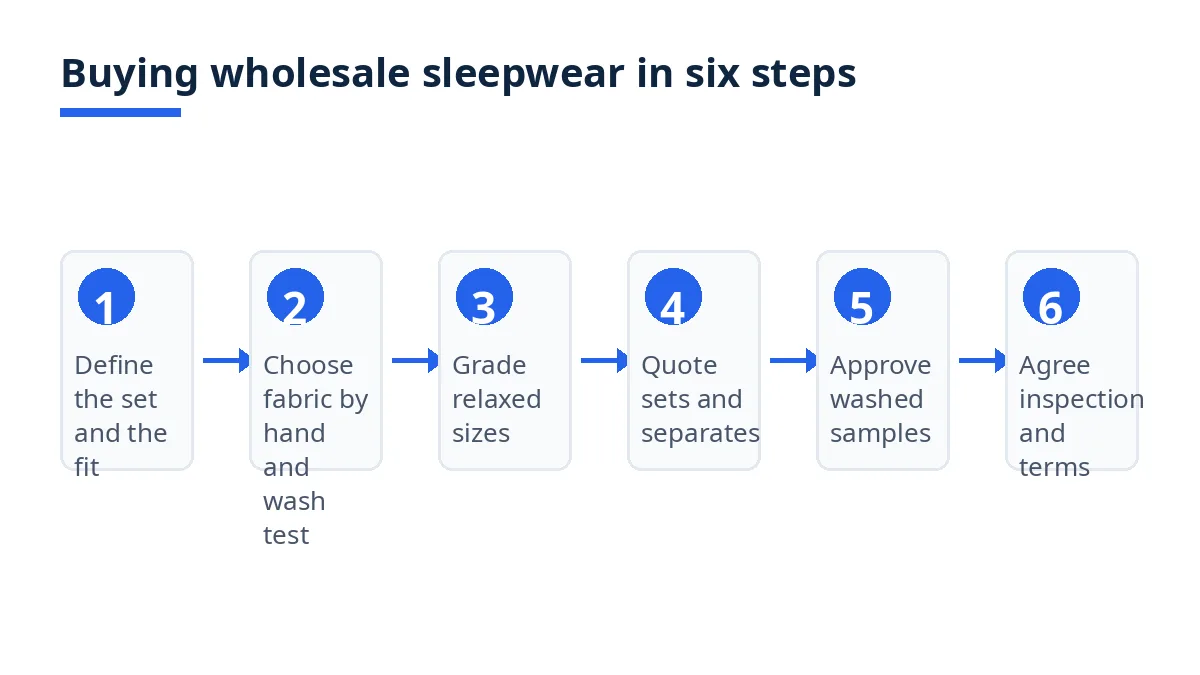
Define the set, the fit and the wearer. State the style for each piece, the wearer and age group, the relaxed-fit ease, the garment measurements for every size, and whether the order is sets, separates or both.
Choose fabric by hand and by wash test. Request swatches in each colour, in the actual fabric and finish. Wash them, check hand, shrinkage, colour and pilling, and only then fix the fabric in the tech pack.
Grade the relaxed fit and check the extremes. Send the full size chart with grade rules, and require sample measurements at the smallest and largest sizes as well as the middle size.
Quote sets and separates side by side. Ask for a set price and separate top and bottom prices, with the minimum per set, per top, per bottom and per colour stated as separate lines, and ask which line binds for your split.
Approve washed samples in writing. Order a proto sample for style and fit, then a pre-production sample in the actual fabric, colours, trims and labels, packed as bulk will be packed. Wash it to the agreed standard, measure it after washing, and approve it in writing or list corrections in writing.
Agree inspection and delivery term before you confirm. Write the inspection level, acceptance values and sleepwear defect list into the purchase order, and state one delivery term and named place for every quotation. See the pajamas and sleepwear quality control checklist for fabric, wash, fit and set-matching points.
Costs, timelines and documents
What are the typical costs and timelines?
There are no typical wholesale pajamas and sleepwear costs or timelines a guide can state as fact, because each factory prices your fabric family, finish, wash standard, grading, trim and label runs, packing and delivery term.
Driver | What moves the price or the minimum | State in your enquiry |
|---|---|---|
Fabric family and hand | Fibre, construction, weight, finish, dye lot per colour | Composition, construction, weight, finish, swatch approved |
Wash durability | Wash cycles, shrinkage control, pilling and elastic testing | Wash standard, pass criteria, cycles |
Relaxed-fit grading | Ease, grade rule, fabric use across the size range | Full size chart, ease, grade rule, size ratio |
Set or separates | Minimum per set, per top and per bottom; size ratios per piece | Set price and separate prices, ratio per piece |
Trims and labels | Buttons, snaps, drawcords, elastic, labels, tags, cartons | Trim spec, label wording, carton spec |
Delivery term | Point at which cost and risk pass | One delivery term and named place |
Example figures: a buyer orders 900 sets across three colours, which is 300 sets per colour. If the factory sets a minimum of 400 sets per colour, each colour falls 100 sets short, and the order needs 1,200 sets in total, calculated as 3 multiplied by 400, to clear all three colours. The same 900 sets in two colours at 450 sets per colour clears the same 400-set minimum on both colours.
For timelines, ask for sampling, fabric ready, dye approval, production, wash testing and shipment as separate dates, not a single delivery week. Dye approval and wash testing slip most often, because a colour that shifts after washing sends the order back to dyeing.
Which documents are needed?
The order documents are the tech pack with fabric, hand, wash standard, grading and set structure, the itemized quotation with set and separate prices and every minimum, and the purchase order carrying the same figures. The production documents are the written sample approvals, including the washed-sample result, and the inspection report.
Nothing loads without clearance: the export declaration — the Bill of Export or Shipping Bill — must be submitted to Customs and approved first.5 The enclosed set is the export contract or purchase order where no export letter of credit exists, the commercial invoice, the packing list, the EXP form certified by an authorized dealer, and a certificate of origin issued by the EPB or a Chamber of Commerce and Industry.5 Reconcile set count, piece count and values across invoice, packing list and purchase order: a set recorded as one unit on one paper and two pieces on another will mismatch at clearance and again at receipt.
Bangladesh-specific rules and tips
Check membership claims with the association. BKMEA membership, if claimed, is verifiable with BKMEA itself.1 A confirmed membership tells you the firm is an active knitwear business; it tells you nothing about its price, MOQ, fabric hand or wash performance.
Settle the children's route before sampling. For children's sleepwear sold in the United States, the flammability route turns on fit and size: Children's sleepwear that meets the definition of an infant garment or a tight-fitting garment falls under the general wearing apparel standard, while other children's sleepwear is subject to the sleepwear standards under 16 CFR part 1615 for sizes 0 through 6X or 16 CFR part 1616 for sizes 7 through 14.6 Decide at the tech-pack stage whether a children's style is tight-fitting or flame-resistant, because that decision fixes the pattern block, measurements and labelling.
One legal name on every document. The export declaration carries the exporter and the foreign buyer,5 so trade licence, quotation, proforma invoice and payment account should all name the same legal entity. A second name anywhere is a stop signal: get the connection documented before paying.
Write the wash test into the tech pack, not into an email. Sleepwear wash failures are disputed most when the standard was never written down. State the wash method, cycles, measurement points, colour and pilling checks, and the elastic recovery check,
Agree inspection and delivery term as controls, not as paperwork. ISO 2859-1 defines a system of acceptance sampling plans for inspection by attributes, indexed by acceptance quality limit (AQL) for lot-by-lot inspection.7 AQL is the maximum average percentage of defective items considered acceptable during random sampling, and it determines sample sizes and acceptance or rejection thresholds.7 The Incoterms 2020 rules set out 11 rules with a clear allocation of cost, risk and obligations.8
Mistakes and red flags
What are the most common mistakes?
Approving a sample that was never washed. A sample measured flat and approved unwashed has passed no test that matters to the end wearer. Wash the pre-production sample to the agreed standard and check that the set still matches after washing.
Grading only the middle size. A relaxed fit approved in a middle size can fail at the extremes. Require measurements at the smallest and largest sizes.
Quoting sets without quoting separates. A buyer who asks only for a set price learns nothing about which piece binds the minimum. Ask for both, with every minimum stated.
Approving colour from a single unwashed swatch. Colour, hand and surface all change with washing. Approve colour on a washed swatch in the actual fabric and finish, and compare both pieces of a set against each other.
Reading a profile or a badge as proof of wash or fit performance. A profile is a starting point for enquiries. It does not test whether a factory can hold your fabric hand, grading or wash standard across bulk, and a badge is not a guarantee of capacity, quality or delivery.9
Checklist
Before you confirm, every line should be answered in writing.
Tech pack sent: style per piece, wearer, fabric family and hand, wash standard, grading and ease, size chart, trims, labels, packing.
Set structure stated: set price and separate top and bottom prices requested, with size ratio per piece.
Minimums confirmed per set, per top, per bottom and per colour; binding line named.
Fabric status per colour recorded: stocked or dyed to order, with washed swatches approved.
Wash standard written: method, cycles, measurement points, colour, pilling and elastic checks.
Grading checked at the smallest and largest sizes, not only the middle size.
Children's route settled where applicable: tight-fitting or flame-resistant, with the applicable standard named.6
Pre-production sample washed, measured after washing, set-matched and approved in writing.
Inspection level, AQL values and sleepwear defect list in the purchase order.7
Quotations compared on the same specification and delivery term.8
Export set agreed: invoice, packing list in sets and pieces, EXP form, certificate of origin, Bill of Export.5
How Exportain helps
On Exportain, browse suppliers and post a request for quotation (RFQ) on the RFQ board with your fabric, hand, wash standard, grading and set structure, so suppliers quote against the same specification. Ask each reply for its set and separate prices and every minimum. See how supplier verification works on Exportain and the MOQ definition guide. Verification is a document and photo review, not a factory inspection,9 10 so washed-sample approval and inspection stay with you.
FAQs
What should I know first about pajamas and sleepwear?
Know the fabric family and its hand, the wash-durability standard, the grading rule for the relaxed fit, and whether you are buying sets or separates, before you ask for a price. Women's or girls' knitted nightdresses and pyjamas sit under HS heading 6108, which covers nightdresses, pyjamas and similar articles, knitted or crocheted.3
What are the typical costs and timelines?
There are no typical figures a buyer can rely on, because each factory sets its price, MOQ and lead time for your specification. Fabric family and finish, wash standard, grading and fabric use, set or separates structure, trim and label runs, and the delivery term drive the price,8 while sampling, dye approval, wash testing and inspection drive the timeline.
Which documents are needed?
Two paper bundles close the order. The commercial bundle — tech pack, itemized quotation, purchase order — must carry set and separate prices and every minimum in both the quotation and the purchase order. The shipment bundle is different paper: a certificate of origin from the EPB or a Chamber of Commerce and Industry, an EXP form certified by an authorized dealer, the packing list, the commercial invoice, and the Bill of Export itself.5
What are the most common mistakes?
The most common mistakes are approving a sample that was never washed, grading only the middle size, quoting sets without quoting separates, and reading a badge as a guarantee. A badge is not a guarantee of capacity, quality or delivery.9
Next steps on Exportain
Browse suppliers, then post your fabric, hand, wash standard, grading and set structure on the RFQ board. Before you confirm, read how to import pajamas and sleepwear from Bangladesh.
Sources
- BKMEA at a Glance. BKMEA (accessed )
- RMG exports rise 6.10pc to US$10.58b in July-Sept of FY27. The Financial Express, (accessed )
- Classification Detail — HS Code 610839. United Nations Statistics Division (accessed )
- Regulation (EU) No 1007/2011 on textile fibre names and related labelling and marking of the fibre composition of textile products. European Union, (accessed )
- Customs Clearance Procedures for Export. Bangladesh Customs, National Board of Revenue (accessed )
- Clothing Business Guidance. U.S. Consumer Product Safety Commission (accessed )
- ISO 2859-1:2026 - Sampling procedures for inspection by attributes — Part 1: Sampling schemes indexed by acceptance quality limit (AQL) for lot-by-lot inspection. ISO (accessed )
- Incoterms® 2020. International Chamber of Commerce (ICC) (accessed )
- Trust & Safety Center. Exportain (accessed )
- Supplier verification: Earn trust badges buyers can see. Exportain (accessed )
About the author
Sourcing from Bangladesh?
Post a request for quotation and suppliers on Exportain can send you their quotes directly.
Post an RFQ