

Wholesale LED Street Lights From Bangladesh: Prices, MOQ and Reliable Suppliers
Wholesale LED street lights from Bangladesh, bought as an assortment: tiered prices per wattage and model, MOQ per model, spares packs and replenishment terms, with per-model evidence checks before you order.
Short answer
Wholesale LED street lights from Bangladesh are bought as an assortment, not as a single model: a ladder of wattages and optics, each with its own tiered price, minimum order quantity, spares pack and replenishment terms. Build the ladder first, ask for the tier price sheet and minimum per model in writing, check each model against its own test evidence, and agree repeat price, validity and lead time before the first order.
On this page
Key takeaways
A wholesale street-light order is an assortment: a ladder of wattages and optics, each with its own tier price, MOQ, spares and lead time.
Ask for the tiered price sheet per model in units, with scope and validity on every line, and check the MOQ per model, not on the order total.
Check each model against its own test evidence: luminaire efficacy, IP rating for housing and driver compartment, and the IEC 62722-2-1 product-information fields.
Price and order the spares pack with the first shipment, per model, and agree repeat price, validity, repeat MOQ and replenishment lead time in writing.
Exportain verification is a document and photo review, not a factory inspection, and a badge is not evidence that a particular model meets its datasheet.
A wholesale order for LED street lights is not a bigger version of a single-model order. It is an assortment order: several wattages, several optics, matching drivers, brackets and spares, bought in quantities that must sell through before a model change or a driver revision makes shelf stock hard to match. Plan the assortment first and the price tiers second, or end up with one wattage in depth and shortages of the rest.
This guide covers the wholesale channel only: building the assortment, tiered pricing across wattages and models, MOQ per model rather than per order, spares packs, and replenishment terms so the second order is as straightforward as the first. It does not rank suppliers.
Why this matters for buyers and sellers
For a buyer, the assortment decides how much cash sits in stock and how often a project stalls for a missing item. A project rarely needs one wattage alone: main road, side road, junction and walkway each call for a different output, and each pole needs a matching driver. A single-wattage assortment leaves side-road work unfilled.
For a seller, the assortment decides whether a production run is efficient: a small quantity of an odd model can cost more to set up than it earns. That is why wholesale terms are set per model, even in the same shipment.
The channel also changes the risk: a driver fault in an assortment affects every wattage sharing that driver. Put the driver identity, surge rating and replacement procedure for each model in writing, and keep one reference sample per model.
Step-by-step: how it works
Work through the assortment before asking for a price: two suppliers pricing different mixes cannot be compared.
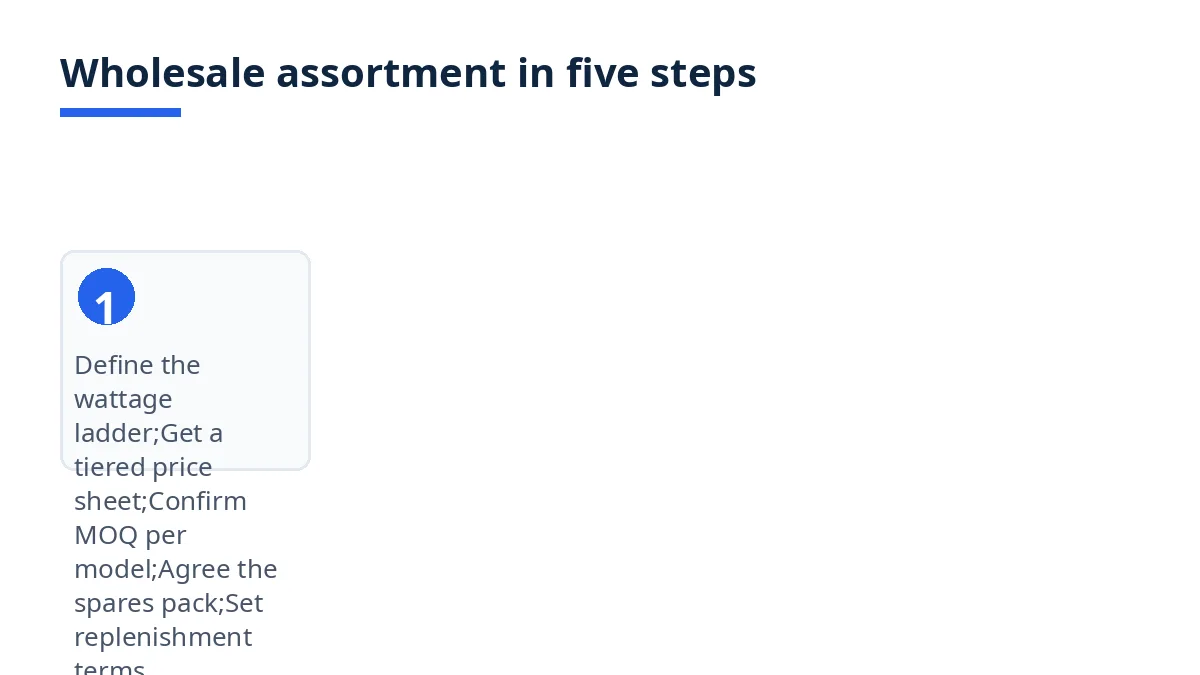
Define the wattage ladder. List every wattage, with the road type, mounting height and pole spacing each serves, plus the optic and the input voltage range for the destination market. Gaps force crews to fit the wrong head; too many rungs split orders below their per-model minimum.
Ask for a tiered price sheet, per model. Ask for the unit price at each tier for each model, with tier boundaries in units, not order value. A tier counting total units across models hides the slow-moving model's real price. Require the sheet to state what each price includes.
Confirm the MOQ per model, in writing. Ask for the minimum per model and per wattage, and whether it counts heads only or heads plus spares. A total-order minimum is not enough: an order can clear the total while one wattage sits below its own minimum and attracts a surcharge or removal.
Check each model against its own test evidence. Ask for the luminaire efficacy rating from a test report, not a headline wattage. Luminaire efficacy is the ratio of light output to electrical power input, in lumens per watt, with a higher number indicating a more efficient product.1 As a reference point, the United States Department of Energy sets a minimum of 136 lumens per watt for outdoor pole or arm-mounted area and roadway luminaires in its federal purchasing guidance, with performance determined under industry test standards including IES LM-79.1 That is a federal purchasing benchmark, not a Bangladesh requirement, and a per-model check, not a supplier claim.
Read the ingress protection rating per model, digit by digit. The IP rating consists of "IP" followed by two digits: the first indicates protection against solid particles, and the second protection against liquid ingress, with a higher digit denoting higher protection.2 Under IEC 60529, a first digit of 6 means dust-tight.2 Ask for the rating for the housing and separately for any driver compartment, per model.
Line up the product information for each model. IEC 62722-2-1, the performance standard for LED luminaires, lists product information including rated input power, rated luminous flux, rated efficacy, rated colour temperature, rated colour rendering index, rated ambient temperature and rated median useful life with its lumen maintenance factor.3 Check that model name, wattage, colour temperature and maintenance figure agree across datasheet, test report and quotation, per model.
Agree the spares pack before the first shipment. State spare drivers per model, replaceable optics or lenses, gaskets, brackets and fixings, with a price and lead time for each. Price spares as their own line, so a later driver failure does not force a full-head purchase.
Set the replenishment terms in the first order. Agree the repeat price and validity, the repeat MOQ per model, the repeat lead time, and whether a repeat can mix models to reach a tier. Without written terms, the second order is negotiated from scratch, often dearer and slower.
Agree the delivery term and the inspection lot plan. The Incoterms 2020 rules provide 11 rules with a clear allocation of cost, risk and obligations.4 State one Incoterm and named place for every quotation, and compare tier prices only on the same term. For inspection, the Acceptable Quality Limit is the maximum percentage of defective items considered acceptable in a batch or lot, and ISO 2859-1 provides sampling procedures and plans for inspection by attributes using that limit.5 Agree the sampling plan, defect classes and failed-lot remedy before payment, per model lot, not across the mixed shipment.
Costs, timelines and documents
Tiered pricing across the assortment
Wholesale pricing is a schedule, not a single figure. Each model carries its own tiers: a higher-wattage head uses a larger housing and driver, a less common optic may run in a smaller batch, and a model with pole and arm in scope costs more to pack and ship than a head alone. Ask whether a repeat order requalifies on cumulative volume or only on that order's volume.
Example figures: the table below shows structure only, not prices, MOQs or lead times any supplier offers. Replace every figure with the supplier's written reply for your models.
Model in the assortment | Tier 1 | Tier 2 | Tier 3 | Price includes |
|---|---|---|---|---|
Low-wattage head, side roads | Example figures: 200 units | Example figures: 500 units | Example figures: 1,000 units | Head, bracket, fixings |
Mid-wattage head, distributor roads | Example figures: 150 units | Example figures: 400 units | Example figures: 800 units | Head, bracket, arm |
High-wattage head, main roads | Example figures: 100 units | Example figures: 250 units | Example figures: 500 units | Head, arm, pole hardware |
Spare driver, per model | Example figures: 20 units | Example figures: 50 units | Example figures: 100 units | Driver only, model named |
Three pricing traps recur: a tier counted on order value, a tier price that drops the pole or arm at the higher tier, and a tier price with no validity date. Ask for units, scope and validity on every tier line, and attach the sheet to the purchase order.
Timelines
There is no typical wholesale lead time to quote, because sampling, component supply, production and inspection run per model. Ask for separate dates per model rather than one delivery week for a mixed assortment, state the replenishment lead time per model in the first order, and judge a quote by its slowest model unless split shipments are agreed in writing.
Documents
For export clearance in Bangladesh, goods may not be loaded unless an export declaration, the Bill of Export or Shipping Bill, is submitted to Customs and approved.6 Enclosed documents include the export contract or purchase order where there is no export letter of credit, the commercial invoice, the packing list, the EXP form certified by an authorized dealer, and a certificate of origin issued by the EPB or a Chamber of Commerce and Industry.6 Keep legal names on the quotation, proforma invoice and payment account consistent with the declaration, which names the exporter and the foreign buyer.6
Alongside the export set, keep a per-model file — datasheet, photometric file, IP test report, luminaire test report, driver datasheet, surge rating — each naming the exact model and wattage. A file for a neighbouring wattage does not cover the model you buy.
Bangladesh-specific rules and tips
Ask which inputs are imported for each model. An imported component can set both the minimum and the earliest production date for that model alone, so record the component position per model.
Confirm product-wise documents early. Bangladesh Customs notes that for some categories, product-wise additional certification or documents are necessary for export.6 Ask which additional documents apply to your models and destination, and who provides them, before confirming the first order.
Keep one specification sheet per model. An assortment fails most often in paperwork: a quotation names one wattage, a datasheet a neighbouring one, and the packing list a third. Write one sheet per model and require every document to match it; when a model changes, issue a new sheet and retire the old one.
Plan stock around model change, not only demand. A driver revision or discontinued optic can strand spares. Ask for written notice of changes and the last-order date for a discontinued model, so a final spares order can be placed in time.
Mistakes and red flags
Buying one wattage in depth and nothing else. Deep stock of one wattage looks like a wholesale deal and behaves like a shortage elsewhere. Build the ladder first, then set depth per rung from project demand.
Counting the MOQ on the order total. The binding minimum is usually per model: an order can clear the total yet fall below one wattage's minimum, which then carries a surcharge or removal.
Comparing tier prices on different scopes. A lower tier price on a head-only line is not cheaper than a higher tier price on a head-plus-arm line. Compare only replies to the same scope list and Incoterm,4 with the same spares and validity terms.
Accepting a tier price without a validity date. A schedule with no validity period invites renegotiation at the repeat order. Record validity, repeat price and repeat MOQ per model in the first order.
Ordering spares as an afterthought. Spares ordered after installation starts compete with new production for line time. Price and order spares with the first shipment, per model.
Mixing drivers across models without a record. If two models share a driver, a fault or a change affects both. Record the driver per model.
Treating a profile or a badge as model evidence. A profile shows declared products and a verification level, not whether a wattage meets its datasheet. Ask for the per-model file on every model.
Skipping lot inspection on a mixed shipment. A mixed shipment contains several lots. Apply the sampling plan per model lot, so a defect in one model does not hide in an average across the shipment.5
Checklist
Before you confirm a wholesale order, every line should be answered in writing, per model where stated.
Wattage ladder defined per model: road type, mounting height, pole spacing.
Tiered price sheet per model, in units, with scope and validity.
MOQ confirmed per model; binding line named for each wattage.
Per-model evidence file: datasheet, photometric file, IP report, test report, driver datasheet, surge rating.
Efficacy checked per model from lumens and watts in the same test report.1
IP rating recorded per model for housing and driver compartment separately.2
Product information lined up per model: power, flux, efficacy, colour temperature, colour rendering, ambient temperature, lumen maintenance.3
Spares pack priced per model, with lead times.
Replenishment terms agreed: repeat price, validity, repeat MOQ, repeat lead time.
One Incoterm and named place on every quotation.4
Inspection plan, defect classes and failed-lot remedy agreed per model lot.5
Export set agreed: Bill of Export, invoice, packing list, EXP form, certificate of origin.6
Model-change notice and last-order date agreed in writing.
How Exportain helps
On Exportain, browse suppliers and post a request for quotation on the RFQ board stating the full assortment: each model and wattage, the quantity per tier, the scope per line, the delivery term, the required certifications and the deadline. A request for quotation states quantity and unit, target price, destination, Incoterm, required certifications and deadline, and suppliers in that category can quote against it.7 Every quotation is versioned, showing unit price, MOQ, lead time, Incoterm, payment terms and validity, so tier sheets can be compared line by line.7
Read badges for what they record. Exportain staff review every verification submission, and approved checks earn badges shown on the company page, listings and quotations, but verification is a document and photo review, not a factory inspection.8 A badge does not tell you a wattage passed a photometric test or that a tier price will hold at the repeat order.
FAQs
What should I know first about LED street lights?
Know the assortment before the price: a ladder of wattages, optics and drivers, each with its own MOQ, tier price, spares and lead time. Luminaire efficacy is the ratio of light output to electrical power input, in lumens per watt,1 and the IP rating reads digit by digit, first for solids and dust, then for water.2 Ask for both, per model, from a test report for the exact model.
What are the typical costs and timelines?
There are no typical wholesale costs or timelines to rely on, because each model carries its own tier schedule, scope and production plan. Price is set per model and per tier, with scope and validity on every line, and timelines per model. The Incoterms 2020 rules allocate cost, risk and obligations for the delivery term you choose,4 so compare quotes only on the same term and scope.
Which documents are needed?
The order documents are the per-model specification sheets, the tiered price sheet, the purchase order with replenishment terms, and the per-model evidence file. The export set is the Bill of Export, commercial invoice, packing list, EXP form certified by an authorized dealer, and a certificate of origin issued by the EPB or a Chamber of Commerce and Industry.6 Keep legal names consistent across quotation, proforma invoice and export declaration.6
What are the most common mistakes?
The most common mistakes are counting the MOQ on the order total instead of per model, comparing tier prices on different scopes or delivery terms,4 accepting a tier price without a validity date, ordering spares after installation, and skipping per-model lot inspection.5
Next steps on Exportain
Browse suppliers in the lighting category, then post your full assortment on the RFQ board with the tier quantities and scope you want priced per model. Before you confirm, read the LED street lights quality control checklist and use it to write the per-model lot inspection clause.
Sources
- Purchasing Energy-Efficient Exterior Lighting. U.S. Department of Energy (accessed )
- What is an Ingress Protection Rating (IP rating)?. Isarsoft (accessed )
- IEC 62722-2-1:2014 - Performance Requirements for LED Luminaires. International Electrotechnical Commission (IEC) (accessed )
- Incoterms® 2020. International Chamber of Commerce (ICC) (accessed )
- ISO 2859-1:2026 — Sampling for Inspection by AQL. American National Standards Institute (ANSI) (accessed )
- Customs Clearance Procedures for Export. Bangladesh Customs, National Board of Revenue (accessed )
- How to source and buy from Bangladesh. Exportain (accessed )
- Supplier verification: Earn trust badges buyers can see. Exportain (accessed )
- MOQ
- supplier verification
- pre-shipment inspection
- importing from Bangladesh
- aql inspection
- Electrical products
- LED street lights
About the author
Sourcing from Bangladesh?
Post a request for quotation and suppliers on Exportain can send you their quotes directly.
Post an RFQ


