Wholesale Leather Gloves From Bangladesh: Prices, MOQ and Reliable Suppliers
Buy wholesale leather gloves from Bangladesh grade first and lot first: fix the glove grade, leather, lining and size curve, count the minimum per combination, and approve sample pairs before bulk.
Short answer
Wholesale leather gloves from Bangladesh should be bought grade first and lot first. Fix the skin, grade, finish, tannage, color, lining, and size curve in writing, count the lot minimum per color and lining combination, and approve sealed sample pairs from the lot offered. Grade the size curve pair by pair, require lab evidence for the lot separately from any tannery audit, and compare quotations only on one identical specification.
On this page
Key takeaways
Buy the grade and the lot first: skin, grade term, finish, lining, and size chart with tolerances in writing before any price comparison.
A lot minimum counts per color and lining combination. Example figures: 150 pairs per combination across 2 colors and 3 linings is 900 pairs.
Grade the size curve pair by pair: finger length, thumb, fourchettes, lining, and closure, with shade judged under one agreed light.
A tannery audit covers the tannery, not the finished glove. Require lab evidence for the lot offered, separately from audit evidence.
Gloves are classified at heading 4203: 4203.21 for sports gloves, 4203.29 for other gloves. Confirm the full national code in the destination tariff.
A wholesale order of leather gloves is an order of pairs, decided grade by grade and lot by lot. One lot can hold pairs that differ in shade, thickness, finger length, and lining. This guide helps buyers order wholesale leather gloves from Bangladesh grade first and lot first: fix the specification, count the minimum per combination, grade the size curve, and approve sample pairs before bulk. All figures are examples. No market price, factory capacity, or standard minimum is stated as fact.
A glove order is a pair order, decided grade by grade
A leather glove is sold and worn as a pair. A glove with one short finger, one tight thumb, or one darker hand is a pair the buyer cannot sell, and most glove faults hide in small parts: a twisted panel between fingers, a lining that pulls out at the fingertip, a cuff that loses grip.1 A specification built for jackets or bags will miss them, because it never asks whether the left hand matches the right hand finger by finger.
Grade names describe which layer of the hide is used and what was done to its surface, so the label alone does not show finish or construction.2 Full-grain keeps the entire grain layer; top-grain includes the outer grain layer; corrected grain had flaws buffed or sanded away before dyeing and embossing.2 Split comes from the fibrous layer under the grain, "genuine leather" is not a grade, and bonded leather is ground fibers combined with other substances.2 Natural marks are inherent to hides, so inspection grades by position and size.1 Agree the grade rules before production.
Choose the skin, the grade, and the lining as one lot decision
A glove lot is one skin, one grade, one finish, one color, and one lining, cut to one size curve. State the animal and skin, grade term, finish, tannage, color, lining, and closure in one specification, and require every quotation to answer it line by line.
Grade term | Layer used | Surface treatment | Confirm in writing |
|---|---|---|---|
Full-grain | Whole grain layer | Not removed | Natural marks accepted, finish named |
Top-grain | Outer grain layer | Varies with finish | Finish type and coating named |
Corrected grain | Grain side | Flaws buffed away, dyed, sometimes embossed | Emboss pattern and coating named |
Split | Corium under the grain | Varies; suede is a common result | End use and coating named |
Bonded | Ground leather fibers | Combined with other substances | Fiber share and backing named |
Lining is a lot decision, not an extra. The lining types named for leather gloves are cashmere, wool, silk, or unlined, and the lining must lie flat, be attached at fingertips and cuff, and not bunch or pull out.1 One glove maker ranks linings for warmth from sheepskin first, then cashmere, wool, and silk, with unlined gloves last, for maximum feel.3 A thicker lining changes fit: the same maker advises choosing the larger size when between sizes with sheepskin linings.3 Judge fit on a lined sample pair, never on an unlined pair.
Grade the size curve before you grade the price
Glove size corresponds to the circumference of the palm in inches: wrap a tape around the widest part of the palm just below the knuckle, excluding the thumb, using the dominant hand.4 On one published chart, 6.5 to 7 inches takes size 7, 7.5 to 8 takes size 8, 8.5 to 9 takes size 9, and 9.5 to 10 takes size 10.4 That chart belongs to its maker. Size charts are not universal, so the supplier's own chart, with its measurement points and tolerances, is the chart the order is graded against.
Set the measurement rules in advance: palm width, finger length, cuff length, thumb position, and overall length.1 Color difference is judged against a stable light source and color datum.1 Example figures: a size curve of 120 pairs in size 7, 240 in size 8, 360 in size 9, 240 in size 10, and 120 in size 11 totals 1,080 pairs. The curve is the order: filling the total with the easiest sizes and starving the middle sizes has not filled it. Grade size by size: each finger against the chart and compared with its pair, fingertips round and symmetrical, thumbs mirroring each other.1 A shade split inside a pair usually means the hands were cut from different skins or dye lots.
Seven lot checks, in the order that settles a glove order
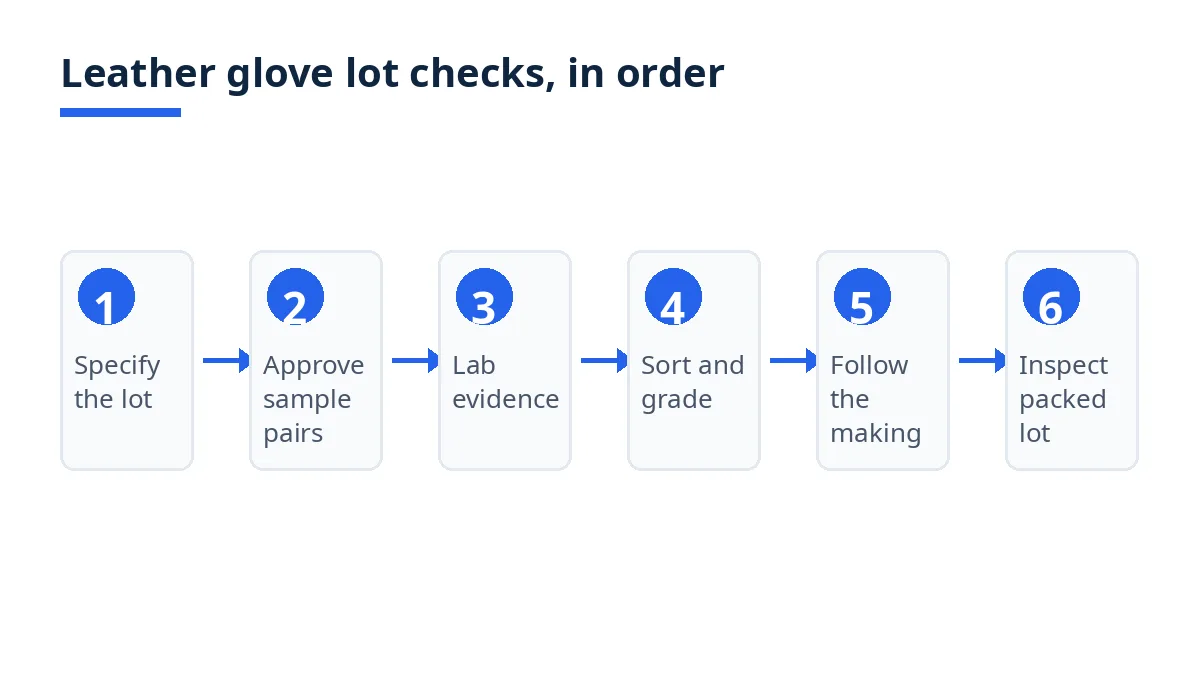
Work the lot in order. Each check answers one question, and a later check cannot repair an earlier one that was skipped.
Specify. Write the skin, grade, finish, tannage, color, lining, closure, size chart with tolerances, grade rules by position, and packing. Name the lot: one skin, one grade, one finish, one color, one lining, one size curve.
Approve sample pairs. Approve sealed sample pairs, one per color and lining combination, showing grain, shade, lining, closure, and hand fit. Record which lot the sample pairs came from: a sample from a different lot approves a different lot.
Get lab evidence by named method. Where the specification requires it, require the method named and the result against the specification. For colorfastness to rubbing, the test rubs leather with wool felt and assesses felt staining and color change against a gray scale, with no grade or threshold stated here.1
Sort and grade the lot. Grade natural marks by position and size, sort shade into bands under the agreed light, and hold any band outside the standard.1 Check the fourchettes, the narrow panels between the fingers, lie flat and are not twisted, and any diamond-shaped pieces at the finger bases do not pull on closing.1
Follow the making. A glove is cut from traced patterns into components: palm and finger pieces, a separate thumb piece, and back finger pieces, and the more components a design has, the more leather a pair requires.5 Manufacturers track a cutting average, the leather used per pair; gloves with many components have a higher cutting average and tend to cost more.5 Check stitching is tight and even, with no skipped stitches, and seams do not gape, pull, or split on flexing.1
Inspect the finished, packed lot. Apply the agreed sampling plan to finished, mostly packed goods, with defects photographed and position-marked. Test each closure so it closes fully and holds under a gentle pull, and wear the sampled pair so it does not bind at the knuckles.1
Confirm documents and packing. Reconcile counts, size-curve totals, labels, and the packing list, and require pairs packed flat with fingers straightened, not folded, banded, or crushed.1 Check labels for content, size, origin, and care, with the size label matching the measured pair.1
The diagram below shows the first six checks in order, with documents and packing as the closing confirmation.
Keep one record per lot: specification, sample approvals, lab reports, grade and shade findings, inspection decision, and packing list.
How a lot minimum multiplies across sizes, colors, and linings
A minimum order quantity is the smallest quantity a supplier will accept on its normal terms, counted per order, per style, or per color, sometimes combined with a minimum order value.6 For leather gloves, read the counting basis as a lot question first: per color, per lining, per leather, per size curve, or per combination. The same number means very different commitments on each basis, and a supplier can apply more than one basis at once.6
Example figures: a lot minimum of 150 pairs per color and lining combination, across 2 colors and 3 linings, means a smallest order of 900 pairs, not 150. Cut the range to 1 color in 1 lining and the smallest order is 150 pairs. The size curve divides that total; it does not add to it. Ask whether a color can share a dye lot and whether a lining counts as a separate combination, and get each answer in the quotation.
Three drivers set the minimum: custom material brings the tannery's minimum into the order, trims and packaging carry minimums of their own, and every extra color or finish adds planning and changeovers.6 For gloves, the custom material is the dyed skin and the lining, bought for one buyer. Stock colors and linings, fewer colors and linings, standard trims and packing, a surcharge, a shared lot, or an honest trial order are levers to raise as questions, none assured.6 State quantity per color, lining, and size in the request for quotation, and require the quotation to state unit price, minimum, lead time, Incoterm, payment terms, and validity.6
Price structure without invented prices
There is no standard wholesale leather glove price to quote, and this guide states none. What a buyer can use is price structure. Example figures only: for one illustrated lot, read the unit price as shares of an index of 100, with skin and leather at 42, cutting and stitching at 26, lining and closures at 12, testing, inspection, and packing at 10, and the remaining 10 covering the price basis and margin. No real lot will match those shares exactly.
Skin and grade decide the material and its yield. Finish decides what surface variation is shown or covered. Lining and closures decide warmth, fit, and the parts that fail first. Lot size per combination spreads changeovers, dye lots, and lining runs across the combination count, not the order total. More components require more leather per pair and a higher cutting average.5
Compare quotations only on one identical specification, with each quotation stating unit price, minimum, lead time, Incoterm, payment terms, and validity.6 Check both sides of every price break with example figures: 1,700 pairs at USD 4.20 costs USD 7,140, while 1,800 pairs at USD 3.90 costs USD 7,020, so ordering at the break can cost less in total. An FOB price covers goods up to loading at the named port, and freight beyond the port is not in that unit price.6 No standard lead time exists: agree dye-lot scheduling, sample approvals, lab turnaround, and inspection booking per stage in writing.
Classification for gloves: the sports boundary and the national line
Heading 4203 covers articles of apparel and clothing accessories of leather or of composition leather, with subheading 420321 for gloves specially designed for use in sports, and 420329 for other gloves of leather or composition leather.7 Only the first six digits are shared internationally.
For a glove whose outer surface is leather or composition leather, the indicative heading is 4203: 4203.21 for gloves specially designed for use in sports, and 4203.29 for other gloves.8 Gloves are classified by the material forming the outer surface, and where the shell combines materials, the composite-goods rule looks to the material giving the goods their essential character.8 A sport name on packaging does not meet the sports test: 4203.21 covers gloves with functional design features making them particularly suitable for sport, such as features to protect the hands or assist holding equipment.8 A warm winter glove belongs in 4203.29 unless its features show a special sporting purpose.8 Lining alone does not move a glove out of 4203. Gloves of imitation leather are not gloves of leather for heading 4203, and "leather look" or "PU leather" is a warning to ask for the exact composition in writing.8
System | Sports gloves | Other leather gloves |
|---|---|---|
International (6 digits) | 4203.21 | 4203.29 |
United States (HTS) | 4203.21.20 batting, 4203.21.70 ice hockey, 4203.21.80 other sports | 4203.29.20 not seamed, 4203.29.30 men's, 4203.29.40 not lined, 4203.29.50 lined |
United Kingdom (commodity code) | 4203 2100 00 | 4203 2910 00 protective, 4203 2990 00 other |
European Union (CN/TARIC) | CN 42032100, then TARIC | CN 420329, then TARIC |
The national lines above must be re-checked in the destination tariff on the entry date.8 Confirm the six-digit line and full national code for the exact glove, keep each glove type as a separate line in the shipment file, and for a decision customs must honor, apply for an advance ruling before shipment, separately for each glove type.8 This guide states no duty rate: read the current rate in the destination tariff and confirm origin and preference paperwork with a broker before shipment.8 Read the HS code guide for leather gloves before declaring.
Bangladesh notes: Savar leather, the tannery audit, and the glove maker
Bangladesh tanning is concentrated at the Savar Tannery Industrial Estate, to which tanneries were relocated from Hazaribagh in Dhaka. The central effluent treatment plant (CETP) there was reported in May 2026 as able to treat between 14,000 and 18,000 cubic meters of waste a day, against about 45,000 cubic meters needed in the peak period after Eid-ul-Azha.9 Ask how the tannery behind the glove leather treats its effluent, and what evidence covers the lot offered. The Leather Working Group audit notes that CETP efficiency could affect a tannery's scores, and third-party evidence of CETP performance is required.10
The tannery audit is the evidence buyers most often misread. The Leather Working Group audit assesses how a tannery measures, controls and reports the impact of its manufacturing operations, across 17 sections.10 Minimum thresholds are 85 percent for Gold, 75 percent for Silver, 65 percent for Bronze, and 50 percent for Audited in each section, and a manufacturer must achieve its medal rating across all categories or be certified at the level of the lowest category.10 Certification is valid for 24 months for manufacturing facilities and 12 months for part-processed material traders.10 That audit covers the tannery, not the finished glove: certification does not guarantee no restricted-substance failures in a final product, and traceability is rated separately as a percentage.10 For Gold and Silver, chromium VI must be below 3 mg/kg, and any level above results in automatic failure.10 Ask for audit evidence naming the tannery, standard, scope, and expiry date, then ask separately for lot evidence: the lab report, method, and result for the leather in the order.
The Leathergoods and Footwear Manufacturers and Exporters Association of Bangladesh (LFMEAB) is the trade body for manufacturers and exporters of leather products, footwear, synthetic, and allied factories in Bangladesh.11 A directory check proves membership only. Read each badge for the checks it records: Factory Verified comes from reviewed photos of the factory, Trading Company Verified from reviewed photos of a trading company's office or warehouse, and Export Verified records that Exportain checked the Export Registration Certificate.12 Verification is a review of documents and photos by Exportain staff, not a factory visit, and a badge is not a guarantee of production capacity, product quality, or delivery.12 Ask for the Export Registration Certificate and trade license yourself, and check that the company name and address match the quotation and invoice.12
Glove-buying errors that waste a whole size run
Buying on a grade word. "Genuine leather" says almost nothing about the layer or surface.2 Require skin, layer, treatment, finish, and lining in writing.
Treating a tannery audit as a product certificate. A medal rates the tannery, and certification does not guarantee no restricted-substance failures in a final product.10 Ask for the audit and the lot lab report, separately.
Approving one pair as the lot. Shade, thickness, and lining vary across a lot.1 Approve sample pairs per combination, sort the lot, and inspect the packed lot.
Judging shade from memory. Batch shade needs a stable light and color datum.1 Agree the light, lay the set out together, and sort into bands.
Counting the minimum once. A minimum per color and lining combination multiplies across the range.6 Confirm the basis in the quotation.
Filing one code for every glove. Outer surface, lining, and sporting design each move the national line.8 Confirm the code per glove type.
Folding pairs for packing. Pairs are packed flat with fingers straightened, not folded or banded.1 Require flat packing and check it at inspection.
Reading a badge as an inspection. Verification is a review of documents and photos, not a factory visit, and a badge is not a guarantee.12 Samples, inspection, and payment terms stay with the buyer.
Pair-by-pair sign-off checklist
Write the specification: skin, grade, finish, tannage, color, lining, closure, size chart with tolerances, grade rules, and packing.
Name the lot: one skin, one grade, one finish, one color, one lining, one size curve, with the lot identity on every document.
Approve sealed sample pairs per color and lining combination, and record which lot they came from.
Count the minimum per color, lining, and leather combination, confirm the counting basis in the quotation, and grade the size curve inside that total.
Compare quotations only on one identical specification and the same fields: price, minimum, lead time, Incoterm, payment terms, validity.
Require lab evidence by named method and limit for the lot offered, separately from tannery audit evidence.
Sort shade bands under the agreed light, grade each pair by position and size, check fourchettes, thumb, stitching, lining, and closure, and hold bands outside the standard.
Confirm classification per glove type: outer surface, sporting design, lining, and the full national code.
Read each badge for the checks it records, and check company name and address across the trade license, Export Registration Certificate, quotation, and invoice.12
Inspect the finished, packed lot on the agreed sampling plan, confirm flat packing, and reconcile counts and size-curve totals against the packing list.
What should I know first about leather gloves?
Know the pair, the grade, the lining, and the size curve before the price. A leather glove is sold and worn as a pair, graded by position and size, with shade, thickness, finger length, and lining varying across one lot.1 Fix the skin, grade term, finish, lining, and size chart with tolerances in writing, then count the minimum per color and lining combination and approve sample pairs from the lot offered.
What are the typical costs and timelines for leather gloves?
There is no typical cost or timeline to quote for wholesale leather gloves. Costs move with skin and grade, finish, lining and closures, component count, and lot size per combination, and only quotations on one identical specification can be compared.6 Example figures only: read a unit price as shares of an index, count the minimum across every combination, check both sides of every price break, and agree the time per stage in writing. A quotation that states no minimum, lead time, Incoterm, payment terms, and validity is incomplete.6
Which documents are needed for a leather glove order?
Agree the document set before production and keep the glove description identical across every document: specification, quotation with its counting basis, sample approvals, lab reports by named method, inspection plan and decision, invoice and packing list with pair count, size-curve totals, color, and lining, and the transport document. Keep the classification file with the shipment: the confirmed code for each glove type, any advance ruling, and origin evidence.8 Ask for the Export Registration Certificate and trade license yourself, and check name and address against the quotation and invoice.12 Confirm any certificate with the body that issued it.10
What are the most common mistakes with leather gloves?
The most common mistakes are buying on a grade word, treating a tannery audit as a product certificate, approving one pair as the lot, judging shade under different lights, counting the minimum once, filing one code for every glove type, folding pairs for packing, and reading a badge as an inspection. Each is fixed in writing before production.
Next steps on Exportain
Browse Bangladeshi suppliers and read each profile for the checks behind its badges before shortlisting. Read how supplier verification works on Exportain, the MOQ guide, and the HS code guide for leather gloves while writing the specification. Then post a free RFQ with skin, grade, finish, lining, colors, quantities per combination, size curve, destination, and delivery term.
Sources
- Quality Control Checklist for Leather Gloves From Bangladesh. Exportain, (accessed )
- Full-Grain vs Top-Grain Leather: What the Names Mean. Leather Collection, (accessed )
- FAQs Help & Support | Customer Service | Dents. Dents (accessed )
- How to measure glove size. Ansell (accessed )
- How Are Leather Gloves Made. Khas Industries, (accessed )
- MOQ Meaning (Minimum Order Quantity). Exportain (accessed )
- Classification Detail: HS, 2017, Code 4203. United Nations Statistics Division (accessed )
- HS Code for Leather Gloves: Classification Guide for Importers. Exportain, (accessed )
- Govt to fix Savar CETP's deficiencies, back tanneries' own ETPs: Commerce minister. The Daily Star, (accessed )
- Certification - Leather Working Group. Leather Working Group (accessed )
- President's Message - LFMEAB. Leathergoods and Footwear Manufacturers and Exporters Association of Bangladesh (LFMEAB) (accessed )
- How Supplier Verification Works on Exportain. Exportain, (accessed )
About the author
Sourcing from Bangladesh?
Post a request for quotation and suppliers on Exportain can send you their quotes directly.
Post an RFQ