

Wholesale Industrial Lighting From Bangladesh: Prices, MOQ and Reliable Suppliers
Wholesale industrial lighting from Bangladesh is an assortment order: high bays, low bays, linear fittings and task lights, each with its own tiered price, MOQ per model, spares pack and replenishment terms. This guide shows how to build that assortment and buy it.
Short answer
Wholesale industrial lighting from Bangladesh is bought as a fixture-type assortment, not as one model in bulk. Build the assortment by building zone and mounting height: high bays for tall warehouses, low bays and linear fittings for workshops and packing halls, and task fittings where detail work happens. Then ask for a tiered price sheet, MOQ, spares pack and replenishment terms per model, and compare models only on the same datasheet fields, inspection plan and delivery term.
On this page
Key takeaways
A wholesale industrial lighting order is a fixture-type assortment built from building zones and mounting heights, not one model bought in bulk.
Ask for a tiered price sheet and an MOQ per model, with scope and validity on every line, and judge each model inside its own tier table.
Check each model on the same datasheet fields: input power, luminous flux, efficacy, colour temperature, colour rendering, life with lumen maintenance, and rated ambient temperature.
Price the spares pack with the first shipment, per model, and agree repeat price, validity, repeat MOQ, lead time and model-change notice in writing.
Exportain verification is a document and photo review, not a factory inspection, and a badge is not evidence that a particular model meets its datasheet.
A wholesale buyer of industrial lighting is not buying one fitting in bulk. The order is a fixture-type assortment for a building: high bays over tall warehouse aisles, low bays and linear fittings over packing halls and workshops, task fittings over benches, and floodlights for the loading yard. Each fixture type has its own price tiers, minimum, spares and replenishment rhythm, and the order only works when each line is settled separately.
The scale is set by the fitting, not by the order total. In the United States Department of Energy federal purchasing table for commercial and industrial LED luminaires, an industrial high bay starts at 10,000 lumens with efficacy of at least 175 lumens per watt, while a low bay sits from 5,000 to under 10,000 lumens at at least 143 lumens per watt.1 Comparing the two on one price line compares two different products, built for different mounting heights and different work.
What should I know first about industrial lighting?
Start with the building, not the catalogue. Walk the zones in order: the tall storage aisles, the packing hall, the workshop, the inspection benches and the loading yard. For each zone, record the mounting height, the work done there, the dust and damp in the air, and how a failed fitting would be reached. That zone sheet becomes the assortment: one fixture type per zone function, with as few models as the work allows.
Why this matters for buyers and sellers
For a buyer, the assortment decides how much cash sits on the shelf and how often a project stalls. A warehouse refit rarely needs one fitting alone: aisles need high bays, the packing hall needs lower, wider light, and benches need focused task light. Depth in one type while another runs short leaves part of the building unlit and the rest unsold.
For a seller, each fixture type is a separate production, testing and packing line. A small quantity of an odd model can cost more to set up than it earns, which is why wholesale terms are set per model even inside one shipment.
Height changes the cost of getting it wrong. A failed low bay over a bench can be swapped from a ladder; a failed high bay over a tall aisle needs access equipment and a planned shutdown of that aisle. That is why the spares pack belongs in the first order. LED luminaires also suit occupancy sensing, task tuning and dimming.1
Step-by-step: how it works
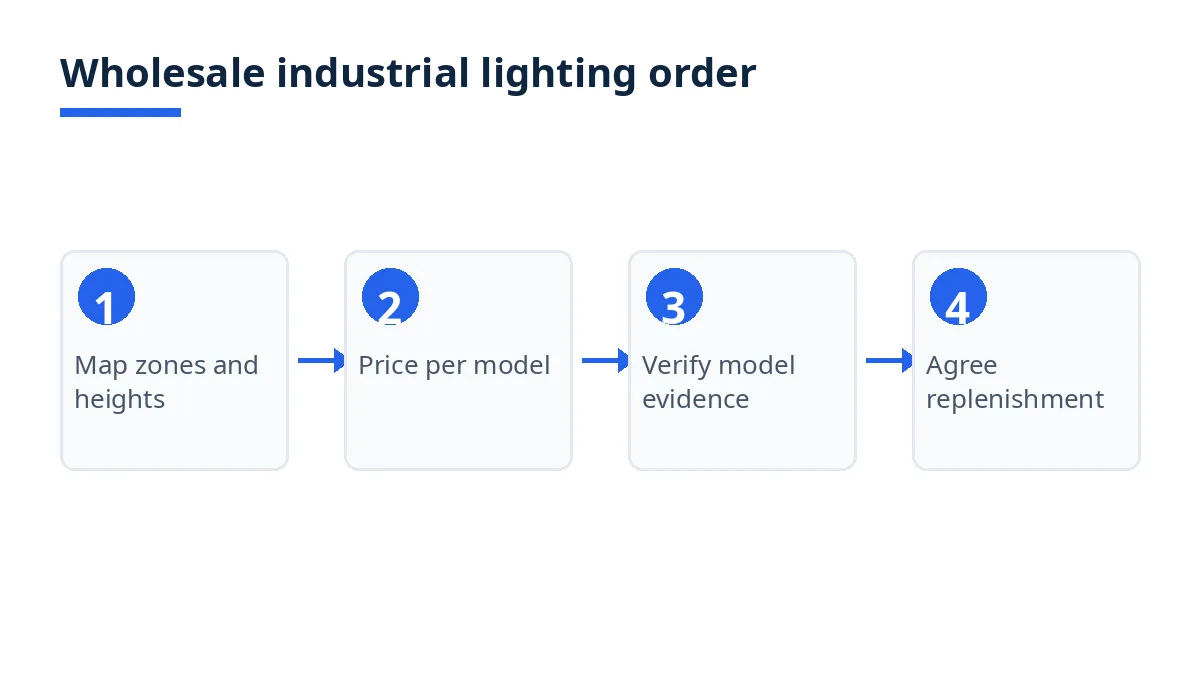
Map the zones and mounting heights. List every zone, its mounting height, dust and damp exposure, and how fittings in it are reached for maintenance. Zones with different heights or exposures get different fixture types.
Fix one model per zone function. Where two models could serve one zone, pick one and record why. Every extra model adds a price tier, minimum, spares line and replenishment line.
Ask for a tiered price sheet per model. Each model gets its own tier table, with quantity bands, unit prices, scope, and how long prices hold. Compare models only within their own tier tables.
Confirm the MOQ per model, not per order. Ask for the minimum in units for each model, and whether it counts finished fittings, cartons, or both. A large order total does not rescue a model below its own minimum.
Get the per-model evidence pack. For each model, ask for the same datasheet fields: rated input power, rated luminous flux, luminaire efficacy, correlated colour temperature, colour rendering index, rated life with its lumen maintenance factor, and rated ambient temperature for performance.2 Luminaire efficacy is worked out from the finished luminaire, not from the LED chip: luminous flux divided by luminaire watts input.1
Set the protection rating zone by zone. IEC 60529 classifies degrees of protection for electrical enclosures, with the first numeral covering access and solid objects and the second covering water.3 A 5 in the first position means dust-protected and a 6 means dust-tight.3 A fitting that suits an open packing hall may fail in a dusty grinding bay or a damp loading bay, so record the rating each zone needs before ordering.
Agree the sample and inspection plan. Order a sample of each model in actual configuration, then write the inspection plan into the purchase order. ISO 2859-1 defines acceptance sampling plans for inspection by attributes, indexed by acceptance quality limit (AQL) for lot-by-lot inspection.4
Agree replenishment terms in writing. Before the first shipment leaves, record the repeat price and its validity, repeat MOQ per model, replenishment lead time, spares availability period, and notice before a model changes or stops.
Zone | Fixture type | What sets its tier and minimum | Ask for |
|---|---|---|---|
Tall warehouse aisle | High bay | Output band, optics, mounting kit | Finished-fitting lumens and efficacy1 |
Packing hall | Low bay | Output band, beam spread | Finished-fitting lumens and efficacy1 |
Workshop and aisle runs | Linear fitting | Length, controls, sensor option | Control and sensor variant |
Inspection and detail benches | Task fitting | Colour rendering, glare control | Colour rendering index and beam2 |
Loading yard and site | Floodlight | Housing protection, mounting | Protection rating for the yard3 |
Costs, timelines and documents
What are the typical costs and timelines?
There are no typical costs or timelines a guide can state as fact, because each supplier prices your fixture types, drivers, optics, mounting kits, controls and spares, and the delivery term you choose. The Incoterms 2020 rules give 11 rules with a clear allocation of cost, risk and obligations,5 so compare price sheets only on the same rule and named place. For timelines, ask for sampling, production, inspection and shipment dates as separate lines: sampling depends on whether the model is stocked or built to order, production on component availability, and inspection on the agreed sampling plan.4
Example figures: a buyer orders a high bay at 300 units, a low bay at 200 units and a linear fitting at 400 units. The high bay tier table prices 100 to 299 units at one unit price and 300 units and above at a lower price, so the high bay clears its top tier while the low bay sits in its middle tier. The example shows tier structure only, not a typical price, MOQ or lead time.
Model (Example figures) | Tier 1 | Tier 2 | Tier 3 | Spares pack basis |
|---|---|---|---|---|
High bay, warehouse aisle | 1 to 99 units | 100 to 299 units | 300 units and above | Spare drivers per 100 fittings |
Low bay, packing hall | 1 to 99 units | 100 to 249 units | 250 units and above | Spare drivers per 100 fittings |
Linear fitting, workshop | 1 to 199 units | 200 to 499 units | 500 units and above | Spare drivers and sensors per 100 fittings |
The spares pack is priced with the first shipment, per model, because a driver or lens matching the installed model matters more than a generic spare. Record the driver identity, lens variant, mounting kit and sensor variant for each model.
Which documents are needed?
For the order itself, the documents are the zone sheet, model list, tiered price sheet per model, per-model datasheets, sample approval in writing, and purchase order carrying the MOQ per model, spares pack and replenishment terms. For export clearance in Bangladesh, goods may not be loaded unless an export declaration, the Bill of Export or Shipping Bill, is submitted to Customs and approved.6 Enclosed documents include the export contract or purchase order where there is no export letter of credit, commercial invoice, packing list, EXP form certified by an authorized dealer, and certificate of origin issued by the EPB or a Chamber of Commerce and Industry.6
Classification sits alongside the documents. In the Harmonized System, heading 9405 covers lamps and light fittings, including searchlights and spotlights and parts thereof, and subheading 940540 covers other electric lamps and light fittings, with parts under 940591, 940592 and 940599 by material.7 Confirm the classification for each fixture type and its spares with your customs broker before packing, because a driver or lens shipped as a spare may classify differently from the finished fitting.
Bangladesh-specific rules and tips
Keep one legal name across every paper. The export declaration names the exporter and the foreign buyer,6 so the name on the trade licence, quotation, proforma invoice and payment account should match. A name mismatch between the quotation and the Bill of Export is a delay no tier discount can recover.
Check evidence per model, not per company. A supplier may carry a wide catalogue, but the datasheet fields in IEC 62722-2-1, including rated input power, luminous flux, efficacy, colour temperature, colour rendering, life with lumen maintenance and rated ambient temperature,2 are stated per model. Ask for them per model, and treat a catalogue page without them as an enquiry still open.
Set the protection rating from the zone, not the catalogue headline. An IP rating alone does not establish suitability for every environmental condition,3 and the water-jet tests behind one rating differ from the immersion tests behind another.3 A damp loading bay and a dusty workshop need different answers.
Mistakes and red flags
What are the most common mistakes?
Ordering on the order total. A wholesale assortment is judged per model. An order clearing the total while one model sits below its own minimum will carry a surcharge, a removal, or a substituted model that no longer matches the zone sheet.
Comparing unlike fittings on price alone. A high bay and a low bay differ in output band and efficacy,1 and two fittings with the same wattage can differ in finished-luminaire lumens. Compare only replies to the same zone sheet, datasheet fields2 and delivery term.5
Reading chip figures as fitting figures. Efficacy for the finished luminaire is luminous flux divided by luminaire watts input.1 A chip figure quoted without the finished fitting's flux and input power does not describe the product you are buying.
Reading an IP code as a general promise. The two numerals describe separate properties,3 dust-protected and dust-tight are different,3 and impact resistance is a separate IK assessment. Ask for the rating each zone needs, for housing and driver compartment separately where they differ.
Leaving spares and replenishment verbal. A spares pack agreed in conversation and a repeat price remembered from a call will not survive a model change or a staff change. Record the spares pack, repeat price and validity, repeat MOQ, lead time and model-change notice on the purchase order.
Treating a profile or a badge as model evidence. A profile is a starting point for enquiries. It does not test whether a particular model meets its datasheet, and a badge is not a guarantee of capacity, quality or delivery.8
Checklist
Before you confirm, answer every line in writing.
Zone sheet done: every zone, mounting height, dust and damp exposure, maintenance access.
One model per zone function, reason for each choice recorded.
Tiered price sheet per model, with quantity bands, unit prices, scope, validity on every line.
MOQ confirmed per model, in units, binding line named for your quantities.
Per-model datasheet fields received: input power, luminous flux, efficacy, colour temperature, colour rendering, life with lumen maintenance, rated ambient temperature.2
Protection rating set per zone, for housing and driver compartment where they differ.3
Spares pack priced per model: drivers, lenses or optics, mounting kits, sensor variants.
Sample of each model approved in writing, in actual configuration.
Inspection level and AQL values in the purchase order.4
Quotations compared on the same zone sheet, datasheet fields and delivery term.5
Replenishment terms in writing: repeat price and validity, repeat MOQ, lead time, spares availability period, model-change notice.
Export set agreed: invoice, packing list, EXP form, certificate of origin, Bill of Export.6
How Exportain helps
On Exportain, browse suppliers and post a request for quotation (RFQ) on the RFQ board with your zone sheet and model list, so suppliers quote tiered prices per model against the same zones. Ask each reply for its MOQ per model, spares pack and replenishment terms, not only a headline price. For the evidence side, the industrial lighting manufacturers in Bangladesh guide sets out the checks to run on a shortlisted supplier.
Read the badges for what they record. Exportain Verified means Exportain has checked identity, phone, email and business registration, and Export Verified means it has checked the Export Registration Certificate (ERC).8 Factory Verified means it has reviewed photos of the manufacturer factory, while Trading Company Verified means it has reviewed photos of the trading company office or warehouse.8 Verification is a document review by staff, free, and never granted by membership plans.9 It is not a factory inspection,8 9 so sample approval and inspection stay with you. See how supplier verification works on Exportain.
FAQs
What should I know first about industrial lighting?
Know the building before the catalogue. A wholesale order is a fixture-type assortment built from zones and mounting heights: high bays for tall aisles, low bays and linear fittings for packing halls and workshops, task fittings for benches, and floodlights for the yard. Each type carries its own tiered price, MOQ per model, spares pack and replenishment terms, and finished-fitting lumens and efficacy, not chip figures, are what you compare.1 2
What are the typical costs and timelines?
There are no typical figures a buyer can rely on, because each supplier prices your fixture types, drivers, optics, mounting kits, controls and spares, and the delivery term you choose.5 Sampling, production, inspection and shipment should be quoted as separate dates, with tier price validity and replenishment lead time recorded as separate promises.
Which documents are needed?
The order documents are the zone sheet, model list, tiered price sheet per model, per-model datasheets, sample approval and purchase order carrying the MOQ, spares pack and replenishment terms. The export set is the Bill of Export, commercial invoice, packing list, EXP form certified by an authorized dealer, and certificate of origin issued by the EPB or a Chamber of Commerce and Industry.6
What are the most common mistakes?
The most common mistakes are ordering on the order total instead of the MOQ per model, comparing unlike fittings on price alone,1 reading chip figures as fitting figures, reading an IP code as a general promise,3 leaving spares and replenishment verbal, and reading a badge as a guarantee.8
Next steps on Exportain
Browse suppliers, then post your zone sheet and model list on the RFQ board so suppliers state tiered prices, MOQ per model, spares pack and replenishment terms. Before you confirm, read how supplier verification works on Exportain to see what each badge records and what it does not.
Sources
- Purchasing Energy-Efficient Commercial and Industrial LED Luminaires. U.S. Department of Energy (accessed )
- IEC 62722-2-1:2014 - Performance Requirements for LED Luminaires. International Electrotechnical Commission (IEC) (accessed )
- What is IEC 60529?. Otomasyon AVM (accessed )
- ISO 2859-1:2026 - Sampling procedures for inspection by attributes — Part 1: Sampling schemes indexed by acceptance quality limit (AQL) for lot-by-lot inspection. ISO (accessed )
- Incoterms® 2020. International Chamber of Commerce (ICC) (accessed )
- Customs Clearance Procedures for Export. Bangladesh Customs, National Board of Revenue (accessed )
- Classification Detail – HS Code 9405. United Nations Statistics Division (accessed )
- Trust & Safety Center. Exportain (accessed )
- Supplier verification: Earn trust badges buyers can see. Exportain (accessed )
- MOQ
- supplier verification
- pre-shipment inspection
- importing from Bangladesh
- aql inspection
- Electrical products
- Industrial lighting
About the author
Sourcing from Bangladesh?
Post a request for quotation and suppliers on Exportain can send you their quotes directly.
Post an RFQ


