Top Industrial Lighting Manufacturers in Bangladesh: How to Find and Verify Them
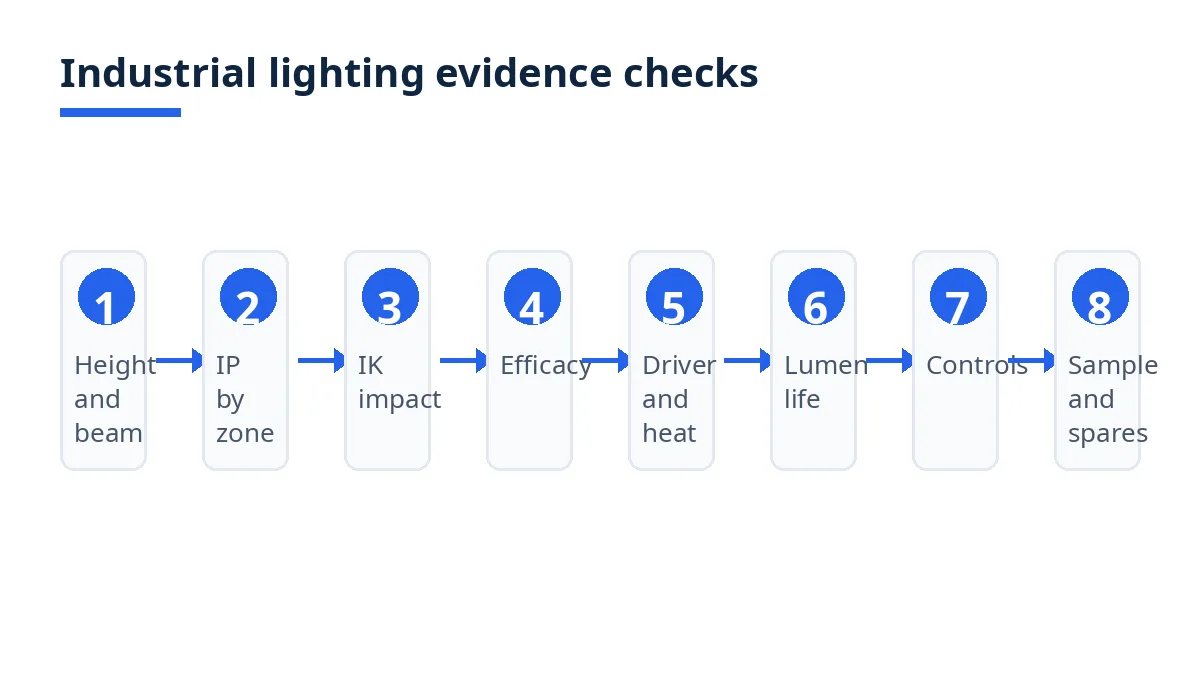
Industrial lighting manufacturers in Bangladesh, judged not by ranking but by evidence: eight checks covering bay height and beam, IP and IK ratings, efficacy, driver life, lumen maintenance, controls, samples and inspection terms.
Short answer
Industrial lighting manufacturers in Bangladesh should be judged on evidence for the exact model, not on ranking or price: mounting height and beam, IP and IK ratings by plant zone, finished-luminaire efficacy, driver and heat behaviour, lumen maintenance at ceiling temperature, controls at mounting height, and a sample with an inspection plan, all agreed in writing before payment.
On this page
An industrial lighting order is not a bigger household bulb order, and it is not a street-light order moved indoors. The fittings here are high bays, low bays, floodlights and task fittings for warehouses, packing halls, workshops and factory floors, where ceilings are high, dust and heat build up, and a failed unit is reached only with access equipment. Evidence for the exact model you plan to buy, matched to your ceiling height, plant zones and maintenance access, tells you far more than a supplier name.
This article names no factory and ranks none. The United States Department of Energy sets its federal purchasing table for industrial high bays at a minimum light output of 10,000 lumens, which shows the scale these fittings work at.1 Work through the eight checks below in order, and ask every shortlisted supplier for the same documents.
Key points to take away
Judge industrial lighting by evidence for the exact model: height and beam, IP and IK ratings, finished-luminaire efficacy, driver and heat, lumen maintenance, controls, and a sample with inspection terms.
Set protection ratings zone by zone. A fitting that suits an open packing hall may fail in a dusty grinding bay or a washdown area.
Work lumens per watt out from the finished luminaire, not from the LED chip, and read every life claim with its test basis, temperature and maintenance threshold.
Price replacement at height into the decision: driver access, spares and a written inspection plan belong in the order.
Exportain badges record document and photo checks reviewed by staff, not a factory inspection, so run these eight checks yourself on every shortlist.
The list: eight evidence checks for industrial lighting manufacturers in Bangladesh
Each check states what to ask for, why it decides the order, and how to close a gap before you pay. The first three fix the fitting to your building, the next three fix its performance claims, and the last two fix control, sampling and maintenance.
1. Mounting height and beam matched to your bay
What to ask for. The mounting height range, beam angle and light distribution for the exact model, with a layout note stating the ceiling height, aisle width or open-floor area it assumes.
Why it decides the order. A high bay above a tall aisle needs its light driven down the aisle, while the same fitting over an open floor needs a wider spread, and neither result follows from wattage alone. Wattage describes power input, not where the light goes or how evenly it falls on the work surface.
How to close the gap. Give every supplier the same bay data: ceiling height, rack height and aisle width, or open-floor dimensions, and the work done below the fitting. Require beam and distribution data for the model quoted, not for a similar model in the same family.
2. An ingress protection rating set zone by zone
What to ask for. The ingress protection (IP) code for each plant zone, stated separately for the housing and for any exposed driver compartment, with the test report and model it covers. The IP code indicates the degree of protection against dust and liquid ingress.2
Why it decides the order. Dust, oil mist, humidity and washdown water test different seals in different parts of a plant, and one plant-wide rating hides the weakest zone.
How to close the gap. Map the plant into zones before asking for quotations: dry storage, dusty production, humid areas and washdown areas. Ask for the IP code for each zone in writing, and put the zone ratings in the order. If a supplier answers with a bare word such as waterproof and no code, ask for the code and the report.
3. An impact protection rating for forklift and handling zones
What to ask for. The impact protection (IK) code for fittings mounted where forklifts, trolleys or falling stock can strike them, with the test basis for the exact model. IEC 62262 defines the IK code for protection against external mechanical impacts, running from IK07 at 2 joules through IK08 at 5 joules and IK09 at 10 joules to IK10 at 20 joules.2
Why it decides the order. A cracked lens or dented housing can break the seal the IP rating depends on and let dust or water reach the driver and LED board. Impact risk concentrates near loading bays, rack ends and dock doors.
How to close the gap. Mark the impact zones on the same plant map used for the IP check, and ask for the IK code for fittings in those zones, covering lens and housing as supplied. If no IK code is stated for a fitting in a forklift zone, move it, guard it, or shortlist a documented model.
4. Luminaire efficacy from the finished fitting, not from the chip
What to ask for. Rated luminous flux and rated input power from the same test report for the finished luminaire, so you can divide one by the other yourself. Luminaire luminous efficacy is calculated from the measured initial luminous flux of a luminaire divided by its measured initial input power, which is the method IEC 62722-2-1 sets for LED luminaires.3 The same standard lists rated input power, luminous flux, efficacy, colour temperature, colour rendering and ambient temperature among the product information a buyer should expect.3
Why it decides the order. Efficacy decides the running cost of every fitting, and it is most easily overstated when lumens come from the LED chip rather than the finished luminaire, leaving out losses in the optic, driver and housing. As a reference point, the United States Department of Energy sets a minimum of 175 lumens per watt for industrial high bays at 10,000 lumens or more in its federal purchasing guidance.1 That is a federal purchasing benchmark, not a Bangladesh requirement.
How to close the gap. Do the division yourself and compare the result with the datasheet figure. Example figures: 21,000 lumens at 120 watts gives 175 lumens per watt, while 15,600 lumens at 120 watts gives 130 lumens per watt. If the lumens and watts do not reproduce the datasheet efficacy, ask for a corrected datasheet or a new report.
5. Driver, heat and replacement access at height
What to ask for. The driver type, rated input voltage range and operating temperature range for the exact model, the driver replacement procedure, and the spare driver price and lead time. Ask whether the driver can be changed without removing the whole fitting from its mount.
Why it decides the order. Heat is the daily condition at a factory ceiling, and the driver is the part most often replaced during a fitting's life, yet replacement at height needs access equipment and a work pause below the fitting. IEC 60598-1, the general safety standard for luminaires, covers thermal safety, mechanical safety and vibration resistance.4
How to close the gap. Ask for the driver datasheet and replacement steps in writing, and price a driver change, including access, before comparing models. Put the spare driver price, lead time and replacement procedure in the order.
6. Lumen maintenance and ambient temperature at ceiling level
What to ask for. The lumen maintenance figure for the exact model, stated with its threshold, test basis and ambient temperature. Ask for the maintenance factor at the temperature the fitting will reach at ceiling level, not only at a laboratory room temperature.
Why it decides the order. A factory fitting is bought for years of service, not for brightness on day one, and heat at ceiling level shortens the light output a cooler test would predict. TM-21 converts LM-80 lumen-maintenance test data into lifetime projections, capped at six times the LM-80 test duration, so a 10,000-hour test supports a 60,000-hour projection and no more.5
How to close the gap. Line up the datasheet, the LM-80 data and the TM-21 projection, and check that model, LED package, temperature and drive current agree across all three. Example figures: a claim of L70 at 60,000 hours needs a 10,000-hour LM-80 test behind it under the six-times cap, while a 6,000-hour test supports 36,000 hours. If the datasheet states a life figure but no maintenance factor or temperature, ask for both before approving the model.
7. Controls and sensors that work at mounting height
What to ask for. The control options for the exact model: dimming method, occupancy sensor type and detection range at the installed mounting height, daylight sensor behaviour, and grouping for aisles versus open floors.
Why it decides the order. Controls decide a large part of the running cost after installation, and a sensor that works at three metres may miss movement at ten metres. LED luminaires are compatible with occupancy sensors, task tuning and dimming, which the United States Department of Energy lists among the control strategies that support further energy savings.1
How to close the gap. Test the control claim on one bay before ordering for the whole plant: sensor range at height, dimming steps and group behaviour. Put the control settings, sensor positions and grouping in the order.
8. A sample, an inspection plan and spares agreed before payment
What to ask for. A sample in production materials, with production optic, driver and finish, checked against the datasheet line by line, plus a written inspection plan and a spares list stating how many units are sampled, what counts as a defect, and what happens to a failed lot. ISO 2859-1 provides sampling schemes indexed by acceptance quality limit (AQL) for lot-by-lot inspection.6
Why it decides the order. A sample is the last point where a buyer can still change the product cheaply. At height, a defect found after installation costs access time and a work pause on top of the replacement itself.
How to close the gap. Photograph the sample, record its model plate, driver label and rating marks, and keep it as the reference for bulk inspection. Approve the sample in writing, stating model, beam, colour temperature, driver and control option, and write the inspection clause into the order. The industrial lighting quality control checklist turns this check into fitting-level tests for the finished order.
Summary table
Check | Evidence to ask for | Walk-away sign |
|---|---|---|
1. Mounting height and beam | Beam and distribution data for your height and layout | Wattage and a photograph only |
2. IP rating by zone | IP code per zone, for housing and driver compartment | A bare waterproof claim with no code |
3. IK rating for impact zones | IK code for the exact model, covering lens and housing | No code for a fitting in a forklift zone |
4. Luminaire efficacy | Lumens and watts from the same report | A printed efficacy figure with no lumens or watts behind it |
5. Driver and heat | Driver datasheet, temperature range, replacement procedure, spare price | A sealed driver with no replacement path |
6. Lumen maintenance | Maintenance threshold, LM-80 duration, ceiling temperature | A bare life figure with no factor or temperature |
7. Controls and sensors | Sensor coverage at your height, dimming range, zoning | A control claim tested only at a lower height |
8. Sample, inspection and spares | Production sample, AQL plan, defect classes, spares list | No inspection clause accepted at any stage |
How Exportain helps
Exportain supplier profiles show verification level, location, main products and certifications the supplier has declared.7 When you post a request for quotation, you can state quantity and unit, target price, destination, Incoterm, required certifications and deadline, and suppliers in that category can quote against it.7 Use that request to demand the eight evidence items above: name the exact model, ceiling height, plant zones and test reports you expect.
Read badges with the same care you apply to a datasheet. Exportain staff review every verification submission, and approved checks earn badges shown on the company page, listings and quotations, but verification is a document and photo review, not a factory inspection.8 A badge tells you documents were reviewed; it does not tell you a particular high bay passed an IP test. Keep the eight checks as your own verification layer.
FAQs
What is the biggest mistake?
The biggest mistake is comparing suppliers on price before comparing models on evidence. Buyers then discover the winning fitting's test report covers a different beam, its IP rating was never set for the washdown bay, or its driver cannot be changed without taking the fitting down. Compare models on the eight evidence items first, then compare suppliers who can supply the winning model on written terms.
How can I avoid it?
Avoid it by making evidence a condition of quotation. Send every supplier the same bay data, zone map and document list: distribution data, IP and IK reports, finished-luminaire test report, driver datasheet, lumen maintenance projection with temperature, and control coverage at mounting height. Score replies on completeness before price. For the ordering steps that follow, read how to import industrial lighting from Bangladesh.
Who is responsible?
Responsibility is shared, and the split should be written down. The supplier is responsible for supplying the model described in the datasheet and order, with the stated ratings, beam, controls and scope. The buyer is responsible for specifying the ceiling height, plant zones, mounting method and destination supply correctly, and for checking the sample and inspection report before releasing payment.
Where can I get help?
Start with the supplier file itself: the distribution data, IP and IK reports, test reports and driver datasheet answer most questions if you ask for them by name. For the commercial side, use the Exportain supplier directory and request-for-quotation route to keep quotations and terms in one thread. For independent assurance, engage a third-party inspector for the bulk lot under the agreed sampling plan.
Next steps on Exportain
Browse Bangladeshi suppliers and filter the industrial lighting listings by badge, MOQ and capability. Before you order, read how supplier verification works on Exportain so you know what each badge covers. Then post a free RFQ with your model, ceiling height, plant zones and evidence list, and compare the versioned quotations that come back.
Sources
- Purchasing Energy-Efficient Commercial and Industrial LED Luminaires. U.S. Department of Energy (accessed )
- Protection provided for enclosed equipment: codes IP and IK. Schneider Electric (accessed )
- IEC 62722-2-1:2014 - Performance Requirements for LED Luminaires. International Electrotechnical Commission (IEC) (accessed )
- What Is IEC 60598-1? Lighting Quality Control Standard. GIS Inspection (accessed )
- Light Standard: What is TM-21? TM-21-19 or TM-21-21?. LED Light Expert (accessed )
- ISO 2859-1:2026 — Sampling procedures for inspection by attributes — Part 1: Sampling schemes indexed by acceptance quality limit (AQL) for lot-by-lot inspection. ISO (accessed )
- How to source and buy from Bangladesh. Exportain (accessed )
- Supplier verification: Earn trust badges buyers can see. Exportain (accessed )
- supplier verification
- pre-shipment inspection
- importing from Bangladesh
- aql inspection
- Electrical products
- Industrial lighting
About the author
Sourcing from Bangladesh?
Post a request for quotation and suppliers on Exportain can send you their quotes directly.
Post an RFQ