Wholesale Finished Leather From Bangladesh: Prices, MOQ and Reliable Suppliers
Buy wholesale finished leather from Bangladesh grade first and lot first: fix the grade, finish, and lot rules, count the minimum per combination, and approve sample hides before bulk.
Short answer
Wholesale finished leather from Bangladesh should be bought grade first and lot first. Fix the grade, finish, tannage, animal, form, thickness, and shade standard in writing, count the tannery lot minimum per color and finish combination, and approve sealed sample hides from the lot offered. Confirm classification per leather type, require lab evidence for the lot separately from any tannery audit, and compare quotations only on one identical specification.

On this page
Key takeaways
Buy the grade and the lot first: grade term, finish, thickness range, and shade standard in writing before any price comparison.
A lot minimum counts per color and finish combination. Example figures: 120 hides per combination across 3 colors and 2 finishes is 720 hides.
A tannery audit covers the tannery, not the finished product. Require lab evidence for the lot offered, separately from audit evidence.
Finished leather has no single HS code: animal, preparation, form, grain, and finish decide the heading, with bovine leather at 4107.
A badge records a document and photo review, not a factory inspection or a guarantee. Samples, inspection, and payment terms stay with the buyer.
A wholesale order of finished leather is an order of lots, not of hides. One lot can hold hides that differ in shade, thickness, grain, and softness, and the buyer who prices first and specifies second inherits every difference. This guide helps buyers order wholesale finished leather from Bangladesh grade first and lot first: fix the grade, the finish, and the lot rules, count the minimum per combination, and only then compare prices. All figures in this guide are examples. No market price, tannery capacity, or standard minimum is stated as fact.
Start with the grade, the lot, and the split
Finished leather means leather further prepared after tanning or crusting. A wet-blue hide, or a crust hide dried but not finished, is not finished leather in tariff terms, even if a supplier describes it as finished.1
Grade names describe which layer of the hide is used and what was done to its surface, so the label alone does not show finish or construction.2 Full-grain leather keeps the entire grain layer with nothing sanded off. Top-grain leather includes the outer grain layer, and corrected grain is leather whose flaws were buffed or sanded away before dyeing and embossing.2 Split leather comes from the fibrous layer under the grain, "genuine leather" is not a grade, and bonded leather is ground leather fibers combined with other substances.2
Grade term | Layer used | Surface treatment | Confirm in writing |
|---|---|---|---|
Full-grain | Whole grain layer | Not removed | Natural marks accepted, finish named |
Top-grain | Outer grain layer | Varies with finish | Finish type and coating named |
Corrected grain | Grain side | Flaws buffed away, dyed, sometimes embossed | Emboss pattern and coating named |
Split | Corium under the grain | Varies; suede is a common result | End use and coating named |
Bonded | Ground leather fibers | Combined with other substances | Fiber share and backing named |
The split is the third decision, after grade and finish: whole hides and skins versus sides, and within each group full grains unsplit, grain splits, or other.3 State grade, finish, tannage, animal, form, thickness, and color in one specification, and require every quotation to answer it line by line.
Read a tannery lot the way a cutter reads it
Finished leather is graded, not passed or failed as a perfect sheet. Natural marks are inherent in hides, so grading turns on position and size: damage in a corner area may mean only a grade drop, while damage in the main area may scrap the hide.4 Agree the grade rules, the prime and secondary areas, and how a defect in each area affects the grade before production, and record them in the buyer's acceptance specification.
Shade, thickness, grain, and softness move from hide to hide and across one hide, and genuine leather varies more batch to batch than synthetic material.4 Thickness is gauged under a specified load, with readings at agreed points including the spine and the belly.4 Example figures: a hide reading 1.4 mm at the spine and 1.1 mm at the belly, against a tolerance of plus or minus 0.1 mm around a stated nominal thickness, passes at the spine and fails at the belly if the belly point is inside the cutting area. Judge yield on the thinnest cutting area.
Finish belongs in the same reading. Aniline leather shows the pore structure clearly and has no topcoat, semi-aniline shows it through a light pigmented coating with a thin topcoat, and pigmented leather is covered by an opaque pigment layer.4 Shade needs a stable light and color datum: lay hides side by side under the agreed light, sort them into shade bands, and hold any band outside the approved standard.4 Agree how area is measured and which unit is used, and reconcile the lot total against the packing list.4
Six checks that settle a lot before you order
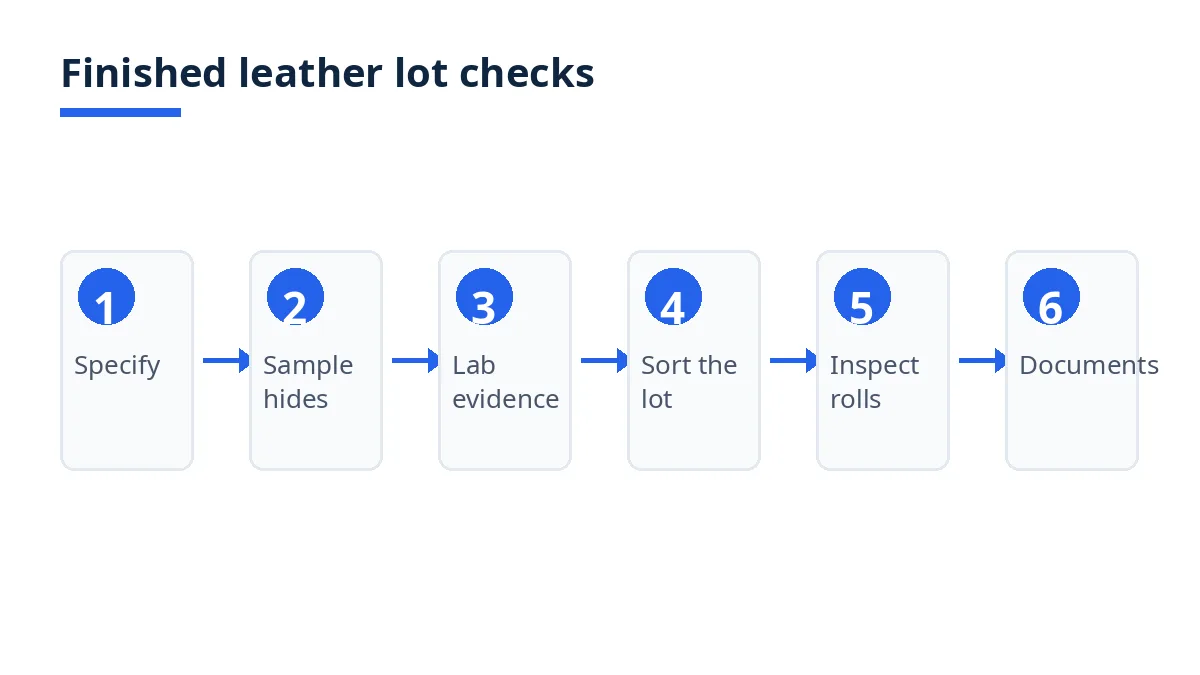
Work the lot in order. Each check answers one question, and a later check cannot repair an earlier one that was skipped.
Specify. Write grade, finish, tannage, animal, form, thickness with tolerance and reading points, shade standard and light source, grade rules by position, and packing. Name the lot: one color, one finish, one thickness range, one tannery run.
Approve sample hides. Approve sealed samples, one per finish and color, showing grain, shade, softness, and finish, kept flat and away from light.4 Record which lot the sample hides came from: a sample from a different lot approves a different lot.
Get lab evidence by named method. Where the specification requires it, require the method named and the result against the specification.4 For chromium VI, name the limit and the method, and require a report for the lot offered.
Hold and sort the lot. Lay the hides out, map prime and secondary areas, grade each hide under the agreed rules, and sort shade into bands.4 Mixed lots cannot be unmixed at the cutting table.
Inspect the finished, packed lot. Apply the agreed sampling plan to finished, mostly packed goods, with defects photographed and position-marked.4 A pre-shipment inspection samples the lot; it is not a guarantee.
Confirm documents and packing. Reconcile counts, labels, and the packing list, and require hides rolled, never folded, with paper between rolls and no weight on the finish, rolling neck to butt.4
The diagram below shows the same six checks in order.
Keep one record per lot: specification, sample approvals, lab reports, grade and shade findings, inspection decision, and packing list.
What a lot minimum really counts
A minimum order quantity is the smallest quantity a supplier will accept on its normal terms, counted per order, per style, or per color, sometimes combined with a minimum order value.5 For finished leather, read the counting basis as a lot question first: per color, per finish, per thickness, or per tannery run. The same number means very different commitments on each basis, and a supplier can apply more than one basis at once.5
Example figures: a tannery lot minimum of 120 hides per color and finish combination, across 3 colors and 2 finishes, means a smallest order of 720 hides, not 120. Cut the range to 2 colors in 1 finish and the smallest order on the same basis is 240 hides. Ask whether a color can share a dye lot and whether a finish counts as a separate combination, and get the answer in the quotation.
Three drivers set the minimum: custom material brings the tannery's minimum into the order, trims and packaging carry minimums of their own, and every extra color or finish adds planning and changeovers.5 For leather, the custom material is the dye lot: a custom color dyed for one buyer cannot be split across buyers, so the dye lot sets a floor even when the tannery would accept fewer hides in a stock color. Stock colors, fewer colors, standard packing, a surcharge, a shared lot, or an honest trial order are levers to raise as questions, none assured.5 State quantity per color, finish, and thickness, the area unit, the delivery term, and the destination in the request for quotation, and require the quotation to state unit price, minimum, lead time, Incoterm, payment terms, and validity.5
Price structure without invented prices
There is no standard wholesale finished leather price to quote, and this guide states none. What a buyer can use is price structure: the shares of cost inside a quotation, and the choices that move each share. Example figures only, structure only: for one illustrated lot, read the unit price as shares of an index of 100, with hide and crust at 40, tanning and finishing process at 25, labor and overhead at 15, testing, inspection, and packing at 10, and the remaining 10 covering the price basis and margin. No real lot will match those shares exactly.
Four choices move the structure most. Grade and split decide the material and its yield. Finish decides what surface variation is shown or covered: an opaque pigmented finish can cover variation that an aniline finish shows. Thickness and usable area narrow the hides that qualify, and rejected area is still paid for inside the lot price. Lot size per combination spreads changeovers and dye lots across the combination count, not the order total.
Compare quotations only on one identical specification. Each quotation states unit price, minimum, lead time, Incoterm, payment terms, and validity, and tiered pricing means the unit price falls in steps as quantity rises.5 Check both sides of every price break with example figures: an order just below a break can cost more in total than a slightly larger one at the next tier. An FOB price covers goods up to loading at the named port, and freight beyond the port is not in that unit price, so confirm the price basis before comparing a Chittagong FOB quotation with a delivered quotation.5 No standard lead time exists: agree dye-lot scheduling, sample approvals, lab turnaround, and inspection booking per stage in writing.
Classification: animal, preparation, form, and grain
Classification follows the leather, not the trade name. The Harmonized System is a multipurpose international product nomenclature developed by the World Customs Organization, comprising more than 5,000 commodity groups, each identified by a six-digit code, and used by more than 200 countries and economies as a basis for their customs tariffs.1 Only the first six digits are shared internationally.
For bovine (including buffalo) or equine leather further prepared after tanning or crusting, the indicative heading is 4107, covering leather without hair on, whether or not split, other than leather of heading 4114.3 The six-digit lines split first into whole hides and skins and other, including sides, then into full grains unsplit, grain splits, and other: 4107.11, 4107.12, and 4107.19 for whole hides and skins, and 4107.91, 4107.92, and 4107.99 for other, including sides.3
Heading | Covers | When it applies |
|---|---|---|
4107 | Bovine or equine leather, further prepared | Whole hides or sides, by grain |
4112 | Sheep or lamb leather, further prepared | Animal is sheep or lamb |
4113 | Other animals, further prepared | Goats, swine, reptiles, and other animals |
4114 | Chamois, patent, patent laminated, metallized leather | Special finish overrides the ordinary heading |
4115 | Composition leather, parings, and waste | Reconstituted or bonded sheet, not finished leather |
The animal test comes first: sheep or lamb leather falls under 4112, and other animals under 4113, so there is no single code for all finished leather.1 Preparation comes second: leather only tanned or brought to crust stays under headings 4104, 4105, or 4106.1 Special finishes come third: chamois, patent, patent laminated, and metallized leather fall under heading 4114 even when the animal is bovine, and composition leather falls under heading 4115.1
Confirm the six-digit line and the full national code in the destination tariff for the exact leather, and keep each leather type as a separate invoice line.1 National lines differ: the United States, the European Union, and the United Kingdom each list their own splits under 4107, including the European Union boxcalf split.1 A six-digit match does not mean the national code also matches. For a borderline case, apply for a binding decision before shipping, separately for each type of leather.1
Bangladesh notes: Savar, effluent evidence, and the tannery audit
Bangladesh tanning is concentrated at the Savar Tannery Industrial Estate, to which tanneries were relocated from Hazaribagh in Dhaka. The central effluent treatment plant (CETP) there was reported in May 2026 as able to treat between 14,000 and 18,000 cubic meters of waste a day, against about 45,000 cubic meters needed in the peak period after Eid-ul-Azha.6 Ask how this tannery's effluent is treated, through the central plant, its own plant, or both, and what evidence covers the lot offered. The Leather Working Group audit notes that the efficiency of a common effluent treatment plant could affect a tannery's scores, and that third-party evidence of CETP performance is required as part of the audit.7
The Leathergoods and Footwear Manufacturers and Exporters Association of Bangladesh (LFMEAB) is the trade body for manufacturers and exporters of leather products, footwear, synthetic, and allied factories in Bangladesh.8 A directory check proves membership only.
The tannery audit is the evidence buyers most often misread. The Leather Working Group audit assesses how a tannery measures, controls, and reports the impact of its manufacturing operations, across 17 sections including water and energy use, environmental management, chemical management, waste management and effluent treatment, and health and safety.7 Minimum thresholds are 85 percent for Gold, 75 percent for Silver, 65 percent for Bronze, and 50 percent for Audited in each section, and a manufacturer must achieve its medal rating across all categories or be certified at the level of the lowest category.7 Certification is valid for 24 months for manufacturing facilities and 12 months for part-processed material traders.7
That audit covers the tannery, not the finished product. It does not guarantee no restricted-substance failures in a final product, and traceability is rated separately as a percentage for physical traceability and documentation.7 For Gold and Silver, chromium VI must be below 3 mg/kg, and any level above 3 mg/kg results in automatic failure.7 Ask for audit evidence naming the tannery, the standard, the scope, and the expiry date, and confirm it with the issuing body, then ask separately for lot evidence: the lab report, the method, and the result for the leather in the order.
Mistakes and red flags that cost a whole lot
Buying on a grade word. "Genuine leather" says the material is real leather and almost nothing about the layer or the surface.2 Require the layer, the surface treatment, and the finish in writing.
Treating a tannery audit as a product certificate. A Leather Working Group medal rates the tannery's manufacturing performance, and certification does not guarantee no restricted-substance failures in a final product.7 Ask for the audit for the tannery and the lab report for the lot, separately.
Approving one hide as the lot. Shade, thickness, grain, and softness move across a lot, so approval must cover sample hides per finish and color, lot sorting, and inspection of the packed lot.4
Judging shade from memory or one light. Batch shade varies and needs a stable light and color datum.4 Agree the light source, lay the set out together, and sort into bands.
Counting the minimum once. A minimum counted per color and finish combination multiplies across the range, and a supplier can combine a quantity minimum with a minimum order value.5 Confirm the basis in the quotation.
Filing one code for every leather. Animal, preparation, form, and finish each move the code, and patent, chamois, or metallized leather leaves heading 4107 for 4114.1 Confirm the code per leather type.
Folding hides for packing. Leather should never be folded, and rolling prevents creases; hides are rolled neck to butt because the butt is the stiffest part.4 Require rolled packing and check it at inspection.
Reading a badge as an inspection. Verification on Exportain is a review of documents and photos by Exportain staff, not a factory visit, and a badge is not a guarantee of production capacity, product quality, or delivery.9 Samples, inspection, and payment terms stay with the buyer.
Lot-buying checklist
Write the specification: grade, finish, tannage, animal, form, thickness with tolerance and reading points, shade standard and light, grade rules by position, and packing.
Name the lot: one color, one finish, one thickness range, one tannery run, with the lot identity on every document.
Approve sealed sample hides per finish and color, and record which lot they came from.
Count the minimum per color, finish, and thickness combination, and confirm the counting basis in the quotation.
Compare quotations only on one identical specification and the same fields: price, minimum, lead time, Incoterm, payment terms, validity.
Require lab evidence by named method and limit for the lot offered, separately from tannery audit evidence.
Sort the lot into shade bands under the agreed light, grade each hide by position and size, and hold bands outside the standard.
Confirm classification per leather type: animal, preparation, form, grain, and finish.
Read each badge for the checks it records, and check company name and address across the trade license, Export Registration Certificate, quotation, and invoice.9
Inspect the finished, packed lot on the agreed sampling plan, confirm rolled packing, and reconcile counts and area against the packing list.
What should I know first about finished leather?
Know the grade, the finish, and the lot before the price. Finished leather is leather further prepared after tanning or crusting, graded by position and size rather than passed as a perfect sheet, with shade, thickness, grain, and softness varying across one lot.1 4 Fix the grade term, the finish type, the thickness range with its reading points, and the shade standard in writing, then count the minimum per color and finish combination and approve sample hides from the lot offered.
What are the typical costs and timelines?
There is no typical cost or timeline to quote for wholesale finished leather. Costs move with grade and split, finish, thickness and usable area, and lot size per combination, and only quotations on one identical specification can be compared.5 Example figures only: read a unit price as shares of an index, count the minimum across every combination, and agree the time per stage in writing. A quotation that states no minimum, lead time, Incoterm, payment terms, and validity is incomplete.5
Which documents are needed?
Agree the document set before production and keep the leather description identical across every document: the specification with grade rules, the quotation with its counting basis, sample approvals, lab reports by named method, the inspection plan and decision, the invoice and packing list with hide count, area, color, finish, and roll labels, and the transport document. Keep the classification file with the shipment: the confirmed code for each leather type, any binding decision, and the origin evidence, with each leather type as a separate invoice line.1 Ask for the Export Registration Certificate and trade license yourself, and check that the company name and address match the quotation and the invoice.9 Confirm any certificate with the body that issued it.7
What are the most common mistakes?
The most common mistakes are buying on a grade word with no specification, treating a tannery audit as a product certificate, approving one hide as the lot, judging shade under different lights, counting the minimum once, filing one code for every species and finish, folding hides for packing, and reading a badge as an inspection. Each is fixed in writing before production: a full specification, separate tannery and lot evidence, lot sorting under one light, minimum counting per combination, classification per leather type, rolled packing, and the buyer's own sample, inspection, and payment checks.
Next steps on Exportain
Browse Bangladeshi suppliers and read each profile for the checks behind its badges before shortlisting. Read how supplier verification works on Exportain, the MOQ guide, the HS code guide for finished leather, and the quality control checklist for finished leather while writing the specification. Then post a free RFQ with grade, finish, tannage, animal, form, thickness, colors, quantities per combination, destination, and delivery term.
Sources
- HS Code for Finished Leather: Classification Guide for Importers. Exportain, (accessed )
- Full-Grain vs Top-Grain Leather: What the Names Mean. Leather Collection, (accessed )
- Classification Detail: HS, 2017, Code 4107. United Nations Statistics Division (accessed )
- Quality Control Checklist for Finished Leather. Exportain, (accessed )
- MOQ Meaning (Minimum Order Quantity). Exportain (accessed )
- Govt to fix Savar CETP's deficiencies, back tanneries' own ETPs: Commerce minister. The Daily Star, (accessed )
- Certification - Leather Working Group. Leather Working Group (accessed )
- President's Message - LFMEAB. Leathergoods and Footwear Manufacturers and Exporters Association of Bangladesh (LFMEAB) (accessed )
- How Supplier Verification Works on Exportain. Exportain, (accessed )
- MOQ
- supplier verification
- quality control
- HS Codes
- buyer guide
- Bangladesh sourcing
- Finished leather
- Leather
About the author
Sourcing from Bangladesh?
Post a request for quotation and suppliers on Exportain can send you their quotes directly.
Post an RFQ