

Wholesale Cotton T-Shirts From Bangladesh: Prices, MOQ and Reliable Suppliers
Wholesale cotton T-shirts from Bangladesh: price drivers, how MOQ is set, the order steps and documents, and how to check a supplier before a bulk order.
Short answer
Wholesale cotton T-shirts from Bangladesh have no standard price or MOQ. Both are set by each supplier for your exact specification, covering fabric weight, print, colors, quantity and packing. This guide explains the price drivers, how MOQs are set, the order steps, the documents to agree, and how to check a supplier on Exportain before you commit to a bulk order.
On this page
Key takeaways
There is no standard wholesale price or MOQ for cotton T-shirts from Bangladesh: each supplier sets both for your exact specification, in writing.
Knitted cotton T-shirts classify under heading 6109, with the cotton line at 6109.10 in the US HTS, and the full national code depends on the exact style.
Compare quotations on the full field set: unit price, MOQ, lead time, Incoterm, payment terms and validity, all quoted against one identical specification.
An Exportain trust badge records a document and photo review, not a factory inspection, so samples, written terms and your own inspection still decide the order.
If you buy cotton T-shirts at wholesale volume, Bangladesh is one of the sourcing options you will compare on price, minimum order quantity (MOQ) and supplier reliability. This guide explains what decides the unit price, what sets the MOQ, how ordering runs, which documents to agree before production, and how to check a supplier before a bulk order. It states no fixed price or MOQ, because neither exists for this product: both are set style by style, in writing, by the supplier who quotes you.
The product and its classification
A wholesale cotton T-shirt in this guide is a knitted or crocheted T-shirt bought in bulk for resale, promotion or uniform programs, specified by fabric composition and weight, size range, colors, print or embroidery, and packing. Classification follows construction and fibre. Chapter 61 of the Harmonized Tariff Schedule of the United States (HTS), published by the U.S. International Trade Commission (USITC), applies only to made up knitted or crocheted articles.1 Within that chapter, heading 6109 covers "T-shirts, singlets, tank tops and similar garments, knitted or crocheted," and the cotton line is 6109.10.00, "Of cotton."1
Two details in the chapter notes shape how you write the specification. Heading 6109 does not cover garments with a drawstring, ribbed waistband or other means of tightening at the bottom of the garment, so a T-shirt style with a tightened hem is tested against a different heading.1 The statistical lines under 6109.10 also split T-shirts by wearer group and by features such as pockets, trim or embroidery, so the full national code depends on the exact style.1 Confirm the full code for your destination before you order, using the HS code for cotton T-shirts guide as a starting point and your customs broker for the final line.
Why this matters for buyers
Cotton T-shirts are a knitwear product, and knitwear is an organized export sector in Bangladesh with its own trade body. The Bangladesh Knitwear Manufacturers and Exporters Association (BKMEA) is the apex trade body for the knitwear sector, was established in 1996, and represents approximately 2,540 knitwear member factories.2 That depth of supply is the reason buyers can usually obtain competing quotes for the same specification, and it is also the reason quotes vary: factories differ in fabric sourcing, machine capacity, compliance record and order book, and each of those differences reaches your price, your MOQ and your delivery date.
The practical consequence is that comparison only works on an identical specification. A quote for a 160 GSM single jersey shirt with a chest print is not comparable with a quote for a 180 GSM shirt with the same print, and a low unit price with a high MOQ or long lead time may cost more overall than a higher unit price on flexible terms. The sections below separate the three variables buyers usually merge: price, MOQ and reliability.
Step-by-step: how a wholesale order works
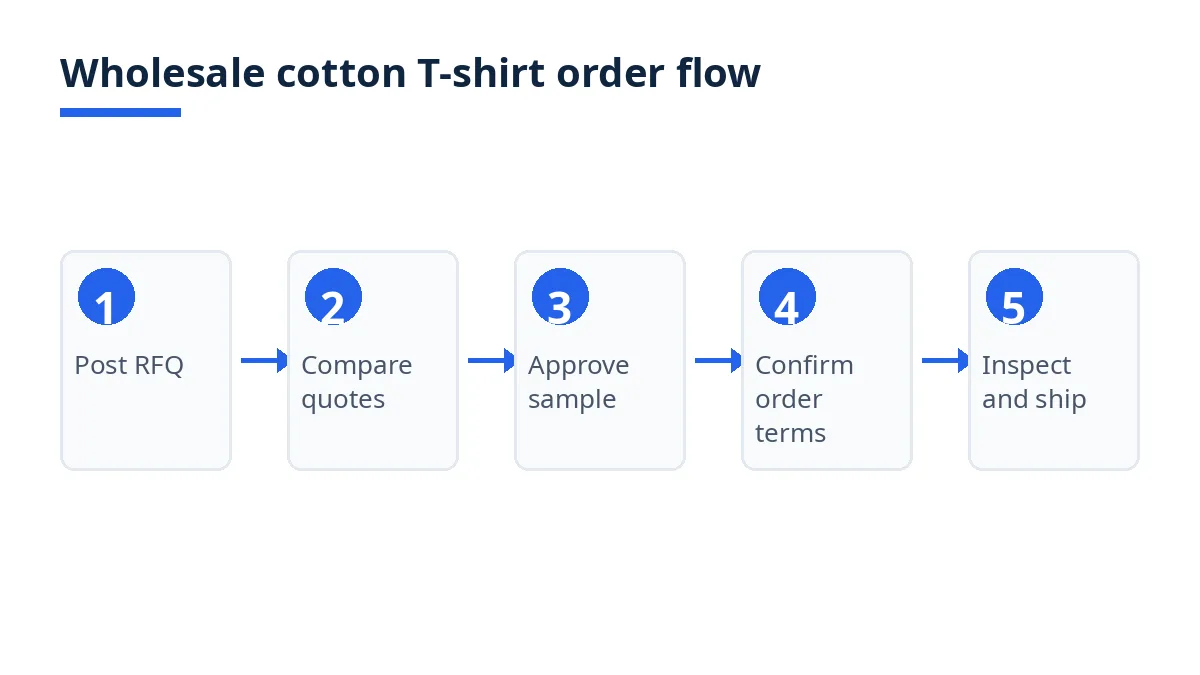
Exportain sets out an eight-step buying sequence, from searching the catalogue and reviewing supplier profiles to arranging freight and inspection.3 For a wholesale T-shirt order, the sequence runs as follows.
Write the specification first. Record fibre composition and percentages, fabric type and weight in GSM, size range and size ratio, colors, print or embroidery artwork and placement, label and packing requirements, quantity per size and color, destination, and the Incoterm you want priced. Every later disagreement traces back to a gap in this document.
Shortlist suppliers and review profiles. On Exportain, each profile shows the supplier verification level, location, main products and the certifications the supplier has declared, and you can filter the catalogue by MOQ or lead time.3 Match the shortlist to your specification: a factory whose main products are woven shirts is a poor fit for a knitted T-shirt program.
Post a request for quotation (RFQ). State quantity and unit, target price, destination, Incoterm, required certifications and deadline, so suppliers in that category can view the request and quote against it.3 The guide on how to import cotton T-shirts from Bangladesh covers the import side of the same order.
Compare quotations on the same fields. Every quotation on Exportain is versioned and records unit price, MOQ, lead time, Incoterm, payment terms and validity, and you can counter-offer in the same thread.3 Compare the full set of fields, not the unit price alone, and ask each supplier to quote the identical specification.
Order and approve samples. Approve a pre-production sample against the specification before bulk production, and keep the approved sample as the reference for inspection. Record any change after approval as a new quotation version, not as a message aside.
Accept a quotation and fix the order terms. Accepting a quotation on Exportain creates an order record with those terms.3 The order record should carry the specification, the inspection arrangement and the shipment conditions, agreed in writing before payment.
Settle payment on the accepted terms. Payment is settled directly with the supplier on the accepted terms, with inspection and shipment conditions agreed in writing first.3 If the supplier asks for a funds hold, you can pay it by card or decline it, and Exportain keeps a paid hold until the supplier has filed an export clearance document and you have confirmed the trade complete.3
Inspect, then ship. Arrange inspection against the approved sample before shipment, and request freight quotes from listed freight, customs and inspection providers.3
The diagram below summarizes the order flow from RFQ to shipment.
What drives the price of a cotton T-shirt
No official source publishes a standard wholesale price for a Bangladeshi cotton T-shirt, and any single figure quoted without a specification is not usable. Suppliers build the unit price from the specification, so ask for the build-up rather than a headline number. The drivers are consistent across suppliers.
Price driver | What changes the cost |
|---|---|
Fabric | Fibre composition, yarn quality, fabric weight in GSM and whether the fabric is knitted and dyed in-house or bought in |
Quantity | Total pieces and the split across sizes and colors, because cutting and machine setup costs spread over the run |
Print and embroidery | Number of colors, print size and placement, embroidery stitch count, and any special finish |
Trims and packing | Labels, hangtags, polybags, cartons and any retail-ready packing you specify |
Compliance and testing | Buyer-required audits, lab tests and certification evidence you ask the factory to supply |
Terms | Incoterm, port, payment terms and how much of the order value is paid before shipment |
Example figures. The table below shows how a buyer can lay out a comparison once quotes arrive. The figures are Example figures only, included to show the format, and they are not market prices.
Cost line | Supplier A (Example figures) | Supplier B (Example figures) |
|---|---|---|
Unit price, FOB | 2.40 per piece | 2.65 per piece |
Quoted MOQ | 3,000 pieces per color | 1,200 pieces per color |
Lead time stated | 45 days after approval | 30 days after approval |
Payment terms stated | 30 percent advance, balance before shipment | 30 percent advance, balance against documents |
Read in this format, Supplier B costs more per piece and less in commitment: the smaller MOQ ties up less cash and the shorter lead time reduces the gap you must cover with existing stock. Which quote is better depends on your order size and selling cycle, not on the unit price alone.
MOQ: what sets it and how to discuss it
The MOQ is the smallest quantity a supplier will accept for one order or one style. It is set by the supplier for each product, not by a national rule, and the same factory may quote different MOQs for a plain shirt and a printed shirt. Three production facts usually sit behind the number: the minimum fabric quantity the factory must knit or buy for one color, the setup time for cutting, printing and line changeover, and the packing and carton configuration you require. More colors and more print placements raise the effective MOQ, because each color and each print run carries its own setup.
To discuss MOQ with evidence rather than pressure, try these steps. Ask whether the MOQ is per style, per color or per order, because the three readings produce very different commitments. Ask which element sets the floor, fabric quantity or setup, and whether a surcharge on a smaller run is available instead. Consolidate colors or sizes where your market allows it, and combine repeat styles into one order where the factory agrees. Whatever you agree, record the MOQ in the quotation and the order record, alongside unit price and lead time.3 The minimum order quantity explainer covers how MOQs work across product types.
Costs, timelines and documents
Beyond the unit price, budget for sampling and courier costs, lab testing where your market requires it, inspection, freight and insurance under the Incoterm you choose, and duty and taxes at destination under the confirmed tariff line. Timelines divide into stages rather than a single number: sample making and approval, fabric preparation, bulk production, inspection, and shipment. Ask the supplier to state a lead time for each stage and the event that starts the clock, usually approval of the sample and receipt of the advance payment, and record the agreed dates in the order record.
Agree the document set before production starts, so nothing is requested for the first time at shipment. A typical set for a T-shirt order includes the commercial invoice, the packing list with carton-level detail, the transport document for the mode you use, and an origin document where you claim preferential treatment at destination. Add the inspection report and any test reports your destination market requires, and keep the approved specification and the accepted quotation version with the same file. Document names and origin proof requirements vary by destination, so confirm the set with your customs broker for the entry date and origin Bangladesh.
Bangladesh-specific rules and tips
Check the trade body record. BKMEA represents the knitwear sector and works on policy, market promotion and compliance awareness among its member factories.2 Membership of a trade body is background information about a supplier, not a quality finding on your order, so treat it as one input beside documents, samples and inspection.
Read verification badges for what they cover. On Exportain, badges such as Exportain Verified and Export Verified record which checks the Exportain team has reviewed, and a badge is not a capacity or quality guarantee.3 The verification itself is a document and photo review carried out by Exportain staff, not a factory inspection, and membership plans never grant a trust badge.4 Use the badge to decide which suppliers to shortlist, then use samples, a defined inspection and written terms to decide which supplier to pay.
Keep the contract with the supplier. Exportain is a marketplace: you settle payment directly with the supplier on the accepted terms.3 That means your protection sits in the order record, the specification, the inspection arrangement and any funds hold you agree, not in an assumption that the platform guarantees the goods.
Mistakes and red flags
Comparing quotes on different specifications. A cheaper quote for a lighter fabric or a smaller print is a different product. Re-issue one specification to every supplier and compare the versioned quotation fields.3
Accepting a price before the MOQ and lead time are written down. A unit price without its MOQ, lead time and validity is incomplete. If any of those fields is missing, ask for a revised quotation before you accept.
Skipping the approved sample. Production without an approved pre-production sample leaves no reference for inspection. Approve the sample, keep it, and name it in the order record.
Paying outside the agreed terms. Requests to move payment to a new account or a different company name after the order is placed are a stop signal. Pause, re-check the supplier profile and the order record, and continue only on the terms you accepted.
Treating a badge as an inspection. A trust badge records a document and photo review.4 It does not inspect goods, and it does not replace your own inspection before shipment.
Checklist before you place a wholesale order
Specification written, with fibre, GSM, sizes, colors, print, labels and packing.
Full tariff line for the destination confirmed with your broker, starting from heading 6109 for knitted cotton T-shirts.1
At least two quotations compared on unit price, MOQ, lead time, Incoterm, payment terms and validity.3
Supplier profile reviewed, including verification level and declared certifications.3
Pre-production sample approved and kept as the inspection reference.
MOQ basis confirmed: per style, per color or per order, and recorded in the order record.
Document set agreed, including origin evidence where you claim a preference.
Inspection arranged before shipment, and freight quoted for the agreed Incoterm.
FAQs
What should I know first about cotton T-shirts?
Know your specification before you ask for a price. Construction and fibre decide classification: Chapter 61 covers made up knitted or crocheted articles, and cotton T-shirts sit on the 6109.10 line of heading 6109.1 Fabric weight, print and packing then decide what suppliers quote, so a complete specification is the first document to write.
What are the typical costs and timelines?
There is no standard wholesale price or standard lead time for this product, and this guide states neither. Costs divide into the unit price, sampling, testing, inspection, freight and destination duty, and timelines divide into sampling, fabric preparation, production, inspection and shipment stages. Obtain both as written, versioned quotation fields for your exact specification and compare suppliers on the same fields.3
Which documents are needed?
Agree the set before production: commercial invoice, packing list, transport document, and an origin document where you claim preferential treatment, plus the inspection report and any test reports your destination requires. Keep the specification and the accepted quotation with the shipment file. Confirm destination-specific requirements with your customs broker, because origin proof and document detail vary by market.
What are the most common mistakes?
The recurring mistakes are comparing quotes written to different specifications, accepting a unit price before the MOQ and lead time are recorded, skipping the approved sample, and treating a verification badge as a goods inspection. A badge records a document and photo review, not a factory inspection.4 Each mistake is avoided by the same habit: one specification, written terms, an approved sample and an inspection before shipment.
Next steps on Exportain
Browse suppliers for cotton T-shirt ranges that match your specification, or post an RFQ with quantity, destination and Incoterm so suppliers quote on the same terms. Before you accept, read how supplier verification works on Exportain, then confirm the tariff line in the HS code for cotton T-shirts guide.
Sources
- Harmonized Tariff Schedule of the United States Revision 18 (2026), Chapter 61. U.S. International Trade Commission (accessed )
- BKMEA at a Glance. BKMEA (accessed )
- How to source and buy from Bangladesh. Exportain (accessed )
- Supplier verification: Earn trust badges buyers can see. Exportain (accessed )
- MOQ
- supplier verification
- importing from Bangladesh
- bangladesh garments
- Cotton T-shirts
- Wholesale sourcing
About the author
Sourcing from Bangladesh?
Post a request for quotation and suppliers on Exportain can send you their quotes directly.
Post an RFQ


