Wholesale Ceiling Fans From Bangladesh: Prices, MOQ and Reliable Suppliers
Wholesale ceiling fans from Bangladesh are bought as an assortment: per-model MOQ, carton quantities, spare parts and warranty terms, compared on one table.
Short answer
A wholesale ceiling fan order from Bangladesh is bought as an assortment, not as a single model: several sweeps, finishes, and control types, each with its own minimum, carton quantity, and lead time. Compare suppliers on the same assortment table and the same delivery term, approve a sample per model, and get the minimum per model and per finish, spare parts cover, and warranty terms in writing before confirming.
On this page
Key takeaways
A wholesale order is an assortment: each model and finish can carry its own minimum, carton quantity, and lead time, so compare quotations per model, not per order total.
Define the assortment as a table with sweep, motor type, control type, finish, carton quantity, and quantity per model, and send the same table to every supplier.
Approve a sample per core model, including its motor, blades, control, and carton, and agree inspection, spare parts, and warranty terms before confirming.
Confirm the BSTI mark and standard edition per model in writing, and confirm the classification per model under subheading 841451.
Exportain verification is a document and photo review, not a factory inspection, and a badge is not a guarantee of assortment, volume, or dates.
A wholesale ceiling fan order from Bangladesh is not a larger version of a retail purchase. It is an assortment decision: several models, several finishes, spare parts, and a reorder plan, all bought at one time so the stock can be sold onward through shops, dealers, or project installers. The supplier who can make one fan well may not be set up to supply that assortment, and the lowest unit price may not come with the model mix, carton quantities, or parts cover a wholesale buyer needs.
This guide covers the wholesale channel only. It explains how wholesale buying changes the order, what to compare between quotations, and what to get in writing before stock is shipped. Every price and quantity figure here is labelled as an example. No figure here is a market price or a typical minimum order quantity.
What wholesale buying changes about a ceiling fan order
What should I know first about ceiling fans?
A ceiling fan for wholesale is defined first by its electrical and mechanical specification, not by its appearance. Subheading 841451 covers table, floor, wall, window, ceiling or roof fans with a self-contained electric motor of an output not exceeding 125 W.1 That line separates the common household ceiling fan from larger or differently powered models, which may fall under a different subheading. Ask the supplier to state motor type, rated output, voltage, and sweep for each model in writing, and confirm the classification per model rather than assuming one code covers the whole assortment.
Safety and performance references give the wholesaler a common language for comparing models. IEC 60335-2-80:2024 deals with the safety of electric fans for household and similar purposes, with rated voltage not more than 250 V for single-phase appliances and 480 V for other appliances, including direct current supplied and battery-operated appliances, and it lists ceiling fans among the examples within its scope.2 The standard also applies to separate controls supplied with fans.2 For Bangladesh, the energy labeling guideline for ceiling fans covers electric ceiling fans powered by induction motors or brushless direct current (BLDC) motors, designed for general air circulation, operating on single-phase AC supply up to and including 250 V, 50 Hz.3 Its references include BDS IEC 60335-2-80:2022 and BDS ISO 2859-1:2016 for sampling procedures.3
Treat those references as questions, not as assurances. Ask which standard edition each model was tested against, who issued the test report, and whether the report covers the exact model, motor, and control supplied. If a supplier cannot name the edition and the issuing body, keep that model out of the first wholesale order.
Define the assortment early. A wholesaler rarely buys one model. The range usually spans blade sweeps for different room sizes, a basic model and a higher specification model, and a finish range for each. Each choice can carry its own minimum, carton quantity, and lead time. State the assortment as a table, one row per model, with sweep, motor type, control type, finish, carton quantity, and quantity per model. A quotation that prices only a total quantity, with no per-model split, cannot be compared with another quotation or turned into a purchase order.
Why this matters for buyers and sellers
For the wholesale buyer, the assortment decides how much capital sits in a warehouse and for how long. A slow model ties up the same space and cash as a fast model, while a missing spare part can stall the sale of a whole batch. A buyer who orders by total quantity alone learns too late that the fast model is sold out and the slow model is still on the shelf.
For the seller, a wholesale order changes production planning. Each model needs its own motor, blade set, control, and packing, and a change between models means a line change and a new packing run. That is why suppliers set minimums per model or per finish, and why adding one more finish late can carry a surcharge or a delay. A buyer who understands that structure can negotiate on it: fewer finishes, one shared motor across two sweeps, or a shared carton design across models.
The relationship also continues after delivery. Fans sold onward will generate warranty claims and requests for replacement blades, regulators, and remote controls. A wholesale agreement should therefore cover spare parts availability, warranty handling, and who pays return freight on defective units, before the first container is loaded.
Step-by-step: how it works
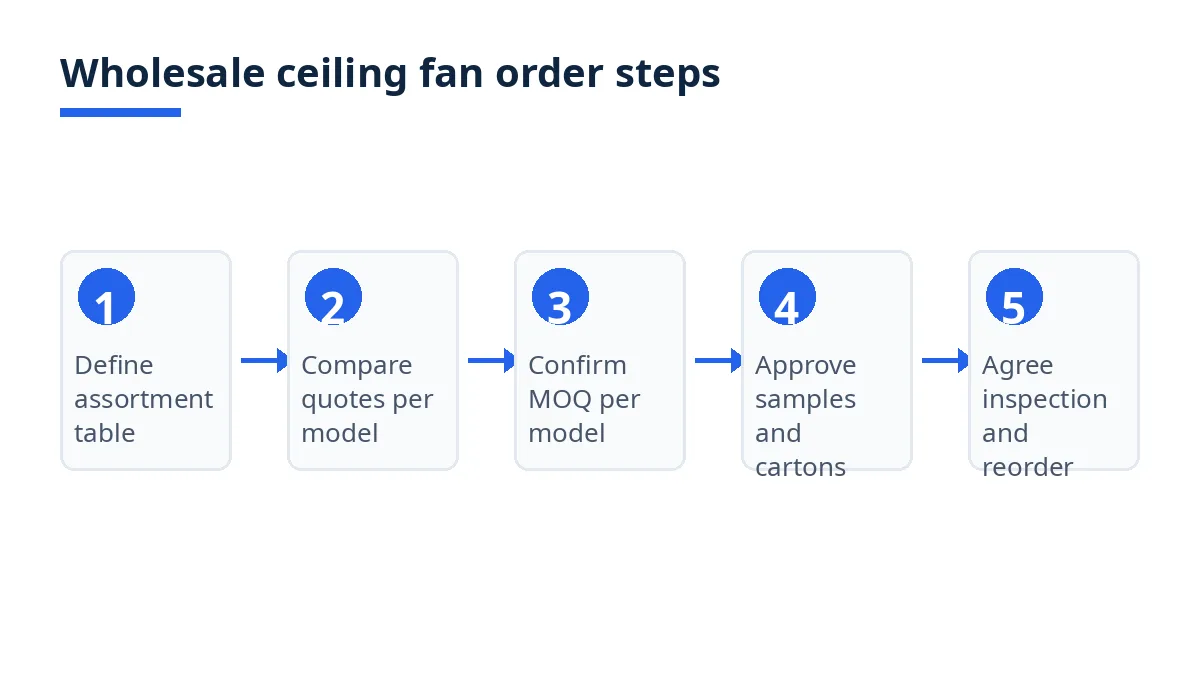
Define the assortment in a table. List each model with sweep, motor type, control type, finish, carton quantity, and quantity. Mark core stock and trial lines.
Send the same table to every candidate supplier. Ask for a quotation per model, with the minimum per model and per finish, carton quantity, spare parts prices, and warranty terms.
Compare quotations on the same assortment and delivery term. The Incoterms 2020 rules set out 11 rules with a clear allocation of cost, risk, and obligations.4 Compare only quotations that state the same rule and named place.
Approve samples per model, not per order. Order a sample of each core model, with its actual motor, blades, control, and carton. Test airflow, noise, control function, and carton protection, then approve or list corrections in writing.
Agree inspection, packing, and reorder terms before confirming. Write the inspection plan, carton marking, spare parts list, and repeat-order price and minimum into the purchase order.
Confirm the first reorder while the first order is in transit. Agree a reorder trigger, such as a stock level per model.
Costs, timelines and documents
What are the typical costs and timelines?
There are no typical wholesale costs or timelines that a guide can state as fact, because each supplier prices your assortment, motor and control specification, finishes, carton design, spare parts cover, and delivery term separately. The drivers to compare are the model mix, the per-model minimum, the carton quantity, the control type, the finish range, the spare parts list, and the delivery term.4 A quotation that bundles those drivers into one unit price hides the line where a cheaper model subsidises an expensive one.
Example figures: a wholesaler plans four models at 250 units per model, totalling 1,000 units. If one finish within one model is ordered at 50 units while that finish carries a per-finish minimum, the order fails on that line even though the total clears the order minimum. The same 1,000 units across two finishes at 500 units per finish can clear both lines. The example shows assortment structure only, not a typical price, minimum, or lead time.
For timelines, ask for sampling, motor and control readiness, production, inspection, and packing dates as separate lines per model, not a single delivery week for the whole assortment. A finish or control that arrives late delays only the models that use it.
Which documents are needed?
For the wholesale order itself, the working documents are the assortment table, the per-model quotation, the purchase order with per-model quantities and minimums, the sample approval record, and the inspection and warranty terms. Keep the same model names, sweep, motor type, and finish wording on every paper.
For export from Bangladesh, the exporter needs an Export Registration Certificate (ERC), obtained from the Chief Controller of Imports and Exports, and a Business Identification Number (BIN) issued by the National Board of Revenue.5 The EXP form is submitted electronically through the ASYCUDA World system, with supporting documents including the commercial invoice, packing list, letter of credit where applicable, and certificate of origin.5 Ask the supplier to confirm in writing that the exporter named on those documents matches the legal name on the quotation, the proforma invoice, and the payment account, and, where a trading company supplies the order, which entity holds the ERC.
Bangladesh-specific rules and tips
Confirm the BSTI position for each model in writing. The use of the BSTI mark has been made mandatory for AC electric ventilating fans and regulators, with manufacturers required to take a BSTI licence and to use the standard seal on the products or their packages, for both locally produced and imported products.6 Ask the supplier to state, per model, whether the model carries the BSTI mark, which standard edition it was assessed against, and whether the licence covers the exact model and motor supplied.
Ask about the energy labeling position for the domestic market. The ceiling fan energy labeling guideline described above applies to fans manufactured, imported, or sold in Bangladesh within its stated scope.3 A model built for export may not carry the same labeling as a model sold in Bangladesh, so a wholesaler who later sells into Bangladesh should ask which labeling applies to that sale, and get the answer in writing.
Keep the assortment table as the single source of truth. A model added after the purchase order should be added as a written amendment to the assortment table, the quotation, and the packing list together. A verbal addition is the most common cause of a wrong model arriving in the right carton.
Plan spare parts as part of the first order, not after it. Blades, regulators, remote controls, and mounting hardware are ordered per model, and a part that fits one sweep may not fit another. List each spare part per model, with quantity and price, on the first purchase order, and agree how warranty replacements are shipped and who pays the freight.
Mistakes and red flags
What are the most common mistakes?
Ordering by total quantity only. The binding minimum is usually per model or per finish. An order can clear the total and still fall below the minimum for one finish, which then carries a surcharge, a removal, or a delay.
Comparing quotations on different assortments. A lower unit price on a narrower finish range, a different control type, or a different delivery term is a different offer. Compare only replies to the same assortment table on the same Incoterm.4
Treating a catalogue as a stock list. A catalogue shows what a supplier can make, not what it holds in stock. Ask which models, finishes, and spare parts are stocked, which are made to order, and the lead time for each.
Skipping the per-model sample. Approving one model does not approve the assortment. Each sweep, motor, and control combination needs its own sample approval, because a fault in one combination does not appear in another.
Ignoring the carton. Wholesale stock is handled many times between factory and shop shelf. Approve the carton, inner packing, and pallet pattern with the sample.
Accepting warranty terms verbally. Record the warranty period per model, what it covers, how a claim is filed, who pays return freight, and how long a replacement takes.
Reading a badge as a guarantee. A profile or a badge is a starting point for enquiries. It does not prove that a supplier can supply your assortment, at your volume, on your dates.
Checklist
Before you confirm a wholesale order, every line should be answered in writing.
Assortment table agreed: one row per model, with sweep, motor type, control type, finish, carton quantity, and quantity.
Minimum confirmed per model and per finish; binding line named.
Quotations compared on the same assortment and Incoterm.4
Sample approved per core model, with motor, blades, control, and carton.
Carton, inner packing, and pallet pattern approved.
Spare parts list per model agreed, with prices and quantities.
Warranty terms in writing: period, coverage, claim route, return freight, replacement time.
Inspection plan agreed, referencing sampling procedures.3
Export set agreed: invoice, packing list, EXP form, certificate of origin, exporter name matched across papers.5
BSTI mark and standard edition confirmed per model, in writing.6
Reorder price, minimum, and trigger agreed before the first shipment.
How Exportain helps
On Exportain, browse suppliers and post a request for quotation (RFQ) on the RFQ board with your assortment table, per-model quantities, and delivery term, so suppliers quote against the same models. Ask each reply for its minimum per model and per finish, its carton quantity, and its spare parts and warranty terms.
Read the badges for what they record. Verification checks cover identity, phone and email, business registration, the Export Registration Certificate (ERC), and photos of the factory or office, and the Exportain team reviews every submission.7 Verification is free on every plan, and badges are earned through these checks and cannot be bought.7 That review is a document and photo review, not a factory inspection, so sample approval and inspection stay with you. See how supplier verification works on Exportain.
For the delivery term on your RFQ, read the best Incoterm for importing electrical products from Bangladesh guide, and for the wider electrical range, the electrical products sourcing guide.
FAQs
What should I know first about ceiling fans?
Know the model before the price. Subheading 841451 covers table, floor, wall, window, ceiling or roof fans with a self-contained electric motor of an output not exceeding 125 W.1 Confirm motor type, rated output, voltage, and sweep per model, and ask which safety references each model was tested against, including IEC 60335-2-80:2024.2
What are the typical costs and timelines?
There are no typical wholesale figures a buyer can rely on, because each supplier prices your assortment, specification, finishes, carton design, spare parts cover, and delivery term separately.4 Compare quotations on the same assortment table and Incoterm, and ask for sampling, production, inspection, and packing dates as separate lines per model.
Which documents are needed?
The order documents are the assortment table, the per-model quotation, the purchase order, the sample approval record, and the inspection and warranty terms. The export set includes the EXP form, the commercial invoice, the packing list, the letter of credit where applicable, and the certificate of origin, with the ERC and BIN held by the exporter.5
What are the most common mistakes?
The most common mistakes are ordering by total quantity only, comparing quotations on different assortments or terms,4 approving one sample for a whole assortment, ignoring carton protection, and accepting warranty terms verbally. Confirm the BSTI mark and standard edition per model in writing,6 and treat a badge as a starting point, not a guarantee.
Next steps on Exportain
Browse suppliers, then post your assortment table and delivery term on the RFQ board so suppliers quote per model and per finish. Before you confirm, read how to import ceiling fans from Bangladesh and the MOQ definition guide.
Sources
- Classification Detail — HS Code 841451. United Nations Statistics Division (accessed )
- IEC 60335-2-80:2024 - Household and similar electrical appliances - Safety - Part 2-80: Particular requirements for fans. International Electrotechnical Commission, (accessed )
- Ceiling Fans — Test Parameters and Standards. Sustainable and Renewable Energy Development Authority (SREDA) (accessed )
- Incoterms® 2020. International Chamber of Commerce (ICC) (accessed )
- Ultimate Guide to Exporting from Bangladesh. SEKO Logistics (accessed )
- 43 more goods come under mandatory BSTI mark. New Age (accessed )
- Sell Bangladeshi Products to Global Buyers | Exportain. Exportain (accessed )
- MOQ
- supplier verification
- buyer guide
- Bangladesh sourcing
- Wholesale sourcing
- Electrical products
- Ceiling fans
About the author
Sourcing from Bangladesh?
Post a request for quotation and suppliers on Exportain can send you their quotes directly.
Post an RFQ