

Wholesale Batteries From Bangladesh: Prices, MOQ and Reliable Suppliers
Wholesale batteries from Bangladesh have no single price or MOQ: chemistry, format and lot structure set the floor. This guide covers lot buying, costs, documents and transport rules by chemistry, and how to compare suppliers.
Short answer
There is no single wholesale price or minimum for batteries from Bangladesh. Each supplier sets its price and minimum per chemistry, format and packing unit, so lead-acid, lithium-ion, nickel and primary cells must be compared on separate lines. Check the classification, the product file and the transport rules for your chemistry before you compare quotations, and get every minimum and term in writing.
On this page
Key takeaways
There is no single wholesale price or minimum for batteries from Bangladesh: each supplier sets its price and minimum per chemistry, format and packing unit.
Chemistry comes first, because it decides the HS classification, the transport rules and the product file for the order.
Lithium transport entries UN3480, UN3481, UN3090 and UN3091 apply to lithium batteries only, never to lead-acid, nickel-cadmium or nickel-metal hydride orders.
For lithium-ion, the UN38.3 test summary must match the exact model being shipped, not a general statement about testing.
Exportain verification is a document review, not a factory inspection, and a badge is not a guarantee.
A wholesale battery order from Bangladesh is not one product bought in bulk. It is a set of chemistries, formats and lot sizes, each with its own packing, transport papers and minimum. A distributor buying lead-acid batteries for vehicles, a retailer stocking dry cells, and a solar installer ordering lithium-ion packs are buying different goods under different rules, even when the cartons leave the same port.
This guide covers the wholesale channel only: how lots are structured, what sets the price and the minimum for each chemistry, which documents and transport rules to check, and how to compare suppliers on the same specification. It does not list manufacturers. For the import sequence, see the how to import batteries from Bangladesh guide, and for inspection points, see the batteries quality control checklist.
Why this matters for buyers and sellers
For a wholesale buyer, the lot structure decides working capital, warehouse space and how long stock sits before it sells. A lot that looks cheap per unit can cost more once freight, warehousing, damage in transit and slow-moving sizes are added. For a seller, the lot structure protects the run: cells, plates, separators and cases are bought or made for your chemistry and format, and a short run still uses the same set-up, packing line and testing. That is why suppliers quote per chemistry, per format and per packing unit, rather than one price for "batteries".
What should I know first about batteries?
Start with chemistry, because chemistry decides the classification, the transport rules and the questions to ask. Primary cells are not rechargeable. Rechargeable batteries, called accumulators or secondary cells, are a separate heading. In the Harmonized System, heading 8506 covers primary cells and primary batteries, and heading 8507 covers electric accumulators, including separators, whether or not rectangular.1 Within heading 8507, the Bangladesh tariff schedule lists lead-acid, nickel-cadmium, nickel-metal hydride and lithium-ion accumulators as separate subheadings.1 Get the chemistry and the subheading right first, because every later document follows from it.
Chemistry | HS heading | Wholesale buying note | Ask the supplier to confirm in writing |
|---|---|---|---|
Primary cells, for example manganese dioxide and zinc-air | 8506 | Sold by cell size and carton count; single-use, so no charging or cycle-life claim applies | Cell size, shelf-life dating and carton count per master carton |
Lead-acid, including vehicle starting and traction types | 8507 | Heavy and bulky; freight and warehouse handling dominate the landed cost | Flooded or sealed construction, weight per unit, and whether the type is a traction battery |
Nickel-cadmium | 8507 | Rechargeable, but cadmium content raises destination-market questions | Cadmium content and any destination restriction that applies to your market |
Nickel-metal hydride | 8507 | Rechargeable, commonly used in consumer and industrial packs | Capacity rating method and the exact cell and pack format |
Lithium-ion | 8507 | Transport and safety papers are part of the product, not an add-on | UN38.3 test summary for the exact model, watt-hour rating and transport classification |
Step-by-step: how it works
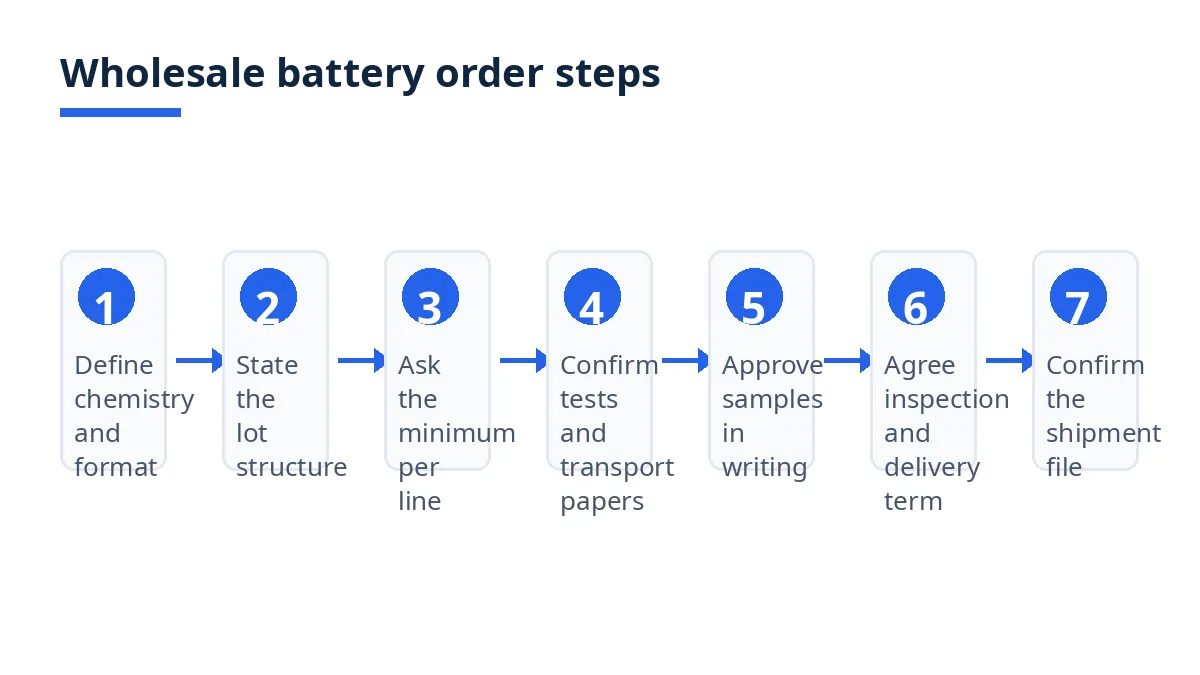
Define chemistry, format and use. State the chemistry, cell or pack format, voltage and capacity, terminal type, case or housing, and the end use. A vehicle starting battery, a traction battery and a backup pack are different specifications.
State the lot structure, not only the total. Give the quantity per chemistry, per format and per size, plus the packing you want: units per inner carton, cartons per master carton, and pallets if the order will be palletised. A total without a split cannot be answered with a usable wholesale price or minimum.
Ask for the minimum per line. Ask for the minimum per chemistry, per format and per packing unit, and which line is binding for your split. Record whether stocked sizes carry a lower minimum than sizes made to order.
Confirm tests, marks and transport papers before samples. For lithium-ion, ask for the UN38.3 test summary for the exact model and the transport classification for your route. For lead-acid types covered by mandatory marking in Bangladesh, ask for the applicable standard mark details.
Approve samples in writing. Order samples in the actual chemistry, format, labelling and packing. Test capacity claims, check terminals and cases, and confirm the carton and pallet build. Approve or list corrections in writing, with the sample kept as the reference for the bulk order.
Agree inspection, delivery term and payment before you confirm. Write the inspection plan into the purchase order, state one delivery term for every quotation, and agree how warranty claims and damaged or short-shipped units will be handled. The Incoterms 2020 rules set out 11 rules with a clear allocation of cost, risk and obligations.2 Compare quotations only on the same term.
Confirm the shipment file. Before loading, confirm the invoice, packing list, certificate of origin and transport documents match the purchase order line by line.
See the MOQ definition guide for how a minimum order quantity is defined.
Costs, timelines and documents
What are the typical costs and timelines?
There are no typical wholesale prices or timelines a guide can state as fact, because each supplier prices your chemistry, format, lot structure, packing, testing and delivery term. The main price drivers are chemistry and cell or plate cost, format and case, the size of each lot line, carton and pallet packing, testing and marking for the destination market, and freight, which for lead-acid is driven by weight.
Example figures: a buyer orders two sizes of one lead-acid type, split unevenly across the sizes, and the smaller size falls below its lot minimum while the total clears the order minimum. The same total split evenly across the two sizes can clear both lines. Example figures: a buyer adds a second chemistry to the same order and gains a separate minimum, a separate test file and a separate transport classification, even though the cartons travel together. Both examples show structure only, not a typical price, minimum or lead time.
For timelines, sampling depends on whether the size is stocked or made to order, bulk production on cell or plate supply and line capacity, and shipping on the transport classification and the forwarder's acceptance checks. Ask for sampling, production ready, inspection and shipment dates as separate lines, not a single delivery week. For lithium-ion, build the transport acceptance check into the timeline: a missing or mismatched test summary stops the shipment.
Which documents are needed?
For export clearance in Bangladesh, goods may not be loaded unless an export declaration, the Bill of Export or Shipping Bill, is submitted to Customs and approved.3 Enclosed documents include the export contract or purchase order where there is no export letter of credit, the commercial invoice, the packing list, the EXP form certified by an authorized dealer, and a certificate of origin issued by the EPB or a Chamber of Commerce and Industry.3
On top of the export set, a wholesale battery order needs its product file: the specification sheet per chemistry and format, the test or standard-mark evidence that applies to that chemistry, the safety data sheet where the carrier or destination requires one, and, for lithium-ion, the UN38.3 test summary for the exact model. The UN38.3 tests cover altitude simulation, thermal cycling, vibration, shock, external short circuit, impact, overcharge and forced discharge for lithium cells and batteries.4 Ask for the summary by model number, not a general statement that testing has been done.
Transport classification is chemistry-specific and must not be generalised. Lithium-ion batteries shipped alone are classified as UN3480, and lithium-ion batteries packed with or contained in equipment are classified as UN3481.5 Lithium metal batteries have their own entries, UN3090 when shipped alone and UN3091 when packed with or contained in equipment.5 For air transport, lithium-ion batteries are subject to a state-of-charge limit, and the current limit must be confirmed with the forwarder before packing.5 6 None of these lithium entries applies to lead-acid, nickel-cadmium or nickel-metal hydride batteries.
Bangladesh-specific rules and tips
Confirm the standard mark position for your type. The Bangladesh Standards and Testing Institution (BSTI) standardisation mark has been made mandatory for lead-acid traction batteries and for uninterruptible power systems, among other products, with manufacturers required to use the mark on the labels or the bodies of the products.7 Separately, published BSTI licence listings give BDS 1335 for lead-acid batteries and BDS 80 for dry cell batteries.8 Ask the supplier which standard and mark applies to your exact type, and get the answer in writing, rather than assuming every battery type carries the same mark.
Keep one legal name across every paper. The export declaration names the exporter and the foreign buyer,3 so the name on the trade licence, quotation, proforma invoice and payment account should match.
Check the destination market rules before the order, not at the port. For the European Union, Regulation (EU) 2023/1542 applies to all categories of batteries placed on the market or put into service in the EU, regardless of chemistry, shape or use.9 CE marking obligations under the Regulation apply from 18 August 2024, and labelling requirements, including a label with general battery information, apply from 18 August 2026 or 18 months after the relevant implementing act, whichever is later.9 If you sell into the EU, ask the supplier for the Declaration of Conformity and the label information that applies to your battery category.
Mistakes and red flags
What are the most common mistakes?
Ordering by total quantity only. The binding minimum is usually per chemistry, per format or per packing unit. An order can clear the total and still fall below the minimum for one size, which then carries a surcharge, a removal or a delayed line.
Comparing wholesale prices on different lots. A lower unit price on a stocked size, a different chemistry, lighter packing or a different delivery term is a different offer. Compare only replies to the same specification and Incoterm.2
Treating lithium transport rules as general battery rules. UN3480, UN3481, UN3090 and UN3091 are lithium entries.5 Applying them to a lead-acid or nickel order, or ignoring them on a lithium order, both create a rejected or misdeclared shipment.
Accepting a test claim without the model-specific paper. A general statement about testing is not a test summary. For lithium-ion, the summary must match the exact model being shipped.4
Accepting a verbal minimum or warranty term. Record any agreed minimum, price validity, warranty period and damage-claims process on the quotation and purchase order, with the split it applies to.
Reading a profile or a badge as a guarantee. A profile is a starting point for enquiries. It does not test whether a supplier can make your chemistry and format at your lot size, and a badge is not a guarantee of capacity, quality or delivery. Verification is a document review, not a factory inspection.10
Skipping inspection to save time. Sampling under an agreed plan checks the lot against agreed acceptance levels before the goods become your stock. ISO 2859-1 defines a system of acceptance sampling plans for inspection by attributes, indexed by acceptance quality limit (AQL) for lot-by-lot inspection.11 Agree the inspection level and AQL values before production.
Checklist
Before you confirm, every line should be answered in writing.
Chemistry, format, voltage, capacity, terminal and case specified per line.
Split stated per chemistry, format and size, with units per inner carton and cartons per master carton.
Minimum confirmed per chemistry, format and packing unit; binding line named.
Stocked sizes separated from made-to-order sizes, with the minimum for each.
Product file complete: specification sheet, applicable standard-mark evidence, and safety data sheet where required.
Lithium-ion only: UN38.3 test summary for the exact model, watt-hour rating and UN number confirmed.5 4
Destination-market labelling and Declaration of Conformity confirmed for your battery category.9
Sample measured, tested and approved in writing, with the reference sample kept.
Inspection level and AQL values in the purchase order.11
Quotations compared on the same specification, split and delivery term.2
Export set agreed: invoice, packing list, EXP form, certificate of origin, Bill of Export.3
How Exportain helps
On Exportain, browse suppliers and post a request for quotation (RFQ) on the RFQ board with your chemistry, format, split per size and delivery term, so suppliers quote against the same specification. Ask each reply for its minimum per chemistry, format and packing unit, and for the product file that applies to that chemistry.
Read the badges for what they record. See how supplier verification works on Exportain before you rely on a badge, and remember that verification is a document review, not a factory inspection.10 Sample approval, transport-paper checks and inspection stay with you as the buyer.
FAQs
What should I know first about batteries?
Start with chemistry. Heading 8506 covers primary cells and primary batteries, and heading 8507 covers electric accumulators, with lead-acid, nickel-cadmium, nickel-metal hydride and lithium-ion listed as separate subheadings in the Bangladesh tariff schedule.1 Chemistry decides the classification, the transport rules and the product file, so it comes before price or lot size.
What are the typical costs and timelines?
There are no typical figures a buyer can rely on, because each supplier sets its price, minimum and lead time for your chemistry, format, split and delivery term.2 Chemistry, format, lot lines, packing, destination-market testing and freight drive the price, and stock status, production capacity and transport acceptance drive the timeline.
Which documents are needed?
The order documents are the specification sheet, itemized quotation and purchase order, with the minimum per chemistry, format and packing unit on both. The export set is the Bill of Export, commercial invoice, packing list, EXP form certified by an authorized dealer, and a certificate of origin issued by the EPB or a Chamber of Commerce and Industry.3 Lithium-ion orders add the model-specific UN38.3 test summary and the transport classification.5 4
What are the most common mistakes?
The most common mistakes are ordering by total quantity only, comparing prices on different specifications or terms,2 treating lithium transport entries as general battery rules,5 accepting a test claim without the model-specific summary,4 and reading a badge as a guarantee. Verification is a document review, not a factory inspection.10
Next steps on Exportain
Browse suppliers, then post your chemistry, format and split per size on the RFQ board so suppliers state their minimum per line. Before you confirm, read the how to import batteries from Bangladesh guide and the MOQ definition guide.
Sources
- Bangladesh Customs Tariff Schedule — Chapter 85. National Board of Revenue (NBR) (accessed )
- Incoterms® 2020. International Chamber of Commerce (ICC) (accessed )
- Customs Clearance Procedures for Export. Bangladesh Customs, National Board of Revenue (accessed )
- UN38.3 Battery Certification 2026: Lithium and Sodium Battery Transport Test and Compliance Guide. GDESTL (accessed )
- Transporting Lithium Batteries and Packs. Custom Power (accessed )
- What Class Are Lithium Batteries? Class 9 Explained. LegalClarity (accessed )
- Sweets, LPG cylinders come under BSTI mandatory certification. The Daily Star (accessed )
- How to Obtain BSTI License in Bangladesh. LegalSeba LLP, (accessed )
- Regulation (EU) 2023/1542 concerning batteries and waste batteries. European Union (accessed )
- How Supplier Verification Works on Exportain. Exportain, (accessed )
- ISO 2859-1:2026 - Sampling procedures for inspection by attributes — Part 1: Sampling schemes indexed by acceptance quality limit (AQL) for lot-by-lot inspection. ISO (accessed )
About the author
Sourcing from Bangladesh?
Post a request for quotation and suppliers on Exportain can send you their quotes directly.
Post an RFQ


