

Wholesale Bath Towels From Bangladesh: Prices, MOQ and Reliable Suppliers
Wholesale bath towels from Bangladesh, compared on one specification: what moves the price, what sets the MOQ per colour and size, and how to score suppliers side by side before you order.
Short answer
Wholesale bath towels from Bangladesh should be compared on one identical specification, not on headline prices. Send every supplier the same fiber, GSM, pile, size after washing, edge, colour, and packing details, ask for the minimum per colour and size on one delivery term, and score samples side by side. The supplier who is cheapest for that exact towel, at a quantity you can place, is the comparison that matters.
On this page
Key takeaways
Compare wholesale bath towels only on one identical specification: fibre, GSM, pile, size after washing, edge, color, and packing, priced on one delivery term.
Ask for the minimum per color and per size, not only per order, because a total minimum can hide a per-color minimum your split does not meet.
Price moves with GSM and pile, size, color count, edge construction, packing, and the split per color, so change one line at a time when a quote is high.
Approve samples in the bulk fabric, color, and edge, agree inspection and AQL values before production, and approve label wording for each destination first.
Exportain verification is a document and photo review, not a factory inspection, and a badge is not a guarantee of capacity, quality, or delivery.
Wholesale bath towels from Bangladesh are hard to compare well. Two suppliers can quote what looks like the same towel at very different prices, and both quotes can be honest, because the towels behind them are not the same. One may be heavier, one may have a denser pile, one may be cut larger, or one may carry a different edge finish. A wholesale comparison only works when every supplier prices the same specification, on the same delivery term, with the minimum stated per color and per size.
In the Harmonized System, subheading 630260 covers kitchen and toilet linen of terry towelling or similar terry fabrics, of cotton.1 That classification is a starting point for customs, not a specification. Your specification turns a general towel into the towel you can sell, wash after wash, without mismatched reorders.
Why this matters for buyers and sellers
For a buyer, the wholesale decision is a stock decision. Towels bought in bulk sit in a warehouse, a shop, or a hotel linen room, and a mistake in weight, size, or color is repeated across every unit. For a seller, the same specification decides whether an order can be produced at all: a towel in five colors at a small quantity per color needs five dye runs and five packing runs, even when the total looks large.
A comparison on one specification protects both sides. The buyer sees which supplier is cheaper for the towel they want, rather than which supplier quoted the lightest towel. The seller sees an enquiry they can answer with a firm price and a firm minimum.
What should I know first about bath towels?
A bath towel specification has five lines that move price and feel more than any other detail. Fiber composition states what the towel is made of, in percentages by weight. GSM, grams per square metre, states fabric weight and is the simplest proxy for thickness and absorbency, although pile height and yarn also matter. Pile describes the looped surface of a terry towel. Size states length and width after washing, not only before it. Edge finish states how the towel is hemmed or bound, and whether a dobby or plain border is included.
Color and packing sit beside those five lines. State each color by a named reference, state how many towels go in each inner pack and export carton, and state whether the towel is sold singly or in a set. A set price and a single-towel price cannot be compared until the pack quantity is the same.
Step-by-step: how it works
Send the same document to every supplier, ask the same questions of every reply, and score the samples on the same sheet.
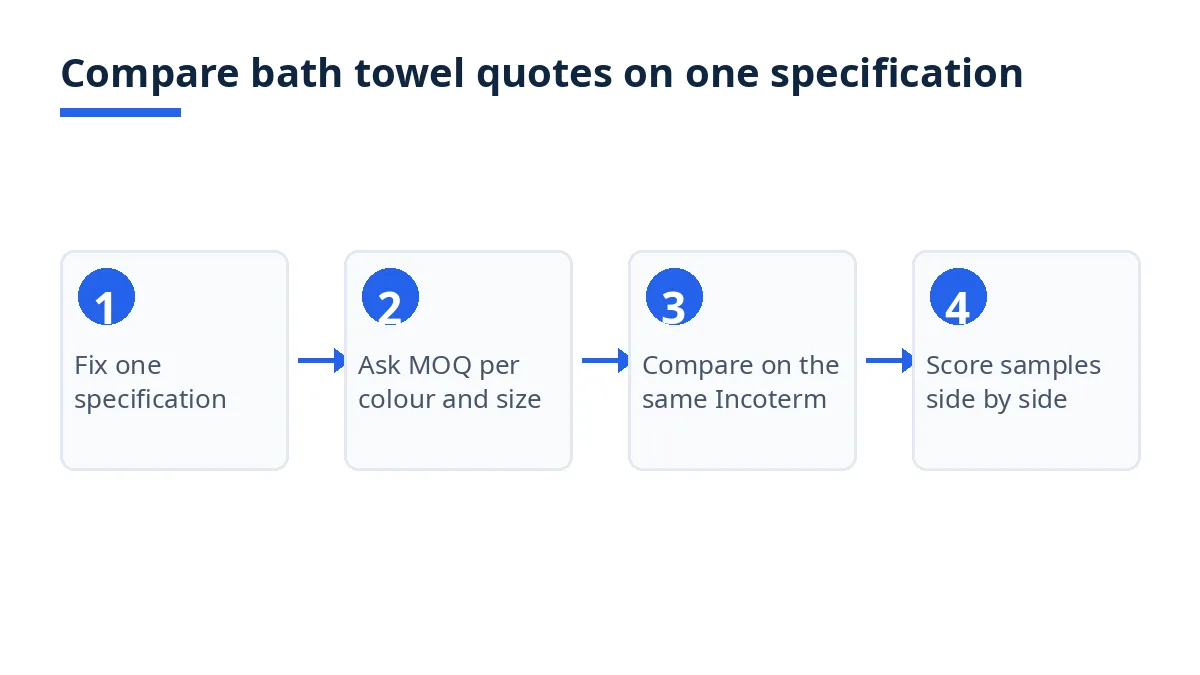
Write one specification sheet. State fiber composition, GSM, pile type, size after washing, edge finish, color references, label wording, and packing, and state the tolerance you will accept on size and weight.
Send the identical sheet to each supplier. If a supplier cannot meet one line, ask them to state the change in writing so the difference is visible.
Ask for the minimum per color and per size, not only per order. A total minimum can hide a per-color minimum your order does not meet. Ask which line binds for your split.
Ask for one price on one delivery term. State one Incoterm and one named place for every quotation. The Incoterms 2020 rules allocate cost, risk, and obligations for each rule,2 so prices on different terms are not comparable.
Order samples in the bulk fabric and color. A sample in a different weight or a stock color does not prove the bulk order. Measure it, wash it under the care instructions you will print, and record the result against each line.
Score samples side by side before you confirm. Use one score sheet for every sample: size after washing, weight, pile feel, edge stitching, color against the reference, label accuracy, and packing. Keep the score sheet with the purchase order.
Comparison line | What to hold constant | What to ask in writing |
|---|---|---|
Fiber | Composition in percentages | Composition and yarn type |
Weight | GSM | GSM and tolerance |
Surface | Pile type and height | Pile description and feel standard |
Size | Size after washing | Size before and after washing |
Edge | Hem, binding, and border | Edge construction and stitching |
Color | Color reference per color | Dye method and color reference |
Packing | Units per pack and carton | Inner pack, carton, and labeling |
Minimum | Split per color and size | Minimum per color, size, and pack |
Delivery | One Incoterm and place | Price on that term only |
For inspection, agree the plan before production. ISO 2859-1 defines a system of acceptance sampling plans for inspection by attributes, indexed by acceptance quality limit (AQL) for lot-by-lot inspection.3 AQL is the maximum average percentage of defective items considered acceptable during random sampling.3 Write the inspection level and AQL values into the purchase order, and see the bath towels quality control checklist.
Costs, timelines and documents
What are the typical costs and timelines?
There is no typical wholesale price or lead time a guide can state as a fact for bath towels, because each supplier prices your fiber, GSM, pile, size, edge, color count, packing, and order split, on the delivery term you choose.
Price driver | Why it moves the price | How to control it in the specification |
|---|---|---|
GSM and pile | More yarn per towel and a denser loop surface use more material | Fix one GSM and one pile standard for all quotes |
Size | A larger towel uses more fabric and more carton space | Fix the size after washing, not only the loom size |
Color count | Each color needs its own dye run and trim set | Reduce colors, or raise the quantity per color |
Edge and border | Binding, dobby work, and stitching add operations | Choose one edge construction for all quotes |
Packing | Inner packs, sets, bands, and cartons add material and labour | Fix units per pack and carton before quoting |
Order split | Small quantities per color spread set-up cost over fewer units | State the split per color and size in the enquiry |
Delivery term | Freight, insurance, and destination charges sit on different sides of the term | Compare only on the same Incoterm and place |
Example figures: three suppliers quote the same bath towel specification, one color, one size, and one edge finish, at different unit prices and per-color minimums. The cheapest unit price carries a per-color minimum twice the quantity of the other two, so a buyer who needs only the smaller quantity pays more per unit on the order they can place. The example shows structure only, not a market price, a typical minimum, or a typical lead time.
For timelines, ask for separate dates rather than one delivery week: sample, fabric ready, production, inspection, and shipment. Sampling depends on fabric availability and correction rounds, and bulk production depends on dyeing, packing material, and line capacity.
Which documents are needed?
The order documents are the specification sheet, the itemized quotation on one delivery term, the purchase order with the split per color and size, the sample approval in writing, and the inspection report against the agreed AQL values.3
For export clearance in Bangladesh, goods may not be loaded unless an export declaration, the Bill of Export or Shipping Bill, is submitted to Customs and approved.4 Enclosed documents include the export contract or purchase order where there is no export letter of credit, the commercial invoice, the packing list, the EXP form certified by an authorized dealer, and a certificate of origin issued by the EPB or a Chamber of Commerce and Industry.4 The declaration names the exporter and the foreign buyer,4 so the legal name on the quotation, invoice, and payment account should match.
Labeling is a destination rule, not a supplier preference. In the European Union, Regulation (EU) No 1007/2011 states that a textile product shall be labeled or marked with the name and percentage by weight of all constituent fibers in descending order.5 In the United States, federal law requires that most textile and wool products have a label that lists the fiber content, the country of origin, and the identity of the manufacturer or another business responsible for marketing or handling the product, and manufacturers and importers must provide care instructions.6 Confirm the label wording, percentages, and care symbols for each destination before production.
Bangladesh-specific rules and tips
Confirm the classification with your customs broker for your exact towel, because a terry towel and a non-terry towel fall under different subheadings within heading 6302. Subheading 630260 covers kitchen and toilet linen of terry towelling or similar terry fabrics, of cotton,1 while other cotton towels sit elsewhere in the heading.
Keep one legal name and one color reference across every paper. A color agreed by a phone photo, without a named reference in the purchase order, is a common source of a bulk delivery that does not match the sample. Ask the supplier to confirm in writing whether each color is dyed to order and what quantity that dye run covers.
Ask which inputs are bought in for your order. Yarn, dyes, and packing material bought for your specification can set both the earliest production date and the minimum per color. Agree the size ratio per color before production, and agree in writing what happens to a color that falls short of its minimum. State the destination on the specification sheet itself, since the USA, the UK, the EU, and the UAE can need different labels, carton marks, and destination documents.
Mistakes and red flags
What are the most common mistakes?
Comparing prices for different towels. A lower price on a lighter GSM, a smaller size, a simpler edge, or a stock color is a different offer. Compare only replies to the same sheet on the same delivery term.2
Asking for a total minimum only. The binding minimum is usually per color or per size. An order can clear the total and still fall below the per-color minimum for one color, which then carries a surcharge or removal.
Approving a sample that is not the bulk towel. A sample in a different weight, a stock color, or a different edge finish proves nothing about the bulk order. Approve the sample in the bulk fabric, color, edge, and label, in writing.
Leaving the label until after production. Fiber percentages, country of origin, and care instructions are destination rules.5 6 A label corrected after the towels are packed costs a repack, and a label corrected after shipment costs far more.
Treating a profile or a badge as a guarantee. A profile is a starting point for enquiries. It does not test whether a supplier can make your towel, and a badge is not a guarantee of capacity, quality, or delivery.7
Skipping inspection to save time. Sampling under ISO 2859-1 checks a lot against an agreed AQL,3 and it is the last control before the towels become your stock.
Red flags in a reply: a price with no specification attached, a minimum stated only as a total, a sample offered only in a stock color, a refusal to state the GSM or the size after washing, and a label promised without sight of the destination rules.
Checklist
Before you confirm, every line should be answered in writing.
Specification sheet sent: fiber, GSM, pile, size after washing, edge, colors, labels.
Identical sheet sent to every supplier, with changes stated in writing.
Minimum confirmed per color, per size, and per pack; binding line named.
Quotations compared on the same specification and Incoterm.2
Sample approved in bulk fabric, color, and edge, in writing.
Inspection level and AQL values in the purchase order.3
Export set agreed: invoice, packing list, EXP form, certificate of origin, Bill of Export.4
Size ratio per color agreed before production.
Repeat-order terms recorded for the same specification.
How Exportain helps
On Exportain, browse suppliers and post a request for quotation on the RFQ board with your specification sheet, split per color and size, and delivery term, so suppliers quote against the same towel. Ask each reply for its per-color and per-size minimum on the same Incoterm. When you accept a quotation, Exportain creates one order and issues one proforma invoice from the accepted terms.7
Read the badges for what they record. Exportain Verified means Exportain has checked identity, phone, email, and business registration, and Export Verified means it has checked the Export Registration Certificate (ERC).7 Factory Verified means it has reviewed photos of the manufacturer factory.7 Verification is a document and photo review, not a factory inspection,7 8 so sample approval and inspection stay with you. See the HS code for bath towels guide and the MOQ definition guide.
FAQs
What should I know first about bath towels?
Know the specification before you ask for a price. Fiber composition, GSM, pile, size after washing, edge finish, color references, and packing decide the price, the minimum, and whether two quotes can be compared. Cotton terry towels sit under subheading 630260, which covers kitchen and toilet linen of terry towelling or similar terry fabrics, of cotton.1
What are the typical costs and timelines?
There are no typical figures a buyer can rely on, because each supplier prices your fiber, GSM, pile, size, edge, color count, packing, and split, on the delivery term you choose.2 Ask for sampling, production, inspection, and shipment dates as separate lines.
Which documents are needed?
The order documents are the specification sheet, the itemized quotation, the purchase order with the split, the written sample approval, and the inspection report.3 The export set is the Bill of Export, commercial invoice, packing list, EXP form certified by an authorized dealer, and a certificate of origin.4 Labels must also meet the destination rules for fiber content, origin, and care.5 6
What are the most common mistakes?
The most common mistakes are comparing prices for different towels, asking only for a total minimum, approving a sample that is not the bulk towel, leaving the label until after production, and reading a badge as a guarantee.7 Verification is a document and photo review, not a factory inspection.7 8
Next steps on Exportain
Browse suppliers, then post your specification sheet, split per color and size, and delivery term on the RFQ board so suppliers state their price and minimum on the same towel. Before you confirm, read the how to import bath towels from Bangladesh guide.
Sources
- Classification Detail — HS Code 630260. United Nations Statistics Division (accessed )
- Incoterms® 2020. International Chamber of Commerce (ICC) (accessed )
- ISO 2859-1:2026 - Sampling procedures for inspection by attributes — Part 1: Sampling schemes indexed by acceptance quality limit (AQL) for lot-by-lot inspection. ISO (accessed )
- Customs Clearance Procedures for Export. Bangladesh Customs, National Board of Revenue (accessed )
- Regulation (EU) No 1007/2011 on textile fibre names and related labelling and marking of the fibre composition of textile products. European Union, (accessed )
- Textile, Wool, Fur, Apparel and Leather Matters. Federal Trade Commission (accessed )
- Trust & Safety Center. Exportain (accessed )
- Supplier verification: Earn trust badges buyers can see. Exportain (accessed )
About the author
Sourcing from Bangladesh?
Post a request for quotation and suppliers on Exportain can send you their quotes directly.
Post an RFQ


