Quality Control Checklist for Bath Towels From Bangladesh
A numbered QC checklist for bath towels from Bangladesh: dimensions, weight and GSM, absorbency, pile and shedding, hems, wash and rubbing fastness, labels and packing, with fixes for common failures.
Short answer
Use this bath towels quality control checklist to check towel dimensions, weight and GSM, absorbency, pile and shedding, hems and stitching, dimensional change and color fastness to washing and rubbing, labels, folding, packing and cartons on bath towels from Bangladesh before shipment. Agree tolerances, test methods and acceptance numbers in the purchase order first.
On this page
Key takeaways
Agree the sample, size chart, tolerances, weight and GSM, test methods and acceptance numbers before inspection, and draw the sample across sizes, colors and cartons.
Weigh towels one by one and verify GSM from known dimensions, because a light towel usually means thinner pile than the approved sample.
Test absorbency and shedding in the condition the order specifies, and again after washing where required, because both can change after the first wash.
Review washing and rubbing fastness evidence for every color, because bath towels are laundered repeatedly and used wet against the skin.
If you import bath towels, this bath towels quality control checklist gives you a practical way to check a shipment before it leaves Bangladesh. A towel fails on use, not on looks alone: under size, light for its agreed weight, slow to absorb, shedding pile, or bleeding color in the wash, it is returned. Sampling should follow an agreed plan, not towels the factory selects. ISO 2859-1 specifies an acceptance sampling system for inspection by attributes, indexed in terms of the acceptance quality limit (AQL), applicable to end items.1
Why this checklist matters
Bath towels are washed and handled daily, in hotels and laundries as well as homes, so small faults grow quickly. A short hem pulls open, loose pile sheds, and a shade gap in one set shows at first unpacking.
A written checklist removes interpretation. Each point is checked against the sample and specification, and recorded as pass, fail or not applicable. Set acceptance numbers for critical, major and minor defects in the purchase order.1 See the AQL acceptance quality limit explainer.
This checklist covers dimensions, weight, absorbency, pile, workmanship, color fastness, labels and packing for woven terry towels.
Before you start
Do not begin until the reference material is complete: an approved sample per size and color, the purchase order, the size chart with tolerances, the agreed weight per towel and mass per unit area (GSM), and the label artwork.
Agree the sampling plan in advance, using the AQL approach described above.1 Draw the sample across sizes, colors and cartons.
Check the label plan before bulk labels are printed. Under Regulation (EU) No 1007/2011, a textile product shall be labelled or marked with the name and percentage by weight of all constituent fibres in descending order.2 ISO 3758 establishes a system of graphic symbols for care labelling, based on the most severe treatments that do not cause irreversible damage.3
Agree every number this checklist leaves open, in writing, before inspection: tolerances, absorbency method and limit, wash procedures behind the test evidence, and acceptance numbers per defect class. A check with no agreed limit can be recorded, but not fairly passed or failed.
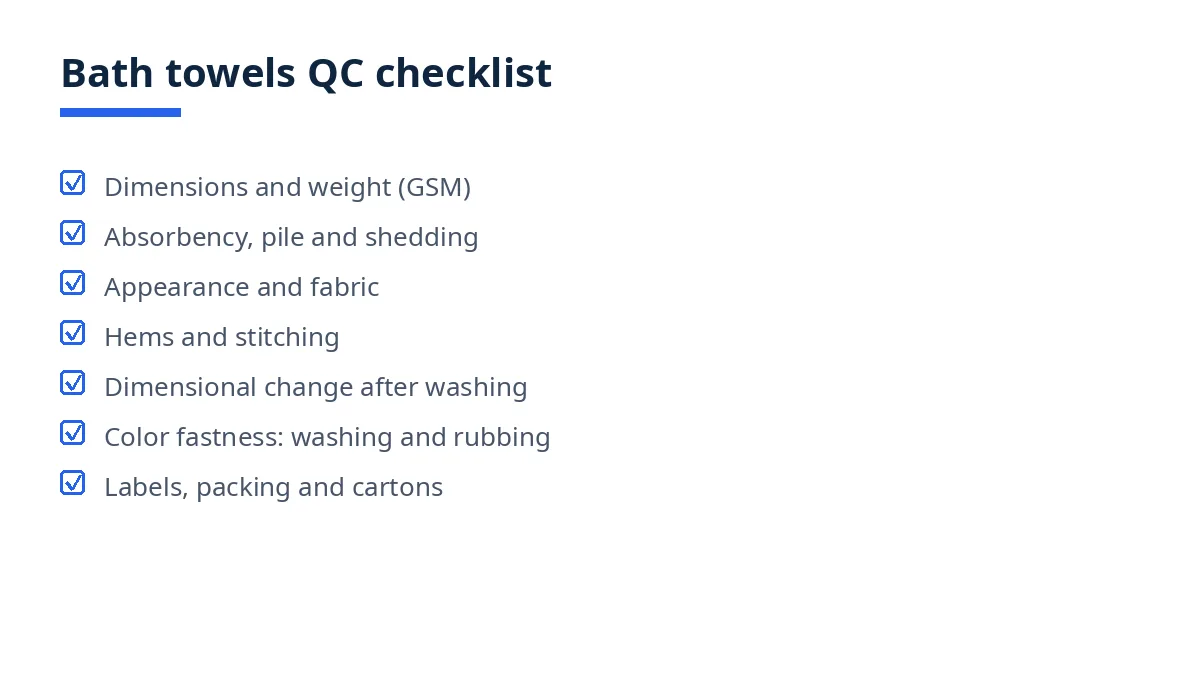
The full checklist (numbered, printable): bath towels quality control checklist
Dimensions and weight
Measure length and width of towels across all sizes and colors, laid flat without stretching, as the size chart directs.
Compare every measurement with the chart tolerance, recording values size by size, not a lot average.
Check both ends and both sides: a towel hemmed unevenly can pass at one edge, fail at the other.
Check squareness: fold a towel in half lengthways and crossways and confirm corners and hems meet without offset.
Weigh individual towels on a calibrated scale against the agreed weight and tolerance.
Verify mass per unit area (GSM) as a buyer-agreed check: weigh a towel of known dimensions and calculate mass per unit area, or review the lot test record. ISO 3801 specifies methods for determining mass per unit length and mass per unit area of woven fabrics from weighed specimens of known dimensions.4
Confirm label and carton size and weight match the order.
Absorbency, pile and shedding
Test absorbency by the method and in the condition agreed in the purchase order, recording the result towel by towel. Finishing still in the pile changes the result, so the tested condition must be the agreed one.
Where the order requires it, re-test absorbency after washing, against the agreed limit and sample.
Check pile height and density against the approved sample, looking for thin patches, missing loops or ground weave showing through.
Check for pulled loops, snags and uncut loops, and confirm no loop pulls free when tugged gently.
Check shedding: rub each towel firmly with a dark cloth (light cloth for white towels), shake it, and record loose fibre against the sample and agreed limit.
Check borders and dobby sections named in the order: flat, matching the design, no pulled threads where pile meets border.
Appearance and fabric
Check for holes, stains, oil marks, weaving defects and uneven dyeing, against the sample.
Check shade within each towel and across towels of one color, against the approved standard under the same light, including border and hem thread.
Check embroidery or logo named in the order for position, size, color and secure edges, with no backing showing through the pile.
Check finishing: no soapy feel in the pile, no uneven softness between towels, no loose threads at borders or hems.
Hems and stitching
Check hems on all four sides where specified: even width, straight stitching, secure corners, no raw edge.
Check hems for skipped or broken stitches, puckering and uneven stitch density, pulling each hem gently along its length.
Check hem corners are finished as ordered, with no fraying or thread tails inside the fold.
Check the hanging loop where fitted: firmly attached at both ends, in position, no twist.
Where hem seam strength is tested, confirm method and limit were agreed in advance. ISO 13935-1 specifies a strip test for maximum force to seam rupture, force applied perpendicularly to the seam, mainly for woven fabrics and straight seams.5
Dimensional change and appearance after washing
Review dimensional change evidence where required, for length and width after the agreed wash procedure. ISO 5077 specifies a method for determining dimensional change of fabrics, garments or other textile articles in specified washing and drying.6
Check appearance after washing where required: even pile, flat hems, no border puckering, shade matching.
Re-check absorbency and shedding after washing where the order requires it, because both can change in the first wash.
Confirm every wash report names the fabric, color tested and this lot.
Color fastness: washing and rubbing
Check color consistency within each towel and across the sample, against the approved standard.
Review washing fastness evidence where required, because towels are laundered repeatedly. ISO 105-C06 specifies methods for determining the resistance of the colour of textiles to domestic or commercial laundering using a reference detergent.7
Review rubbing fastness evidence for dark colors, wet and dry, because a wet towel is rubbed against skin. ISO 105-X12 specifies a method for determining the resistance of the colour of textiles, including pile fabrics, to rubbing off and staining other materials, using one dry and one wet rubbing cloth.8
Confirm fastness reports cover every color in the order, not only the lightest.
Labels and product claims
Check thread, border yarn and trims for color match and correct type, with no substitution in bulk.
If a harmful-substances claim will appear on the product, check the certificate scope. Under OEKO-TEX STANDARD 100, the label is awarded only if all components meet the criteria, including fabric, threads, dyes and finishes, and towels fall in the class for textiles in direct skin contact.9
Check any other claim matches the evidence and wording in the order.
Packing and cartons
Verify care, fibre, origin, size and brand labels are present, legible and correctly positioned on every sampled towel. For the EU, check fibre names against Regulation No 1007/2011,2 and care symbols against ISO 3758.3
Check barcode and size stickers scan and match the purchase order.
Confirm folding and packing follow the specification, size and color ratios per carton match the packing list, and no damp towels are sealed in polybags.
Weigh and measure sample cartons, and check markings and count against the packing list.
Common failures and how to fix them
The most frequent failure is a towel light for its agreed weight, which usually means thinner pile than the approved sample, not a weighing error. Re-weigh towels from several cartons, compare pile density with the sample, and hold packing until it is settled against the agreed GSM check. The second is heavy shedding, from short or poorly anchored pile: rub and shake more towels and agree sorting, re-washing or rejection before cartons are sealed.
Slow absorbency usually traces to finishing left in the pile: wash a towel by the agreed procedure and re-test, because a towel that fails dry can pass after washing. Open hems point to stitch tension or an uneven fold: re-check a test towel before sewing restarts. A body-to-border shade gap usually means border yarn from another dye lot: re-sort by lot.
Above the agreed acceptance level, the options are re-inspection after sorting or rework, documented partial acceptance, or rejection.
Downloadable template / summary table
Copy the numbered checklist into your inspection sheet, add the size chart, tolerances, agreed weight and GSM and acceptance numbers from the order, and record a result per towel sampled.
Section | Checks | Evidence |
|---|---|---|
Dimensions and weight | Length, width, weight, GSM | Measurements |
Absorbency and pile | Absorbency, pile, shedding | Test results |
Hems and stitching | Hems, corners, loop | Pull checks |
Dimensional change | Change after washing | Wash reports |
Color fastness | Washing, rubbing | Reports per color |
Labels and packing | Labels, folding, cartons | Packing list |
How Exportain helps
Exportain is a B2B marketplace that connects buyers with Bangladeshi suppliers of bath towels, so this checklist can be agreed at the enquiry stage. Browse suppliers, the home textiles category and inspection services for the shipment check. Supplier profiles show which document and photo checks have been recorded: reviews of documents and photos, not factory inspections. Exportain is not a party to the goods contract and does not inspect goods.
FAQs
When should this checklist be used?
Use it at final inspection, when towels are finished and largely packed. For larger and first orders, also run the measurement, weight and absorbency checks during production.
Who should complete it?
The buyer, a local agent or an independent inspector can complete it, using the approved sample and agreed limits, with the sample drawn randomly across sizes and colors.
What are the most common failures?
Towels light for the agreed weight, heavy shedding, slow absorbency, open hems and shade gaps between body and border.
Can a third party do it?
Yes, provided you share the approved references, tolerances and acceptance levels first, and agree who pays for re-inspection after a failure.
Next steps on Exportain
Before production starts, agree your size chart, tolerances, weight and GSM, absorbency method and label wording, then read the pre-shipment inspection guide for timing and the AQL acceptance quality limit explainer for sampling. When ready, post a free RFQ on Exportain at https://exportain.com/rfqs and compare quotes against the same checklist.
Sources
- ISO 2859-1:1999 - Sampling procedures for inspection by attributes — Part 1: Sampling schemes indexed by acceptance quality limit (AQL) for lot-by-lot inspection. International Organization for Standardization (accessed )
- Regulation (EU) No 1007/2011 on textile fibre names and related labelling and marking of the fibre composition of textile products. European Union, (accessed )
- ISO 3758:2023 - Textiles — Care labelling code using symbols. International Organization for Standardization (accessed )
- ISO 3801:1977 - Textiles — Woven fabrics — Determination of mass per unit length and mass per unit area. International Organization for Standardization (accessed )
- ISO 13935-1:2014 - Textiles — Seam tensile properties of fabrics and made-up textile articles — Part 1: Determination of maximum force to seam rupture using the strip method. International Organization for Standardization (accessed )
- ISO 5077:2007 - Textiles — Determination of dimensional change in washing and drying. International Organization for Standardization (accessed )
- ISO 105-C06:2010 Textiles — Tests for colour fastness — Part C06: Colour fastness to domestic and commercial laundering. International Organization for Standardization, (accessed )
- ISO 105-X12:2016 - Textiles — Tests for colour fastness — Part X12: Colour fastness to rubbing. International Organization for Standardization (accessed )
- OEKO-TEX STANDARD 100 for textiles tested for harmful substances. Hohenstein (accessed )
- pre-shipment inspection
- quality control
- aql inspection
- home textiles
- Bangladesh home textiles
- Bath towels
About the author
Sourcing from Bangladesh?
Post a request for quotation and suppliers on Exportain can send you their quotes directly.
Post an RFQ