

Wholesale Baby Clothes From Bangladesh: Prices, MOQ and Reliable Suppliers
Wholesale baby clothes from Bangladesh are bought as assortments: how colour splits, size ratios, pre-packs and cartons work, how wholesale MOQ is structured, and the compliance pack to pass downstream.
Short answer
Wholesale baby clothes from Bangladesh are bought as assortments, not single garments: one style in a set colour split, packed to a size ratio across the baby sizes, in pre-packs or bulk, and shipped in export cartons. Each supplier sets its wholesale MOQ per style, per colour and per size run for your fabric, packing and destination-market compliance pack, so confirm the assortment, carton specification and documents in writing before ordering.
On this page
Key takeaways
Wholesale baby clothes are bought as assortments: one style in a set colour split, packed to a size ratio across the baby sizes, in pre-packs or bulk, and shipped in export cartons.
A wholesale MOQ is a structure, not one number: it is set per style, per colour and per size run, and the binding line for your split is the one to confirm in writing.
Unit price follows the structure: fabric and trims per piece, fixed set-up per style or colour spread over the run, and packing labour per pack and carton.
The compliance pack travels downstream: EU fibre labelling under Regulation (EU) No 1007/2011, EN 14682:2014 cord rules, and for the US a CPC, third-party test evidence and tracking labels.
Exportain verification is a document and photo review, not a factory inspection, and a badge is not a guarantee of capacity, quality or delivery.
Wholesale baby clothes from Bangladesh are not bought as single garments. A wholesaler buys an assortment: one style, in a set colour split, packed to a size ratio across the baby sizes, in pre-packs or in bulk, and shipped in export cartons. The assortment, the pack and the carton set the price and the minimum, so an enquiry stating only a total cannot be quoted accurately.
In July to September 2026, knitwear exports reached $5.963 billion, up 6.88 percent year on year, and woven garment exports reached $4.614 billion, within ready-made garment exports of $10.578 billion, according to data released by the Export Promotion Bureau (EPB).1 The Bangladesh Knitwear Manufacturers and Exporters Association (BKMEA), established in 1996, is the apex trade body for the knitwear sector and represents approximately 2,540 knitwear member factories.2
This guide covers the wholesale route only: assortment and size-ratio structure, how a wholesale MOQ is structured, carton specifications, and the compliance documents a wholesaler must pass downstream. For factory types, see baby clothes manufacturers in Bangladesh.
How wholesale assortments, size ratios and cartons work
What should I know first about baby clothes?
A wholesale assortment is defined by five fixed points: style, fabric, the colour split, the size ratio inside each pack, and pieces or packs per carton. Change any one and the factory quotes a different assortment.
The colour split. The split states what share of the order each colour takes. Each colour is dyed, cut and packed separately, so the split decides how many production runs sit inside one order, and a split weighted to one core colour concentrates the small runs in the minor colours, where the minimum binds first.
The size ratio. Baby clothes are rarely ordered in equal numbers per size. A size ratio states how many pieces of each size go into one pack or one colour run, so the factory cuts and packs to the ratio instead of sorting loose pieces at the end. State the ratio per colour, because each colour is cut separately.
Pre-packs versus bulk. A pre-pack is a fixed-ratio bundle packed at the factory: the wholesaler receives shelf-ready assortments and passes them on unchanged. Bulk packing ships solid sizes or colours, and the wholesaler builds assortments in its own warehouse. Pre-packs move the sorting labour and ratio labels to the factory; bulk keeps the flexibility to rebalance sizes later, at your own labour cost. Each format carries its own polybags, ratio stickers, barcodes and carton marks.
Classification travels with the assortment. In the Harmonized System, heading 6111 covers babies' garments and clothing accessories, knitted or crocheted, split by fibre, including cotton under subheading 611120.3 Heading 6209 covers babies' garments and clothing accessories that are not knitted or crocheted, split by fibre in the same way.4 One assortment can cross two headings when it mixes knit and woven styles.
Wholesale unit | What it fixes | State in your enquiry |
|---|---|---|
Style | Pattern, markers and line set-up | Style, with tech pack |
Colour split | Share of the order per colour | Quantity or share per colour |
Size ratio | Pieces of each size in one pack or run | Ratio per size, per colour |
Pre-pack or bulk | Where assortment sorting happens | Pack format and pieces per pack |
Export carton | Packs or pieces per shipping box | Pieces per carton, mixed or solid |
Example figures: a buyer orders one bodysuit style in four colours, as pre-packs of nine pieces in the size ratio 1-2-3-2-1 across five sizes. At 150 pre-packs per colour, the order is 600 pre-packs and 5,400 pieces, and at 12 pre-packs per carton it ships as 50 cartons. Example figures only: they show how split, ratio, pack and carton connect, not a typical MOQ, price or lead time.
Why this matters for buyers and sellers
For the buyer, the assortment decides what can be sold on. A ratio that does not match how your customers buy leaves surplus sizes that cannot be reordered alone without a new run, and a pre-pack you cannot split locks you into the factory ratio for the season. The compliance pack matters just as much: a wholesaler resells to retailers, so the test evidence and labels that arrive with the goods are what your customers will ask you for.
For the seller, the assortment protects the run. Fabric dyed for your colours, snaps matched to your specification and ratio labels printed for your packs cannot be sold to another buyer. A split or ratio change after cutting is a new instruction with its own cost.
Two controls keep a wholesale order checkable. The first is an inspection plan agreed before production. ISO 2859-1 defines a system of acceptance sampling plans for inspection by attributes, indexed by acceptance quality limit (AQL) for lot-by-lot inspection.5 AQL is the maximum average percentage of defective items considered acceptable during random sampling, and it determines sample sizes and acceptance or rejection thresholds.5 The second is one delivery term for every quotation: the Incoterms 2020 rules set out 11 rules with a clear allocation of cost, risk and obligations.6
Step-by-step: how it works
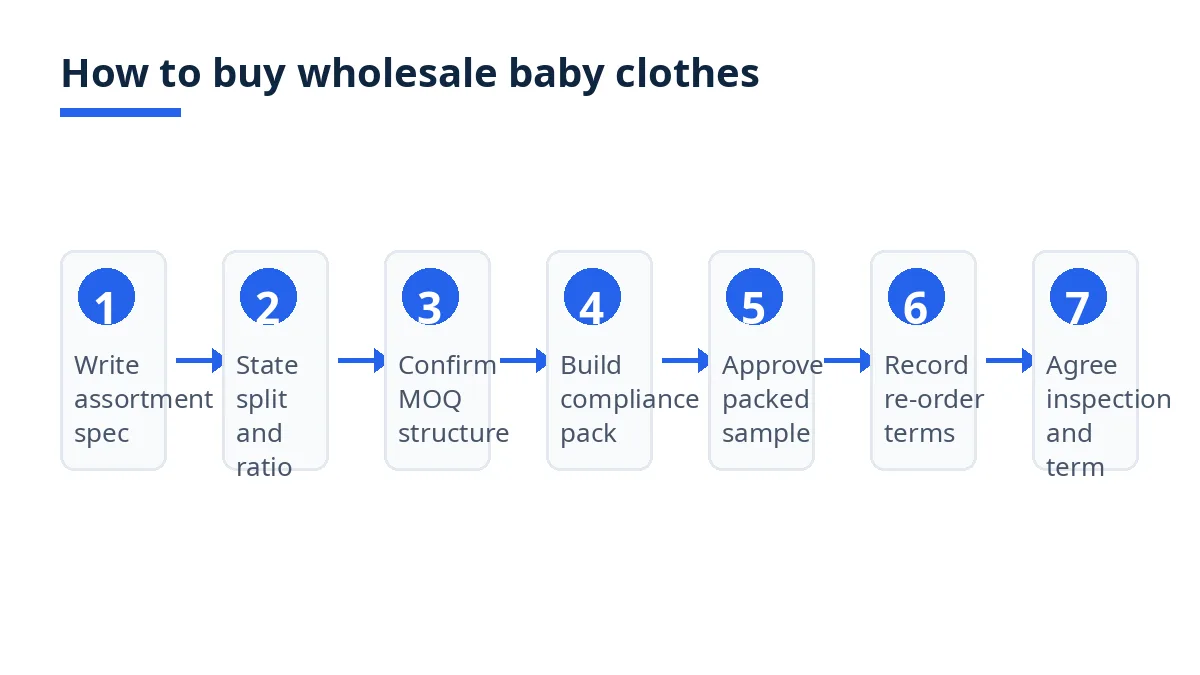
Write the assortment specification first. State style, fabric composition and weight, size chart, colour split, size ratio per colour, pre-pack or bulk format, labels, barcodes and pieces per carton.
State the split, not only the total. Give quantity per style, per colour and per size run.
Ask how the MOQ is structured. Ask for the minimum per style, per colour and per size run, and which line binds first for your split.
Build the compliance pack into the order. Name the destination market, its safety and labelling rules, the test evidence you need, and who supplies each document, before production starts.
Approve samples in the production pack. Order a pre-production sample in your actual fabric, colour and fasteners, then check the packed unit as your customer will receive it: ratio sticker, fibre and care labels, barcode and carton marks.
Confirm continuity terms for re-orders. Record the style code, fabric, colour references and ratio a repeat order will reuse, and its re-order minimum.
Agree inspection and delivery term before you confirm. Write the inspection level and AQL values into the purchase order, following ISO 2859-1,5 and state one Incoterm and named place for every quotation.6
See the baby clothes quality control checklist.
Costs, timelines and documents
What are the typical costs and timelines?
There are no typical wholesale costs or timelines a guide can state as fact. Each factory prices your fabric, colour split, size run, fasteners and trims, pre-pack or bulk packing, label and carton runs, testing, and the delivery term you choose.6
Read the price as a structure. Fabric and trims are consumed per piece, so that part follows the piece count. Pattern work, dye lots, label and barcode print runs and carton printing are fixed per style or per colour, so that part per piece falls as quantity per colour rises, and rises when one total is split across many colours or size runs. Packing labour follows the pack: a ratio pre-pack costs more packing time than a bulk carton, at any volume. This is why the wholesale MOQ is structured per style, per colour and per size run rather than as one order total, and why this guide states no MOQ figures.
For timelines, sampling depends on fabric and trim availability and correction rounds, and bulk production on dyeing, cutting, packing labour and carton supply. Ask for sampling, fabric ready, production, packing and inspection dates as separate lines.
Which documents are needed?
The order documents are the assortment specification, the itemized quotation and the purchase order, with the split, ratio, pack format and carton specification on each, plus a packing list that carries your carton specification into the shipment.
The compliance pack is the set a wholesaler must hold and pass downstream, and the destination market sets it. If you sell into the European Union, Regulation (EU) No 1007/2011 states that a textile product shall be labelled or marked with the name and percentage by weight of all constituent fibres in descending order.7 Under EN 14682:2014, as summarised by the Office for Product Safety and Standards (OPSS), garments intended for young children shall not be designed, manufactured or supplied with drawstrings or functional cords in the head, neck or upper chest area, and decorative cords are not permitted on the hood or at the back of the neck.8 Verify your style against the standard itself before approving the sample. For the United States, the Consumer Product Safety Commission (CPSC) states that testing on children's wearing apparel must be performed at a third-party, CPSC-accepted laboratory, and that after manufacturers and importers receive applicable passing test results and gather the compliance documentation, they must issue a Children's Product Certificate (CPC).9 Children's products and their packaging are also required to have tracking labels: permanent marks giving identifying information including the manufacturer, importer or private labeler, the date and location of production, and batch or cohort information.9 Ask at quotation stage which documents the supplier's test reports will support.
Bangladesh-specific rules and tips
Confirm association claims at the source. If a supplier claims BKMEA membership, confirm it with the association itself. BKMEA represents the knitwear sector and its member factories,2 so membership signals an active knitwear business, not the assortment size, MOQ or price on offer.
Keep one legal name across every paper. The name on the trade licence, quotation, proforma invoice and payment account should match.
Ask which inputs are imported for your assortment. Snaps, zips, printed ratio labels and some yarns may be bought in for your specification, and an imported input can set both a minimum and the earliest production date.
Mistakes and red flags
What are the most common mistakes?
Quoting a total instead of an assortment. A total split later across colours, size runs and pack formats produces a different price and a different binding minimum, and suppliers will requote.
Building a ratio you cannot sell. A pre-pack ratio is fixed at cutting. If the middle sizes sell through and the end sizes do not, the surplus cannot be corrected until the next run, so set the ratio from your own sales pattern.
Treating compliance as a factory problem only. The wholesaler passes documents downstream. If the CPC support, tracking label information or fibre labelling for your market is missing at shipment,7 9 the gap becomes yours.
Approving a garment but not a pack. The unit your customer receives is the packed garment. An unapproved ratio sticker, barcode or carton mark is found at the warehouse, where correction means repacking.
Assuming a re-order is automatic. A repeat uses new fabric and dye lots. Confirm shade continuity against the retained sample and the re-order minimum on the same specification, in writing.
Treating a profile or a badge as verification. A profile does not test whether a factory can cut your ratio or pack your format, and a badge is not a guarantee of capacity, quality or delivery.10
Checklist
Before you confirm, every line should be answered in writing.
Assortment specification sent: style, fabric, sizes, labels, packing.
Colour split and size ratio stated per colour.
Pack format chosen: pre-pack or bulk, with pieces per pack.
Carton specification confirmed: packs per carton, solid or mixed.
MOQ structure confirmed per style, colour and size run; binding line named.
Set-up and print-run costs itemized apart from unit price.
Destination market named; compliance pack listed.
Fibre labelling checked against Regulation (EU) No 1007/2011 for EU sales.7
Cord and drawstring design checked against EN 14682:2014 for young children's garments.8
For US sales, CPC support, third-party test evidence and tracking label information agreed.9
Pre-production sample approved in its production pack.
Re-order terms recorded: style code, fabric and colour references, ratio, minimum.
Inspection level and AQL values in the purchase order.5
Quotations compared on same specification, pack format and Incoterm.6
How Exportain helps
On Exportain, browse suppliers and post a request for quotation (RFQ) on the RFQ board with your assortment specification: colour split, size ratio, pack format, carton specification, destination market and delivery term. An RFQ on Exportain states quantity and unit, target price, destination, Incoterm, required certifications and deadline.11 Each quotation is versioned and states unit price, MOQ, lead time, Incoterm, payment terms and validity,11 so ask each supplier to state its MOQ per style, per colour and per size run in the thread.
Read the badges for what they record. Exportain Verified means Exportain has checked identity, phone, email and business registration, and Export Verified means it has checked the Export Registration Certificate (ERC).10 Factory Verified means it has reviewed photos of the manufacturer factory, while Trading Company Verified means it has reviewed photos of the trading company office or warehouse.10 Verification is a document review by staff, free, and never granted by membership plans.12 It is not a factory inspection,10 12 so sample and pack approval stay with you. See how supplier verification works on Exportain. When you accept a quotation, Exportain creates one order and issues one proforma invoice from the accepted terms.10
FAQs
What should I know first about baby clothes?
Know your wholesale units first: the colour split, the size ratio per colour, pre-packs or bulk, and the carton specification. Knitted baby garments sit under HS heading 61113 and woven baby garments under HS heading 6209.4
What are the typical costs and timelines?
There are no typical figures a buyer can rely on, because each factory sets its price, MOQ structure and lead time for your fabric, split, size run, pack format and delivery term.6 Ask for the price basis and the binding minimum line in writing.
Which documents are needed?
The order documents are the assortment specification, itemized quotation and purchase order, with split, ratio, pack and carton specification on each, plus the packing list for the shipment. The compliance pack depends on the destination: fibre labelling under Regulation (EU) No 1007/2011 for the EU,7 cord and drawstring design under EN 14682:2014,8 and for the US a CPC supported by third-party test results and tracking labels on the product and its packaging.9
What are the most common mistakes?
Quoting a total instead of an assortment, fixing a ratio you cannot sell, leaving the compliance pack to the factory alone, approving the garment but not the packed unit, and reading a badge as a guarantee. A badge is not a guarantee of capacity, quality or delivery.10
Next steps on Exportain
Browse suppliers, then post your split, ratio, pack format and carton specification on the RFQ board so suppliers quote the same assortment. Before you confirm, read how to import baby clothes from Bangladesh and the baby clothes quality control checklist.
Sources
- Merchandise exports rise 6.34pc to $13.09b in Q1 FY27: EPB. The Financial Express, (accessed )
- BKMEA at a Glance. BKMEA (accessed )
- Classification Detail — HS Code 6111. United Nations Statistics Division (accessed )
- Classification Detail — HS Code 6209. United Nations Statistics Division (accessed )
- ISO 2859-1:2026 - Sampling procedures for inspection by attributes — Part 1: Sampling schemes indexed by acceptance quality limit (AQL) for lot-by-lot inspection. ISO (accessed )
- Incoterms® 2020. International Chamber of Commerce (ICC) (accessed )
- Regulation (EU) No 1007/2011 on textile fibre names and related labelling and marking of the fibre composition of textile products. European Union, (accessed )
- PRISM: Narrative style risk assessment - non-compliant cords and drawstrings identified in clothing intended for children. GOV.UK (accessed )
- Clothing Business Guidance. U.S. Consumer Product Safety Commission (accessed )
- Trust & Safety Center. Exportain (accessed )
- How to source and buy from Bangladesh. Exportain (accessed )
- Supplier verification: Earn trust badges buyers can see. Exportain (accessed )
About the author
Sourcing from Bangladesh?
Post a request for quotation and suppliers on Exportain can send you their quotes directly.
Post an RFQ


