

TT Payment Meaning in Shipping: Complete Guide
What TT payment means in shipping, how a telegraphic transfer moves between banks, what it costs, which documents support it, and how buyers pay Bangladeshi suppliers in safer stages.
Short answer
In shipping, TT payment means a telegraphic transfer: an electronic bank-to-bank payment the buyer instructs their bank to send to the seller bank, usually through the SWIFT network. Unlike a letter of credit, a TT carries no bank promise to pay, so the timing of each stage, in advance, against documents or after shipment, decides who carries the risk.
On this page
Key takeaways
TT means telegraphic transfer: an electronic bank-to-bank payment sent on the buyer instruction, usually through the SWIFT network.
A TT carries no bank undertaking to pay, so the payment schedule and the documents checked at each stage provide the protection.
The charge code, OUR, SHA or BEN, decides who pays intermediary and receiving bank fees and whether the seller is credited in full.
International TTs typically arrive within 1 to 5 business days, and a credited transfer is hard to reverse, so details are checked before sending.
For exports from Bangladesh, the EXP form certified by Authorised Dealers sits in the standard customs document set.
The tt payment meaning in shipping is simple to state and easy to get wrong in practice. TT stands for telegraphic transfer, and buyers who import from Bangladesh meet the term on proforma invoices and in payment negotiations. This guide explains what a TT payment is, how it travels between banks, what it costs, which documents support it, and how to structure it so neither side carries more risk than the order justifies.
A telegraphic transfer is an electronic method of sending funds from one bank account to another, primarily across international borders, and the sending bank transmits a secure payment instruction through the SWIFT network before the recipient bank credits the funds.1 The name dates back to instructions sent by telegraph cables, and the same transaction is usually called a wire transfer in the United States and Europe.1
Why this matters for buyers and sellers
A TT payment is not a guarantee. The bank moves money on the buyer instruction; it does not promise to pay against documents, and it does not inspect the goods. That is the central difference from a letter of credit. Under a documentary credit, a confirming bank adds its own undertaking, in addition to that of the issuing bank, to honour or negotiate a complying presentation, and most modern documentary credits are issued subject to the ICC Uniform Customs and Practice for Documentary Credits, known as UCP 600.2 A TT carries no equivalent undertaking, so protection in a TT order comes from the payment schedule, the documents you check at each stage, and your verification of the supplier.
For a buyer, TT is attractive because it is straightforward: you instruct your bank, the funds travel to the supplier bank, and production or shipment can proceed without the document examination a letter of credit requires. For a seller, TT improves cash flow: an advance stage can fund raw materials, and a balance stage against shipping documents lets the factory close the order soon after shipment.
The difficulty is the balance of risk. A full TT in advance puts the buyer at risk if the supplier fails to ship, while a full TT long after shipment puts the seller at risk if the buyer delays payment. Most workable arrangements split the payment into stages linked to events both sides can verify, such as order confirmation and shipment. Compare the fuller explanation of a telegraphic transfer and the letter of credit where the order value or the newness of the relationship calls for a bank undertaking.
Step-by-step: how it works
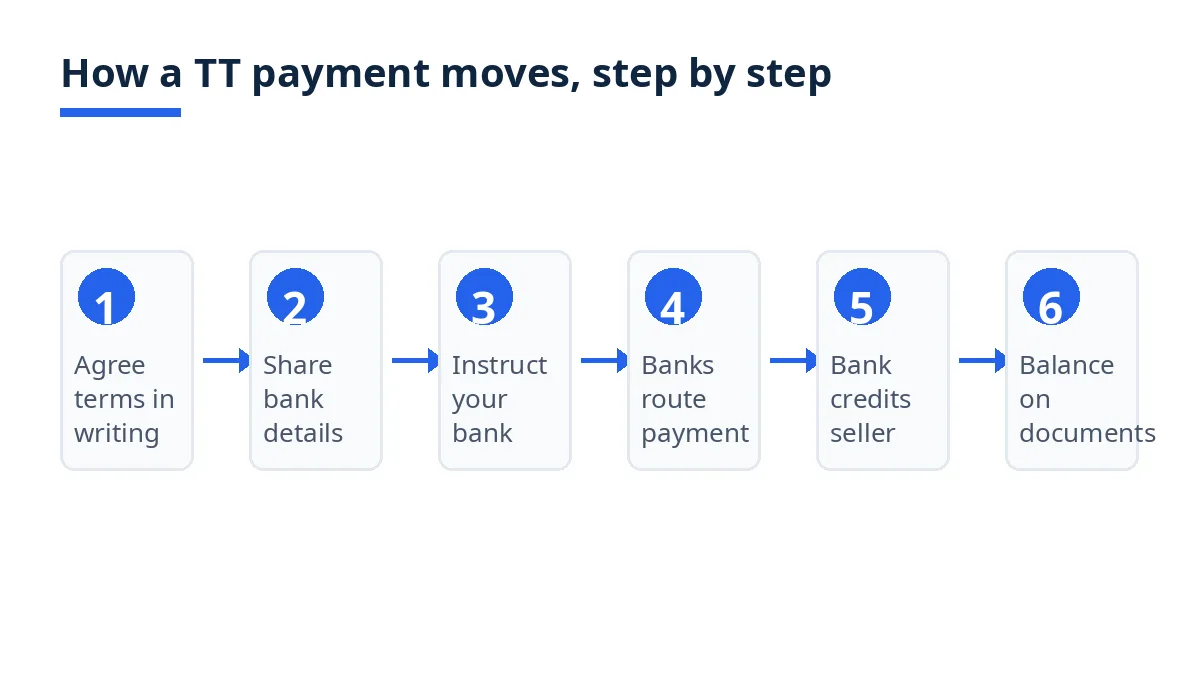
Step 1: Agree the terms first
Before any transfer, buyer and seller agree the total price, the currency, the TT schedule, when each stage falls due, and which documents the seller will provide at each stage, and record all of it on the proforma invoice or contract. A TT instruction is hard to correct once sent, so this written agreement is the control point for the order.
Step 2: Collect the exact beneficiary details
To send a TT, you need the recipient full name as it appears on the bank account, the account number, the bank name and branch address, and the SWIFT/BIC code, the unique identifier the SWIFT network uses to route the payment, together with the amount, the currency and, where the bank requires it, the purpose of the transfer.1 Copy the details from the seller written bank instruction, and confirm any change of bank details through a separate, known contact channel.
Step 3: Instruct your bank and choose how charges are shared
Complete your bank transfer instruction with the beneficiary details, amount, currency, purpose of payment and invoice reference. Before you confirm, the bank asks you to select a charge code that decides who pays the intermediary and receiving bank fees: under OUR the sender pays all fees so the recipient receives the full amount, under SHA the sender pays the sending bank fees and the recipient absorbs intermediary and receiving charges deducted from the payment, and under BEN the recipient bears all fees.1
Step 4: The transfer travels through the banking system
Three types of banks are usually involved: the sending bank, the recipient bank, and in many cases one or more intermediary banks in between.1 The sending bank verifies your details, deducts the amount and sends a secure payment instruction through the SWIFT network, and where the two banks have no direct relationship, intermediary banks forward the instruction along the chain.1 Each intermediary may deduct a charge where the charge code leaves charges to be taken from the payment, which is why the credited amount can differ from the amount sent.
Step 5: The beneficiary bank credits the seller
The recipient bank receives the SWIFT message, verifies the details and credits the funds to the recipient account.1 Banks also screen transfers for fraud, anti-money laundering requirements and sanctions compliance, and those checks can delay a transfer, particularly for certain currencies, countries or higher-value payments.1 The seller normally confirms receipt with a bank advice: proof of receipt is the beneficiary bank credit, not a copy of your sending instruction.
Step 6: The balance stage follows its trigger
If the arrangement includes a balance TT, its trigger might be a passed inspection, a shipped-on-board bill of lading copy, or receipt of the full document set. Check the trigger document before you instruct the balance: names, dates, quantities and ports should match the order. Once credited, the seller releases any documents still held and the order closes financially.
Costs, timelines and documents
What does a TT payment cost?
There is no single TT price. A transfer can carry a handling commission set by the sending bank, a cable or SWIFT charge, an exchange-rate conversion margin, and agent bank fees charged by intermediary banks on the route.1 The exchange-rate margin, the difference between the bank rate and the interbank rate, can be a significant part of the total cost even though it may not appear as a separate fee.1 United States rules for consumer remittance transfers require providers to disclose their fees, the exchange rate, certain fees charged by other institutions, and the amount expected to be delivered.3 Ask for the same four figures before you send.
Cost element | Who sets it | What to confirm before you send |
|---|---|---|
Handling commission | Your sending bank | Amount or percentage, and any minimum or maximum |
Cable or SWIFT charge | Your sending bank | Included in the commission or charged separately |
Exchange-rate margin | Your sending bank | Rate applied and amount the recipient receives |
Intermediary bank fees | Banks on the route | Deducted from the payment or paid by the sender |
Receiving bank fee | The seller bank | Whether the seller bank charges for inward transfers |
How long does a TT payment take?
International TTs typically arrive within 1 to 5 business days, depending on the destination country, the currencies involved, the number of intermediary banks and the cut-off times at each bank on the route.1 Bank holidays in either country, incorrect recipient details and large time zone differences can push the timeline toward the longer end.1 Cancellation rights are narrow once money moves: under United States federal rules, a consumer sending a remittance transfer has up to 30 minutes to cancel at no charge, and only if the transfer has not already been picked up or deposited into the recipient account.3 Treat a business TT as final once credited, and check details before you send.
Which documents support a TT order?
A TT itself needs only the bank instruction, but a well-run order is supported by trade documents at each stage. Before an advance stage, keep a proforma invoice or contract showing the TT schedule and the seller bank details. Bangladesh Customs requires these documents with the Bill of Export for customs clearance of all export consignments: an export letter of credit, or, where there is no export letter of credit, an export contract or purchase order or export guarantee approved by the negotiating bank, a commercial invoice, a packing list, an EXP form certified by Authorised Dealers, and a certificate of origin.4 At shipment, add the transport document, a bill of lading for sea freight or an air waybill for air freight, and keep the set together.
Bangladesh-specific rules and tips
Payments for exports from Bangladesh move through the formal banking system. Bangladesh Customs states that the EXP form is certified by Authorised Dealers to ensure the realization of export proceeds.4 Bangladesh Bank foreign exchange circulars govern the declaration of exports on the EXP Form and the repatriation of export proceeds, and its February 2026 circular letter on exports exempted from declaration confirms that the EXP Form framework remains the reference point for export proceeds.5
In practice, a Bangladeshi supplier will ask you to send the TT to the company bank account in the company name, not to a personal account or a different company name. Treat any request to do otherwise as a stop signal and verify it independently. Expect the exporter bank to match the incoming payment against the shipment documents, especially for a balance received after shipment, which is why sellers ask buyers to quote the invoice reference clearly in the transfer instruction.
Three practical points follow. First, keep the beneficiary name identical to the contracting supplier name, letter for letter, because small differences can cause the receiving bank to query or return a payment. Second, allow extra time around weekends and public holidays in both countries when a payment releases documents or goods. Third, for a first order, confirm the supplier business registration and export credentials, and agree an inspection before the balance stage if the order justifies one. Compare the telegraphic transfer definition and LC payment meaning for the terms your supplier proposes.
Mistakes and red flags
Sending a full advance on a first order. A staged schedule and a balance linked to shipment documents reduce exposure more effectively than any reassurance given in messages.
Acting on changed bank details sent by email alone. Payment diversion fraud works by intercepting or imitating a message that announces new bank details. If details change, stop and verify through a contact you already trust, such as a known phone number, before sending anything.
Copying beneficiary details incorrectly. A misspelled name, a missing SWIFT/BIC code or an account number copied from an old invoice causes delays and extra charges. Copy details from the current written instruction and have a second person read them back.
Leaving charge sharing unagreed. If charges are deducted along the way and no one agreed who bears them, the seller receives less than the invoice amount and the balance stage stalls over a bank deduction. Agree the charge code, OUR, SHA or BEN, in advance.
Paying a balance without its document trigger. A balance TT sent on a promise, rather than against the agreed inspection result or transport document copy, removes your last practical check.
Confusing TT with protection. TT has no bank undertaking, no document examination by a bank and no automatic right to reverse a completed transfer. If you need those features for a large first order, discuss a letter of credit with your bank.
Red flags that justify pausing the transfer include pressure to pay urgently outside the agreed schedule, a beneficiary name that does not match the supplier, refusal to provide written bank details, terms that change only after you ask for verification, and any request to split a payment to an unrelated third party.
Checklist
Before you instruct any TT stage, work through this list:
Supplier identity verified, and the beneficiary name matches the contracting company exactly.
The proforma invoice or contract states the price, currency, TT stages and each trigger.
Bank details taken from the seller current written instruction and checked character by character, including the SWIFT/BIC code.
Any change to bank details verified through a separate, known contact channel.
The charge code agreed, so both sides know what amount should be credited.
The transfer reference quotes the invoice or order number as the seller requested.
For a balance stage, the trigger document received and checked against the order.
Cut-off times, weekends, holidays and compliance checks allowed for in the timetable.
Receipt to be confirmed by the beneficiary bank credit, not assumed from your instruction.
The full document set filed together for the order.
How Exportain helps
Exportain is a marketplace where buyers find Bangladeshi suppliers, post requests for quotation and compare replies in one place. You can review the verification information recorded for a supplier before you agree payment terms. Those checks are reviews of documents and photos, not factory inspections, and they do not replace your own checks or inspection. Exportain is not a party to your contract for goods, and it does not move your payment: the TT runs between your bank and the supplier bank.
FAQs
What should I know first about TT payment?
Know three things first. TT is a direct bank-to-bank transfer sent on your instruction, so the bank moves the money but does not guarantee the transaction or examine the goods. The timing you agree, in advance, against documents or after shipment, decides who carries the risk, so stage the payment against events you can verify. Beneficiary details must be exact and independently verified, especially if they change, because a credited TT is hard to reverse.
What are the typical costs and timelines?
Costs are a combination rather than a single fee: a sending bank handling commission, a cable or SWIFT charge, any intermediary bank fees, any receiving bank charge, and the exchange-rate margin where currencies are converted, each shaped by the charge code you choose.1 Timelines typically run from 1 to 5 business days, lengthened by cut-off times, holidays, intermediary banks and compliance checks.1
Which documents are needed?
To instruct the transfer, you need the seller full written bank details and your bank transfer instruction, referencing the invoice or order. Around the TT, keep a proforma invoice or contract stating the payment schedule, then the commercial invoice, packing list, certificate of origin and EXP form that Bangladesh Customs lists for export clearance, plus the transport document.4 For the balance stage, the agreed trigger document is essential: receive and check it before you pay.
What are the most common mistakes?
The most common mistakes are sending a full advance on a first order, acting on changed bank details without independent verification, copying beneficiary details incorrectly, leaving the charge code unagreed so the seller is credited short, and paying a balance without checking its trigger document.
Next steps on Exportain
Browse Bangladeshi suppliers whose product range matches your order, then read the how to buy guide before you agree payment terms. When your specification and TT schedule are ready, post an RFQ so suppliers quote against the same requirements, and record the agreed charge code and document triggers in the order thread before the first stage falls due.
Sources
- Telegraphic Transfer (TT): What It Is and How It Works. Airwallex (accessed )
- Documentary credits: Rules, guidelines & terminology. ICC Academy, International Chamber of Commerce (accessed )
- What is a remittance transfer and what are my rights?. Consumer Financial Protection Bureau (accessed )
- Customs Clearance Procedures for Export. Bangladesh Customs, National Board of Revenue (accessed )
- FEPD-1 Circular Letter No. 03: Modification of paragraph 7 of FE Circular No. 31, dated July 31, 2025. Bangladesh Bank, (accessed )
About the author
Sourcing from Bangladesh?
Post a request for quotation and suppliers on Exportain can send you their quotes directly.
Post an RFQ


