Terry Bathrobes Lead Time From Bangladesh: Production and Shipping Timeline
Plan a terry bathrobe lead time from Bangladesh by robe-specific approvals: terry and GSM lock, proto fit, washed size set, bulk dyeing, cutting and sewing, testing, inspection and loading, with dated phases for USA, UK, EU and UAE buyers.
Short answer
A terry bathrobe lead time from Bangladesh is set by approvals, not by sewing speed. Lock the terry construction, GSM and size set first, then pass the proto fit, the washed size set and the pre-production sample before bulk cutting. Published Bangladesh garment ranges put bulk fabric at 15 to 35 days and cutting and sewing at 10 to 30 days, with inspection, export documents and loading after that. Plan 10 to 16 weeks to loading, plus sea transit.

On this page
Key takeaways
A terry bathrobe lead time is set by approvals, not by sewing speed: cloth, fit, size set and inspection are the four gates.
Lock GSM, pile construction and the absorbency expectation before sampling, because a GSM change after the proto sample means new cloth.
Approve fit on a person and the size set after washing, since cotton robes can shrink 3 to 5 percent after the first few washes.
Ask for dated lines, not a single delivery week: proto, size set, bulk fabric ready, sewing finish, inspection, loading and sailing dates.
Plan 10 to 16 weeks from tech pack to loading, plus sea transit, and plan backwards from the selling date per destination.
A terry bathrobe is a garment, not a flat textile, and that single fact shapes its lead time. A towel needs one approval for its cloth. A robe needs approvals for its cloth, its fit, its collar, its belt and its size range, and each approval can send the calendar back a step.
For a standard terry bathrobe from Bangladesh, the realistic planning window runs from tech pack to loaded container in roughly 10 to 16 weeks, with sea transit on top of that. That range is a planning frame, not a promise: fabric, size range, colour count and inspection move it either way. This guide breaks the timeline into seven phases, shows where the time actually goes, and gives you the dates to ask for in writing before you confirm.
Why robe timelines stretch
A robe order carries three kinds of work that a flat towel order does not: fit work across a graded size range, construction work on the shawl collar, belt, belt loops and patch pockets, and testing work on absorbency, shrinkage and shade on the finished garment.
GSM, grams per square meter, is the number that ties these together. GSM measures fabric density, and for bathrobes it drives warmth, absorbency, drying time and price.1 Commercial buyers most often work in the 400 to 600 GSM band, where cotton terry balances absorbency and weight, and a 500 GSM cotton terry robe absorbs about 2 to 2.2 times its weight.1 Lock the GSM, the pile construction and the absorbency expectation before sampling starts, because a change of GSM after the proto sample means new cloth, not a new stitch.
The timeline in seven phases
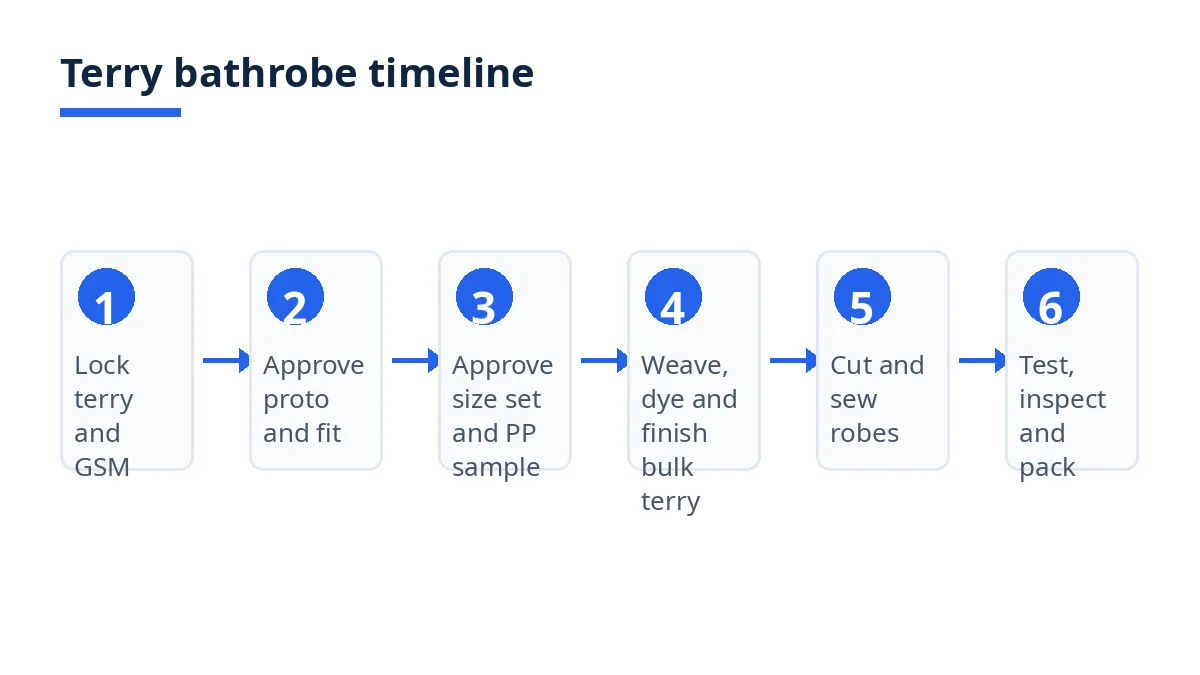
Lock the specification. Send the tech pack with the robe style, collar type, belt and pocket construction, size chart with a size ratio, fabric composition and GSM, pile description, colour references, label and packing requirements. State the absorbency expectation and the shrinkage tolerance in writing: a tech pack that leaves GSM or the size ratio open cannot produce a dated timeline.
Approve the proto and the fit. The factory makes a proto sample in the intended cloth, or the nearest available cloth if the intended cloth is not yet woven. Check the fit on a person, not on a table: collar roll, sleeve length, belt length and pocket placement only show themselves when worn. List corrections in writing and set a date for the corrected sample.
Approve the size set and the pre-production sample. The factory makes the full size range and one pre-production sample in the final cloth, colour and trims. Measure every size against the chart, wash one robe and check shrinkage and shade after washing. Cotton robes can shrink 3 to 5 percent after the first few washes,1 so the washed measurement, not the unwashed one, is the approval that matters.
Weave, dye and finish the bulk terry. Bulk fabric production is the longest single phase in most robe orders. One published Bangladesh garment timeline puts bulk fabric production at 15 to 35 days, after 7 to 21 days for fabric and trims sourcing.2 Add dye-lot matching across body, collar and belt cloth, and a finishing pass that sets the hand feel and the shrinkage behavior.
Cut and sew the robes. Cutting follows the marker plan for the agreed size ratio, and sewing covers the collar, sleeves, belt loops, belt, pockets and hems. The same published timeline puts cutting and sewing at 10 to 30 days and washing and finishing at 5 to 15 days.2 Inline checks during sewing catch collar and pocket faults while they can still be fixed; a fault found at final inspection costs the whole order time.
Test, inspect and pack. Run the agreed lab tests on the finished robe, then hold the final random inspection before packing. The published timeline allows 1 to 3 days for final inspection and 2 to 5 days for packing and shipment handover.2 Confirm the pieces per carton, the carton dimensions and the size ratio per carton before packing starts, because repacking a bulky robe order is slow.
Clear export and load. The exporter files the export declaration, and goods load once it is approved: goods may not be loaded for export unless an export declaration, the Bill of Export or Shipping Bill, is submitted to Customs and approved.3 Most apparel shipments from Bangladesh move through Chattogram Port or by air cargo from Dhaka, depending on urgency and product value.2
Costs, timelines and documents
What should I know first about terry bathrobes?
A terry bathrobe lead time is set by approvals, not by sewing speed. The cloth approval, the fit approval, the size-set approval and the inspection result are the four gates, and a failure at any gate restarts the phase behind it.
What are the typical costs and timelines?
There is no single typical cost for a terry bathrobe order, because fabric weight, collar construction, embroidery, labels and the delivery term all move the price. For timelines, the published ranges give a usable frame. One Bangladesh garment timeline lists inquiry and costing at 2 to 7 days, sample development at 7 to 14 days, sample approval at 3 to 10 days, bulk fabric production at 15 to 35 days, cutting and sewing at 10 to 30 days, washing and finishing at 5 to 15 days, final inspection at 1 to 3 days and packing and handover at 2 to 5 days.2 A separate industry guide puts Bangladesh bulk production for basics at 4 to 12 weeks, with ocean freight at 20 to 35 days for price-sensitive buyers.4
Ask for the timeline as dated lines, not as a total: tech pack confirmed, proto date, size-set date, pre-production approval date, bulk fabric ready date, cutting start date, sewing finish date, inspection date and loading date. Then add sea transit and destination clearance on top. The delivery term decides where the supplier timeline ends and yours begins: the Incoterms 2020 rules set out 11 rules with a clear allocation of cost, risk and obligations.5 See the Incoterms guide and compare every quotation on the same rule and named place.
Example figures: a 2,000-piece robe order in two colours, sizes S to XL, placed on 1 March, could run as follows. Tech pack and cloth lock by 8 March, proto and fit approval by 29 March, size set and pre-production approval by 12 April, bulk terry ready by 10 May, cutting and sewing finished by 31 May, inspection and packing by 5 June, loading by 8 June, and arrival at a European port in early July after sea transit. These are example figures only, built from the published ranges above, not a quoted timeline for any factory. A repeat order in stocked cloth and an approved size set can run several weeks shorter; a new colour, a new collar or a failed inspection can run several weeks longer.
Phase | Published range | Robe-specific driver |
|---|---|---|
Inquiry and costing | 2–7 days2 | GSM, collar and size range in the tech pack |
Fabric and trims sourcing | 7–21 days2 | Terry weaving, dye lots, belt and label runs |
Sample development | 7–14 days2 | Proto fit: collar, sleeves, belt, pockets |
Sample approval | 3–10 days2 | Fit corrections and washed measurements |
Bulk fabric production | 15–35 days2 | Dye matching across body, collar and belt |
Cutting and sewing | 10–30 days2 | Size-set cutting, collar and pocket operations |
Washing and finishing | 5–15 days2 | Shrinkage control on a heavy GSM robe |
Final inspection | 1–3 days2 | Random inspection across sizes and cartons |
Packing and handover | 2–5 days2 | Bulky cartons, size ratio per carton |
Which documents are needed?
The order file is the tech pack, the itemized quotation, the purchase order with the approved specification and tolerances, the sample approval records and the inspection report. The export set is the Bill of Export, the commercial invoice, the packing list, the EXP form certified by an authorized dealer, and a certificate of origin issued by the EPB or a Chamber of Commerce and Industry.3 Enclosed documents for export clearance also include the export contract or purchase order where there is no export letter of credit, the commercial invoice and the packing list.3
For buyers in the European Union, labels carry a legal layer on top of the commercial one. Regulation (EU) No 1007/2011 lays down harmonised provisions on textile fibre names and related labelling and marking of fibre composition, and labelling or marking of fibre composition should be compulsory so that correct and uniform information is available to consumers.6 Confirm the fibre composition, the care label and the country-of-origin marking for each destination before bulk labels are printed.
Bangladesh-specific rules and tips
Book the inspection before the packing, not after it. The measurement, shade and absorbency checks are done most reliably on finished robes before they are folded into cartons. If inspection fails, unpacked robes can be corrected faster than packed ones.
Treat the port leg as part of the timeline. Most apparel shipments from Bangladesh move through Chattogram Port or by air cargo from Dhaka.2 Under FOB, your forwarder books the vessel; under CIF or CIP, the seller arranges carriage and, for CIF, minimum insurance cover.5 A vessel that sails weekly turns a two-day document delay into a nine-day transit delay, so confirm the loading date and the sailing date separately.
Plan backwards from the selling date, per destination. The USA, the UK, the EU and the UAE differ in transit routing, destination clearance and labelling expectations, so one delivery date for all four markets is not a plan. Set the selling date, subtract destination clearance and inland delivery, subtract sea transit, subtract inspection and packing, subtract production, and the result is the latest tech-pack date.
Mistakes and red flags
What are the most common mistakes?
Approving a sample on a table, not on a person. A robe that measures correctly flat can still pull at the collar or sit short in the sleeve when worn. Fit approval needs a worn check in every size that matters.
Approving shade on a swatch. Shade must match across the robe body, the collar, the belt and the pockets on the finished garment. A swatch approval hides the variation that pressing and sewing introduce.
Accepting a single delivery week. A timeline without dated gates for cloth, fit, size set, inspection and loading cannot be managed. Ask for the dated lines and hold the supplier to them.
Skipping the washed measurement. An unwashed robe that meets the size chart can fall outside tolerance after its first wash. Cotton robes can shrink 3 to 5 percent after the first few washes,1 so the washed robe is the approval sample.
Changing the specification after bulk cutting. A collar change, a colour change or a size-ratio change after cutting wastes cloth and restarts sewing. Freeze the specification at pre-production approval and price any later change as a new timeline.
Checklist
Before you confirm, every line should be answered in writing.
Tech pack sent: robe style, collar, belt, pockets, size chart and ratio, GSM, pile, colours, labels, packing.
GSM, pile construction, absorbency expectation and shrinkage tolerance locked before sampling.1
Proto fit approved on a person, with corrections listed in writing.
Size set measured in every size, and one robe washed and measured after washing.
Shade approved on the finished robe across body, collar, belt and pockets.
Bulk fabric ready date, cutting start date and sewing finish date confirmed as separate lines.2
Inspection date booked before packing, with the inspection level and acceptance criteria in the purchase order.
Export set agreed: invoice, packing list, EXP form, certificate of origin, Bill of Export.3
Delivery term and named place agreed in the form of one Incoterms 2020 rule, with the same rule on every quotation.5
Loading date and sailing date confirmed separately, with sea transit and destination clearance added to reach the selling date.
How Exportain helps
On Exportain, browse suppliers and post a request for quotation (RFQ) on the RFQ board with your tech pack summary, GSM, size range, colours and delivery term, so suppliers quote against the same specification and the same dated phases. Ask each reply for its proto date, size-set date, bulk fabric ready date, inspection date and loading date as separate lines.
Read the badges for what they record. Exportain Verified means Exportain has checked identity, phone, email and business registration, and Export Verified means it has checked the Export Registration Certificate (ERC). Verification is a document review by staff, free, and never granted by membership plans. It is not a factory inspection, so sample approval and inspection stay with you. See the terry bathrobes quality control checklist, the terry bathrobes MOQ guide and how to import terry bathrobes from Bangladesh.
FAQs
What should I know first about terry bathrobes?
A terry bathrobe lead time is set by approvals, not by sewing speed. Lock the GSM, the pile construction and the absorbency expectation first, because GSM drives warmth, absorbency, drying time and price,1 and a change of GSM after sampling means new cloth.
What are the typical costs and timelines?
There are no typical costs a buyer can rely on, because fabric weight, collar construction, decoration and the delivery term drive the price.5 For timelines, published Bangladesh garment ranges run from 2 to 7 days for inquiry and costing through 15 to 35 days for bulk fabric production and 10 to 30 days for cutting and sewing,2 with bulk production for basics at 4 to 12 weeks and ocean freight at 20 to 35 days.4
Which documents are needed?
The order documents are the tech pack, itemized quotation and purchase order, with the approved specification, tolerances and inspection criteria on all three. The export set is the Bill of Export, commercial invoice, packing list, EXP form certified by an authorized dealer, and a certificate of origin issued by the EPB or a Chamber of Commerce and Industry.3
What are the most common mistakes?
The most common mistakes are approving fit on a table instead of on a person, approving shade on a swatch instead of the finished robe, accepting a single delivery week instead of dated gates, skipping the washed measurement, and changing the specification after bulk cutting. Each of these turns a manageable timeline into a missed selling date.
Next steps on Exportain
Browse suppliers, then post your tech pack summary, GSM, size range and delivery term on the RFQ board so suppliers state their dated phases against the same specification. Before you confirm, read the Incoterms guide and the terry bathrobes quality control checklist to set the delivery term and the inspection criteria in the purchase order.
Sources
- What Is The Best Material For Bathrobes. Towel Depot (accessed )
- Inside Bangladesh Garment Manufacturing Process. Minmax Textile (accessed )
- Customs Clearance Procedures for Export. Bangladesh Customs, National Board of Revenue (accessed )
- Made in Bangladesh: Top 5 Cost Drivers for Volume Knitwear & Basics. Ninghow Apparel (accessed )
- Incoterms® 2020. International Chamber of Commerce (ICC) (accessed )
- Regulation (EU) No 1007/2011 on textile fibre names and related labelling and marking of the fibre composition of textile products. European Union, (accessed )
- Incoterms
- export documents
- quality control
- buyer guide
- Bangladesh sourcing
- home textiles
- Terry bathrobes
- Lead time
About the author
Sourcing from Bangladesh?
Post a request for quotation and suppliers on Exportain can send you their quotes directly.
Post an RFQ