Typical MOQ for Terry Bathrobes in Bangladesh (and How to Negotiate It Down)
Terry bathrobe MOQ in Bangladesh, from the buyer side: why the dye lot usually sets the floor, how to find the binding line in a quotation, and the GSM, trim, and commitment trades that move it.
Short answer
There is no typical MOQ for terry bathrobes from Bangladesh. The binding minimum is usually a dye lot for one color or a cutting floor for one size at one terry weight, not the order total. Negotiation works by changing that line: one GSM across colors, a stock white, standardized belt and pocket, a shared dye lot, a surcharge, or a phased commitment. Put every agreed exception in writing with its split, and approve a washed sample before bulk.
On this page
Key takeaways
There is no single typical terry bathrobe MOQ: the binding minimum is usually a dye lot for one color or a cutting floor for one size at one GSM weight, not the order total.
The strongest moves change the binding line itself — one GSM across colors, a stock white, a shared dye lot, a standard belt and pocket, or no hood on the first order — rather than asking for the same order at a lower quantity.
Adding colors to reach a headline total makes the problem worse, because each new color carries its own dye-lot floor and may add a surcharge; cut lines first and the total follows.
A lower quantity at the same specification usually costs more per robe, through a small-lot surcharge or a higher unit price, and every agreed exception belongs in writing on the quotation and purchase order, with its split.
A terry bathrobe order rarely fails on the total quantity. It fails on the dye lot. Terry pile loop yarn must be dyed, dried, and cut as one lot if every robe in a color is to match after washing, and a lot that is too small costs the dyer almost as much in setup and shade matching as a full one. That is why a factory can accept a large-looking order and still refuse one color, weight, or size inside it: the refused line falls below the lot, loom, or cutting floor that makes that line worth running.
This guide stays on that mechanism: what sets a terry bathrobe minimum, which line inside a quotation is binding, and which trades move that line. It does not repeat the maker checks or laundry proof in the companion guides. A bathrobe is a garment, not a towel, even when both are cut from terry cloth: a robe adds sleeves, collar, pockets, belt, and a size range on top of the fabric lot, so a robe and a towel order from the same cloth do not share a minimum.
Why this matters for buyers and sellers
For the buyer, the minimum decides whether a first order can test a robe at all. A hotel buyer wanting white robes in four sizes faces a different problem from a retail buyer wanting six colors in five sizes with a hood and logo. Each added color, weight, size, or trim creates a line that must clear its own floor, and clearing it by ordering more stock ties up cash in slow lines that go out of date when a logo or shade changes.
For the seller, the minimum protects the parts of the run that cannot be reused: yarn dyed to your shade, a pattern graded across your sizes, and cartons printed with your artwork have no second buyer. A short run still consumes loom setup, dye-lot work, cutting plan, and shade approval, so cost per robe rises as quantity per line falls.
The useful question is never "what is your MOQ?" in the abstract. It is "which line in my specification sets the floor, and what change to that line would lower it?"
Step-by-step: how it works
Work in this order, so the factory can answer with a usable minimum instead of a headline total.
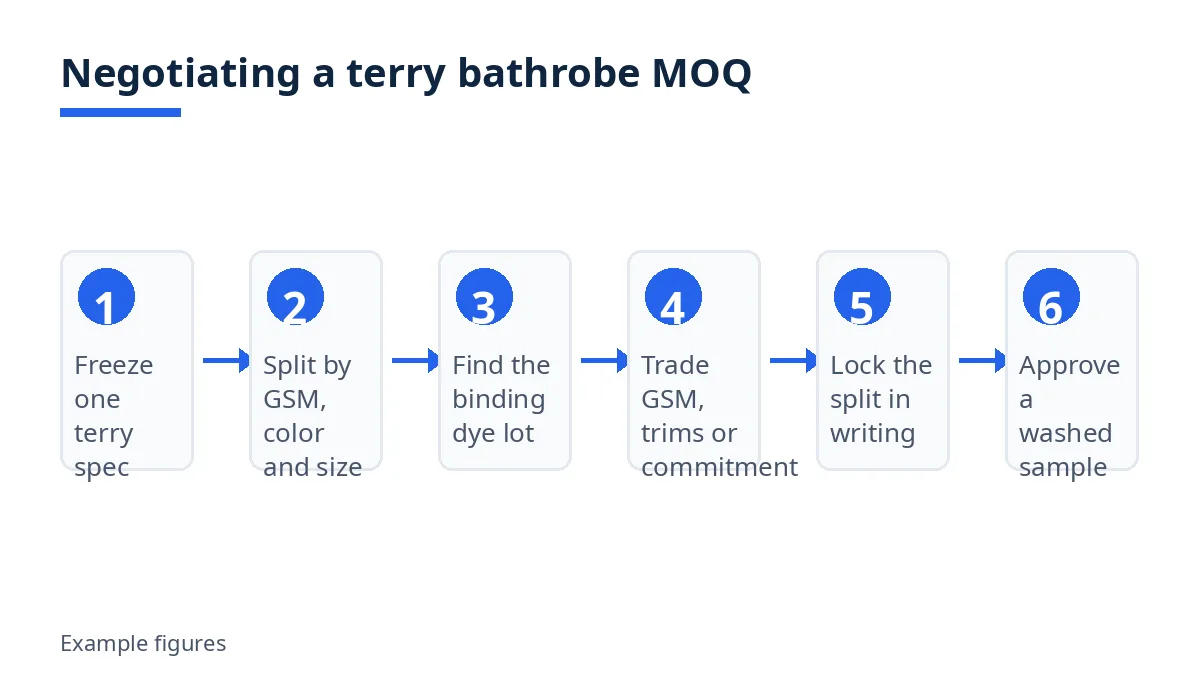
Freeze one terry specification before you ask. State fiber content, terry weight in grams per square meter (GSM), weave and pile height, robe style (shawl collar, hood, or kimono), pocket and belt construction, color list, and size range with quantity per size. A factory cannot set a dye-lot or cutting minimum from a style name alone.
Ask for the minimum on every terry line, not one total. Ask separately for the minimum per dye lot and color, per GSM, per style, per size, per trim (belt, pocket, hood, piping), per embroidery or print run, and per label and carton run — and which line is binding, and by how much your smallest line falls short.
Find the binding line. With terry robes it is usually the dye lot for one color, or the cutting floor for one size at one weight — for example, the smallest size in the heaviest weight, which uses the most cloth per robe but sells in the fewest units. Most failed negotiations argue about the total while the binding line sits untouched in one color or size.
Trade on the binding line only. Offer one lever that changes that line: fewer colors, one GSM across colors, a stock white, a shared dye lot, a standard belt and pocket, no hood on the first order, a small-lot surcharge, or a phased commitment. Ask for the revised minimum on the binding line, not a new headline total.
Lock the agreed split in writing. Record the revised minimum, any surcharge, the exact color, GSM, style, and size split it applies to, and what happens if one line drops out. Put it on the quotation and the purchase order.
Approve a washed sample on the agreed split. Order a development sample, then a pre-production sample in your actual terry weight, color, trims, and labels. Wash it under your care instructions, check pile, belt, and shade after washing, and approve or list corrections in writing. A sample approved unwashed proves nothing after the first laundry.
Agree inspection and the delivery term before you confirm. Write the inspection plan into the purchase order and state one delivery term and named place on every quotation. The Incoterms 2020 rules set out 11 rules allocating cost, risk, and obligations.1
Costs, timelines and documents
What sets the cost
There is no typical terry bathrobe cost, because cost follows your terry weight, color count, style, trims, and packing — not the order total alone. Product costs cover terry fabric and yarn, dyeing, cutting and sewing, belt and pocket work, embroidery, finishing, and packing. Setup costs sit apart: dye-lot work and shade approval, pattern grading, embroidery digitizing, and label and carton print runs. A small-lot surcharge, where offered, is a third line: it prices the setup your short run does not absorb. Keep the three groups separate on the quotation.
Example figures: one offer for the same robe at the same total quantity may look cheaper per robe but turn dearer once a per-color surcharge on two slow colors is added, while the other carries no surcharge but a higher unit price across all colors. The example shows structure only, not a typical price, surcharge, or MOQ. Compare offers only on the same specification, split, and term.1
What sets the timeline
Timelines run in stages, not as a single delivery week. Ask for separate dates for yarn and fabric ready, dye-lot ready, sample approval, production, inspection, and shipment. With terry robes, the dye-lot date is usually the longest pole: removing a color or switching one color to a stock shade can shorten the fabric-ready date more than any later expediting request. Adding a surcharge while keeping every dyed-to-order color shortens nothing.
Which documents sit in the order file
The order documents are the specification sheet with the agreed split, the itemized quotation showing the minimum on every terry line, the purchase order carrying the revised minimum and any surcharge, the washed sample approval record, and the inspection plan. The export set is separate: goods may not be loaded for export unless an export declaration, the Bill of Export or Shipping Bill, is submitted to Customs and approved, and the enclosed documents include the export contract or purchase order where there is no export letter of credit, the commercial invoice, the packing list, the EXP form certified by an authorized dealer, and a certificate of origin issued by the EPB or a Chamber of Commerce and Industry.2 Keep the split identical across all of them.
Bangladesh-specific rules and tips
Confirm the terry route before you argue the minimum. A factory that weaves its own terry controls the loom and dye lot, while one that buys terry cloth in inherits its supplier's width, weight, and lot minimum. Ask whether a stocked terry weight or stocked white would carry a lower floor; stocked white is often fastest for a hotel order, because white needs no color dye lot.
Use one GSM to carry several colors. A factory can sometimes dye several colors from the same terry ground if weight, yarn, and weave are identical. Consolidating two or three weights to one for the first order can turn three small dye lots into one workable lot — the trade most likely to move a binding dye-lot line.
Standardize belt, pocket, and hood first. Each adds cutting and sewing lines with their own floors. A first order with one belt, one pocket style, and no hood is easier to accept at a lower quantity than one with three belt styles. Settle trims at sampling stage, then negotiate color.
Settle labeling at sampling stage for each market. In the EU, Regulation (EU) No 1007/2011 covers textile fiber names and related labeling of fiber composition.3 In the USA, labels must list fiber content, origin, and the responsible business, with care instructions accurate for the robe as laundered.4 A label change after bulk cutting is a new label run with its own minimum.
Do not let a garment code surprise sit in the export set. A women's cotton bathrobe is classifiable under heading 6208, with bathrobes and dressing gowns of cotton under subheading 6208.91, while a men's cotton bathrobe falls under heading 6207.5 Confirm the code per style and wearer with your factory and forwarder before the declaration is filed, because a robe coded as a towel creates a mismatch across invoice, packing list, and declaration.2
Agree the inspection plan before production, not at the packing table. ISO 2859-1 defines acceptance sampling plans for inspection by attributes, indexed by acceptance quality limit (AQL); AQL is the maximum average percentage of defective items considered acceptable during random sampling.6 Write level and AQL values into the purchase order.
Keep one legal name across every paper. The export declaration names the exporter and the foreign buyer,2 so a mismatch between quotation, proforma invoice, and payment account can hold up clearance after packing. The revised split on the purchase order must match the invoice and packing list, color by color and size by size.
Mistakes and red flags
Which mistakes repeat most often
Asking for a total MOQ only. The binding minimum is usually the dye lot for one color or the cutting floor for one size at one weight. An order can clear the total and still fall below the dye minimum for one color. Always ask for the lines underneath the total.
Comparing MOQs on different terry weights. A lower minimum on a light stock terry, a hoodless style, or a stock white is a different offer from a minimum on a heavy dyed-to-order hooded robe. Compare only replies to the same specification, split, and term.1
Adding colors to reach the total. Buyers sometimes add a color to hit a headline quantity, then discover that the new color is itself below its dye-lot floor and carries a surcharge. Adding lines makes the binding problem worse. Cut lines first; the total follows the lines.
Accepting a verbal exception. A lower minimum agreed in conversation, without the color, GSM, style, and size split it applies to, is routinely lost when the order is entered. Record it on the quotation and purchase order, with its split.
Approving an unwashed sample. Terry pile, shade, and belt length all change after washing. A sample approved before washing hides exactly the defects a short run is most likely to carry. Wash the pre-production sample, then approve.
Treating a profile or a badge as negotiation protection. A profile is a starting point for enquiries. Exportain verification is a document and photo review, not a factory inspection.7 Your protection is the specification, the written MOQ lines, the washed sample approval, and the inspection plan in your order file.
Red flags in a supplier reply. A reply that will not state its minimum per color, per weight, or per size, will not say which line is binding, will not put an exception in writing, or quotes a minimum without asking for your GSM, color, and size split is a reply to pause on. So is one that promises any quantity at the same unit price with no surcharge and no specification change.
Checklist
Before you confirm at a negotiated MOQ, answer every line in writing.
Specification frozen as one document: fiber, GSM, pile, style, collar, pocket, belt, colors, sizes.
Quantity stated per color, GSM, style, and size, not only as a total.
MOQ received on every line: dye lot, color, GSM, style, size, trims, embroidery, labels, cartons.
Binding line identified, and by how much your split falls short.
Lever chosen and priced, with the revised minimum on the binding line.
Agreed exception written on quotation and purchase order, with its split.
Inspection plan written in: level and AQL.6
Delivery term stated once, on every quotation.1
Export set agreed: invoice, packing list, EXP form, certificate of origin, Bill of Export.2
Classification confirmed per style and wearer before filing.5
How Exportain helps
On Exportain, browse suppliers and post a request for quotation (RFQ) on the RFQ board with your terry specification and full split — quantities per color, GSM, style, and size — so suppliers quote MOQ lines against the same terry lines. Ask each reply for its binding line and stocked terry weights.
Read the badges for what they record. Exportain verification is a document and photo review, not a factory inspection, and membership plans never grant a trust badge.7 It is not a substitute for the specification, the written MOQ lines, the washed sample approval, and the inspection plan.
FAQs
What should I know first about terry bathrobes?
Know first that a terry bathrobe is a garment, not a towel, and that its MOQ is usually set by a dye lot for one color or a cutting floor for one size at one weight, rather than by one order total.5 Freeze fiber, GSM, style, trims, colors, and sizes, and find the binding line before you negotiate.
What are the typical costs and timelines?
There are no typical figures a buyer can rely on, because each factory prices your terry weight, dye lots, trims, embroidery, labels, cartons, and delivery term for your specification.1 Costs split into product, setup, and any small-lot surcharge lines; timelines split into fabric ready, dye-lot ready, sample, production, inspection, and shipment dates. Compare offers only on the same specification, split, and term.
Which documents are needed?
The order documents are the specification sheet with the agreed split, the itemized quotation showing the MOQ on every terry line, the purchase order carrying the revised minimum and any surcharge, the washed sample approval, and the inspection plan. The export set is the Bill of Export, invoice, packing list, EXP form certified by an authorized dealer, and a certificate of origin from the EPB or a Chamber of Commerce and Industry.2
What are the most common mistakes?
The most common mistakes are asking for a total MOQ only, comparing MOQs on different terry weights, adding colors to reach a total, accepting a verbal exception, approving an unwashed sample, and reading a badge as protection: verification is a document and photo review, not a factory inspection.7
Next steps on Exportain
Browse suppliers, then post your terry specification with its full per-color, per-GSM, and per-size split on the RFQ board so suppliers state their MOQ lines and binding line. Before you confirm, read the MOQ guide.
Sources
- Incoterms® 2020. International Chamber of Commerce (ICC) (accessed )
- Customs Clearance Procedures for Export. Bangladesh Customs, National Board of Revenue (accessed )
- Regulation (EU) No 1007/2011 on textile fibre names and related labelling and marking of the fibre composition of textile products. European Union, (accessed )
- Textile, Wool, Fur, Apparel and Leather Matters. Federal Trade Commission (accessed )
- HS Code 62089110 - Bathrobes, dressing gowns and similar articles. Flexport (accessed )
- ISO 2859-1:2026 — Sampling procedures for inspection by attributes — Part 1: Sampling schemes indexed by acceptance quality limit (AQL) for lot-by-lot inspection. ISO (accessed )
- Supplier verification: Earn trust badges buyers can see. Exportain (accessed )
About the author
Sourcing from Bangladesh?
Post a request for quotation and suppliers on Exportain can send you their quotes directly.
Post an RFQ