Televisions Lead Time From Bangladesh: Production and Shipping Timeline
Televisions lead time from Bangladesh, planned backwards from your in-stock date: panel supply, parallel certification, production, inspection and transit ranges.
Short answer
Televisions lead time from Bangladesh is a chain, not a single factory number: specification and sampling, panel and parts supply, certification, bulk assembly, testing and burn-in, inspection, export clearance, and transit. Plan backwards from your in-stock date, confirm the panel ready date for every screen size, and run certification beside sampling. A standard order often needs roughly 12 to 20 weeks from confirmed specification to arrival, and a custom or newly certified order needs longer.

On this page
Key takeaways
Lead time is a chain of stages, not a single factory number; plan backwards from your in-stock date.
Panel supply for each screen size is usually the critical path; confirm stocked, made-to-order, or imported status with a ready date per size.
Run certification in parallel with sampling; a test failure found after assembly is the costliest delay.
Compare quotations only on the same specification and Incoterm; transit varies by route and service.
Keep stage-by-stage dates, written sample approval, a packing plan, and an inspection plan in the purchase order.
A television order usually misses its selling season long before it reaches a port. It misses it in the weeks when the panel size is still undecided, the tuner variant for the destination market is still unconfirmed, or the certification test is still waiting for a sample. The televisions lead time Bangladesh buyers should plan for is therefore a chain of linked stages, with the panel at the centre: without a confirmed panel, there is no firm production date, and without that, no reliable arrival date.
This guide plans backwards from the date the televisions must be in your warehouse. It names the stage that most often controls the schedule, shows how certification can run beside sampling, and gives planning ranges to confirm with each supplier in writing. Treat every range here as a planning allowance, not a quoted figure.
Why this matters for buyers and sellers
For the buyer, lead time decides when the order must be placed, not only what is ordered. A retailer stocking for a promotion, a distributor rebuilding stock, and a project buyer all face the same risk: ordering by factory production time alone, then discovering that panel supply, certification, inspection, clearance, and transit still sit ahead of the goods.
For the seller, lead time decides how assembly lines and bought-in parts are scheduled. A television is assembled from parts that rarely share one supplier: the panel, the mainboard, the backlight unit, the power board, the housing, the remote, and the packing. If one part is made to order or imported for your specification, bulk assembly waits for it.
Work backwards: subtract transit, clearance, assembly, parts supply, and sampling from your in-stock date to reach the latest date you can confirm the order, and keep a buffer at the stages you do not control, such as shipping connections.
Step-by-step: how it works
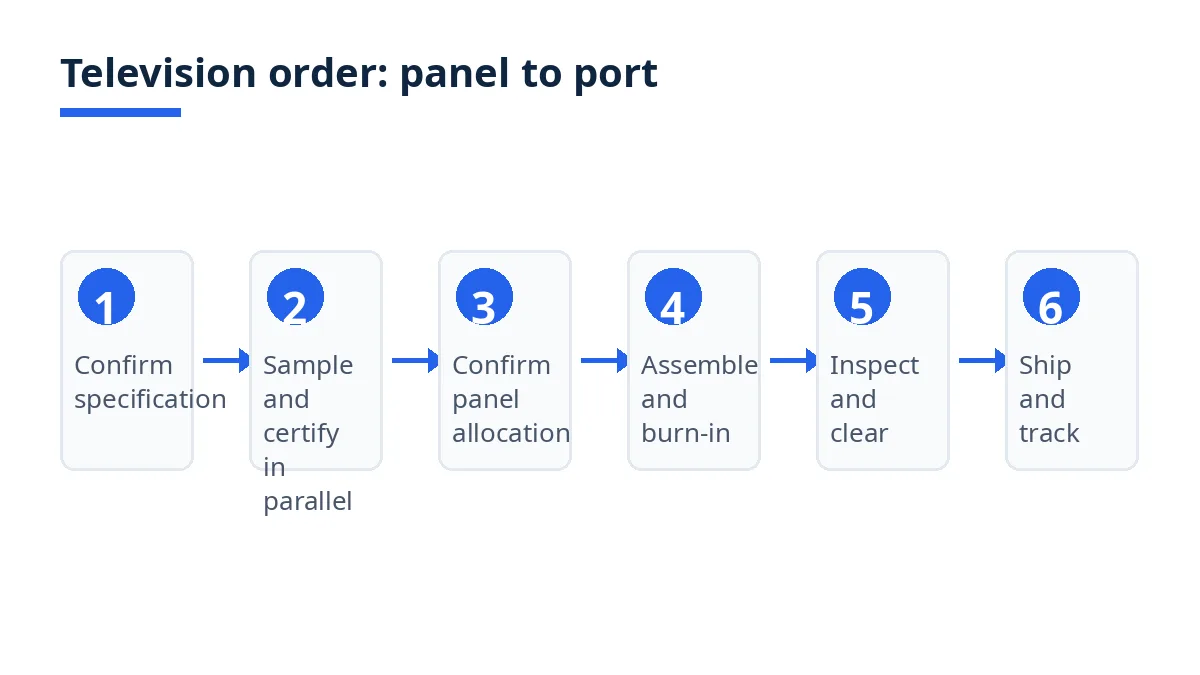
Write one specification and send it to every candidate supplier. State screen size and resolution, panel type, tuner and broadcast standard for your market, voltage and frequency, smart platform and remote type, wall-mount pattern, housing colour, and quantity by screen size. Each size is a separate panel with its own supply timing.
Ask for a dated plan, not a single lead time. Ask each supplier to split the schedule into enquiry response, sample dates, panel and parts ready date, assembly start and finish, testing and burn-in dates, inspection date, and shipped date.
Run certification beside sampling, not after assembly. Send the proto sample for market testing while you check picture, sound, and controls. A test failure found on the proto sample costs a correction round; the same failure found on finished stock costs a rework or a missed vessel.
Order a proto sample, then a pre-production sample in the exact production parts. Check the panel, the backlight uniformity, the tuner for your market, the remote, the stand or wall-mount parts, and the packing. Measure the carton, because it decides pallet layout and container loading, and a late carton change can delay packing.
Confirm panel allocation in writing before bulk assembly starts. Ask which panels are stocked, which are made to order, and which are imported for your sizes, with a ready date for each size. A backlight unit using LED edge or direct arrays is integrated with diffuser films, prism sheets, and light guide plates, and optical calibration checks brightness uniformity, colour temperature, and chromaticity.1
Approve the pre-production sample in writing, then release assembly. The written approval should name the model, screen size, resolution, panel type, tuner standard, smart platform, housing colour, remote, packing, and inspection plan. Verbal approval is where later disputes start.
Track assembly against the dated plan, and protect the testing gate. Finished modules pass full-line testing covering electrical performance, pixel function, and optical uniformity, and burn-in cycles run at elevated voltage and temperature to catch early failures before packing.1 Book inspection before assembly finishes, so the inspector is not the reason for a missed vessel.
For the inspection points that matter on the finished television, read the televisions quality control checklist.
Costs, timelines and documents
Televisions lead time Bangladesh: planning ranges by stage
The table below gives typical planning ranges for a standard television order. Treat each range as a planning allowance to confirm with your supplier, not as a quoted figure. A new panel size, tuner variant, or certification pushes toward the long end.
Stage | Typical planning range | What moves it |
|---|---|---|
Enquiry and quotation | 1 to 2 weeks | Specification detail, number of screen sizes |
Proto sample | 2 to 4 weeks | Panel availability, tuner variant, smart platform |
Pre-production sample and corrections | 2 to 4 weeks | Correction rounds, parts availability |
Panel and parts, stocked inputs | 1 to 2 weeks | Stock levels by screen size |
Panel and parts, made-to-order or imported | 4 to 8 weeks | Panel size, mainboard, import lead time |
Certification testing in parallel | 3 to 6 weeks | Market, lab slot, test outcome |
Bulk assembly | 3 to 6 weeks | Quantity, line capacity, size mix |
Final testing, burn-in and packing | 1 to 2 weeks | Defect rate, carton and pallet plan |
Inspection and export clearance | 1 to 2 weeks | Inspector booking, document readiness |
Transit to destination port | 2 to 6 weeks | Route, direct versus transshipment service |
Added together, a standard order with stocked panels often needs roughly 12 to 20 weeks from confirmed specification to arrival at the destination port, and a custom, multi-size, or newly certified order needs longer. Confirm the panel supply for every size first, since panels are usually the longest driver.
On cost, the drivers are panel size and type, resolution, tuner and smart platform, quantity by size, packing and pallet plan, and the delivery term. A larger panel, a higher resolution, and a smart platform with licensed software each change both the unit cost and the schedule, so compare quotations only when they cover the same specification and the same delivery term. The Incoterms 2020 rules set out 11 rules with a clear allocation of cost, risk, and obligations, so the term you choose changes who pays for freight and insurance and where risk passes.2 Read the Incoterms guide for shipments from Bangladesh before you compare a FOB price with a CIF price.
Transit time depends heavily on the route you buy. For the United Arab Emirates, an indicative port-to-port transit of about 10 days and 9 hours has been listed for Chattogram to Jebel Ali.3 For Europe, direct services from Chattogram were reported at 22 to 24 days, against about 40 days through transshipment ports.4 Ask your forwarder for the actual service on your sailing week.
On documents, two sets matter: your order papers, and the export set for Bangladesh. Goods may not be loaded unless an export declaration, the Bill of Export or Shipping Bill, is submitted to Customs and approved, and the enclosed documents include the export contract or purchase order where there is no export letter of credit, the commercial invoice, the packing list, the EXP form certified by an authorized dealer, and a certificate of origin issued by the Export Promotion Bureau or a Chamber of Commerce and Industry.5 Televisions with a colour video display or screen fall under HS subheading 852872, described as reception apparatus for television incorporating a colour video display or screen.6 Confirm the exact code with your customs broker for your model.
Bangladesh-specific rules and tips
Run certification in parallel with sampling, not after assembly. Regulation (EU) 2019/2021 generally applies to electronic displays placed on the EU market, including televisions, and sets requirements on energy efficiency, power consumption, standby functions, material efficiency, repairability, and product information.7 If your model needs a new test report or a new energy label entry, start it with the proto sample.
Confirm market requirements size by size and market by market. Voltage, frequency, tuner standard, plug type, safety listing, and labelling differ between the United States, the United Kingdom, the European Union, and the United Arab Emirates. In the United States, a TV broadcast receiver requires equipment authorization before marketing, by Supplier's Declaration of Conformity or certification.8
Keep one legal name across every paper. The export declaration names the exporter and the foreign buyer,5 so the name on the trade licence, quotation, proforma invoice, and payment account should match.
Ask which parts are imported for your order. Panels, mainboards, and some backlight parts may be bought in for your specification, and an imported part sets the earliest assembly date. Ask for the import arrival date for each bought-in part.
Plan the size mix as separate orders inside one order. A 32-inch, a 43-inch, and a 55-inch television do not share a panel, and they may not share a mainboard or a carton. An order can be on schedule for the main size and weeks late on one size, and the shipment still waits for the late size unless you agree split shipments in writing.
Protect the screen in the packing plan. Televisions are fragile at the corners and the panel face, so agree the carton, corner protection, screen protection, and pallet pattern at the sample stage. A packing failure found at inspection sends goods back for repacking.
Mistakes and red flags
What are the most common mistakes?
Accepting a single delivery date with no stage split. A single date hides which stage controls the schedule, so when the date moves you cannot tell which stage caused it.
Comparing quotations on different delivery terms. The Incoterms 2020 rules allocate cost, risk, and obligations differently under each rule,2 so compare only replies to the same specification on the same term with the same named place.
Approving a sample in a different size or tuner variant. A sample approved in one screen size does not approve another size, and a sample approved with one tuner standard does not approve a different broadcast standard. Approve the exact size and market variant you will ship.
Treating certification as paperwork after assembly. Test reports, declarations, energy labels, and labelling take calendar time. If certification is left until the goods are packed, the shipment waits while the paper catches up.
Skipping inspection to recover lost time. Inspection under an agreed sampling plan is the last control before the goods become your stock. ISO 2859-1 defines a system of acceptance sampling plans for inspection by attributes, indexed by acceptance quality limit (AQL) for lot-by-lot inspection.9
Planning transit on the shortest published time. Published transit times describe a good sailing, not your sailing. A transshipment service or a missed feeder can add weeks.4 Plan on the slower service.
Checklist
Before you confirm a television order, every line below should be answered in writing.
Specification complete: screen size and resolution, panel type, tuner standard, voltage and frequency, smart platform, remote, housing colour, packing, quantity by size.
Dated plan received: sample dates, panel and parts ready dates, assembly start and finish, testing dates, inspection date, shipped date.
Critical path named: panel supply confirmed as stocked, made to order, or imported, with a ready date per size.
Market requirements in the specification for the United States, United Kingdom, European Union, or United Arab Emirates as applicable.
Certification plan running in parallel with sampling, with test lab and report dates named.
Pre-production sample approved in writing in the exact production size, tuner variant, and packing.
Inspection plan agreed: sampling standard, acceptance quality limit values, inspector booking date.9
Quotations compared on the same specification and Incoterm with the same named place.2
Export set agreed: Bill of Export, commercial invoice, packing list, EXP form, certificate of origin.5
Shipping plan confirmed: service type, feeder cut-off, one spare week for a missed connection.
Packing plan agreed: carton, corner and screen protection, pallet pattern.
In-stock date protected: the backwards plan leaves a buffer between arrival and the selling or project date.
How Exportain helps
On Exportain, browse suppliers and post your specification, quantity by screen size, target in-stock date, and delivery term on the RFQ board, so suppliers quote against the same plan. Ask each reply for stage-by-stage dates and a panel ready date per size, not only a total lead time.
FAQs
What should I know first about televisions?
Start with the specification and the panel. A television order passes through panel and backlight integration, final assembly, full-line testing, and burn-in,1 and the panel supply for each screen size usually sets the earliest assembly date. Televisions with a colour video display or screen fall under HS subheading 852872.6 Plan backwards from your in-stock date.
What are the typical costs and timelines?
There is no single typical figure, because panel size and type, resolution, tuner and smart platform, quantity by size, packing, and delivery term all move both cost and time. As planning ranges, allow 2 to 4 weeks for a proto sample, 2 to 4 weeks for a pre-production sample with corrections, 4 to 8 weeks for made-to-order or imported panels, 3 to 6 weeks for bulk assembly, 1 to 2 weeks for inspection and clearance, and 2 to 6 weeks for transit. A standard order often needs roughly 12 to 20 weeks from confirmed specification to arrival.
Which documents are needed?
Your order papers are the specification, itemized quotation, purchase order with the dated plan, written sample approvals, certification test reports, and inspection report. The Bangladesh export set enclosed with the Bill of Export includes the export contract or purchase order where there is no export letter of credit, the commercial invoice, the packing list, the EXP form certified by an authorized dealer, and a certificate of origin issued by the Export Promotion Bureau or a Chamber of Commerce and Industry.5 Add destination market documents for your model, such as test reports for the European Union under Regulation (EU) 2019/2021.7
What are the most common mistakes?
The most common mistakes are accepting a single delivery date with no stage split, comparing quotations on different delivery terms,2 approving a sample in a different size or tuner variant, leaving certification until after assembly, skipping inspection to recover lost time, and planning transit on the shortest published time. Get stage-by-stage dates and a panel ready date per size, in writing, before you confirm.
Next steps on Exportain
Browse suppliers, then post a free RFQ on Exportain and get quotes from verified Bangladeshi suppliers through the RFQ board, stating your specification, quantity by screen size, target in-stock date, and delivery term. Before you compare replies, read the Incoterms guide for shipments from Bangladesh so every quotation is judged on the same delivery term.
Sources
- What are the production standards of a modern lcd display factory?. LCDLCM (accessed )
- Incoterms® 2020. International Chamber of Commerce (ICC) (accessed )
- Chittagong to Jebel Ali FCL Shipping Rates | Schedules & Transit Time. Cogoport (accessed )
- Bangladesh exporters welcome two more Chittagong Europe direct services. The Loadstar (accessed )
- Customs Clearance Procedures for Export. Bangladesh Customs, National Board of Revenue (accessed )
- Classification Detail — HS Code 852872. United Nations Statistics Division (accessed )
- Ecodesign of Electronic Displays. Enviropass (accessed )
- 47 CFR 15.101 - Equipment authorization of unintentional radiators. Cornell Law Institute (accessed )
- ISO 2859-1:2026 - Sampling procedures for inspection by attributes — Part 1: Sampling schemes indexed by acceptance quality limit (AQL) for lot-by-lot inspection. ISO (accessed )
- Incoterms
- export documents
- quality control
- buyer guide
- importing from Bangladesh
- Bangladesh sourcing
- Electrical products
About the author
Sourcing from Bangladesh?
Post a request for quotation and suppliers on Exportain can send you their quotes directly.
Post an RFQ