Telegraphic Transfer Example: Complete Guide
A worked telegraphic transfer example from deposit to balance, with the OUR, SHA and BEN charges codes, timelines, documents, Bangladesh rules and a pre-payment checklist.
Short answer
A telegraphic transfer example shows how a buyer pays a Bangladeshi supplier in stages: the contract fixes the currency, split and charges instruction, the buyer instructs a deposit, the supplier produces and ships, and the buyer sends the balance against shipping documents. Each leg is a bank-to-bank instruction, commonly sent as a SWIFT MT103, so protection comes from verified details, matching documents and the agreed split, not from the transfer itself.
On this page
Key takeaways
A telegraphic transfer is a bank-to-bank electronic payment instruction, commonly sent over SWIFT as an MT103, and it is not a payment guarantee.
In the worked example, a USD 24,000 order is paid as a 30 percent deposit of USD 7,200 and a balance of USD 16,800 against inspection and shipping documents. Example figures.
The OUR, SHA and BEN instruction in field 71A of the MT103 decides who pays transfer charges and whether the beneficiary receives the full invoice amount.
International TTs typically arrive within 1 to 5 business days, and banks screen transfers for fraud, money laundering and sanctions before release.
Verify bank details through an independent channel before paying, because changed details sent by email are a known business email compromise pattern.
A complete telegraphic transfer example shows how an overseas buyer pays a Bangladeshi supplier in stages, and where the risk sits at each stage. A telegraphic transfer (TT), also called a wire transfer, is an electronic method of sending funds from one bank account to another, primarily across international borders, with the sending bank transmitting a secure payment instruction through the SWIFT network and the recipient bank crediting the funds once the instruction arrives and clears.1 This guide walks through one worked example from purchase order to final balance payment, then covers costs, timelines, documents, Bangladesh-specific points, and common mistakes.
Why this matters for buyers and sellers
Payment terms decide who finances a transaction and who carries risk while goods are made and shipped. With TT, the buyer sends money directly to the seller's bank account at agreed moments. If the full amount is paid in advance, the buyer carries almost all of the risk, because payment leaves before goods exist. If payment is made only after goods arrive, the seller carries almost all of the risk. Most trade TT payments sit in between, with a deposit to start production and the balance linked to evidence that goods are ready or shipped.
TT does not require the buyer to open a letter of credit, and its document set is lighter than a documentary credit. Buyers who want the background first can read the TT (telegraphic transfer) definition and the guide to defining a telegraphic transfer. TT itself is only a delivery mechanism for money. Protection comes from the contract, the split you negotiate, the documents you check, and how carefully you verify the other party.
Step-by-step: how it works
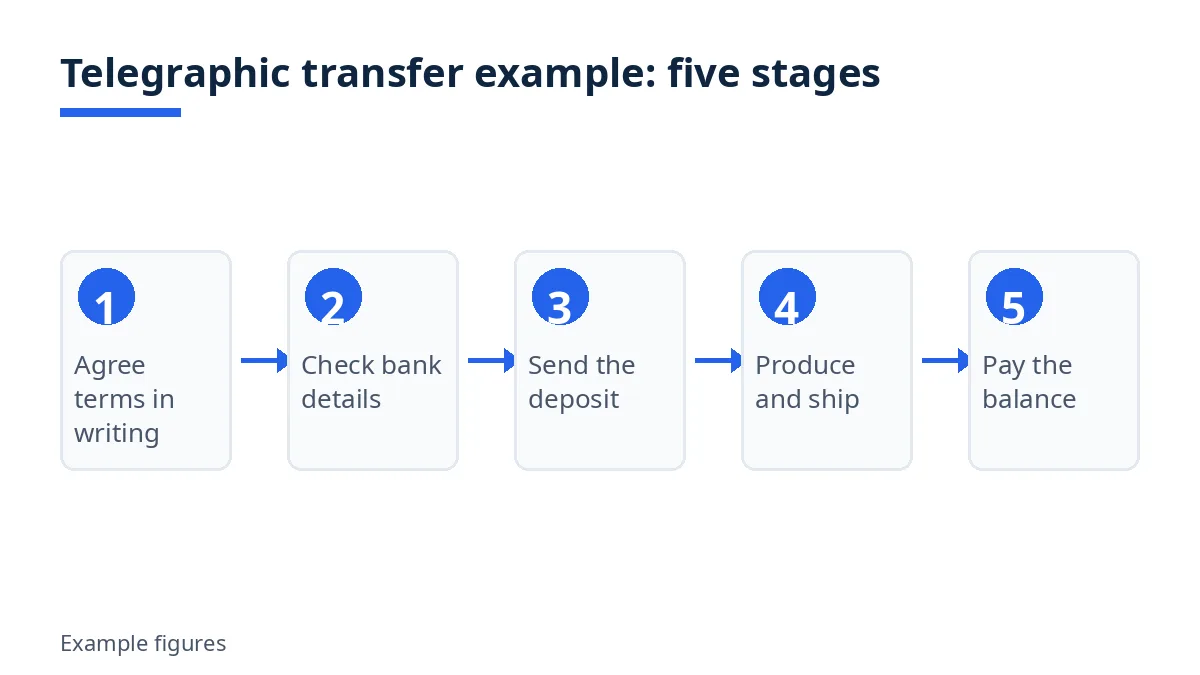
The following telegraphic transfer example is a worked illustration. Example figures: a buyer in the United States orders home textiles from a supplier in Bangladesh for USD 24,000, paid by TT in two legs, a 30 percent deposit of USD 7,200 on order confirmation and a balance of USD 16,800 after pre-shipment inspection and presentation of shipping documents. The amounts and split are a structure two parties might agree, not a standard rate or recommendation. Adapt the stages to your own contract.
Step 1: Agree the payment clause in writing
Before anything is sent, the sales contract or proforma invoice states the currency, the total value, the deposit share, the balance trigger, and who pays bank charges. It also names the exact beneficiary: the supplier's company name as it appears on the bank account, not a shortened name or an individual's name. Most TT problems are created at this stage.
Step 2: Exchange and verify bank details
The supplier provides its bank details in writing: account name, account number, bank name and branch, and SWIFT/BIC code, with an IBAN where the receiving country uses one. To send a TT, the buyer needs the recipient's full name as it appears on the bank account, the account number, the bank name and branch address, and the SWIFT/BIC code.1 The buyer verifies those details through an independent channel, for example a call to a number already on file, rather than trusting a single new email. This step is the main defence against payment-diversion fraud.
Step 3: The buyer instructs the deposit
The buyer instructs their bank to send USD 7,200, quoting the proforma invoice number in the payment reference. The buyer's bank debits the account and sends the instruction, typically over SWIFT, directly or through correspondent banks where the two banks have no direct relationship.1 A single customer credit transfer sent over SWIFT is the MT103 message, and SWIFT's training on the MT103 covers its charging options and the market practice guidelines for settling international payment charges.2 The buyer asks for the transfer confirmation, often called the MT103 or SWIFT copy, and shares it with the supplier.
Every SWIFT payment instruction carries a Unique End-to-end Transaction Reference (UETR), a string of 36 unique characters that acts as a single source of truth for the payment and lets parties in the chain locate it at any time.3 Since the end of 2020, SWIFT member banks have been required to confirm payment status to the Tracker once funds are credited to the end beneficiary's account, including whether a payment was rejected, for every MT103 customer payment.3 Keep the UETR for tracing.
Step 4: The supplier's bank credits the deposit
When the instruction arrives, the supplier's bank checks the beneficiary details. If the name and account number match, it credits the account. If something does not match, the payment may be held while the bank queries it. The supplier confirms receipt of the exact expected amount, and only then does production start. A transfer confirmation shows an instruction was sent, not that funds were credited.
Step 5: Production, inspection and document preparation
The supplier produces the goods. If the contract provides for it, the buyer arranges a pre-shipment inspection before the balance falls due. The supplier prepares the commercial invoice and packing list and, once goods are handed to the carrier, the transport document, such as a bill of lading or airway bill, plus any certificate the contract requires. Names, quantities and values should read identically across every document.
Step 6: The buyer instructs the balance
The balance trigger in this example is the accepted inspection result plus copies of the shipping documents. The buyer checks that invoice value, quantities and descriptions match, then instructs the balance of USD 16,800 by telegraphic transfer, using the bank details verified at step 2 and quoting the final invoice number.
Step 7: Final credit and release of documents
The supplier's bank credits the balance, and the supplier releases the original documents the buyer needs to clear the goods, following the contract. Both sides file the transfer confirmations, invoices and shipping documents together for later reconciliation. Almost all of the time and risk sits around the transfer, not in the bank instruction itself.
Costs, timelines and documents
What does a TT payment cost?
A TT payment can involve the sending bank's fee, correspondent bank charges, the receiving bank's fee, and a currency conversion margin if the currencies differ. Who bears which charge is set by the charges instruction. In a SWIFT MT103, that instruction appears in the Details of Charges field, field 71A, as OUR, SHA or BEN.4
Charges code | Who pays | What the beneficiary receives |
|---|---|---|
OUR | The sender pays the transfer fees | The full payment amount, which is why OUR helps the full amount reach the beneficiary |
SHA | Fees are shared between sender and beneficiary | The amount minus any fees deducted along the route, which may cause a short payment |
BEN | The beneficiary pays the transfer fees | The amount sent minus the fees, so the beneficiary may receive less than expected |
The table follows the definitions published by Flywire for field 71A.4 Because deductions under SHA or BEN can leave the beneficiary short of the invoice value, an exporter who needs the full amount should settle the charges instruction when the payment clause is drafted, not after the money arrives. Fees vary by bank, currency and route, so ask both banks for current charges before the first transfer.
How long does a TT payment take?
International TTs typically arrive within 1 to 5 business days, depending on the destination country, the currencies involved, the number of intermediary banks in the route, and cut-off times at each bank.1 Bank holidays in either country, incorrect recipient details and large time zone differences can push the timing toward the longer end.1 Banks also screen transfers before release, including fraud, anti-money laundering and sanctions checks, which can delay a transfer, particularly for certain currencies, countries or higher-value payments.1 Do not plan on same-day credit. Build a buffer into the schedule and put a clear invoice reference on every instruction.
Which documents support each leg?
For the deposit leg, keep the contract or purchase order, the proforma invoice, and the supplier's written bank details. For the balance leg, keep the commercial invoice, packing list, transport document, and any inspection report or certificate the contract calls for. Keep the transfer confirmation and UETR for every leg.
Bangladesh-specific rules and tips
Bangladesh export and import payments move through the formal banking system, and both sides should plan around it rather than look for informal workarounds.
First, exporters work through authorised dealer bank branches. Bangladesh Bank's Foreign Exchange Policy Department oversees authorised dealer bank branches under the Foreign Exchange Regulations Act 1947 and related guidelines and circulars, and close monitoring of export proceeds repatriation is one of its stated priorities.5 Expect the supplier to ask for references and document details to be exact, because incoming funds must be reconciled with the export record held by the bank.
Second, the beneficiary name matters even more than usual. The account name should be the supplier's registered business name exactly as the bank holds it. Payments to a shortened name, a different group company, or a personal account for a business transaction are likely to be queried or returned.
Third, discuss the letter of credit alternative openly. A documentary credit is a written undertaking given by a bank to the seller, on the instruction of the buyer, to pay at sight or at a determinable future date up to a stated amount, conditional on the beneficiary complying and making a complying presentation of documents.6 For a larger first order, that bank undertaking may suit both sides better than open TT stages. Many relationships use an LC first and move to TT splits once trust is established. Either way, the method belongs in the contract before production starts.
Fourth, allow for local banking realities. Public holidays in both countries affect value dates, and branch documentation practices can differ. A short call between the buyer's finance contact and the supplier before the first deposit prevents most surprises. Never route payment through a third party's account in another country because it seems quicker. That breaks the reconciliation chain the exporter's bank needs.
Mistakes and red flags
Paying details received in a single unverified email. In business email compromise, criminals send an email that appears to come from a known source making a legitimate request, such as a vendor sending an invoice with changed payment details.7 The FBI advises companies not to rely on email alone and to contact the person or company directly to verify any payment changes.7 Any change of bank details during a transaction is a red flag until verified by voice.
Name and number errors. A transposed digit or a misspelled beneficiary name can send a payment into a query queue for days. Copy details electronically rather than retyping them.
Paying the full amount in advance on a first order. Without a track record, a full advance leaves the buyer exposed if production slips.
Vague payment references. References such as "payment" or "goods" slow compliance screening and reconciliation. Always quote the invoice or order number.
Ignoring the charges instruction. If charges were never discussed, the beneficiary may receive less than the invoice value under SHA or BEN, and a dispute follows.
Document mismatch. Invoice values, quantities or descriptions that differ from the shipping documents give banks reasons to pause. Prepare documents as one consistent set.
Red flags that should stop a payment include pressure to pay urgently outside the agreed schedule, which the FBI lists as a warning sign of business email compromise.7 Other stop signals are a beneficiary name that does not match the contracting company, a refusal to provide a transfer confirmation, and any request to split a payment across unrelated accounts without a documented reason.
Checklist
Before the deposit:
Payment clause written into the contract or proforma invoice: currency, total value, split, balance trigger and charges instruction.
Contracting company name checked against the bank account name.
Bank details received in writing and independently verified through a trusted channel.
Both banks' charges and the likely timeline confirmed.
Before the balance:
Inspection completed, if the contract provides for one, and the result accepted.
Commercial invoice, packing list and transport document checked against each other and the order.
Payment reference quotes the final invoice number.
Transfer confirmation and UETR requested from the sending bank and shared with the supplier.
After each leg:
Supplier confirms credit of the exact expected amount, with any shortfall explained by documented charges.
Transfer confirmations, invoices and shipping documents filed together in one order file.
How Exportain helps
Exportain connects buyers with Bangladeshi suppliers across garments, textiles, leather, jute, seafood and other categories. Buyers can review supplier profiles, keep sourcing conversations and documents in one place, and compare quotations before agreeing payment terms. The platform records document and photo checks on supplier profiles. Those checks are not factory inspections or guarantees, and Exportain is not a party to your contract for goods.
FAQs
What should I know first about Telegraphic Transfer Example?
Know first that a telegraphic transfer is only a way of moving money between banks. It is not a guarantee that goods will be produced or shipped. In the telegraphic transfer example in this guide, protection comes from the staged structure and from verifying the supplier and the bank details before the first payment.
What are the typical costs and timelines?
Costs can include the sending bank's fee, correspondent charges, the receiving bank's fee and a currency conversion margin, and who pays them is set by the OUR, SHA or BEN instruction in field 71A of the MT103.4 Confirm current charges with both banks in advance. International TTs typically arrive within 1 to 5 business days, but cut-off times, holidays, intermediary banks and compliance screening can extend that, so do not plan on same-day credit.1
Which documents are needed?
For the deposit leg you need the contract or purchase order, the proforma invoice, and the supplier's written bank details. For the balance leg you need the commercial invoice, packing list, transport document such as a bill of lading or airway bill, and any inspection report or certificate the contract requires. Keep the transfer confirmation and UETR for every leg.
What are the most common mistakes?
The most common mistakes are paying bank details that were never independently verified, errors in the beneficiary name or account number, paying in full in advance on a first order, vague payment references, never agreeing who pays bank charges, and letting invoice details drift from the shipping documents. Unverified or changed bank details should stop a payment until the change is checked directly with the company through a channel you already trust.7
Next steps on Exportain
Browse Bangladeshi suppliers by category and read the how to buy guide before you agree payment terms with a new supplier. When your specification is ready, post an RFQ so suppliers quote against the same requirements, and use the TT (telegraphic transfer) guide to check your payment structure.
Sources
- Telegraphic Transfer (TT): What It Is and How It Works. Airwallex (accessed )
- Mastering the Single Customer Credit Transfer (MT 103). Swift (accessed )
- What is a Unique End-to-end Transaction Reference (UETR)?. Swift (accessed )
- What do OUR/DEBT, BEN/CRED, and SHA/SHAR mean in the fees section?. Flywire (accessed )
- Bangladesh Bank, Khulna Office. Bangladesh Bank (accessed )
- A guide to types of documentary credit. ICC Academy (accessed )
- FBI Tech Tuesday: Business Email Compromise (BEC) Fraud. Federal Bureau of Investigation, (accessed )
About the author
Sourcing from Bangladesh?
Post a request for quotation and suppliers on Exportain can send you their quotes directly.
Post an RFQ