

Typical MOQ for Tank Tops in Bangladesh (and How to Negotiate It Down)
No single tank top MOQ in Bangladesh: what sets the minimum per style, colour and fabric lot, and how to negotiate it by changing the order structure.
Short answer
There is no single typical MOQ for tank tops from Bangladesh. Each factory sets its minimum per style, per colour and per fabric lot, driven by body fabric weight, rib lots for the neck and armholes, slub yarn lots, dye lots and print screens. Ask for the minimum lot by lot in writing, then lower it by cutting colours, sharing one fabric across styles, using stocked inputs, or paying set-up costs separately.

On this page
Key takeaways
There is no single typical MOQ for tank tops from Bangladesh, because each factory sets its minimum per style, per colour and per fabric lot for your specification.
Body fabric weight, rib lots for the neck and armholes, slub yarn lots, dye lots and print screens are the drivers that set the floor, and the smallest lot decides whether the order can run.
A light garment needs more pieces to fill a fabric lot, so a tank's small grams per piece push its per-colour minimum up rather than down.
Ask for the minimum lot by lot in writing, with set-up costs itemized apart from the unit price.
Negotiate the structure first: fewer colours, one fabric shared across two styles, stocked jersey and rib, set-up paid separately, and colours staged across orders.
Divide a dye lot by the weight of a single tank and most tank-top minimums start to make sense. The garment is light, the lots behind it are not, and that arithmetic sets the order size. A factory first checks whether your specification fills each lot production has to open. When one lot stays half empty, the quote either grows, gains a surcharge, or drops that color or size.
That arithmetic also explains why two factories quote very different minimums for the same tank: one holds your jersey color in stock, the other must dye it; one cuts rib from stock, the other must knit and dye a matching rib lot; one reuses screens, the other must make new ones.
Bangladesh offers a wide knitwear base for testing those differences. The Bangladesh Knitwear Manufacturers and Exporters Association (BKMEA) dates to 1996 and counts roughly 2,540 member factories.1 Export Promotion Bureau (EPB) data put knitwear shipments at $5,963.76 million for July to September of fiscal year 2026-27, up 6.88 percent, inside ready-made garment exports of $10.578 billion.2 That scale means choice, not a shared floor.
Fabric first: how rib, jersey and slub lots set a tank-top minimum
A tank-top order opens more lots than buyers usually count: body jersey, rib, slub yarn, dye per color, screens per print color, and a marker per cut, each with its own floor in different units. The order proceeds only when the smallest is met.
Rib decides the neck and armhole, and often the order. With no sleeves to hide behind, rib at the neckline and armholes must match the body color exactly, and it is usually knitted and dyed apart from the body fabric. A color that passes the body test can still fail the rib test, and a contrast rib turns one garment into two color lots. Put rib composition, width, and color on the tech pack, and ask in writing whether the rib floor sits inside the garment floor or beside it.
Jersey weight works against a small first order. A plain jersey tank weighs little, so one kilogram lot stretches across far more pieces than in a heavier garment. So the factory must dye a full lot for a short run or hold leftover cloth. A heavier ribbed tank reaches the same lot with fewer pieces. State grams per square meter in the first enquiry, because weight converts a kilogram floor into a piece count.
Slub adds a yarn lot before dyeing even starts. Slub yarn is spun with deliberate uneven thickness, giving the fabric its texture, and a spun lot must stay consistent through the run. A factory will not spin half a lot for one shade and half for another and expect the same texture, so a slub style in three colors starts as three yarn lots, then three dye lots, then cutting. Ask whether your slub color is already spun and held, or spun only after confirmation.
Dye floors follow colors, never order totals. A dyed-to-order color brings its own lot floor, and two colors at half a lot each do not combine into one full lot. Stocked cloth in a standard color skips that floor, which is why a stocked black or white tank can carry a lower minimum than the identical tank in a custom shade.
Print floors follow screens, not garments. A chest graphic needs one screen per artwork color, made once whether the run is long or short, so a four-color graphic carries four set-ups before printing begins. Separating screen charges from the unit price can let the garment run shrink when screens are the constraint.
Size ratios decide the smallest cell. Demand clusters in the middle sizes, while the smallest and largest sizes sit at the marker ends, where narrow straps and curved armholes leave the most waste. Factories need a ratio per color, and the end size in the smallest color usually breaks first.
Each cut carries its own marker floor. A racerback, a muscle tank, and a straight A-line body nest differently: the racerback loses cloth around its narrow back panel and shaped straps, the muscle tank through deep armholes, and the A-line widens toward the hem. Each cut needs its own pattern and marker, so each keeps its own minimum even when fabric and color are shared.
Lot | Measured in | Where a tank order breaks | Ask in writing |
|---|---|---|---|
Body jersey | Kilograms per lot | A light tank needs many pieces to fill one lot | Lot size, weight, stocked or dyed to order |
Rib | Kilograms per color | Matching rib lot too small for the color | Rib floor, inside or apart from garment floor |
Slub yarn | Spun lots per shade | Texture cannot be split across shades | Yarn stocked or spun to order |
Dye | Pieces per color | Two half lots do not make one full lot | Dye floor per color |
Print screens | Screens per artwork color | A short run still pays every screen | Screen count, separate charge, reuse on repeat |
Cutting marker | Pieces per style and size | End sizes and shaped straps waste cloth | Ratio per color, smallest cell checked |
Example figures: a 1,600-piece order in four colors gives 400 per color, while the same 1,600 in two colors gives 800 per color, which can clear a dye floor that blocks the four-color split. A ratio of 1:2:3:2:1 across XS to XL divides 1,080 pieces per color into 120, 240, 360, 240, and 120, and the 120-piece end sizes are the cells to verify first. Both illustrations show structure only, not a typical MOQ, price, or lead time.
Knitted tank tops fall under HS heading 6109, for T-shirts, singlets, and other vests, knitted or crocheted, with 610910 for cotton and 610990 for other materials.3 In the European Union, Regulation (EU) No 1007/2011 requires the name and percentage by weight of every constituent fiber, in descending order.4 See the HS code for tank tops guide.
Negotiation levers: changing the structure behind the number
Leverage comes from removing a lot, not from pressing a factory to overlook one. The levers below start with inputs that disappear entirely when already in stock.
Start from the stock list, not from the color chart. Ask for stocked jersey and rib shades before locking colors, and build the first order around what is held. Stocked body fabric plus stocked matching rib can remove the dye lot and much of the set-up in one move.
Put one fabric under two cuts. A straight tank and a muscle tank in the same jersey and color can draw on one dye lot together, though each cut still needs its own marker floor. Ask in writing whether the fabric floor can be met across both cuts combined.
Cut colors after you have cut lots. Once stocked inputs and shared fabric are settled, dropping a color merges its dye lot, rib lot, and cutting run into the remaining colors. At a fixed total, fewer colors mean more pieces behind each surviving color.
Separate set-up charges from the unit price. Screens, woven labels, and printed cartons each have their own run floor, and folding them into the garment price hides which floor binds. Itemizing them lets the garment run shorten where set-up was the constraint, and paid screens and plates remain usable for the repeat.
Stage colors, and keep the repeat terms written down. When a four-color launch will not move, place two colors first with a written repeat price and floor for the identical specification, and hold the rest for the repeat.
Mistakes and red flags
Reading the total and missing the cell. An order can pass its headline figure and still fail on one color, one rib lot, or one end size. Check the smallest cell, not the sum at the top.
Judging a tank by its size instead of its grams. Small garments do not mean small minimums. Judge by grams per piece, because a light tank needs more pieces to absorb a fabric lot than a heavier garment does.
Comparing quotes built on different cloth. A lower floor on stocked jersey and a higher floor on dyed-to-order slub are two different offers, not two prices for one product. Compare only quotes that answer the same tech pack, the same rib spec, and the same delivery term.
Letting a slub shade drift across lots. Slub texture and shade must stay consistent through the run, so a second lot spun later can read differently from the first. Confirm continuity in writing, and check the pre-production sample against bulk cloth, not only the proto.
Put every concession on paper. If a floor is lowered, a lot shared, or colors staged, write the exact split into the quote and the order. A later change of merchandiser can otherwise erase an unwritten deal.
Reading a listing as a capacity test. A supplier page can show what a business claims to make, but not whether its rib dye matches your body shade or its marker handles your racerback. Treat listings as a shortlist for sampling.
Why this matters for buyers and sellers
For the seller, a floor protects cloth that cannot be resold: jersey dyed to your shade, rib matched to it, slub spun for your texture, and screens cut for your artwork belong to your order alone once production opens. For the buyer, the same floor decides how much cash is tied up in stock and whether a first order can test a style before a larger repeat. A tank that sells in one color and stalls in another leaves the slow color as dead stock.
Step-by-step: how it works
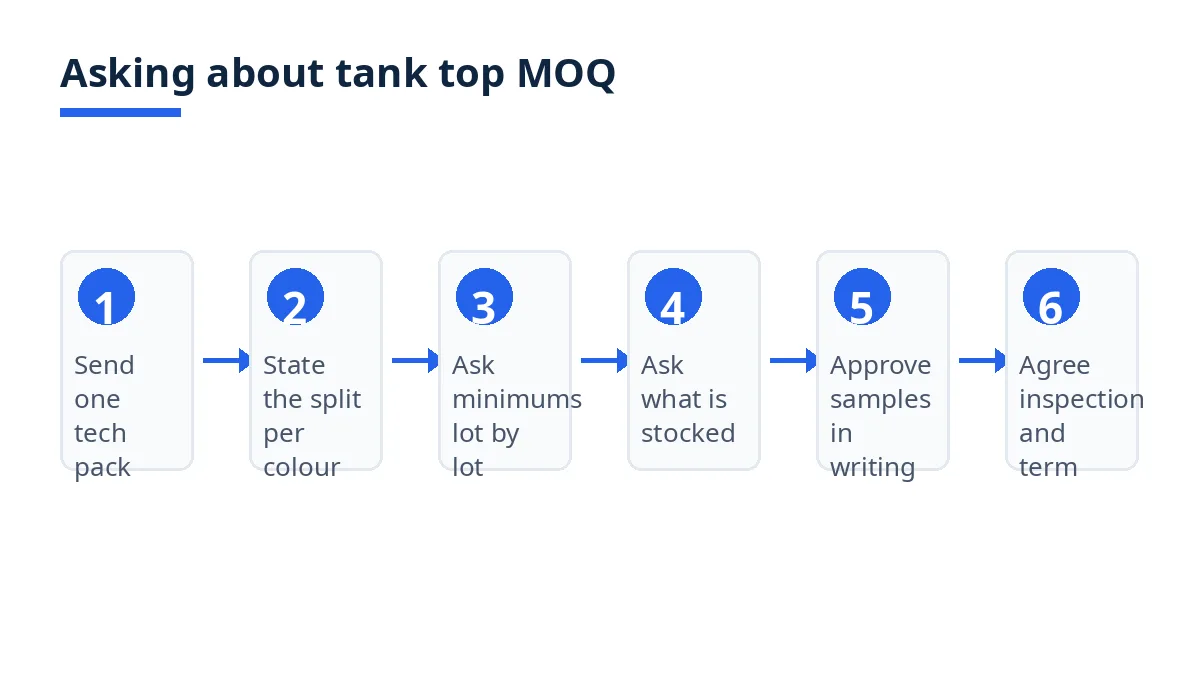
Circulate one tech pack to every candidate. Cover fabric, weight, body length, neck shape, armhole depth, rib spec, artwork, labels, size chart, and packing.
Break the total into its cells. Give counts by cut, by color, and by size, with a ratio attached to each color. A bare total cannot yield a usable floor.
Ask lot by lot. Request separate floors for cut, color, dye, rib, screens, labels, and cartons, and name the line that limits your split.
Record stocked versus made-to-order status. Note for each body fabric, rib, and slub yarn whether it is held in stock or produced after confirmation.
Approve samples against the real inputs. Order a proto, then a pre-production sample in the actual fabric, color, rib, and artwork. Measure it before and after washing, and record approval or corrections in writing.
Settle checking and delivery terms up front. Before confirming, write the sampling level and AQL figures into the order, per ISO 2859-1,5 and attach one Incoterm and place to each quote.6
Costs, timelines and documents
No guide can publish a typical cost or timeline for tank tops, because each factory prices your exact specification. Weight, rib, slub, print colors, label and carton runs, and the delivery term move the unit price.6
On timing, ask for separate dates rather than one lead time: sampling, fabric-ready, production, and inspection. Sampling stretches with fabric availability and correction rounds, while bulk production waits on dyeing, rib supply, and print set-up.
On paperwork, confirm the full Bangladesh export set with your supplier and customs broker before loading. The customs source sets out the export declaration and the papers enclosed with it.7
Bangladesh-specific rules and tips
Treat a BKMEA claim as a lead to check directly with BKMEA, not as evidence about your order's floor. BKMEA represents the knitwear sector,1 and membership speaks to the sector a supplier works in, not to its minimum.
Paperwork friction usually starts with a name mismatch. Keep exporter and buyer names identical on every document, from trade licence through to payment, since the declaration names both.7
Imported inputs deserve an early question. Slub yarn, special rib, and some print inks may be bought in for your specification, and a bought-in input can set both the floor and the earliest start date.
Checklist
Run through this list before you sign anything, and get every answer in writing.
Spec sheet sent to all candidates, with cloth, GSM, neckline shape, armhole depth, rib detail, artwork, labelling, size chart, and packing method.
Quantities broken down by cut, color, and size, ratio shown for each color, smallest and largest sizes verified.
Each lot floor confirmed, and the one that limits the order identified by name.
For rib and slub, note whether stock is held or production starts after confirmation, and whether rib shade matches body.
Printed packaging and labels ordered in their own run sizes.
Charges for screens and plates shown separately, and reuse on repeat orders noted.
Bulk-cloth sample: check dimensions, launder, re-check dimensions, then confirm by signature.
Order document states the sampling plan: level and AQL figures.5
All quotes judged on identical spec and identical delivery term.6
Paperwork for export verified ahead of loading, declaration included.7
How Exportain helps
Use the supplier directory and RFQ board to send the same tech pack and split to several suppliers and compare per-lot replies on one delivery term. Read what verification badges record on Exportain's trust and verification pages before relying on them, and keep sample approval and inspection as your own checks.8 9 Browse suppliers, post on the RFQ board, and see how supplier verification works on Exportain.
FAQs
What should I know first about tank tops?
Start from lots, not totals. A tank-top minimum is set per style, per color, and per fabric lot by body weight, rib lots, slub yarn lots, dye lots, and print screens, and the smallest lot decides whether the order runs.
What are the typical costs and timelines?
No reliable typical figure exists, because each factory prices and schedules your specification. Weight, rib, slub, print colors, and the delivery term drive price,6 while sampling, dyeing, rib supply, and print set-up drive timing.
Which documents are needed?
Keep the tech pack, itemized quotation, and purchase order for the order itself, with the floor per style, per color, and per lot on both the quotation and the order. Confirm the Bangladesh export declaration set with your supplier before shipment.7
What are the most common mistakes?
Reading only the order total, comparing quotes built on different cloth or terms,6 leaving an agreed exception unwritten, and treating a listing or a badge as a capacity test. A badge is not a guarantee of capacity, quality, or delivery.8
Next steps on Exportain
Start from suppliers, post your tech pack and split as an RFQ on the RFQ board, and read how to import tank tops from Bangladesh and the MOQ definition guide before you confirm.
Sources
- BKMEA at a Glance. BKMEA (accessed )
- RMG exports rise 6.10pc to US$10.58b in July-Sept of FY27. The Financial Express, (accessed )
- Classification Detail — HS Code 6109. United Nations Statistics Division (accessed )
- Regulation (EU) No 1007/2011 on textile fibre names and related labelling and marking of the fibre composition of textile products. European Union, (accessed )
- ISO 2859-1:2026 - Sampling procedures for inspection by attributes — Part 1: Sampling schemes indexed by acceptance quality limit (AQL) for lot-by-lot inspection. ISO (accessed )
- Incoterms® 2020. International Chamber of Commerce (ICC) (accessed )
- Customs Clearance Procedures for Export. Bangladesh Customs, National Board of Revenue (accessed )
- Trust & Safety Center. Exportain (accessed )
- Supplier verification: Earn trust badges buyers can see. Exportain (accessed )
About the author
Sourcing from Bangladesh?
Post a request for quotation and suppliers on Exportain can send you their quotes directly.
Post an RFQ


