

Typical MOQ for Switchgear in Bangladesh (and How to Negotiate It Down)
No single switchgear MOQ in Bangladesh: what sets the minimum per panel, rating and configuration, how to ask for it line by line, and how to negotiate a smaller order without dropping type-test evidence or inspection.
Short answer
There is no single typical MOQ for switchgear from Bangladesh. Each supplier sets its minimum per panel type and per rating for your configuration, driven by enclosure fabrication, breaker frames, busbar size, component lots and test evidence. Ask for the minimum per type and per rating in writing, then negotiate the structure: fewer ratings, shared enclosure sizes, standard frames, setup priced apart, or a staged order.
On this page
Key takeaways
There is no single typical switchgear MOQ: suppliers set minimums per panel type and per rating, and the binding line is usually inside the total.
Enclosure fabrication, breaker frames, busbar size, component lots and test evidence tied to a model and rating are the drivers that set the floor.
Negotiation works by changing the structure: fewer ratings, shared enclosure sizes, standard frames, setup priced apart, or a staged order.
Ratings, test standards and efficiency claims are per-model verification items: evidence for a neighbouring rating does not cover the rating you buy.
Every agreed exception belongs in writing on the quotation and purchase order, with the exact split it applies to.
Ask three suppliers for the switchgear MOQ in Bangladesh for the same panel lineup and you will get three different answers. There is no single typical MOQ for switchgear from Bangladesh, because each supplier sets its minimum for your configuration: the panel type, the rating of each panel, and the quantity of each rating, not just the total number of panels.
Switchgear is a broad family, so the first job is to say which part of it you are buying. Heading 8537 covers boards, panels, consoles, desks, cabinets and bases fitted with apparatus for electricity control and distribution, with 853710 for a voltage not exceeding 1,000 volts and 853720 for a voltage exceeding 1,000 volts.1 Low-voltage power assemblies are covered by IEC 61439-2, which sets requirements for assemblies rated at or below 1,000 V AC or 1,500 V DC.2 Metal-enclosed high-voltage switchgear falls under IEC 62271-200, which covers alternating current equipment for rated voltages above 1 kV and up to and including 52 kV.3 A supplier's minimum for a low-voltage distribution board and its minimum for a medium-voltage panel are different questions, and a quotation that does not separate them cannot be compared with another.
Why this matters for buyers and sellers
For the buyer, the MOQ decides how much capital sits in panels that may serve one project, and whether a first order can prove a configuration before a larger repeat. A panel bought for one site's voltage, rating and protection scheme is hard to redeploy elsewhere, so ordering above the real need is waste, not safety stock.
For the seller, the minimum protects work that cannot be reused. An enclosure is cut and fabricated for your panel dimensions, busbars are sized for your rating, and breaker frames and protection devices are procured for your scheme. A short run still uses the fabrication setup, the busbar work and the assembly and test time, so cost per panel rises as quantity per rating falls.
The verification question sits between the two sides. Ratings, test standards and any efficiency claim for a model are verification items for that exact model and configuration: ask which type-test evidence covers the rating you are buying, and whether it covers your configuration or a neighbouring one. Evidence for a different rating is not evidence for yours, and a lower minimum that drops that check is not a saving.
Driver | What sets the floor | State in your enquiry |
|---|---|---|
Panel type | Enclosure fabrication and assembly setup per type | Panel type and single-line diagram |
Rating | Breaker frame, busbar size and protection per rating | Rated voltage and current per panel |
Configuration | Incomer, feeder and bus-coupler differences | Quantity per panel type and rating |
Components | Breaker, relay and meter lots per scheme | Protection and metering scheme per panel |
Enclosure | Sheet-metal batch and finish per size | Dimensions, indoor or outdoor use |
Test evidence | Type-test evidence tied to a model and rating | Evidence requested per model and rating |
Example figures: a buyer orders 10 panels in total, made up of 8 feeder panels at one rating and 2 incomer panels at a higher rating. The total clears the supplier's headline minimum, but the 2 incomers sit below the per-rating line for their breaker frame and busbar size. The same 10 panels split as 5 and 5 across two ratings can clear both lines. The example shows structure only, not a typical MOQ, price or lead time.
See the HS code for switchgear guide and the MOQ definition guide.
Step-by-step: how it works
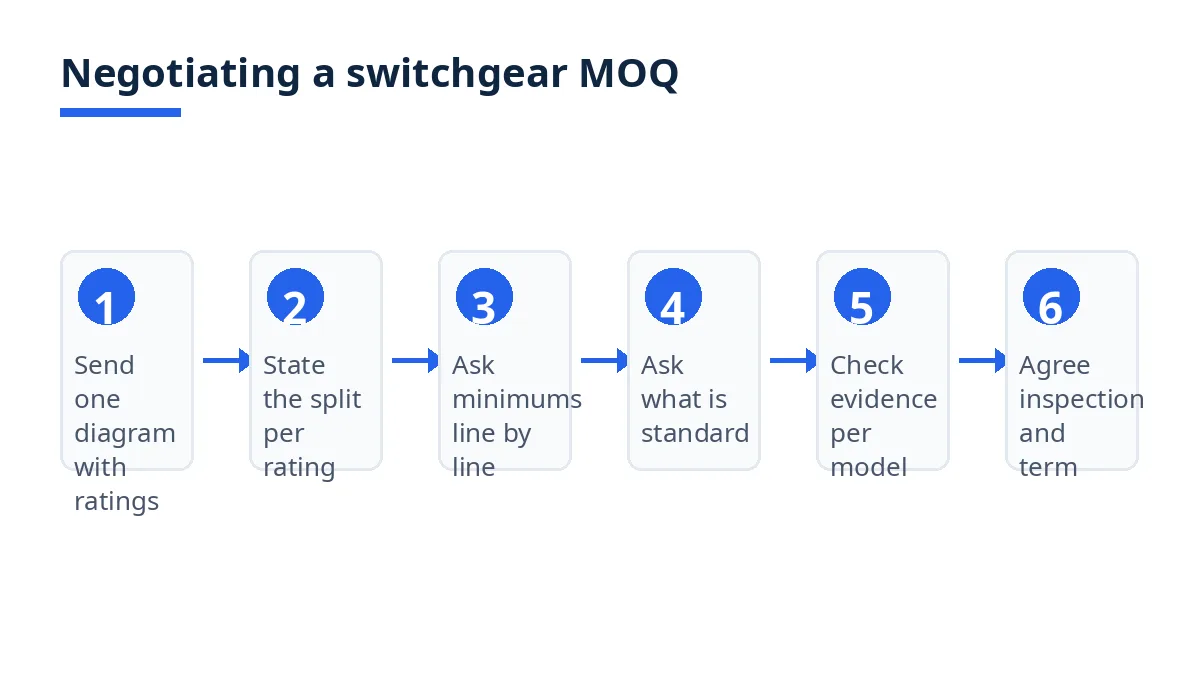
Send one single-line diagram to every candidate. State the panel lineup, the load list, the rated voltage and current of each panel, indoor or outdoor installation, and the protection and metering scheme. A quotation without ratings cannot carry a usable MOQ.
State the split, not only the total. Give the quantity per panel type and per rating, and the quantity of any spare panels or spare components. A total without a split hides the binding line.
Ask for the minimums line by line. Ask for the MOQ per panel type, per rating, per enclosure size, and any separate minimum for breaker frames, busbars or component lots, and ask which line is binding for your split.
Ask what is standard. Record whether each enclosure size and breaker frame is a standard item the supplier builds regularly or a made-to-order item for your scheme. Standard items are where a lower minimum is most often possible.
Ask for verification evidence per model. Request the type-test evidence for the exact model and rating, and the routine test reports that will accompany your panels. Ratings, test standards and efficiency claims belong here, as per-model verification items, never as a general claim about a supplier.
Agree inspection and delivery term before you confirm. Write the inspection plan and one delivery term into the purchase order. ISO 2859-1 defines a system of acceptance sampling plans for inspection by attributes, indexed by acceptance quality limit (AQL) for lot-by-lot inspection.4 AQL is the maximum average percentage of defective items considered acceptable during random sampling, and it sets sample sizes and acceptance or rejection thresholds.4 The Incoterms 2020 rules give a clear allocation of cost, risk and obligations across 11 rules,5 so compare MOQs only on the same term.
Negotiation levers that move the floor
Negotiation works when you change the structure that creates the minimum, not when you ask for an exception to it. Get the result in writing.
Reduce the number of ratings first. Ratings multiply breaker frames, busbar sizes and test evidence. Aligning two feeders to one rating raises the quantity per remaining rating at the same total.
Share one enclosure size across panel types. A feeder and a bus-coupler panel built in the same enclosure size can share a fabrication batch. Ask whether the enclosure minimum can be met across both types combined, in writing.
Use standard frames and schemes. A standard breaker frame and a standard protection scheme remove made-to-order procurement. Ask for the standard list before you finalise the scheme.
Pay setup as a separate line. Where the floor comes from enclosure tooling or a new test arrangement, ask for those costs apart from the unit price. The run can then be shorter, and the same setup serves the repeat order. Record which setup lines you have paid for.
Stage the order. If the supplier cannot move, place a smaller first order in fewer ratings, with a written repeat price and MOQ for the same configuration. Do not negotiate by dropping type-test evidence, routine tests or inspection.
See the switchgear quality control checklist for panel, wiring and test points.
Costs, timelines and documents
What are the typical costs and timelines?
There are no typical costs or timelines a guide can state as fact, for the same reason there is no typical MOQ. Each supplier prices your enclosure size, breaker frame per rating, busbar work, protection and metering scheme, packing for panel size and weight, and the delivery term you choose.5
For timelines, design approval depends on how many correction rounds the single-line diagram needs, and production on component availability, assembly capacity and routine testing. Ask for design approval, component ready, assembly, routine test and packing dates as separate lines, not a single delivery week.
Which documents are needed?
For export clearance in Bangladesh, goods may not be loaded unless an export declaration, the Bill of Export or Shipping Bill, is submitted to Customs and approved.6 Enclosed documents include the export contract or purchase order where there is no export letter of credit, the commercial invoice, the packing list, the EXP form certified by an authorized dealer, and a certificate of origin issued by the EPB or a Chamber of Commerce and Industry.6 The export set also includes the VAT registration certificate and the Taxpayer Identification Number.6
The order documents are the single-line diagram, the load list, the itemized quotation and the purchase order, with the MOQ per panel type and per rating on both the quotation and the order.
Bangladesh-specific rules and tips
Keep one legal name across every paper. The export declaration names the exporter and the foreign buyer,6 so the name on the trade licence, quotation, proforma invoice and payment account should match. A mismatch discovered at clearance costs more time than any MOQ saving.
Confirm what the badge records before you rely on it. Export Verified means Exportain has checked the Export Registration Certificate (ERC), and Factory Verified means it has reviewed photos of the manufacturer's factory.7 Verification is a document and photo review by staff, free, and never granted by membership plans.8 It is not a factory inspection,7 8 so type-test evidence, routine test reports and your own inspection stay with you.
Ask which components are bought in for your rating. Breaker frames, relays and meters for a particular rating may be procured for your order, and a bought-in component can set both the minimum and the earliest assembly date. Agree the rating split before assembly starts, because a late rating change can restart procurement.
Plan for panel size and site access. Switchgear panels are bulky and heavy for their value, so packing, handling and delivery to site deserve a line in the quotation. Confirm panel dimensions, weight and any split-shipment arrangement before you confirm, and keep the delivery term consistent across quotations.5
Mistakes and red flags
What are the most common mistakes?
Asking for a total MOQ only. The binding minimum is usually per panel type or per rating. An order can clear the total and still fall below the per-rating minimum for one incomer panel, which then carries a surcharge or removal.
Comparing MOQs on different ratings or terms. A lower minimum on a lower rating, a standard scheme instead of your scheme, or a different delivery term is a different offer. Compare only replies to the same single-line diagram on the same Incoterm.5
Accepting evidence for a different model. Type-test evidence, ratings and efficiency claims must match the exact model and rating you are buying. Evidence for a neighbouring rating does not cover yours.
Accepting a verbal exception. Record any agreed lower minimum, shared enclosure batch or waived setup on the quotation and purchase order, with the split it applies to.
Paying setup twice. Keep the paid setup lines from the first purchase order and attach them to the repeat enquiry.
Treating a profile or a badge as verification. A profile is a starting point for enquiries. It does not test whether a supplier can build your panel lineup, and a badge is not a guarantee of capacity, quality or delivery.7
Skipping routine tests or inspection to save time. Sampling under ISO 2859-1 checks a lot against an agreed AQL,4 the last control before the panels become your project stock.
Checklist
Before you confirm, every line should be answered in writing.
Single-line diagram sent: panel lineup, load list, ratings, protection and metering scheme.
Split stated per panel type and per rating, with spare panels and components listed apart.
MOQ confirmed per panel type and per rating; binding line named.
Standard versus made-to-order status recorded per enclosure size and breaker frame.
Type-test evidence requested per exact model and rating; routine test reports agreed.
Setup costs itemized apart from the unit price; paid setup lines recorded.
Inspection plan and AQL values in the purchase order.4
Quotations compared on the same diagram and Incoterm.5
Export set agreed: invoice, packing list, EXP form, certificate of origin, Bill of Export.6
How Exportain helps
On Exportain, browse suppliers and post a request for quotation (RFQ) on the RFQ board with your single-line diagram summary, split per rating and delivery term, so suppliers quote against the same configuration. Ask each reply for its per-type and per-rating minimums. When you accept a quotation, Exportain creates one order and issues one proforma invoice from the accepted terms.7
Read the badges for what they record. Exportain Verified means Exportain has checked identity, phone, email and business registration, and Export Verified means it has checked the Export Registration Certificate (ERC).7 Factory Verified means it has reviewed photos of the manufacturer factory, while Trading Company Verified means it has reviewed photos of the trading company office or warehouse.7 Verification is a document review by staff, free, and never granted by membership plans.8 It is not a factory inspection,7 8 so sample approval, test evidence and inspection stay with you.
FAQs
What should I know first about switchgear?
There is no single MOQ to look up. The minimum is set per panel type and per rating by enclosure fabrication, breaker frames, busbar size, component lots and test evidence. Assembled boards and panels for electricity control and distribution sit under HS heading 8537, with 853710 for a voltage not exceeding 1,000 volts and 853720 for a voltage exceeding 1,000 volts.1 Low-voltage power assemblies fall under IEC 61439-2,2 and metal-enclosed high-voltage switchgear under IEC 62271-200 for rated voltages above 1 kV up to and including 52 kV.3
What are the typical costs and timelines?
There are no typical figures a buyer can rely on, because each supplier sets its price, MOQ and lead time for your configuration. Enclosure size, breaker frame per rating, busbar work, the protection scheme and the delivery term drive the price,5 and design approval, component availability, assembly and routine testing drive the timeline.
Which documents are needed?
The order documents are the single-line diagram, load list, itemized quotation and purchase order, with the MOQ per panel type and per rating on both. The export set is the Bill of Export, commercial invoice, packing list, EXP form certified by an authorized dealer, and a certificate of origin issued by the EPB or a Chamber of Commerce and Industry.6
What are the most common mistakes?
The most common mistakes are asking only for a total MOQ, comparing minimums on different ratings or terms,5 accepting test evidence for a different model, accepting a lower minimum verbally, and reading a badge as a guarantee. A badge is not a guarantee of capacity, quality or delivery.7
Next steps on Exportain
Browse suppliers, then post your single-line diagram summary, split per rating and delivery term on the RFQ board so suppliers state their MOQ per panel type and per rating. Before you confirm, read how to import switchgear from Bangladesh.
Sources
- Classification Detail — HS Code 8537. United Nations Statistics Division (accessed )
- GSO IEC 61439-2:2025 — Low-voltage switchgear and controlgear assemblies, Part 2. GCC Standardization Organization (accessed )
- IEC 62271-200:2011 — AC Metal-Enclosed High-Voltage Switchgear. International Electrotechnical Commission (accessed )
- ISO 2859-1:2026 — Sampling procedures for inspection by attributes — Part 1: Sampling schemes indexed by acceptance quality limit (AQL) for lot-by-lot inspection. ISO (accessed )
- Incoterms® 2020. International Chamber of Commerce (ICC) (accessed )
- Customs Clearance Procedures for Export. Bangladesh Customs, National Board of Revenue (accessed )
- Trust & Safety Center. Exportain (accessed )
- Supplier verification: Earn trust badges buyers can see. Exportain (accessed )
About the author
Sourcing from Bangladesh?
Post a request for quotation and suppliers on Exportain can send you their quotes directly.
Post an RFQ


