

Top Switchgear Manufacturers in Bangladesh: How to Find and Verify Them
Switchgear manufacturers in Bangladesh, judged not by ranking but by evidence: eight checks covering design verification, in-house build, component lists, routine records, drawings, references, agreeing documents and destination-market files.
Short answer
Switchgear manufacturers in Bangladesh should be judged on evidence matched to your design, not on ranking or price. Ask for design verification covering your exact ratings, a stage-by-stage in-house build statement, a component list by make, series and rating, and a routine verification record for every panel serial number. Add drawing control, reference assemblies in your voltage class, agreeing company documents and a destination-market file, then score each supplier on evidence seen.
On this page
No published ranking of switchgear manufacturers in Bangladesh is safe to order from, and for this product a ranking is the wrong tool. Switchgear is built to order against a single-line diagram: the enclosure, the busbar, the fitted devices and the ratings change from one assembly to the next, so the supplier you need is the one whose evidence matches your design, not the one with the broadest catalogue. Bangladesh's electrical exports are growing into this kind of work. Exports of electrical products reached US$206.19 million in FY2025-26, up 23.82 per cent from US$166.52 million a year earlier, making electrical products the largest earner among engineering products, according to Export Promotion Bureau (EPB) data reported by The Business Standard.1 The same report notes testing infrastructure gaps for Western-market standards, which is why test evidence should decide your shortlist.1
Switchgear is the assembly of switching, protecting and isolating devices that controls and protects an electrical circuit. For low-voltage assemblies, IEC 61439 is the international standard for design, manufacture, testing and performance, covering temperature rise, short-circuit withstand, degree of protection, dielectric properties and mechanical operation.2 For AC metal-enclosed assemblies above 1 kV and up to and including 52 kV, IEC 62271-200:2021 applies, for indoor and outdoor installation.3 The evidence you ask for follows the voltage class, and experience in one class says nothing about the other. IEC 61439-1 also fixes who answers for what: the specifier, the original manufacturer and the assembly manufacturer, or panel builder, each carry distinct verification duties.4
Key points to take away
Judge a switchgear supplier on evidence matched to your design: design verification, in-house stages, a component list by make and rating, and a routine record per serial number.
A test report for a different rating, enclosure or component set does not cover your panel: match its report number, configuration and ratings against your order.
Low-voltage and higher-voltage work are verified under different standards, so reference work only counts when it sits in your voltage class.
On Exportain, trust badges record document and photo checks reviewed by staff, not a factory inspection, and they do not replace your own checks.5
For the European Union, the importer must check the manufacturer's conformity assessment, and the declaration and technical documentation must be kept for 10 years.6
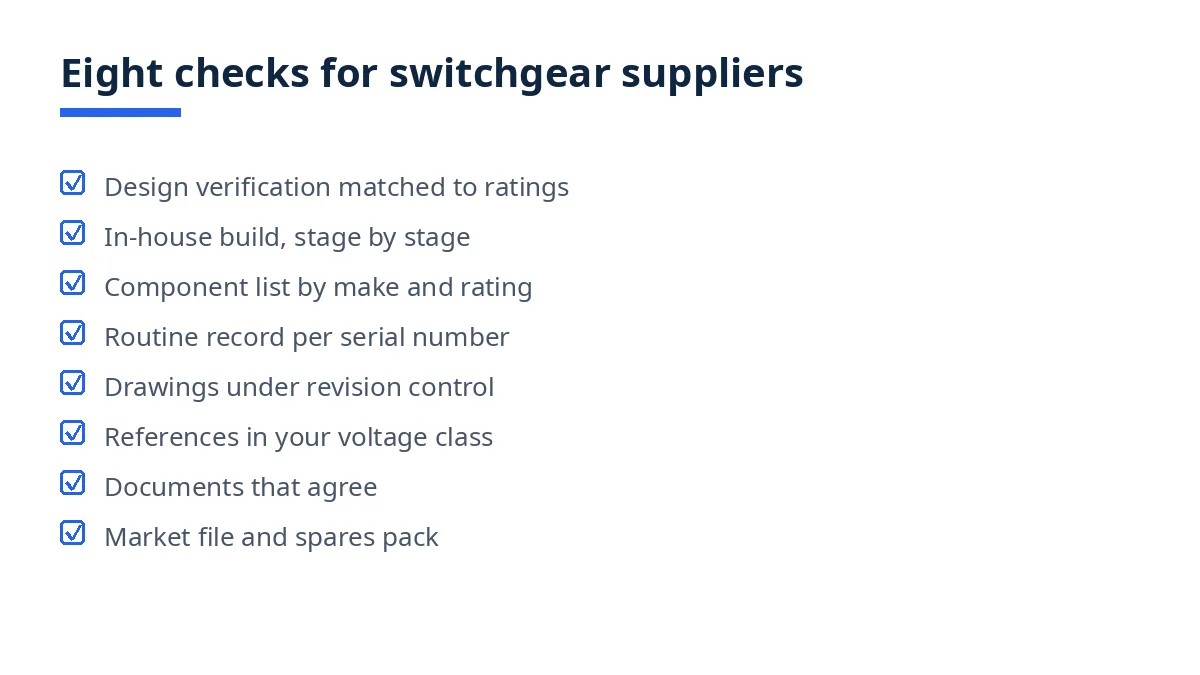
The list: eight checks for switchgear manufacturers in Bangladesh
Each check below states what it is, why it matters, and how to run it. The first four test whether the supplier can build your design; the last four test whether the order survives drawings, documents, market rules and service life. A supplier that fails check 1 or check 4 stays off the shortlist.
1. Design verification matched to your exact ratings
What it is. Design verification is the evidence that the assembly design itself has been tested: temperature rise, short-circuit withstand strength, dielectric properties, degree of protection, mechanical operation and protection against electric shock.2 Under IEC 61439, design verifications sit with the original manufacturer and routine verifications with the assembly manufacturer.4
Why it matters. Design evidence is tied to one tested configuration. Change the rating, the enclosure, the busbar or a fitted device series and the old report stops describing your panel.
How to check it. Ask for the report number, the testing laboratory, the tested configuration and the ratings it covers, then compare all four against your specification line by line. Confirm the report names the standard for your voltage class: IEC 61439 for low-voltage work, IEC 62271-200 above 1 kV.3 A design that deviates from the original manufacturer's instructions needs a new, full design verification.4
2. Build stages done in-house, stated stage by stage
What it is. A written statement of which stages the supplier performs itself — enclosure fabrication, busbar work, coating, wiring, labelling, routine verification — and which it buys in.
Why it matters. A stage done elsewhere is a stage the supplier does not directly control, so a subcontractor's delay or failure becomes yours.
How to check it. Ask for the stage list in the quotation, not in a brochure. Then ask to see a current-production assembly in the same class, and check its busbar jointing, clearances, wiring finish, labelling and door fit. If a stage is subcontracted, ask who performs it and what happens when that stage fails inspection, and get the answer in writing before you pay a deposit.
3. A component list with make, series and rating for every device
What it is. A bill of components naming each fitted device's make, series and rating: main breaker, outgoing devices, relays, meters, current transformers and auxiliaries.
Why it matters. Two breakers of the same frame size can carry different breaking capacities, and a substituted relay can change what the panel protects. Marks and certificates on a fitted device belong to that device. They do not certify the assembled panel, which is verified as an assembly under its own standard.
How to check it. Require the full component list in every quotation, and compare quotations device by device rather than by the final price. Bar substitution without written approval, and re-check any approved substitution against the design verification scope. At inspection, check fitted devices against the list by make, series and rating. The switchgear quality control checklist turns this into panel-level checks for the finished order.
4. A routine verification record for every panel serial number
What it is. A routine verification record for each completed assembly, filed against that panel's serial number.4
Why it matters. Design verification covers the design. Routine verification is the evidence that your panel, the one in the crate, was built and checked as that design requires. One sample record for a whole shipment proves nothing about the other panels in it.
How to check it. Require a record per serial number in the order terms, and hold any panel whose record is missing or matched to a different serial number until the file is corrected. For repeat units in the same shipment, agree the sampling plan before production: ISO 2859-1:2026 defines AQL-indexed sampling schemes for lot-by-lot inspection, with AQL as the maximum average percentage of defective items considered acceptable during random sampling.7 For first and project orders, inspect every unit.
5. Drawings under revision control
What it is. Approved drawings — single-line diagram, general arrangement, door layout — each with a revision number named in the purchase order.
Why it matters. A panel is built from drawings, not from a quotation summary. If the factory builds to an earlier revision, or a change is agreed verbally on site, the panel you receive differs from the panel you approved, and the design verification evidence no longer lines up with the build.
How to check it. Approve the drawings in writing before metal is cut, and name the drawing revision in the purchase order. Treat every later change the same way: revised drawing, written approval, scope check. A change outside the scope goes back through check 1 first.
6. Reference assemblies at your voltage class
What it is. Completed assemblies already built in your voltage class at ratings near yours, described by standard, rated voltage, busbar current and short-time withstand current, not by photographs.
Why it matters. Low-voltage board work and metal-enclosed work above 1 kV are different disciplines under different standards.3 A long low-voltage record does not demonstrate medium-voltage capability, and a catalogue photograph shows someone else's specification.
How to check it. Ask for reference assemblies with their standard and ratings stated, and check that the class matches your order. Ask whether you or an inspector may view a current-production assembly of the same class, and treat a refusal to show current work as a failed check. Do not accept references whose ratings, standard or configuration the supplier cannot state.
7. Company documents that agree with each other
What it is. The company's trade licence, Export Registration Certificate (ERC) and business bank account details, with company name, address and account name agreeing across every document, the quotation and the invoice.
Why it matters. Payment discipline starts here: an account that does not match the registered company name cannot be traced through the supplier's own documents.
How to check it. Ask for the documents yourself and compare them character by character. On Exportain, use badges only for what they state: Export Verified means Exportain checked the seller's ERC, Factory Verified means staff reviewed factory photos, and verification is a document and photo review, not a factory inspection.8 Membership plans never grant a badge, and a missing badge means a check has not been approved, not that the supplier failed one.8 Pay only into the business account named in the verified documents, and verify any change of bank details separately before you act on it.
8. A destination-market file and a spares pack
What it is. Two files agreed before shipment: the market file, holding what your destination requires for the equipment to be placed on that market, and the spares pack of manuals, keys, handles and spare devices.
Why it matters. Market responsibility follows the importer, not the factory. For equipment sold in the European Union, all equipment on sale must bear the CE marking, the manufacturer must conduct a safety and conformity assessment and sign an EU declaration of conformity, and importers must check that assessment.6 The declaration and technical documentation must be kept for 10 years, and instructions must be in a language easily understood by end users.6
How to check it. Name the market file in your specification: declaration, documentation route, marking and instruction languages. For any other destination, name its equivalent file; do not assume the European file covers it. Agree the spares list and availability period in writing, and pack spares, keys and documentation with their panels, counted against the packing list.
Score each supplier on evidence, not on claims
Score each candidate before you contact anyone: 2 points where evidence has been seen and matched to your specification, 1 where promised but not shown, 0 where absent or refused. Example figures: 14 out of 16 with two points lost on spares is a negotiation; 12 out of 16 with zeros on design verification and routine records is a shortlist exit.
Summary table
Check | Evidence that passes | Red flag |
|---|---|---|
1. Design verification | Report, laboratory, configuration and ratings matching your specification | Report for a different rating or device series |
2. In-house stages | Stage list in the quotation, current-production assembly to view | Subcontracted stages unnamed, no current work to show |
3. Component list | Every device by make, series and rating; substitutions only in writing | Catalogue descriptions, devices named by size alone |
4. Routine records | One record per serial number | One sample record for a whole shipment |
5. Drawing control | Approved drawings, revision named in the purchase order | Verbal changes, build revision nobody can name |
6. Reference assemblies | Completed work by standard, voltage class and ratings | Photographs only, references in another voltage class |
7. Agreeing documents | Licence, ERC and bank account name agreeing across documents | Account name differing from the registered company |
8. Market file and spares | Declaration, marking, languages and spares period agreed in writing | Market documents promised after shipment |
How Exportain helps
Exportain is a B2B marketplace for sourcing from Bangladesh. Buyers browse Bangladeshi suppliers, read each profile's trust and verification checklist, and post a request for quotation (RFQ) stating the specification, quantity and destination. The electrical products sourcing guide sets out the wider sourcing approach, and how supplier verification works on Exportain explains what each badge does and does not cover.
Use badges as a starting filter, not a conclusion: verification is a document and photo review, not a factory inspection, and a badge is not a guarantee of capacity, quality or delivery.8 Exportain is not a party to your goods contract. Run the eight checks above on your shortlist, including the suppliers you found on the platform, and keep the whole exchange in the RFQ and message thread so the agreed terms are recorded.
FAQs
What is the biggest mistake?
Choosing by quoted price or catalogue before checking whether any design verification covers your ratings. Two quotations can differ because one assumes a different breaker series, thinner busbar or lower short-time withstand current. Compare the same specification, component list and evidence file, then compare prices.
How can I avoid it?
Send one specification to every candidate: standard, ratings, component list by make and series, drawings for approval and evidence per serial number. Score every reply on the eight checks, approve drawings and the first article in writing, and put inspection, market file and payment terms in the order before production starts. For the ordering steps that follow, read how to import switchgear from Bangladesh.
Who is responsible?
Responsibility is split by role, and no badge moves it. The specifier states the needs and checks integration, the original manufacturer carries out the design and its verification, and the assembly manufacturer is responsible for the completed assembly and its routine verifications.4 The buyer must write a checkable specification and inspect against it. In the European Union, the importer must place only compliant equipment on the market and check the manufacturer's conformity assessment.6
Where can I get help?
Start with the records that exist: the testing laboratory or issuing body for any report or certificate, the supplier's document set for company details, and trade association records where available. The Bangladesh Electrical Merchandise Manufacturers Association (BEMMA) runs member workshops covering product origin, warranties, after-sales service, repairability and documentation.1 On Exportain, read what each badge covers before relying on it, and message the supplier through its profile so questions and answers stay in one thread.8 For finished panels, an independent inspector working to the switchgear quality control checklist checks the order against the approved drawings.
Next steps on Exportain
Browse Bangladeshi suppliers and filter by badge and product category, then post a free RFQ with your specification, ratings, component list and evidence requirements. Before you order, read how to import switchgear from Bangladesh for the ordering, shipping and duty steps that follow this shortlist.
Sources
- Electrical, electronics exports hit record growth amid rising EU compliance hurdles. The Business Standard, (accessed )
- IEC 61439 certification. DEKRA (accessed )
- IEC 62271-200 Ed. 3.0 b:2021. American National Standards Institute (ANSI) (accessed )
- What IEC 61439-1 & 2 Mean for Your Low-Voltage Equipment Specifications. Schneider Electric, (accessed )
- Supplier verification: Earn trust badges buyers can see. Exportain (accessed )
- Directive 2014/35/EU on electrical equipment designed for use within certain voltage limits — summary. European Union (accessed )
- ISO 2859-1:2026 — Sampling procedures for inspection by attributes — Part 1: Sampling schemes indexed by acceptance quality limit (AQL) for lot-by-lot inspection. ISO (accessed )
- How Supplier Verification Works on Exportain. Exportain, (accessed )
- supplier verification
- buyer guide
- importing from Bangladesh
- Bangladesh sourcing
- Electrical products
- Switchgear
About the author
Sourcing from Bangladesh?
Post a request for quotation and suppliers on Exportain can send you their quotes directly.
Post an RFQ


