

Switchgear Lead Time From Bangladesh: Production and Shipping Timeline
Switchgear lead time from Bangladesh is set by drawing approval, breaker reservation, panel assembly and routine verification, not by one figure. This guide maps each gate, the documents, and the mistakes that move the date.
Short answer
Switchgear lead time from Bangladesh has no single figure. The date is set by a chain of gates: single-line diagram approval, breaker and relay reservation, enclosure and busbar assembly, routine verification of every panel, and export clearance. A post-approval device change can force a new design verification, so ask for dated gates for each stage, compare quotations only on the same specification and delivery term, and never book a sailing before verification passes.

On this page
Key takeaways
There is no single switchgear lead time from Bangladesh: drawing approval, device reservation, assembly, routine verification and export clearance each set part of the date.
Design verification belongs to the original manufacturer's system; routine verification is carried out on every completed assembly by the assembly manufacturer.
A device change that departs from the original manufacturer's instructions can force a new design verification and restart the schedule.
Ask for dated gates, not one figure: drawing approval, device reservation, assembly, verification per serial number, packing, inspection and sailing.
Prepare the export set while verification runs: Bill of Export, commercial invoice, packing list, EXP form certified by an authorized dealer, and certificate of origin.
A switchgear order from Bangladesh is an assembly order, not a single-product order. The enclosure, the breakers, the busbar and the wiring must reach the same bench at the same time, and the finished panels must pass their verification file before they can be packed. When one breaker make is still unreserved, or one drawing is still unapproved, the rest of the order waits, however far the enclosure work has advanced.
That is why a single lead-time figure misleads for switchgear. Ask instead for a dated gate schedule, and judge the quotation by its weakest gate. Every duration below is a planning shape to confirm with your supplier in writing, not a supplier quote and not a figure from a published source.
For classification, heading 8537 covers boards, panels, consoles, desks, cabinets and other bases equipped with two or more apparatus of heading 8535 or 8536, for electric control or the distribution of electricity.1 Subheading 8537.10 covers those bases for a voltage not exceeding 1,000 volts.1 A single breaker shipped alone is not an 8537 assembly, so keep single apparatus, assemblies and parts on separate invoice lines. See the HS code for switchgear guide.
Why this matters for buyers and sellers
For the buyer, a switchgear panel often sits on a project path: rooms cannot be energized until the incomer and distribution panels are installed and connected, so a late panel delays commissioning work sequenced from its arrival. For the seller, assembly is a fixed sequence: enclosure fabrication, busbar work, device mounting and wiring, then verification. A change after wiring is not a small edit; it can mean rework on a finished panel and a fresh verification result for that panel.
What should I know first about switchgear?
Know which kind of verification your order needs before you ask for a date. Under IEC 61439, design verification and routine verification are two different jobs. The original manufacturer carries out the original design and its design verification, while the assembly manufacturer, or panel builder, is responsible for the completed assembly and for routine verification where the assembly is produced to the original manufacturer's requirements.2 IEC 61439-1 lays down the definitions, service conditions, construction requirements, technical characteristics and verification requirements for low-voltage switchgear and controlgear assemblies, and it applies to assemblies rated not over 1,000 V alternating current or 1,500 V direct current.3 It cannot be used alone to specify an assembly; the assembly must also comply with the relevant part of the series from Part 2 onward.3
The trap for timelines is deviation. Where the assembly manufacturer departs from the original manufacturer's instructions, a new, full design verification process is forced.2 A breaker substitution, a busbar change or a layout change made after approval can therefore restart the verification gate, even if the panels look finished. Ask at the enquiry stage who holds the design verification for your exact configuration, and what happens to the schedule if a device make changes.
Step-by-step: how it works
Work the gates in order, and do not let a later gate start on an unapproved input.
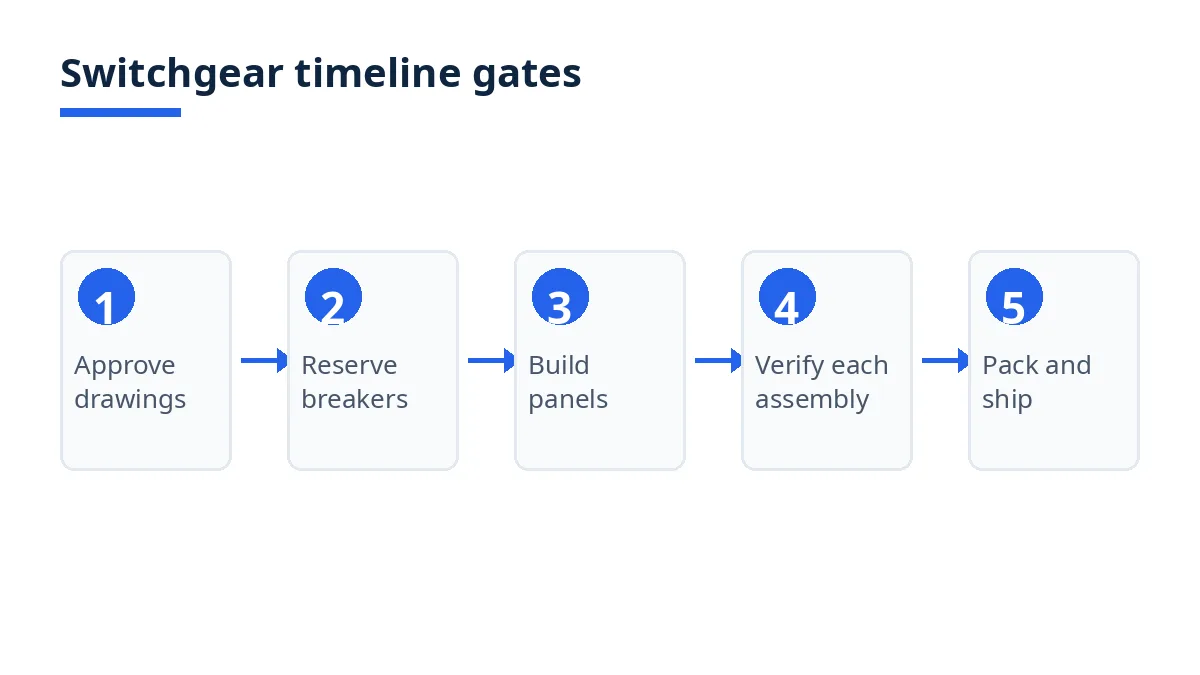
Freeze the single-line diagram and the ratings per panel type. State rated voltage, current, short-circuit rating, frequency, protection degree and assembly standard for each panel type, not for the order as a whole.
Confirm design-verification coverage for the exact configuration. Ask which design-verification evidence covers this rating, this device set and this layout, and whether it covers a different assembly instead. Record the answer in writing; a report for another build is not evidence for yours.
Reserve the switching devices by make, type and rating. Ask which devices are stocked, which are ordered for your panels, and on what date each reservation is confirmed.
Approve the enclosure drawings. Confirm dimensions, cable-entry positions, plinth and lifting arrangements, door and cover fit, and the rating plate data for each panel type. Assembly should not start on a panel type whose drawing is still open.
Build in sequence, with a hold point after wiring. Enclosure fabrication comes first, then busbar cutting and jointing, then device mounting, then internal wiring and labelling. Check wiring against the diagram before covers go on; a wiring fault found after packing costs a reopened panel.
Run routine verification on every completed assembly. Routine verification is the assembly manufacturer's check on each finished assembly, distinct from the design verification of the system.2 Record the result per serial number, and hold any panel that fails until it is reworked and re-verified under the same serial number.
Agree the witness test or factory acceptance test before assembly ends. If you or your inspector will witness tests, book the slot and test list early; a slot requested after packing is a new gate.
Pack, inspect and clear in that order. Pack with bracing, moisture protection and lifting marks, then inspect, then start the export papers.
Costs, timelines and documents
What are the typical costs and timelines?
There are no typical costs or timelines a guide can state as fact for switchgear, because each order prices its own device set, enclosure size, busbar work, test scope and delivery term. Costs move with drivers, not with a standard panel price.
Cost driver | What moves it | State in your enquiry |
|---|---|---|
Switching devices | Breaker make, frame size and trip type per circuit | Make, type and rating per panel type |
Busbar | Material, cross-section and joint count | Busbar material and arrangement as drawn |
Enclosure | Size, protection degree and finish | Dimensions and protection degree per panel type |
Test scope | Design-verification evidence, witness test, inspector attendance | Test list, witness requirement, report per serial |
Packing | Crating, bracing and moisture protection per panel | Packing specification and lifting marks |
Delivery term | Who arranges carriage, insurance and clearance | One Incoterm and named place for every quotation |
For timelines, use planning shapes and replace each one with the supplier's dated gate. The Incoterms 2020 rules set out 11 rules with a clear allocation of cost, risk and obligations, and for containers handed over at a terminal in Bangladesh, FCA, CPT or CIP usually match the handover better than FOB, CFR or CIF.4 Compare quotations only on the same rule and named place.4
Gate | Planning shape, not a quote | Evidence to ask for |
|---|---|---|
Single-line diagram and drawing approval | 1 to 2 weeks | Approved drawings with approval dates |
Device reservation confirmed | At order, in writing | Reservation confirmation per device make and type |
Enclosure and assembly | 3 to 6 weeks | Build schedule per panel type |
Routine verification and witness test | 1 to 2 weeks | Verification file per serial number |
Packing and inspection | 1 week | Packing list with serials and crate marks |
Export clearance and sailing | Per sailing schedule | Approved Bill of Export and vessel booking |
Which documents are needed?
The order documents are the single-line diagram, the bill of materials per panel type, the approved drawings, the itemized quotation and purchase order, the routine verification file per serial number, and the packing list. The export set is separate. For export clearance in Bangladesh, goods may not be loaded unless an export declaration, the Bill of Export or Shipping Bill, is submitted to Customs and approved.5 Enclosed documents include the export contract or purchase order where there is no export letter of credit, the commercial invoice, the packing list, the EXP form certified by an authorized dealer, and a certificate of origin issued by the EPB or a Chamber of Commerce and Industry.5 The declaration names the goods, their value, the exporter, the foreign buyer and the transport operator,5 so keep those names identical across every paper.
Bangladesh-specific rules and tips
Name one assembly standard in the order. For low-voltage panels, name IEC 61439 and the part that applies to your assembly type, and confirm the design-verification evidence covers that standard for your configuration.3 2 A panel built to an unnamed standard cannot be checked against anything at inspection.
Ask which devices are imported for your order. Breakers and relays may be bought in for your specification rather than held in stock, and an imported device can set the earliest assembly date. Record stocked versus ordered-for-you status per device.
Keep one legal name across every paper. The export declaration names the exporter and the foreign buyer,5 so the name on the trade licence, quotation, proforma invoice, verification file and payment account should match. A name mismatch found at clearance is a delay found at the worst moment.
Start the export papers while verification runs. Draft the invoice, packing list, EXP form and certificate of origin from the approved drawings and packing plan, then finalize them against the verified serial numbers.5
Confirm the destination-market file before assembly. Market documents and labels for your destination belong in the order specification, not at packing. A document set agreed after panels are crated means reopening crates or reissuing papers.
Mistakes and red flags
What are the most common mistakes?
Counting the clock from the enquiry or the deposit. Suppliers usually count from drawing approval and device reservation, not from first contact. Agree in writing which event starts the clock, and write it into the purchase order.
Accepting verification wording without checking its coverage. A report for a different rating, device set or layout is not evidence for your panels. Ask whether the design verification covers this exact configuration, and whether routine verification will be recorded per serial number.2
Changing a device after approval without repricing the schedule. A substituted breaker can force a new design verification where the assembly departs from the original manufacturer's instructions.2 Treat every post-approval change as a schedule change until the supplier confirms otherwise in writing.
Comparing quotations on different device makes, test scopes or delivery terms. A lower price on a different breaker make, without a witness test, or on a different Incoterm is a different offer. The Incoterms 2020 rules allocate cost, risk and obligations differently by rule,4 so compare only replies to the same specification on the same rule and named place.
Booking the sailing before verification passes. A vessel slot is not a reason to skip a failed panel. Hold the failed panel, rework it, re-verify it under the same serial number, and rebook if the sailing is missed.
Treating a profile or a badge as verification of the panels. A profile is a starting point for enquiries. A badge records a document and photo check; it is not a guarantee of production capacity, product quality or delivery.6
Skipping the per-serial check to save time. Routine verification is recorded per completed assembly.2 A file that covers the panel type in general, with no result per serial number, does not show that your panels passed.
Checklist
Before you confirm, every line should be answered in writing.
Single-line diagram frozen, with ratings per panel type: voltage, current, short-circuit rating, frequency, protection degree, assembly standard.
Design-verification evidence confirmed for the exact rating, device set and layout.
Devices reserved by make, type and rating, with stocked versus ordered-for-you status per device.
Enclosure drawings approved, with dimensions, cable entry, plinth and lifting arrangements.
Build sequence agreed, with a wiring hold point before covers go on.
Routine verification agreed per serial number, with rework and re-verification rules for failed panels.
Witness test or factory acceptance test booked, with the test list agreed before assembly ends.
Quotations compared on the same specification, device makes, test scope and Incoterm.4
Packing specified per panel: bracing, moisture protection, lifting marks, spares, keys and document packs.
Export set agreed: Bill of Export, commercial invoice, packing list, EXP form, certificate of origin.5
Clock-start event written into the purchase order: drawing approval and device reservation dates.
One legal name used across licence, quotation, invoice, verification file and payment account.5
How Exportain helps
On Exportain, browse suppliers and post a request for quotation (RFQ) on the RFQ board with your diagram summary, ratings per panel type, test scope and delivery term, so suppliers quote against the same specification. When you accept a quotation, Exportain creates one order and issues one proforma invoice from the accepted terms.6
Read the badges for what they record. Exportain Verified means Exportain has checked identity, phone, email and business registration, and Export Verified means it has checked the Export Registration Certificate (ERC).6 Factory Verified means it has reviewed photos of the manufacturer factory, while Trading Company Verified means it has reviewed photos of the trading company office or warehouse.6 Verification is a document review by staff, free, and never granted by membership plans.7 It is not a factory inspection,6 7 so drawing approval, routine verification and inspection stay with you. See the switchgear quality control checklist for panel, busbar and test points.
FAQs
What should I know first about switchgear?
Know the verification split before you ask for a date. Design verification belongs to the original manufacturer's system, and routine verification is carried out on each completed assembly by the assembly manufacturer.2 A change that departs from the original manufacturer's instructions can force a new design verification,2 so freeze the diagram and the device set early.
What are the typical costs and timelines?
There are no typical figures a buyer can rely on, because each order prices its own devices, enclosure, busbar work, test scope and delivery term. Use the planning shapes in the table above, and replace each one with the supplier's dated gates in writing. Compare quotations only on the same specification and the same Incoterm and named place.4
Which documents are needed?
The order documents are the diagram, bill of materials, approved drawings, quotation and purchase order, verification file per serial number, and packing list. The export set is the Bill of Export, commercial invoice, packing list, EXP form certified by an authorized dealer, and certificate of origin.5
What are the most common mistakes?
The most common mistakes are counting the clock from the enquiry instead of drawing approval and device reservation, accepting verification evidence for a different configuration, changing a device after approval without repricing the schedule, comparing quotations on different terms,4 and reading a badge as a guarantee. A badge is not a guarantee of capacity, quality or delivery.6
Next steps on Exportain
Browse suppliers, then post your single-line diagram summary, ratings per panel type, test scope and delivery term on the RFQ board so suppliers state their dated gates. Before you confirm, read the HS code for switchgear guide and the switchgear quality control checklist, and check the Incoterms for shipments from Bangladesh guide for the rule and named place on your quotation.
Sources
- Classification Detail — HS Code 853710. United Nations Statistics Division (accessed )
- What IEC 61439-1 & 2 Mean for Your Low-Voltage Equipment Specifications. Schneider Electric, (accessed )
- IEC 61439-1:2011 Low-voltage switchgear and controlgear assemblies - Part 1: General rules. International Electrotechnical Commission (accessed )
- Incoterms for Shipments From Bangladesh. Exportain (accessed )
- Customs Clearance Procedures for Export. Bangladesh Customs, National Board of Revenue (accessed )
- Trust & Safety Center. Exportain (accessed )
- Supplier verification: Earn trust badges buyers can see. Exportain (accessed )
- quality control
- buyer guide
- customs clearance
- importing from Bangladesh
- Bangladesh sourcing
- Electrical equipment
- Lead time
About the author
Sourcing from Bangladesh?
Post a request for quotation and suppliers on Exportain can send you their quotes directly.
Post an RFQ


