

Top Sweaters Manufacturers in Bangladesh: How to Find and Verify Them
Sweater sourcing in Bangladesh works best as a check, not a ranking: seven routes and checks for finding a factory that can knit your gauge, proving its documents and certificates, and approving a washed sample before you pay.
Short answer
To find sweaters manufacturers in Bangladesh, start from BKMEA member records and the factory clusters around Dhaka, Gazipur, Narayanganj and Chattogram, send one written specification to several factories through an RFQ, and verify each shortlisted factory in the same order: documents, gauge and yarn capability, certificate scope, a washed sample in production yarn, and an agreed AQL inspection before payment. No ranking or badge replaces those checks.
On this page
Key takeaways
Sweaters are knitted garments, so the supplier pool is the knitwear sector: BKMEA represents approximately 2,540 knitwear member factories.
Factory location is a starting filter: close to 98 per cent of operating ready-made garment enterprises are in Dhaka, Gazipur, Chattogram and Narayanganj districts.
Gauge decides what a sweater factory can knit: gauge is needles per inch, lower numbers give coarser stitches and higher numbers give finer stitches.
A certificate is only useful inside its scope: check the holder, site, product scope and expiry date with the issuing body.
Verification is a sequence: member records, one specification, document and certificate checks, a washed sample, and an agreed inspection standard before payment.
Buyers looking for sweaters manufacturers in Bangladesh are not short of factories to contact. They are short of a reliable way to tell which factory can knit the sweater they want, at the gauge and yarn they specified, and prove it before money moves. Knitwear shipments, the segment sweaters sit in, earned US$5,963.76 million in the first quarter of fiscal 2026-27, up 6.88 per cent year on year, per Export Promotion Bureau (EPB) data.1 The Bangladesh Knitwear Manufacturers and Exporters Association (BKMEA) says it represents approximately 2,540 knitwear member factories.2 With a pool that size, a ranked list of names would go out of date fast. This article gives you the method instead: seven sourcing routes and checks, in the order to run them.
The method in brief
Sweaters are knitted garments, so the supplier pool is the knitwear sector: BKMEA represents approximately 2,540 knitwear member factories.
Factory location is a starting filter: close to 98 per cent of operating ready-made garment enterprises are in Dhaka, Gazipur, Chattogram and Narayanganj districts.
Gauge decides what a sweater factory can knit: gauge is needles per inch, lower numbers give coarser stitches and higher numbers give finer stitches.
A certificate is only useful inside its scope: check the holder, site, product scope and expiry date with the issuing body.
Verification is a sequence: member records, one specification, document and certificate checks, a washed sample, and an agreed inspection standard before payment.
The list: seven ways to find and verify sweaters manufacturers in Bangladesh
The seven items below are not a ranking of companies. Each one is a route to a factory or a check on a factory, with what it is, why it matters, and how to run the check. Work through them in order. A supplier that fails the sample or the certificate check does not get the order, however good the first quote looked.
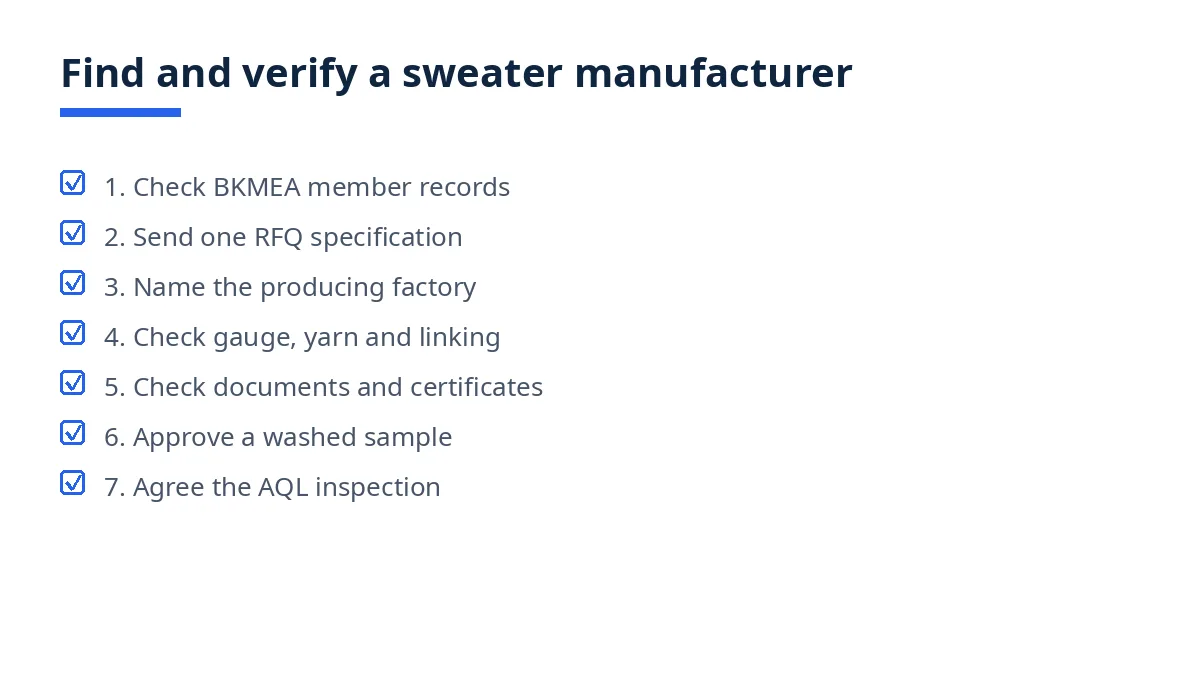
1. Start with BKMEA member records and the factory clusters
What it is. BKMEA is the apex trade body for the knitwear sector in Bangladesh, established in 1996, representing approximately 2,540 knitwear member factories.2 A Centre for Policy Dialogue study that compiled nine datasets identified 3,856 factories in operation, with about 98 per cent in four districts: Dhaka at 38 per cent, Gazipur at 28.9 per cent, Chattogram at 16.1 per cent and Narayanganj at 14.7 per cent.3
Why it matters. Knitting, linking, washing and finishing, and the yarn, dyeing and inspection services around them, sit close together in these clusters.
How to check. Confirm the company name and factory address against the BKMEA record. Treat membership as proof of registration only: it does not prove the factory knits your gauge or holds a current certificate. Record the exact address now, because every later check must match it.
2. Send one written specification to several factories through an RFQ
What it is. A request for quotation (RFQ) is a single written specification sent to several suppliers so each one quotes the same sweater: gauge, yarn, stitch structure, sizes, colors, trims, labels, packing, quantity, destination, Incoterm and deadline. On Exportain, buyers post RFQs that sellers filter by category and answer with a quotation.4
Why it matters. One factory may quote a finer gauge with more yarn, another a coarser gauge with less, under the same style name. A single specification forces the difference into the gauge, yarn and quantity lines.
How to check. Send the identical document to every candidate, and ask each supplier to quote the same Incoterm and packing and to state gauge, yarn, site and lead time. Reject any quotation that answers a different specification, leaves the gauge blank, or omits the producing factory. Keep the exchange in the RFQ thread.
3. Work through a buying house or sourcing agent, and name the producing factory
What it is. Buying houses and sourcing agents in Dhaka and Chattogram sell garments made in partner factories rather than on their own knitting lines. They aggregate capacity, manage sampling and follow-up, and handle export documentation. For mixed or small orders, that route can be practical.
Why it matters. An intermediary helps when it manages follow-up well, and hurts when it hides which factory knits your sweaters.
How to check. Ask which factory will knit each style, and get the name and address before you pay a deposit. Match that factory, not the intermediary, against the member record, certificate and sample. A certificate belonging to a parent, sister company or different factory may be genuine but irrelevant, so confirm it applies to the entity and site involved.5 If the intermediary will not name the factory, move on.
4. Check gauge, yarn and linking capability before you discuss price
What it is. Gauge is the needle density of the knitting machine: the number of knitting needles per inch, with lower numbers producing coarser stitches and higher numbers producing finer stitches.6 As a practical starting point, 3GG to 5GG is commonly used for chunky knitwear, 7GG to 10GG for mid-gauge products, and 12GG to 18GG for finer knitwear, although yarn, stitch structure and finishing still change the final fabric.6 Trade reporting on Bangladesh sweater production has described demand concentrated in heavy gauges of 3 to 7 gauge, with automated flat knitting machines required mainly for finer 12 gauge work.7
Why it matters. Gauge separates factories that can knit your sweater from factories that would have to improvise, and yarn decides weight, warmth, pilling and wash behavior.
How to check. Ask which gauges the factory runs every month, which yarns it buys regularly, and whether knitting, linking, washing and finishing are in-house or subcontracted. Ask for a swatch in your gauge and yarn before a full sample. If you need the classification, read the guide to the HS code for sweaters before you finalize the specification.
5. Run document and certificate checks against the issuing body
What it is. The document set starts with business registration, a trade licence and an Export Registration Certificate (ERC), plus factory or office photos. On Exportain, verification checks cover identity, phone and email, business registration, the ERC and factory or office photos, and the Exportain team reviews every submission.4 Certificates are separate: each one is issued for a named holder, site, scope and period.
Why it matters. Documents prove the company exists and is registered to export. Certificates prove a narrower claim, only for the products and site they cover.
How to check. For each certificate, get the number and issuing body, then check it in the issuer's public registry. For OEKO-TEX, the label check shows the holder, validity dates, product scope and issuing institute, and the scope must cover your products.8 OEKO-TEX STANDARD 100 certificates run for 12 months and must be renewed.8 For GOTS and similar schemes, cross-check the number, confirm the scope covers your products and processes, and require a transaction certificate for each shipment where the scheme requires one.9 Compare the registered name, factory address and contracting entity, and check the expiry date.5
6. Approve a washed sample in production yarn and trims
What it is. A pre-production sample is a finished sweater made from the bulk yarn, trims and labels, in your sizes, before bulk production starts. It must be washed and dried the way the care label says, then measured against your size chart.
Why it matters. Sweater faults show after washing: shrinkage, twisting, pilling, color change and linking failure appear when the garment is washed.
How to check. Approve the sample only in the exact production yarn and trims, wash it, and measure it after washing. Check stitch consistency, linking, ribbing recovery, trim attachment and label accuracy. Keep one sealed, washed sample as the reference, and require a new sample if the factory changes yarn, gauge or washing. The sweaters quality control checklist turns these checks into steps you can hand to an inspector.
7. Agree the inspection standard and the order terms in writing
What it is. A pre-shipment inspection checks a random sample of finished sweaters against the approved sample and the specification, and accepts or rejects the lot against a sampling plan. The acceptance quality limit (AQL) is the quality level that is the worst tolerable process average when a continuing series of lots is submitted for acceptance sampling, under ISO 2859-1.10
Why it matters. Without an agreed standard, inspection becomes an argument about opinion. With a written plan, both sides know the sample size, level, AQL values and accept and reject numbers before production starts. Safety inspection is separate: the Ready-Made-Garment Sustainability Council (RSC) has served since June 2020 as the implementing agent of the International Accord safety programs in Bangladesh, with results reported publicly.11
How to check. Set the inspection level, AQL values, sample size and accept and reject numbers in the order, and name who inspects, when, and what happens on rejection. Put payment terms, shipment conditions and the producing factory in the same written terms, since Exportain is not a party to your goods contract.
Summary table
Route or check | What it proves | Main check before ordering |
|---|---|---|
BKMEA records and clusters | The company is registered in the knitwear trade | Name and factory address match the record |
One RFQ specification | Quotes compare on the same sweater | Gauge, yarn, site and Incoterm stated in each quote |
Buying house or sourcing agent | Capacity is aggregated and managed | Producing factory named in writing |
Gauge, yarn and linking | The factory can knit your sweater | Monthly gauge range and a swatch in production yarn |
Documents and certificates | Registration, export status and certificate scope | Issuer registry, site, scope and expiry date |
Washed sample | Bulk will match the approved sweater | Sample in production yarn, washed and measured |
Inspection and written terms | The lot is accepted or rejected by a rule | AQL plan and rejection terms agreed before production |
What sets the price and MOQ for a sweater order
A sweater quotation is built from parts, so compare quotes part by part instead of by the final number. Yarn is often the main cost: fiber, count and ply decide how much yarn each sweater uses, and a coarser gauge uses more yarn per garment than a fine gauge at the same size. Quantity spreads the fixed costs of pattern work, dye lots and line setup over more pieces, which is why the unit price falls as quantity rises and why each style and color carries its own MOQ. Splitting an order across more colors adds dye lots, and each color needs its own shade approval. Decoration, such as embroidery, intarsia or applique, adds a charge per placement, and retail-ready packing, labeling and testing add further line items.
Example figures, for structure only: one style in one color, yarn and gauge needs one dye lot and one shade approval, while the same style in four colors needs four of each, even at the same total quantity. That structure is why a supplier may accept a smaller quantity in one color and require more when colors multiply. No figure here is a market price or MOQ. Every price and MOQ is set per style by the supplier quoting your specification. Ask each supplier to quote the same specification, Incoterm and packing, then question any line that differs. For how MOQ works, read the guide to MOQ, or minimum order quantity.
How Exportain helps
Exportain is a B2B marketplace for sourcing from Bangladesh. Buyers search published products by keyword and category, and suppliers answer RFQs against the buyer's specification. Sellers complete verification checks covering identity, phone and email, business registration, the ERC and factory or office photos, and the Exportain team reviews every submission.4 Use those badges as a starting filter, not a conclusion. Verification on Exportain is a document and photo review, not a factory inspection, and membership never grants a badge. Run the sequence in this article on your shortlist and keep the exchange in the RFQ thread.
What mistake costs sweater buyers the most?
Choosing by the quoted price before checking gauge and the producing factory. A heavy-gauge factory, a fine-gauge factory and a trading company quoting another factory's capacity are three different offers, and the cheapest quote often describes a different sweater. Compare the same specification from factories that knit the same gauge, name the producing factory, and verify the one you choose before you pay.
How can I avoid ordering from a factory that cannot knit my gauge?
Send the gauge, yarn and stitch structure in the specification, ask for the factory's monthly gauge range, and require a knitted swatch in production yarn before a full sample. If the swatch comes back in a substitute yarn or a different gauge, stop and ask again. A factory that knits your gauge every month answers from current production. A factory that cannot knit it answers from a catalogue.
Who is responsible for checking a sweater certificate, the buyer or the supplier?
Both, at different points. The supplier must hold a current certificate covering the factory, products and processes in your order, and produce the number on request. The buyer must check that number with the issuing body, confirm scope, site and expiry date, and require a transaction certificate where the scheme requires one.
Where can I get help if a sweater supplier stops answering?
Start with the records that exist: BKMEA member listings for registration, the certificate issuer for any audit or fiber claim, and an inspection provider for the pre-shipment check.2 On Exportain, message the supplier through its profile and the RFQ thread so your questions and the answers stay in one thread, and check what each profile badge covers before relying on it.4 If the supplier will not name the producing factory, produce the certificate number or approve a washed sample, move to the next shortlisted factory.
Next steps on Exportain
Browse Bangladeshi suppliers and filter the knitwear listings by badge and capability, then read how supplier verification works on Exportain so you know what each badge covers. When your specification is ready, post it as an RFQ at Exportain RFQs and compare the quotations on gauge, yarn, site and Incoterm before you approve a sample.
Sources
- Bangladesh's merchandise exports grow 6.34pc in Q1. Daily New Nation (accessed )
- BKMEA at a Glance. BKMEA (accessed )
- CPD Working Paper 123: Data Universe of Bangladesh's RMG Enterprises. Centre for Policy Dialogue (CPD) (accessed )
- Sell Bangladeshi Products to Global Buyers | Exportain. Exportain (accessed )
- How to Verify a Supplier Certificate Is Real. Zignify (accessed )
- Sweater Knitting Gauge Guide: 3GG-18GG. KnitSeek (accessed )
- Bangladesh knitting the largest eco-system for sweater manufacturing after China. Apparel Resources (accessed )
- OEKO-TEX Standard 100 Meaning: What It Certifies & Doesn't. Affix Apparel (accessed )
- GOTS vs OEKO-TEX vs GRS: Certifications Compared (2026). One Aim Apparel (accessed )
- ISO 2859-1:2026 - Sampling procedures for inspection by attributes — Part 1: Sampling schemes indexed by acceptance quality limit (AQL) for lot-by-lot inspection. International Organization for Standardization (accessed )
- International Safety Accord / Bangladesh. Worker Rights Consortium (accessed )
About the author
Sourcing from Bangladesh?
Post a request for quotation and suppliers on Exportain can send you their quotes directly.
Post an RFQ


