

Quality Control Checklist for Surgical Gloves From Bangladesh
A numbered QC checklist for surgical gloves from Bangladesh: material and size, dimensions, water-leak testing, tensile evidence, powder and latex labeling, sterile packaging and carton counts, with fixes for pinhole clusters, size drift and labeling mismatches.
Short answer
Use this surgical gloves quality control checklist to check material and size, dimensions, water-leak results, tensile evidence, powder and latex labeling, sterile packaging and carton counts for surgical gloves from Bangladesh before shipment. Agree the governing standard, test methods and acceptance numbers in the purchase order, and record every figure with the standard it came from.

On this page
Key takeaways
Agree the governing standard, test methods and acceptance numbers in the purchase order, and record the standard next to every figure, because figures do not transfer between standards.
Test freedom from holes with the water-leak method named in the specification, and apply that standard's acceptance rule, such as the EN 455-1 surgical AQL of 0.65.
Measure length, width and thickness per size against the retained sample, and check sterile pack seals and unit markings character for character.
Treat pinhole clusters, size drift, unproven powder-free claims and labeling mismatches as stop points, and re-check the whole lot before packing resumes.
If you buy surgical gloves from Bangladesh, this checklist gives you a practical way to check a shipment before it leaves the factory. A surgical glove is judged as a single-use sterile item: one pinhole, one wrong size run, or one broken sterile pack can reject an otherwise sound order. It covers material and size, water-leak testing, tensile evidence, powder and labeling, sterile packaging and carton counts. It is a quality-control and process checklist for buyers, not clinical guidance on glove use. Agree the governing standard, test methods and acceptance numbers in the purchase order first, because destination markets use different standards.
Why this checklist matters
Surgical gloves concentrate risk in a thin, single-use product. A buyer cannot see a pinhole, a thin finger wall or a weak sterile seal on a sealed carton, and a near-correct size only shows when gloves are donned. ASTM D3577 covers certain requirements for packaged sterile rubber surgical gloves of the natural rubber latex type (Type 1) and of the synthetic rubber latex type (Type 2), with tests for sterility, holes, dimensions, tensile strength, elongation, stress, powder residue and amount, and protein content.1 ISO 10282:2023 specifies requirements for packaged sterile rubber gloves intended for use in surgical procedures, applicable to single-use gloves worn once and then discarded, and it does not apply to examination or procedure gloves.2 Check each point against the specification, sample and lot documents, and record the purchase order standard next to every figure.
Before you start
Do not begin until the references are complete: the specification naming the governing standard, a retained sample per material and size, the size chart, the artwork and labeling proofs, the sterilization method and shelf-life claim, and the packing specification. Confirm the destination market first, because United States and European requirements differ in the standard cited, the labeling and the treatment of powdered gloves. The FDA regulates medical gloves as Class I reserved medical devices that require a 510(k) premarket notification, and it reviews criteria such as leak resistance, physical properties and biocompatibility.3 Confirm the sampling plan in advance. ISO 2859-1 specifies an acceptance sampling system for inspection by attributes, indexed in terms of the acceptance quality limit (AQL) for lot-by-lot inspection.4 Draw the sample randomly across sizes, lots and cartons, never from pieces the factory selects, and keep water-leak gloves separate from dimension-check gloves.
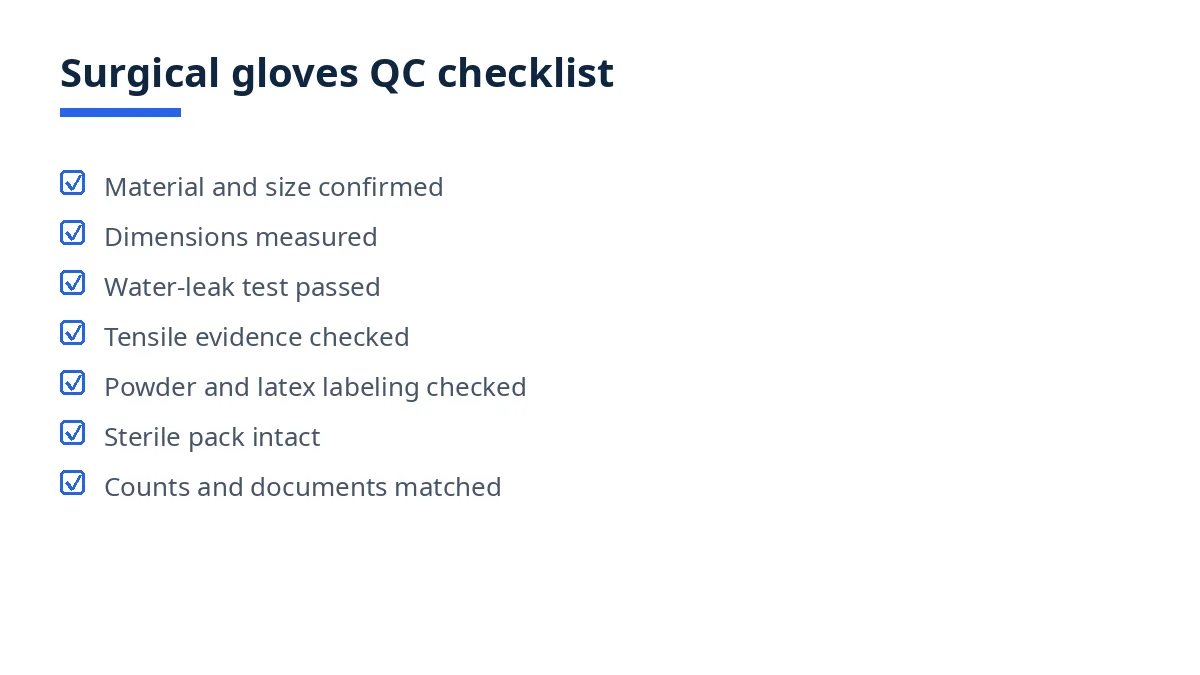
The full checklist (numbered, printable)
Material, type and size confirmation
Confirm the material matches across sample, specification and carton: natural rubber latex or the named synthetic material, such as nitrile, polyisoprene or polychloroprene. Under ASTM D3577, Type 1 is natural rubber latex and Type 2 is synthetic rubber latex.1 ISO 10282:2023 adds isoprene, SBR and thermoplastic elastomer solutions to Type 2.2
Confirm the design: straight or palmar-curved fingers, and a cut or rolled cuff rim, per ISO 10282:2023.2
Confirm the finish: smooth or textured, powdered or powder-free, per ISO 10282:2023.2
Confirm every ordered size is in the sample set, in numeric surgical sizing, with no examination-glove labeling.
Dimensions and fit
Measure length, middle-finger tip to cuff, unstretched, recording actual values per size.
Measure palm width unstretched at the specification point, and compare the median per size with the size chart. ISO 10282:2023 gives size code 7 as 89 mm plus or minus 5 mm wide with a 270 mm minimum length, but the purchase order figure governs.2
Measure single-wall thickness at finger, palm and cuff separately; a thin finger wall is missed if only the palm is measured.
Check finger balance, thumb placement and cuff fit against the sample.2
Freedom from holes and barrier checks
Confirm the water-leak method before testing starts. Under EN 455-1, the glove is secured on a tube, suspended vertically, filled with one liter of water, inspected at once and again after two to three minutes.5
Record numbers tested and leaked, and the location of each leak: finger, palm or cuff.
Apply the purchase order standard's acceptance rule, not a general rule. Under EN 455-1, surgical gloves must achieve an AQL of 0.65 for freedom from holes, equal to at most three failures in 200 gloves tested under its general inspection level 1, code letter L plan.5
Segregate leaking gloves; do not retest them for a pass. If the lot fails its agreed rule, stop and follow the agreed disposition.
Tensile and aging evidence
Review tensile evidence before and after accelerated aging, from the named test method: force at break and elongation at break. Under EN 455-2, the median force at break for surgical gloves is given as 9.0 N, on received gloves and after accelerated aging.5
Where ISO 10282:2023 governs, check its figures instead: minimum elongation before aging of 700 percent (Type 1) and 600 percent (Type 2), and minimum force at break before aging of 12.5 N (Type 1) and 9.0 N (Type 2).2
Confirm tensile reports name the lot, material type, test method and aging stage. A report for another lot counts as missing evidence.
Powder, latex and surface checks
Confirm the powdered or powder-free claim against the governing standard's powder test. Under EN 455-3, gloves with less than 2 mg of powder per glove are classified as powder-free.5
For the United States market, confirm the lot contains no powdered surgical gloves. The FDA final rule of December 19, 2016 banned powdered surgical gloves, powdered patient examination gloves and absorbable powder for lubricating a surgical glove.3
Check sampled gloves for holes, tears, thin spots, particles, discoloration and tackiness, checking textured areas separately.
Check latex labeling on the smallest packaging unit for natural rubber latex gloves. Under EN 455-3, the warning must appear there at a minimum, with the latex symbol and a statement that latex can cause allergic reactions, including an anaphylactic response.5 The FDA requires manufacturers to identify the materials used on the package labeling.3
Sterility, packaging and labeling
Check every unit pack is sealed, undamaged and dry; set aside packs with a torn seal, puncture, crushed corner or water mark.
Confirm sterile-pack integrity evidence for the lot. Under EN 455-4, shelf-life assessment for sterile gloves includes pack integrity testing alongside holes and force at break.5
Check unit package marking character for character. Under ISO 10282:2023, it carries maker, material, finger shape, finish, size, lot, manufacture date, sterile-unless-opened and single-use wording, surgical gloves, expiry date, and a latex warning for Type 1 gloves.2
Check inner, multi-unit and shipper packs for consistent size, material, finish, lot and expiry information, with no mixed lots unless allowed.
Check expiry and manufacture dates against the lot documents, and confirm the shelf-life claim rests on evidence for this lot.
Cartons, counts and documents
Verify the lot certificate names product, material, size range, lot, standard and test methods, with every result within agreed limits.
Check traceability from unit pack through multi-unit pack and shipper carton to the packing list, with no uncovered lot numbers on cartons.
Weigh and measure sample shippers, check markings line by line against the packing list, count pairs, shippers and pallets against the order, and record the final count with inspector name and date.
Common failures and how to fix them
The most frequent failure is a pinhole cluster in one part of the glove, often the fingers or the cuff, which points to one former, one dipping run or one handling step rather than random damage. Stop, record the leak locations across the whole sample, and ask the factory to identify the run behind them before packing resumes. Next is size drift: re-measure a fresh random sample, compare medians per size with the size chart, and do not accept a lot on one size that happens to measure correctly. Powder disputes usually trace to an unclear claim: a lot described as powder-free without a powder test for that lot. Ask for the powder result for the exact lot and the test method used, and treat a claim without a lot result as unproven. Labeling mismatches are stop points: compare all pack levels against the approved artwork and re-check every carton in the lot before packing resumes. Above the agreed acceptance level, options are re-inspection after sorting or rework, documented partial acceptance, or rejection of the lot.
Downloadable template / summary table
Copy the checklist into your inspection sheet, add the standard, test methods and acceptance numbers, and record a result per size and lot.
Section | Checks | Evidence |
|---|---|---|
Material and size | Material, design, finish, sizes | Specification, sample |
Dimensions | Length, width, thickness, fit | Measurements |
Freedom from holes | Water-leak test, acceptance rule | Leak count, locations |
Tensile and aging | Force, elongation, aging | Test reports |
Powder and latex | Powder claim, latex warning | Powder result, pack check |
Sterility and labeling | Seals, markings, dates | Pack check, artwork |
Cartons and documents | Counts, traceability, certificates | Packing list, lot records |
How Exportain helps
Exportain is a B2B marketplace connecting buyers with Bangladeshi suppliers, so the governing standard, size chart, test methods and acceptance numbers behind this checklist can be agreed at the enquiry stage. Use inspection services when you plan the check, and share the specification, sample details and labeling rules with the supplier before production starts. Supplier profiles show recorded document and photo checks, not factory inspections. Exportain is not a party to the goods contract and does not inspect goods.
FAQs
When should this checklist be used?
Use it at final inspection, when goods are finished, packed and ready for shipment. For larger and first orders, also use it during production, while errors can still be corrected.
Who should complete it?
The buyer, a local agent or an independent inspector can complete it, using the specification, retained sample, lot documents and a randomly drawn sample.
What are the most common failures?
Pinholes clustered in the fingers or cuff, size drift, unproven powder-free claims, damaged sterile packs and labeling mismatches are the failures buyers find most often.
Can a third party do it?
Yes, if you share the governing standard, size chart, test methods, acceptance numbers and approved artwork first, and if the inspector can access the lot documents and sample.
Next steps on Exportain
Before production starts, agree your governing standard, size chart, test methods and acceptance numbers, then read the AQL acceptance quality limit explainer and the pre-shipment inspection guide, and plan the check with inspection services.
Sources
- D3577 Standard Specification for Rubber Surgical Gloves. ASTM International (accessed )
- ISO 10282:2023 - Single-use sterile rubber surgical gloves — Specification. International Organization for Standardization (accessed )
- Medical Gloves. U.S. Food and Drug Administration (accessed )
- ISO 2859-1:1999 - Sampling procedures for inspection by attributes — Part 1: Sampling schemes indexed by acceptance quality limit (AQL) for lot-by-lot inspection. International Organization for Standardization (accessed )
- Assessing single-use medical gloves to EN 455. SATRA (accessed )
About the author
Sourcing from Bangladesh?
Post a request for quotation and suppliers on Exportain can send you their quotes directly.
Post an RFQ


