

Quality Control Checklist for Snack Foods From Bangladesh
A numbered QC checklist for snack foods from Bangladesh: snack type and appearance, crispness, frying-oil quality and rancidity evidence, seasoning coverage, weight, hygiene, shelf life, destination labels, and packing, with fixes for common failures.
Short answer
Use this snack foods quality control checklist to check snack type and appearance, crispness and moisture, frying-oil quality and rancidity evidence, seasoning coverage, weight and fill, hygiene, shelf life, destination labels, and packing on snack foods from Bangladesh before shipment, with acceptance numbers agreed in the purchase order.
On this page
Key takeaways
Sort snacks by type first: fried, baked, extruded, and coated snacks need different checks, and a test that fits a potato crisp does not fit a coated peanut.
Judge frying oil on its own record and lab evidence for this lot: odour, oil-change history, and the agreed total-polar-compounds, acid-value, and peroxide-value limits.
Check seasoning across the whole bag and crispness against the approved sample, because uneven coverage and moisture damage show only in opened packs.
Agree sampling, tolerances, and acceptance numbers per defect class in the purchase order before inspection, and draw the sample at random across flavours, pack sizes, and cartons.
If you buy snack foods from Bangladesh, judge the shipment by how it will eat after transit, not only by how it looks on packing day. A crisp that goes soft, a seasoning that rubs off in the bag, or frying oil that has turned rancid will not show in a sealed carton. Use this checklist at final inspection, with the approved sample beside you, recording each point as pass, fail, or not applicable.
Snack foods cover fried crisps, baked crackers, extruded puffs, coated nuts, and mixed snacks. This checklist follows the eating result: type and appearance, crispness and oil, seasoning, weight, hygiene, shelf life, labels, and packing. Agree the sampling plan in advance, and draw the sample at random across flavours, pack sizes, and cartons. ISO 2859-1 specifies an acceptance sampling system for inspection by attributes, indexed in terms of the acceptance quality limit (AQL), for lot-by-lot inspection.1 Set acceptance numbers per defect class in the purchase order, because this article sets no universal acceptance figure.1
Why this checklist matters
A snack is judged in one bite after shipping and storage. Moisture is the main enemy of crispness: a fried crisp turns leathery, a baked cracker turns hard, and a coated nut loses its coating in handling. Frying oil is the second risk: oil heated too long or stored badly carries rancid odour and flavour into the snack. Seasoning is the third: uneven coverage means one bag tastes bland and the next over-salted.
A written checklist removes interpretation: each point is checked against the approved sample, specification, and destination artwork.
Before you start
Do not begin until the references are complete: an approved sample per snack type, flavour, and pack size; the purchase order and specification; seasoning, coating, and oil specifications with agreed lab evidence; label artwork per destination; and the packing specification. Confirm the snack type for each line: fried, baked, extruded, and coated snacks are checked differently.
Check the label plan before bulk labels are printed, because a label error at final inspection means rework of finished packs. Under the Codex General Standard for the Labelling of Prepackaged Foods, mandatory labelling includes the name of the food, ingredients, net contents, name and address, origin, lot identification, date marking, storage instructions, and instructions for use.2 The Codex General Principles of Food Hygiene set out good hygiene practices as the foundation of hazard control, with HACCP added where they alone are not enough.3 Ask for records covering this lot, not an earlier lot.
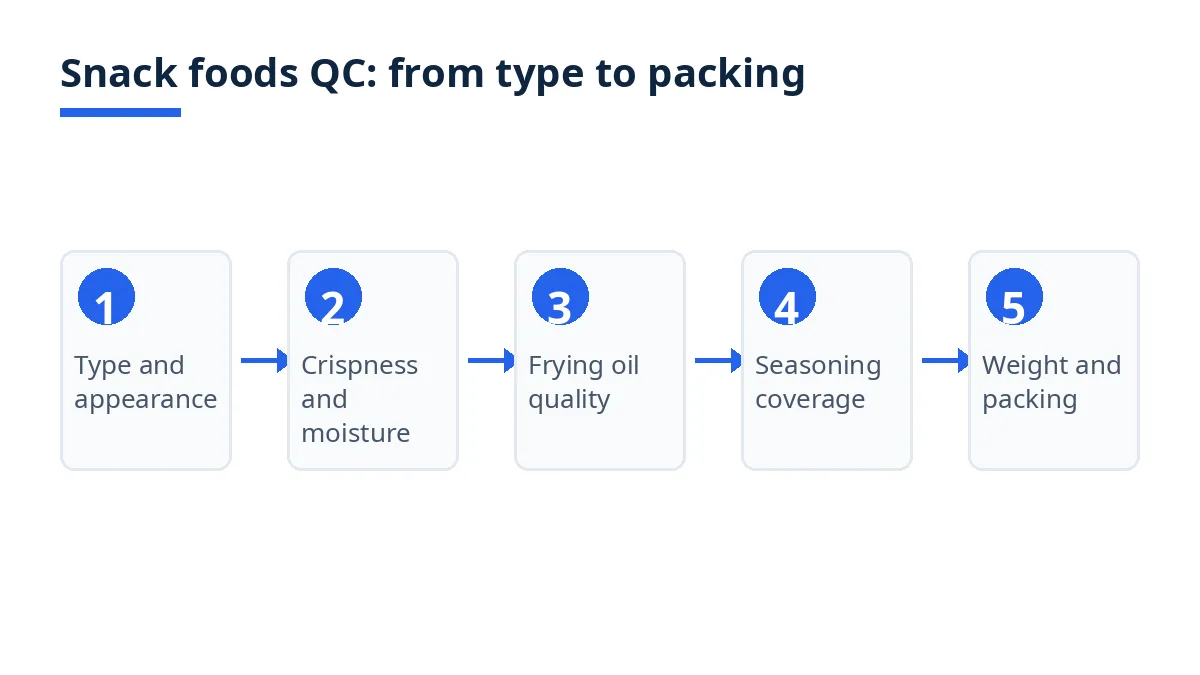
The full checklist (numbered, printable)
Snack type, appearance, and colour
Confirm each sampled snack matches the approved sample for type and shape, with no cheaper base substituted.
Check size and thickness against the specification, recording actual values.
Check colour against the approved sample under the same light, recording pale or over-browned pieces.
Check the surface for blistering, bubbling, cracking, or broken edges, counting broken pieces against the agreed defect class.
Check coatings for even coverage and adhesion, with no bare patches or flaking, and mixed snacks for the agreed component ratio.
Crispness, moisture, and texture
Break a sampled piece and check crispness against the approved sample: a bending crisp, a soggy cracker, or a collapsing puff fails.
Taste sampled pieces against the approved sample for flavour, salt, sweetness, and any stale or off note, recording date and lot.
Check for moisture damage: soft packs, damp cartons, or lost crispness point to a seal or storage problem, so segregate affected cartons.
Where a moisture or water-activity limit is set, confirm the agreed test method and limit, and check reports name product, flavour, and lot.
Frying oil: the snack-specific core
For fried snacks, smell the opened pack and snack for rancid, stale, burnt, or paint-like odour, and taste for rancid flavour.
Check that the oil in the snack is free from foreign and rancid odour and taste, as the Codex standard for edible fats and oils requires.4
Review the frying-oil record: oil type, change frequency, and topping-up practice, and confirm it covers this production run.
Where total polar compounds are measured, confirm the agreed method and limit. Many national rules use 25% as the discard point for used frying oil, but your written limit applies.5
Review acid value and peroxide value evidence where required. For fresh oils, the Codex maximum acid value is 0.6 mg KOH/g for refined fats and oils and 4.0 mg KOH/g for virgin and cold-pressed fats and oils.4 Confirm reports name oil, lot, and test method, and never apply a fresh-oil figure to used frying oil.
Seasoning, coating, and flavour
Check seasoning coverage across the bag: top, middle, and bottom pieces should all carry seasoning, with no bare pieces, clumps, or sweet coating sticking pieces together.
Check seasoning flavour matches the flavour named on the pack, opening at least one pack per flavour to confirm no seasoning is swapped.
Record any flavour, spice, or colour claim on the pack without agreed evidence as a failure.
Weight, count, and fill
Weigh whole packs against declared net weight, and sampled pieces where a piece weight is set, recording actual values.
Check pack counts where promised, and mixed-pack assortments against the purchase-order ratio.
Check fill level and headspace where set, and multi-packs contain the flavours and pack sizes named on the outer pack.
Foreign matter and hygiene
Check sampled packs and open pieces for foreign matter, including metal, plastic, hair, and insect fragments, and segregate the lot on any contamination.
Check the packing area observed is clean, staff follow the hygiene rules in place, and metal-detection records cover this lot.
Shelf life and rancidity evidence
Check best-before or expiry dates against production dates and agreed shelf life, and confirm remaining shelf life on arrival meets the contract.
Check storage instructions against the product type: fried snacks need protection from heat, light, and air, which speed oil rancidity.
For potato crisps sold into the EU, ask for the acrylamide position: Commission Regulation (EU) 2017/2158 sets a benchmark level of 750 micrograms per kilogram for potato crisps from fresh potatoes and from potato dough.6 Benchmark levels are performance indicators, not maximum limits.
Labels and destination rules
Check product name, flavour name, net quantity, and pack count against the purchase order, and spelling in every language on the pack.
Check the ingredient list against approved artwork, including every seasoning, coating, and oil ingredient, in descending order.
For the USA, declare the nine major food allergens, sesame added as the ninth effective 1 January 2023:7 milk, eggs, fish, Crustacean shellfish, tree nuts, peanuts, wheat, soybeans, and sesame. Give the allergen source name in parentheses after the ingredient or in a Contains statement.7
For the EU and the UK, emphasise each Annex II allergen name so it stands out, for example by font, style, or background colour, as Regulation (EU) No 1169/2011 requires.8 The 14 Annex II allergens include gluten cereals, crustaceans, eggs, fish, peanuts, soybeans, milk, nuts, celery, mustard, sesame, sulphites, lupin, and molluscs.
Check nutrition, date marking, lot code, and storage instructions on each destination version, with no artwork used for the wrong market, and confirm UAE Arabic wording, date format, and importer details with your UAE importer before printing.
Packs, cartons, and storage
Check pack seals for full closure, with no gaps, channel leaks, or air leakage, and that seals survive a gentle squeeze without bursting.
Check pack material protects crispness: no pinholes, weak seals, or carton-pressure damage, and no packs crushed by overfilling.
Check outer cartons for crushing, water damage, and pressure marks, and carton counts, flavour mix, and pack sizes against the packing list, with markings and barcodes matching the packs inside.
Common failures and how to fix them
A snack gone soft usually traces to a seal, a pack material change, or damp storage: check seals and storage first. Rancid odour points to oil quality or storage: check the frying-oil record and lab evidence for that lot.
Uneven seasoning usually traces to drum or spray settings: run a test batch and compare top, middle, and bottom pieces first. Broken pieces and dust point to handling or carton pressure: re-check filling and stacking. A wrong allergen line is a label fault: stop printing, correct the artwork, and re-check every version.
Above the agreed acceptance level, the options are re-inspection after sorting or rework, documented partial acceptance, or rejection.
Downloadable template / summary table
Copy the checklist into your inspection sheet, add tolerances and acceptance numbers, and record a result per pack.
Section | Checks | Evidence |
|---|---|---|
Type and appearance | Shape, size, colour, coating | Sample comparison |
Crispness and texture | Snap, taste, moisture damage | Opened pieces |
Frying oil | Odour, oil record, polar compounds, acid and peroxide | Reports per lot |
Seasoning | Coverage, flavour match, clumping | Opened packs |
Weight and fill | Net weight, count, assortment | Weighed packs |
Hygiene | Foreign matter, records | Area check, reports |
Shelf life | Dates, storage, acrylamide position | Date check, reports |
Labels | Allergens, nutrition, dates, claims | Destination artwork |
Packs and cartons | Seals, counts, marks, storage | Packing list |
How Exportain helps
Exportain is a B2B marketplace connecting buyers with Bangladeshi suppliers of processed food, so snack types, oil specifications, and label versions can be agreed at the enquiry stage. Use inspection services when you plan the check, and read the pre-shipment inspection guide first. Supplier profiles show document and photo checks recorded, not factory inspections. Exportain is not a party to the goods contract and does not inspect goods.
FAQs
When should this checklist be used?
Use it at final inspection, when goods are finished and sealed. For first orders, also use it during production.
Who should complete it?
The buyer, a local agent, or an independent inspector can complete it, using the approved sample and a random sample.
What are the most common failures?
Loss of crispness, rancid frying oil, uneven seasoning, broken pieces, and wrong allergen lines are the failures buyers find most often.
Can a third party do it?
Yes, if you share approved references, tolerances, and acceptance levels first, including the oil specification and label artwork.
Next steps on Exportain
Before production starts, agree snack types, oil specification, seasoning coverage, test methods, and label wording, then read the AQL acceptance quality limit explainer and the pre-shipment inspection guide, and plan the check with inspection services.
Sources
- ISO 2859-1:1999 - Sampling procedures for inspection by attributes — Part 1: Sampling schemes indexed by acceptance quality limit (AQL) for lot-by-lot inspection. International Organization for Standardization (accessed )
- General Standard for the Labelling of Prepackaged Foods CXS 1-1985. Codex Alimentarius Commission (accessed )
- General Principles of Food Hygiene CXC 1-1969. Codex Alimentarius Commission (accessed )
- Standard for Edible Fats and Oils Not Covered by Individual Standards CXS 19-1981. Codex Alimentarius Commission (accessed )
- Modified Test Kit for Detecting Polar Compounds and Evaluating Their Distribution in Reused Frying Oil. National Library of Medicine (PubMed Central) (accessed )
- Commission Regulation (EU) 2017/2158 establishing mitigation measures and benchmark levels for the reduction of the presence of acrylamide in food. European Commission (accessed )
- Sesame = 9th major food allergen (FDA message on the FASTER Act). Naugatuck Valley Health District (accessed )
- Regulation (EU) No 1169/2011 on the provision of food information to consumers, Article 21 - Labelling of certain substances or products causing allergies or intolerances. European Union (accessed )
About the author
Sourcing from Bangladesh?
Post a request for quotation and suppliers on Exportain can send you their quotes directly.
Post an RFQ


