

Private Label Sweaters Manufacturing in Bangladesh: A Brand Owner's Guide
Private label sweaters in Bangladesh from the brand-owner side: gauge, yarn and shade locks, label and trademark control, and the approval sequence that keeps a repeat order matching the first.
Short answer
Private label sweaters in Bangladesh mean a factory knits to your tech pack and applies your labels, tags and packing. You own the specification, artwork and label content, so lock the gauge, yarn, shade and label approvals in writing before bulk production, and file the approved sample for the repeat order.
On this page
Key takeaways
Private label control is decided before knitting: the tech pack, the gauge and yarn lock, the label set, and written approvals decide whether a repeat order matches the first.
Gauge is the number of knitting needles per inch, so lock it together with yarn, stitch structure, dye route, and finishing, and approve a washed swatch in the production yarn and colorway.
Label law and certification claims stay with the brand owner: check fiber wording per market, and use a logo only with a scope certificate covering the product, process, and site.
Trademark rights are territorial and exclusivity must be written down, and Exportain verification is a document and photo review, not a factory inspection or a guarantee.
A private label sweater order is decided before the first panel is knitted: the brand pack, the gauge and yarn lock, the label set, and the written approval that ties a repeat order to the first one. Get them wrong and the second shipment can differ in shade, size, or label wording while every document still looks complete.
The supply base sits in the knitwear sector. The Bangladesh Knitwear Manufacturers and Exporters Association (BKMEA), established in 1996, represents approximately 2,540 knitwear member factories.1 A factory that knits well for one buyer can still miss another buyer's label, shade, or measurement standard if those standards were never written down.
Gauge is a machine decision, not a quality grade. Machine gauge is the number of knitting needles per inch, with lower numbers producing coarser stitches and higher numbers producing finer stitches.2 State the gauge together with the yarn and stitch structure, and approve a physical swatch before you approve a price. Heading 6110 covers jerseys, pullovers, cardigans, waistcoats and similar articles, knitted or crocheted.3 See the HS code for sweaters guide for the breakdown under heading 6110.
The brand-control decisions you make before you ask for a price
Private label work reverses the usual buying order. In a wholesale order, you choose from what exists. In a private label order, you define what will exist. Make these decisions before you send a request for quotation, and send the same decisions to every factory.
Own the tech pack, and keep the master copy. The tech pack is the specification: silhouette, measurements, gauge, yarn, stitch structure, colorways, trims, artwork, labels, and packing. Write it, version it, and date it. State in the order that the approved version governs, and that no substitution happens without your written approval.
Lock gauge, yarn, and shade together. A gauge number alone does not fix the fabric. Ask the factory to confirm the gauge, yarn, dye route, and finishing in one reply, then knit and wash a swatch in the production yarn and colorway. Approve the swatch against a shade standard you both hold, not against a screen image.
Control the label set as a separate product. A sweater carries the brand label, size label, fiber content label, care label, and hang tag. Approve each element as artwork, with size, position, attachment, and wording, and check fiber content against the finished garment. For the European Union, Regulation (EU) No 1007/2011 requires that a textile product be labelled or marked with the name and percentage by weight of all constituent fibers in descending order.4 A trade name does not replace the required generic fiber name.
For the United States, the Federal Trade Commission requires most textile and wool products to carry a label listing fiber content, country of origin, and the identity of the manufacturer or another business responsible for the item, with care labels required under a separate rule.5 The label duty stays with the brand owner even though the factory sews the label in. Confirm the country of origin wording against where the product was processed or manufactured, as determined under customs rules.5
Treat every claim as a document, not a slogan. A claim needs a certificate covering the product, the process, and the site. For GOTS labelling, only products processed in certified facilities and compliant with all applicable GOTS requirements may carry the GOTS label, and every label must include the GOTS logo, the label grade, a reference to the Certification Body, and the certification number of the Certified Entity, approved by the Certification Body before use.6 The "Organic" grade requires at least 95 percent certified organic fibers, and "Made with Organic" covers 70 percent to below 95 percent.6 Do not approve a claim until you have seen the scope certificate.
Settle trademark and exclusivity in writing, before sampling. Trademark rights are territorial: they are only protected in the countries or regions where they are registered.7 The Madrid System allows a single international application, with one set of fees, to seek protection in up to 130 countries.7 In Bangladesh, registration sits with the Department of Patents, Designs and Trademarks (DPDT) under the Trademarks Act 2009, and an application may be made by a person claiming to be the proprietor of a trademark already in use or proposed to be used in Bangladesh.8 Registration is valid for seven years, with later renewals running for ten years each.8 Ask your adviser whether your mark is filed in the markets where the sweaters will sell, and whether the factory agreement should bar use of your mark, artwork, or tech pack for any other buyer.
Decide who owns the tools and the artwork. State who paid for each knitting program, pattern, label plate, and artwork file, who holds the files, and whether the factory may reuse them.
Why this matters for buyers and sellers
For the buyer, private label control turns a one-off shipment into a brand line: the same label, shade, and measurements, reordered and sold across seasons. Without it, each shipment needs new photography and size advice.
For the seller, a clear brand pack is protection too: a factory knitting to a written specification can plan its run and refuse a late change without argument.
Step-by-step: how it works
Work in this order, and do not skip a written approval to save a week.
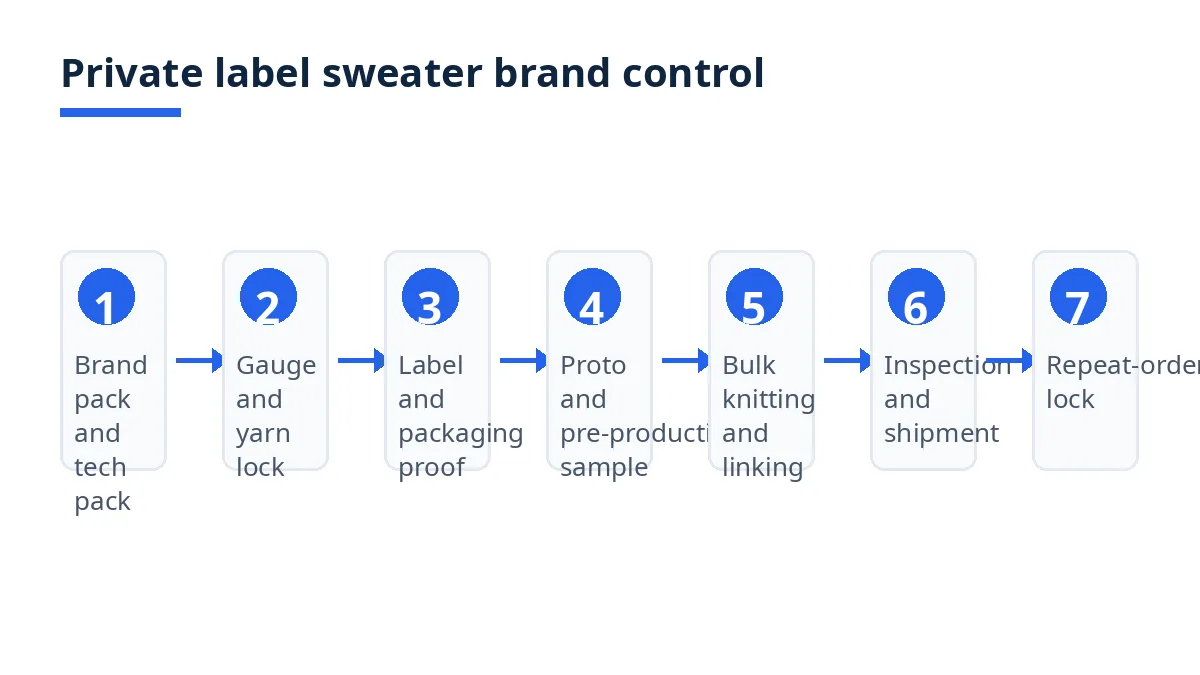
Send the brand pack to every candidate. Include the tech pack, label artwork set, packaging specification, size range and ratio, colorways, and target delivery date, so quotations can be compared on the same specification.
Ask for a gauge and yarn answer, not only a price. Require the factory to state the gauge, yarn composition and count, dye route, and finishing route, and whether each yarn and trim is stocked or made to order.
Approve the label and packaging proof. Check the brand label, size label, fiber content, care wording, hang tag, and carton marking as printed proofs, and confirm any certification logo matches a certificate you have seen.
Approve a proto sample, then a pre-production sample. The pre-production sample must use the production yarn, gauge, colorway, trims, and labels, and go through the intended washing and finishing. Measure it, wash it, and record corrections in writing.
Confirm the order in writing. State the approved tech pack version, quantities per style, color, and size, the label and packaging specification, the inspection standard, the delivery term and named place, and payment terms.
Inspect during production and before shipment. ISO 2859-1:2026 defines acceptance sampling plans indexed by acceptance quality limit (AQL), the maximum average percentage of defective items considered acceptable during random sampling.9 Write the inspection level, AQL values, and accept and reject numbers into the order, and inspect labels, shade, measurements, and packing in the same inspection.
Lock the repeat. File the approved sample, tech pack version, label proofs, shade standard, and inspection report together, so the repeat order starts from that file.
Costs, timelines and documents
There is no single private label sweater price, and this guide states none. The cost is the sum of lines that change with your specification: yarn, knitting and linking, dyeing and finishing, trims and labels, testing and inspection, packing, and freight to the named place. A woven label, a hang tag, and a printed carton each carry a print run of their own, so a small garment order can still carry a full label run. Ask for label, tag, and carton costs as separate lines.
Sampling time depends on yarn availability and correction rounds. Bulk time depends on dyeing, finishing, trim delivery, and line capacity. Label lead time is often the quiet constraint, because a label plate or printed carton cannot be rushed after the garments are knitted. Ask for separate dates for label approval, sample approval, yarn ready, production, inspection, and shipment.
Example figures: a brand owner orders 1,200 sweaters in two colorways. The garment quantity clears the factory minimum, but the woven label run is set for the full 1,200 pieces, so a late label change would waste the label run before the garments are knitted. The example shows structure only, not a typical price, minimum, or lead time.
Cost or time line | What to ask for in writing | Why it matters for a brand owner |
|---|---|---|
Yarn and dye lot | Composition, count, dye route, quantity per color | Shade must repeat |
Knitting and linking | Gauge, stitch structure, finishing route | The surface customers feel |
Labels, tags, cartons | Artwork approval, print run, cost per line | A label run can exceed the garment run |
Testing and inspection | Test list, inspection level, AQL values | The repeat-order standard |
Packing | Fold, polybag, carton marking, assortment | The first thing the retailer sees |
Delivery term | Incoterms rule and named place | Who pays and who carries risk |
The Incoterms 2020 rules give 11 rules with a clear allocation of cost, risk, and obligations.10 State one rule and one named place on every quotation. See the sweaters price guide and the MOQ, or minimum order quantity guide.
Documents fall into three groups: the brand group, the order group, and the shipment group. Keep all three in one order file. The brand group holds the tech pack, label approvals, trademark and certification records, and the sample record.
Bangladesh-specific rules and tips
Start from member records, then test capability. BKMEA member records give a first filter, but membership alone does not prove that a factory can knit your gauge, hold your shade, or run your label set. Ask for the gauge range, the yarn stocked, and a recent sample in a gauge close to yours. See the sweaters manufacturers guide and the sweaters MOQ guide.
For export clearance, Bangladesh Customs requires an export declaration, known as a Bill of Export or Shipping Bill, approved before goods are loaded, with the export letter of credit or contract, commercial invoice, packing list, EXP form certified by an authorized dealer, certificate of origin, VAT registration certificate, and taxpayer identification number enclosed.11 The invoice must carry a detailed description of the goods and be signed by the exporter.11 Check that the invoice, purchase order, packing list, and carton markings match.
Confirm the producing factory by name and record any subcontracted step. Confirm the label and carton supplier and lead time with the garment lead time. Keep a retained sample in Bangladesh as well as at your office.
Mistakes and red flags
Approving a sample in the wrong yarn or colorway. A sample in stock yarn and a near color proves the silhouette only. Approve the pre-production sample in the production yarn, gauge, colorway, trims, and labels, after washing and finishing.
Approving label artwork on screen only. Screen, print, and woven label colors differ. Ask for a printed or woven proof of each label element and check spelling, fiber content, size, and care wording on the proof.
Letting the factory choose the fiber wording. Fiber names and percentages follow the market rules, not the yarn supplier's description. Check the wording for the EU and the United States separately.
Using a certification logo without the certificate. If the certificate does not cover the product, the process, and the site, remove the logo before the order ships.
Leaving exclusivity and file ownership unwritten. Write the bar on reuse, the file ownership, and the return of artwork and programs into the order or supply agreement.
Red flags include a factory that will not name the producing site, a quotation with no gauge or yarn answer, a label proof without a certificate for a claimed logo, and a request to approve an unwashed sample. Pause and ask for the missing document.
Checklist
Every item should have a document or a written approval behind it.
Tech pack version, dated and approved, held by both sides
Gauge, yarn, stitch structure, and finishing route confirmed in writing
Shade standard agreed, with a washed swatch in production yarn and colorway
Label set approved as proofs, with fiber and care wording checked per market
Trademark filings checked, and exclusivity and file ownership in the agreement
Certification claims checked against a scope certificate
Quantities per style, color, and size, with label, tag, and carton runs priced separately
Inspection standard, AQL values, and accept and reject numbers in the order
Delivery term, named place, and shipment documents agreed
Approved sample, label proofs, shade standard, and inspection report filed for the repeat order
How Exportain helps
Browse suppliers for sweater factories, and read how supplier verification works on Exportain to see what a verification check covers and what it does not cover. A verification result is a document and photo review, not a factory inspection, and it does not guarantee that a factory can knit your gauge or hold your shade.
Post the brand pack as an RFQ through the RFQ board, with the tech pack, label set, quantities per color and size, and inspection standard attached. Compare replies on the same specification and delivery term.
FAQs
What should I know first about private label?
Know that you own the brand decisions, and the factory owns the production run. Before you ask for a price, settle the tech pack, the gauge and yarn lock, the label set, the trademark position, and the written approval sequence. The quality of that specification decides the quality of the repeat order.
What are the typical costs and timelines?
There are no typical costs or timelines a guide can state as fact, because each order prices a different gauge, yarn, color count, label set, and delivery term. Label, tag, and carton lines are priced and run separately, and label lead time can constrain the order. Ask for each cost and date as a separate written line, and compare quotations only on the same specification, delivery term, and named place.
Which documents are needed?
You need three groups: brand, order, and shipment documents. For export from Bangladesh, the Bill of Export must be approved by Customs with the invoice, packing list, EXP form, certificate of origin, VAT registration, and taxpayer identification number enclosed.11
What are the most common mistakes?
The most common mistakes are approving a sample in the wrong yarn or colorway, approving label artwork on screen only, letting the factory choose the fiber wording, using a certification logo without a covering certificate, and leaving exclusivity and file ownership unwritten. Each is preventable with a written approval: a washed sample, a printed label proof, a market-by-market label check, a scope certificate, and a written agreement on reuse and files.
Next steps on Exportain
Start with the brand pack, not the price. Browse suppliers, read how supplier verification works on Exportain, and post the brand pack on the RFQ board with the tech pack, label set, and inspection standard attached.
Sources
- BKMEA at a Glance. BKMEA (accessed )
- Sweater Knitting Gauge Guide: 3GG-18GG. KnitSeek (accessed )
- Classification Detail — HS Code 6110. United Nations Statistics Division (accessed )
- Regulation (EU) No 1007/2011 on textile fibre names and related labelling and marking of the fibre composition of textile products. European Union, (accessed )
- Threading Your Way Through the Labeling Requirements Under the Textile and Wool Acts. Federal Trade Commission (accessed )
- GOTS labelling. Global Standards, (accessed )
- How to Protect a Trademark?. World Intellectual Property Organization (accessed )
- Trademark registration — an overview. The Financial Express (accessed )
- ISO 2859-1:2026 - Sampling procedures for inspection by attributes — Part 1: Sampling schemes indexed by acceptance quality limit (AQL) for lot-by-lot inspection. ISO (accessed )
- Incoterms® 2020. International Chamber of Commerce (ICC) (accessed )
- Customs Clearance Procedures for Export. Bangladesh Customs, National Board of Revenue (accessed )
About the author
Sourcing from Bangladesh?
Post a request for quotation and suppliers on Exportain can send you their quotes directly.
Post an RFQ


