Typical MOQ for Sweaters in Bangladesh (and How to Negotiate It Down)
No single sweaters MOQ in Bangladesh: what sets the minimum per style and colour, gauge, yarn dye lots, linking and finishing, how it is quoted, and how to negotiate a smaller order without cutting sample or inspection.
Short answer
There is no single typical MOQ for sweaters in Bangladesh. Each factory sets its minimum per style and per colour for your specification, driven by gauge, yarn dye lots, linking, washing and finishing, and trim and label runs. Ask for the minimum per style and per colour in writing, then negotiate the structure: fewer colours, stocked yarn, yarn shared across styles, split shipments, and set-up paid separately.
On this page
Key takeaways
There is no single typical MOQ for sweaters in Bangladesh, because each factory sets its minimum per style and per colour for your specification.
Gauge, yarn and dye lots, linking, washing and finishing, and trim, label and carton runs are the drivers that set the floor.
Ask for the MOQ per style and per colour in writing, with set-up costs itemised apart from the unit price.
Negotiate the structure first: fewer colours, stocked yarn, one yarn shared across styles, split shipments, and set-up paid as a separate line.
Exportain verification is a document and photo review, not a factory inspection, and a badge is not a guarantee.
Ask three factories for the sweaters MOQ in Bangladesh for the same crew-neck sweater and you will receive three different answers. There is no single typical figure to look up, because each factory sets its minimum for your specification, per style and per colour, and the binding line is often a yarn dye lot or a linking run rather than the total order size. This guide stays on that negotiation: what sets the minimum, how it is quoted, and which changes to the order can bring it down without weakening the sample or the inspection.
The Bangladesh Knitwear Manufacturers and Exporters Association (BKMEA), established in 1996, represents approximately 2,540 knitwear member factories.1 Knitwear exports reached $5.963 billion in the July to September 2026 quarter, up 6.88 percent year on year, within ready-made garment exports of $10.578 billion, according to data released by the Export Promotion Bureau (EPB).2
The MOQ negotiation in brief
There is no single typical sweaters MOQ in Bangladesh. Each factory sets its minimum per style and per colour for the specification you send.
Gauge, yarn and dye lots, linking, washing and finishing, and trim, label and carton runs set the floor.
Ask for every minimum line by line, in writing, before you discuss price. A total without a split per style, colour and size cannot be answered with a usable minimum.
The strongest levers change the structure: fewer colours, yarn shared across styles, stocked yarn and trims, and set-up costs priced apart from the unit price.
A lower minimum agreed verbally is not an agreement. Record the split, the yarn lot, the set-up lines and the delivery term on the quotation and the purchase order.
Why this matters for buyers and sellers
For a buyer, the minimum decides how much cash is tied up in stock before the sweater has proved itself. A first order too large for one colour locks money into the slowest colour, while one too small for the dye lot may be refused or surcharged. A buyer testing a 12-gauge crew neck and a 5-gauge cable cardigan needs a minimum that works for each style separately.
For a seller, the minimum protects work that cannot be reused. Yarn dyed to your shade, panels linked for your stitch structure and cartons printed for your packing cannot be sold to another buyer if you cancel or cut the order. A short run still uses the dye lot, the linking changeover and the washing batch, so cost per piece rises as quantity per colour falls.
Step-by-step: how the sweaters MOQ in Bangladesh is quoted and negotiated
A sweater MOQ is quoted in layers, and the headline total is the least useful layer. Work through the layers in order, keeping each answer in writing.
Gauge comes first. Gauge is the number of knitting needles per inch, with lower numbers producing coarser stitches and higher numbers producing finer stitches, and as a practical starting point 3GG to 5GG is commonly used for chunky knitwear, 7GG to 10GG for mid-gauge products and 12GG to 18GG for finer knitwear.3 State gauge, yarn count and ply, stitch structure and intended weight together, and ask which gauges the factory runs regularly.
Yarn and dye lots come next. Sweater yarn is commonly dyed before knitting, so each colour carries its own dye lot and shade approval. Ask whether each yarn colour is stocked or dyed to order, and ask for the lot minimum per colour apart from the garment total.
Linking is the step buyers most often overlook. Knitted panels are joined by linking, stitch by stitch, and each style needs its own linking setup and quality check. Sharing yarn across styles does not remove the linking minimum for each style. Washing, finishing, trims, labels and cartons are also run in batches or ordered in runs, each with its own minimum.
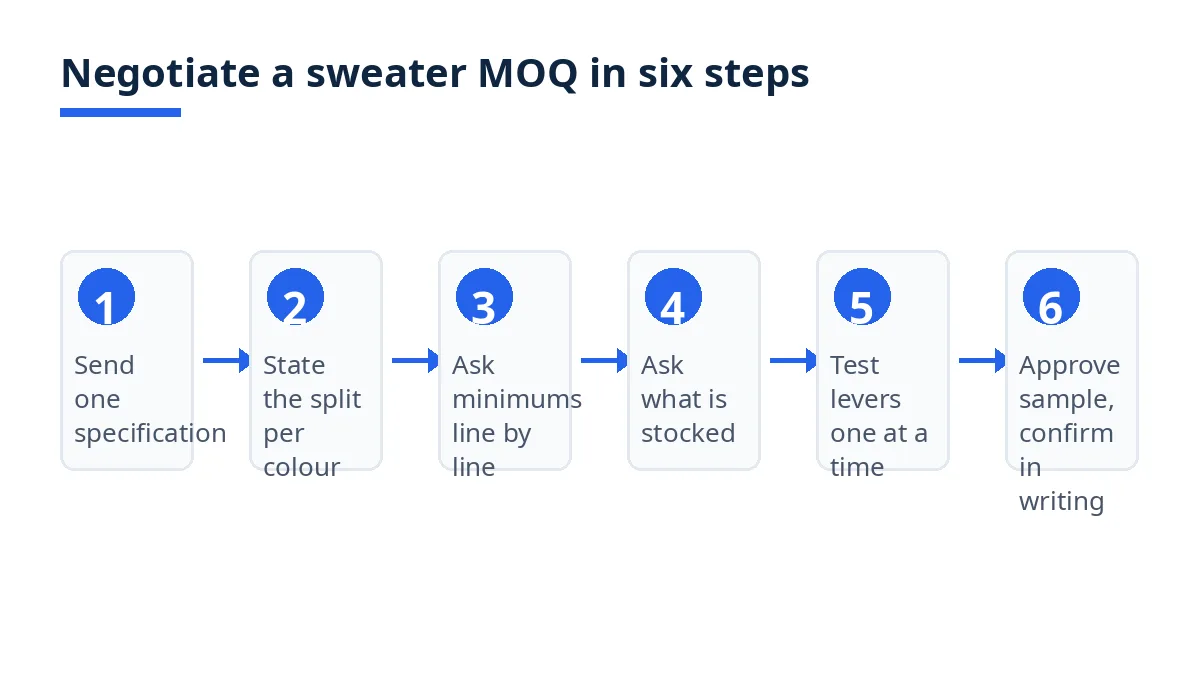
Send one specification to every candidate. State gauge, yarn, stitch, neck and sleeve construction, button or zip details, size chart, artwork method, trim and label spec, and packing.
State the split, not only the total. Give the quantity per style, per colour and per size, with one size curve per colour.
Ask for the minimums line by line. Ask for the MOQ per style, per colour and dye lot, per linking setup, and any separate trim, label, tag and carton minimums, and which line binds for your split.
Ask what is stocked. Record whether each yarn colour, button, label and carton is stocked or made to order.
Test the levers against the binding line. Change colours, shared yarn, stocked inputs or set-up pricing one at a time, and ask for the revised minimum for each change in writing.
Approve the washed sample, then confirm in writing. Measure and wash the pre-production sample in production yarn, trims and labels, then record the agreed minimum, split, set-up lines and delivery term on the quotation and purchase order.
In the Harmonized System, heading 6110 covers jerseys, pullovers, cardigans, waistcoats and similar articles, knitted or crocheted.4 The heading splits by fibre, including wool or fine animal hair, cotton, man-made fibres and other textile materials,4 so confirm the subheading for your fibre on export papers. Read the HS code for sweaters guide if the classification is uncertain.
Driver | What sets the floor | State in your enquiry |
|---|---|---|
Gauge and stitch | Machine setup, yarn use, linking time | Gauge, yarn count and ply, stitch structure |
Yarn and dye lot | Dye lot per colour, shade approval | Fibre, colour, stocked or dyed to order |
Linking | Setup and labour per style | Neck, sleeve and opening construction |
Washing and finishing | Batch size per finishing step | Wash, brush and press requirements |
Trims and labels | Separate lots and print runs | Button, zip, label, tag and carton spec |
Size curve | Time across sizes | Quantity per size, per colour |
Example figures: a buyer orders 900 pieces of one crew-neck style in three colours at 300 per colour. Each colour clears its own dye lot, but the same 900 pieces split across six colours at 150 per colour can fall below the per-colour lot even though the total is unchanged. The example shows structure only, not a typical MOQ, price or lead time.
Costs, timelines and documents
How does a lower MOQ change the unit cost?
A lower minimum rarely leaves the unit price untouched, because fixed work is spread over fewer pieces: dye lots, shade approval, linking setup, washing batches, artwork or intarsia setup, and label and carton runs. When you pay set-up as a separate line, the unit price can stay closer to the bulk price. Ask for the quotation split into yarn, knitting and linking, dyeing and finishing, trims and labels, packing, and set-up lines.
What timeline should I ask for?
There is no typical timeline a guide can state as fact. Sampling depends on yarn availability and correction rounds, bulk production depends on dyeing, linking capacity, washing batches and line time, and shipment depends on inspection and the delivery term. Ask for sampling, yarn ready, knitting and linking, washing and finishing, inspection and shipment dates as separate lines, not a single delivery week.
Which documents are needed?
For the order, the documents are the specification or tech pack, the itemised quotation, the sample approval and the purchase order, with the MOQ per style and per colour on both the quotation and the purchase order. For export clearance in Bangladesh, goods cannot be loaded onto a vessel or stuffed into containers for export until a Bill of Export (Shipping Bill) is submitted and approved, and standard documents include an export LC or contract or purchase order, commercial invoice, packing list, EXP Form certified by an Authorized Dealer bank, certificate of origin issued by EPB or a Chamber of Commerce, VAT registration certificate and TIN certificate.5 For sales into the European Union, a textile product shall be labelled or marked with the name and percentage by weight of all constituent fibres in descending order.6
One delivery term should apply to every quotation you compare. The Incoterms 2020 rules explain a set of eleven trade terms, describing obligations, risk and costs, including who organises carriage or insurance, where risk transfers, and which party bears transport, packaging, loading and checking costs.7 Compare MOQs only on the same term and named place. See the MOQ definition guide for how a minimum order quantity is used beyond sweaters.
Bangladesh-specific rules and tips
Confirm association claims at the source. If a supplier claims BKMEA membership, confirm the company name and factory address against the association record. BKMEA represents approximately 2,540 knitwear member factories and was established in 1996,1 so membership signals an active knitwear business, not the MOQ on offer, the gauge range, or capacity for your order.
Ask which inputs are imported for your order. Yarn, buttons, zips and some labels may be bought in for your specification, and an imported trim can set both the minimum and the earliest production date. Agree the size curve per colour before production.
Handle timing as a question, not an assumption. A factory may welcome a small order in a quiet period and refuse the same order when lines are full, or the reverse may apply where yarn supply is tight. Ask when the factory has line time for your gauge and whether a split shipment would let production start sooner.
Mistakes and red flags
Which sweater MOQ mistakes cost buyers the most?
Asking for a total MOQ only. The binding minimum is usually per colour, per style or per dye lot. An order can clear the total and still fall below the per-colour minimum for one colour, which then carries a surcharge or removal from the order.
Comparing MOQs on different specifications. A lower minimum on a finer gauge, a stocked shade, a crew neck instead of a cardigan or a different delivery term is a different offer. Compare only replies to the same specification on the same Incoterm.7
Treating gauge as a style name. Gauge is needles per inch, and the ranges 3GG to 5GG, 7GG to 10GG and 12GG to 18GG are practical starting points, not fixed garment specifications.3 A quotation with a style name but no gauge, yarn count or stitch structure has not answered the specification.
Accepting a verbal exception. Record any agreed lower minimum, shared dye lot or waived set-up on the quotation and purchase order, with the split it applies to.
Removing sample approval or inspection to earn a lower minimum. Sampling under ISO 2859-1 uses an acceptance quality limit (AQL), defined as the quality level that is the worst tolerable process average when a continuing series of lots is submitted for acceptance sampling.8 Skipping the washed sample removes the last control before the goods become your stock.
Reading a profile or a badge as proof of capacity. A profile is a starting point for enquiries. It does not test whether a factory knits your gauge or holds your yarn. Verification on Exportain is a document and photo review, not a factory inspection, and a badge is not a guarantee.
Red flags that should pause the order include a quotation with no gauge or yarn detail, a minimum that changes without a changed specification, a refusal to name the dye lot, a request to pay set-up without an itemised line, and a sample in substitute yarn presented as a production sample.
Checklist
Before you confirm, every line should be answered in writing.
Specification sent: gauge, yarn fibre, count and ply, stitch, neck and sleeve construction, buttons or zip, labels, sizes, packing.
Split stated per style, colour and size, with one size curve per colour.
MOQ confirmed per style and per colour, with the binding line named: dye lot, linking, washing batch or trim run.
Trim, label, tag and carton minimums confirmed apart from the garment MOQ.
Set-up costs itemised apart from the unit price, and paid set-ups recorded for repeats.
Washed pre-production sample measured and approved in writing, in production yarn, trims and labels.
Inspection level and AQL values in the purchase order, following ISO 2859-1.8
Quotations compared on the same specification and Incoterm.7
Export set agreed: Bill of Export, commercial invoice, packing list, EXP Form, certificate of origin, VAT and TIN documents.5
How Exportain helps
On Exportain, browse suppliers and post a request for quotation (RFQ) on the RFQ board with your specification summary, split per colour and delivery term, so suppliers quote against the same sweater. Ask each reply for its per-style and per-colour minimums, gauge range, yarn status per colour and set-up lines.
Read the badges for what they record. Verification checks on Exportain cover identity, phone and email, business registration, the Export Registration Certificate (ERC) and photos of the factory or office, the Exportain team reviews every submission, and badges are earned through these checks and cannot be bought.9 That review is a document and photo review, not a factory inspection. See how supplier verification works on Exportain for what each badge covers.
FAQs
What is the lowest MOQ I can expect for sweaters from Bangladesh?
There is no lowest figure to expect. The minimum is set per style and per colour for your gauge, yarn, dye lot, linking, washing and trim runs, so the only usable answer is the line-by-line minimum for your specification, in writing.
How do I negotiate a sweater MOQ down without cutting quality?
Change the structure that sets the floor: cut colours, share one yarn and shade across styles, accept stocked yarn or trims, simplify intarsia, pay set-up separately, or split the shipment. Keep sample approval and inspection in place, and record each change in writing.
Which sweater details drive the MOQ up the most?
Gauge and stitch, the number of colours, and any feature with its own setup: intarsia, embroidery, a button band, a zip, a washed or brushed finish, and private labels and cartons. Heading 6110 covers jerseys, pullovers, cardigans, waistcoats and similar articles, knitted or crocheted, split by fibre.4
What documents should the agreed MOQ appear on?
The agreed minimum, with the split per style, colour and size, should appear on the itemised quotation and the purchase order, with the set-up lines, shade reference and delivery term. The export set is separate: Bill of Export, commercial invoice, packing list, EXP Form, certificate of origin, VAT and TIN documents.5
Next steps on Exportain
Browse suppliers, then post your specification summary, split per colour and delivery term on the RFQ board so suppliers state their MOQ per style and per colour. Before you confirm, read the HS code for sweaters guide and the sweaters quality control checklist so the classification and the inspection points match the order you place.
Sources
- BKMEA at a Glance. BKMEA (accessed )
- Exports up over 6% to $13.1bn in Q1 of current fiscal. United News of Bangladesh (accessed )
- Sweater Knitting Gauge Guide: 3GG-18GG. KnitSeek (accessed )
- Classification Detail — HS Code 6110. United Nations Statistics Division (accessed )
- Custom Clearance in Bangladesh: Port Procedures and C and F Agent Guide. Bizmend (accessed )
- Regulation (EU) No 1007/2011 on textile fibre names and related labelling and marking of the fibre composition of textile products. European Union, (accessed )
- How to use Incoterms proficiently: risk, responsibility, and transfer operations. Trade Finance Global (accessed )
- SIST ISO 2859-1:2003 - Sampling procedures for inspection by attributes, Part 1: Sampling schemes indexed by acceptance quality limit (AQL). International Organization for Standardization, (accessed )
- Sell Bangladeshi Products to Global Buyers | Exportain. Exportain (accessed )
About the author
Sourcing from Bangladesh?
Post a request for quotation and suppliers on Exportain can send you their quotes directly.
Post an RFQ