

Private Label Leather Wallets Manufacturing in Bangladesh: A Brand Owner's Guide
A brand-owner briefing guide for private label leather wallets from Bangladesh: write the wallet brief, specify marks, lining and pack, set the shade standard, and clear the approval gates before bulk production.
Short answer
Private label leather wallets from Bangladesh start with a written brief, not a catalogue choice. Write the layout, measurements, card test, brand marks, lining, leather, pack, and labels in one version-numbered document, settle plate ownership and confidentiality in writing, approve the wallet at four gates against a sealed sample, and require test evidence naming your leather and lot before bulk production.
On this page
Key takeaways
Write one version-numbered brief covering layout, measurements, card test, marks, lining, leather, pack, and labels, and send the identical document to every maker.
Settle plate, die, and mould ownership and confidentiality in writing before the first sample, and control unused labels and boxes bearing your mark.
Approve the wallet at four gates — brief, mark, fit, and sealed — and judge bulk inspection against the sealed sample, not a photograph.
Require test evidence naming your leather, color, and lot, and confirm label and classification rules per selling market before the label run.
Price the briefing lines separately — set-up, samples, lots, and pack — and state repeat-order treatment of set-up charges in writing.
A leather wallet is judged in a pocket, in one hand, and in a few seconds. A card slot either releases the card or it does not, a fold either lies flat or it springs open, and a debossed logo either reads cleanly at arm's length or it looks like a smudge.
This guide is for a brand owner briefing a first private label leather wallet order from Bangladesh. It covers one job: writing the briefing pack a maker can build from, so the wallet that ships is the wallet you approved. Keep every decision in one version-numbered document.
Write the wallet brief before you ask for a price
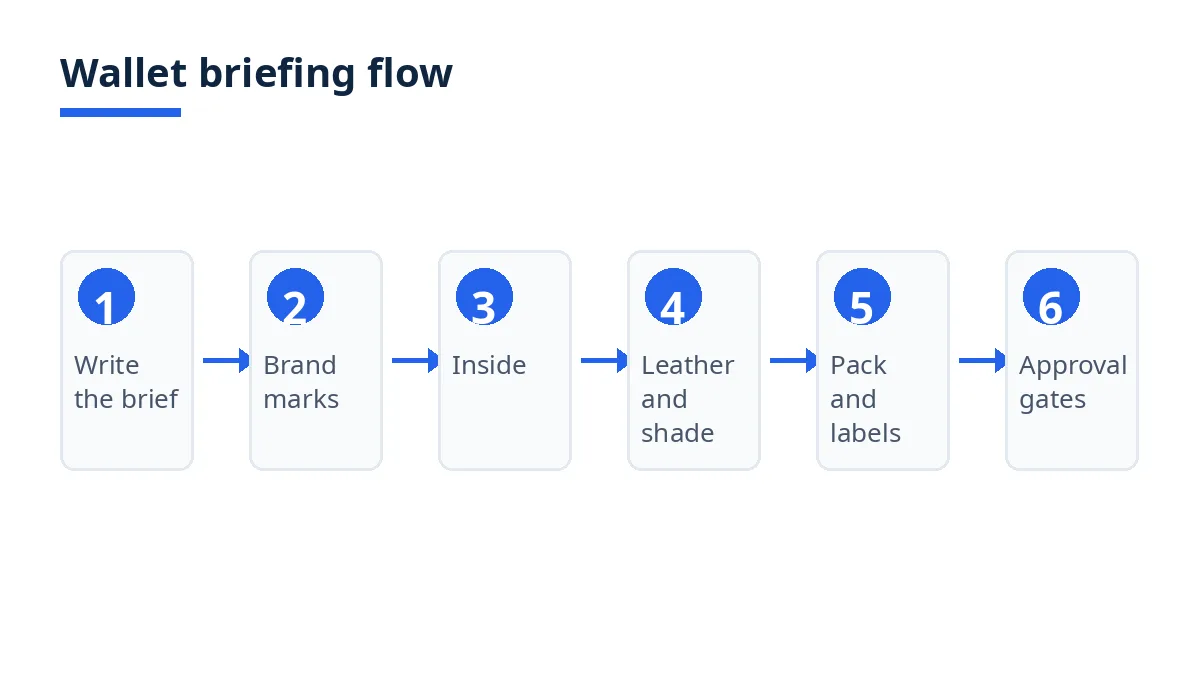
A brief is not a mood board. It is the instruction set for one wallet, complete enough that two makers quoting from it price the same article. Start with the assortment, one row per wallet: layout, purpose, and buyer. A bifold, a card holder, and a zip wallet are three different briefs, even when they share a leather and a color.
Add the measurements that decide fit: closed length, width, and thickness with the contents you specify, and open length and width. State the test that decides pass or fail: the card size, how many cards each slot must hold, and how the wallet must behave when tipped gently with cards in place. A slot that holds a card only when forced will tear at the mouth. Use the same test card on every sample.
Close the brief with the commercial frame: quantity split per layout and per color, target delivery date, destination, delivery term with a named place, currency, and the brief version and date. Send the identical document to every maker.
Brief the brand marks: embossing, debossing, foil, print and secrecy
The brand mark on a wallet is small, and small marks punish vague instructions. Decide the mark method per position, not per wallet: the outside, the inside label, the zip pull, and the box can each carry a different method, each with its own plate, die, or screen. State the artwork file, version number, exact position, size in millimeters, and color or finish for each position. Send controlled artwork files and keep the masters yourself.
Mark method | Where it suits a wallet | Specify |
|---|---|---|
Deboss | Outside leather | Plate, depth, position |
Emboss | Leather patch or label | Die, height, patch |
Foil | Box, sleeve, hang tag | Foil color, substrate |
Lining and care labels, insert | Ink, stock, position | |
Metal plate or zip pull | Hardware mark | Mould, finish, fixing |
Agree plate and die ownership in writing before the first sample is made: who pays, who holds it, and whether it may be used for any order other than yours. The same rule covers unused labels, patches, and printed boxes bearing your mark: unused stock is returned to you or destroyed with written confirmation.
Confidentiality needs the same written treatment, and realistic limits. It can cover the artwork, the tech pack, and the pricing, and bar the maker from selling your design under another name. It cannot, on its own, stop a similar wallet shape being made for another buyer. Get advice from a professional adviser before you rely on it, and send the artwork only after it is signed.
Brief the inside of the wallet: slots, lining, thread and edge
Buyers open a wallet far more often than they look at its outside, and the inside is where a private label order most often drifts from the brief. Specify the interior slot by slot: card slots, their depth and order, the note section, and the coin section. State the lining material and color for each part, not only for the wallet as a whole.
State the thread color per leather color, and the edge treatment: painted, burnished, or folded, with the edge paint color named. An edge painted in the wrong color reads as a different wallet, and an unfinished edge on a card slot will fray. Approve the edge and thread on the pre-production sample, in the production leather, and check them again after the fit test. Standardize the interior across layouts where you can, per the leather wallets quality control checklist.
Brief the leather and the shade standard
Leather is the one input where the brief must name the evidence, not only the description. State the leather by tannery, name or code, thickness range, finish, and color, and require the maker to state the leather it priced. Ask whether the leather is stocked in your color or dyed to order, and record the answer per color.
Set the shade standard before sampling starts: the light the shade is judged under, the reference sample, and the tolerance between the reference and bulk. Judge shade under the named light, never from a phone photograph, and judge the exterior against the card panels of the same wallet. Keep the shade reference sealed and dated, and require re-approval when the lot changes.
Chemical evidence belongs in the leather brief, per lot. Leather articles coming into contact with the skin shall not be placed on the market in the European Union where they contain chromium VI at or above 3 mg/kg of the total dry weight of the leather, and the same limit applies to leather parts of articles coming into contact with the skin.1 The Leather Working Group audit covers 17 sections, and certification is valid for 24 months for leather manufacturing facilities.2 For Gold and Silver, chromium VI must be below 3 mg/kg.2 Certification does not guarantee there will be no restricted substance failures in a final product.2 Require a test report naming your leather, color, and lot, and hold bulk approval until it exists.
Brief the pack: box, sleeve, insert and carton as part of the brand
The pack is the first part of your brand the buyer touches, and it is usually priced last, when the budget is already fixed. Brief it with the wallet, in the same document: pack type per layout, box board, print, foil, and size. State whether the box, sleeve, hang tag, and insert are included in the unit price, and price each as a separate line.
Write the insert as a brand document, not as filler: size, paper, print, and exact wording, approved with the label wording in the same round. Each claim must match the evidence you hold.
Brief the labels for each selling market
Label wording is set in the market where the wallet is sold, not where it is made, and a wallet sold in more than one market may need more than one label set. Confirm every requirement with a professional adviser or your customs broker for each selling market before the label run is printed.
For the European Union, textile products containing non-textile parts of animal origin must carry the phrase "Contains non-textile parts of animal origin" on the labeling or marking whenever they are made available on the market, and the labeling must not be misleading and must be easily understood.3 A wallet with a textile lining may therefore need both a fiber statement for the textile component and the animal-origin phrase for the leather parts.3
For the United States, the Federal Trade Commission guides state that it is unfair or deceptive to use the unqualified term "leather" unless the product is composed in all substantial parts of leather, and that imitation or simulated leather must be disclosed, including "Imitation leather" and "Vinyl".4 The kind and type of leather should be disclosed when leather has been embossed, dyed, or otherwise processed to simulate a different kind or type, and backing should be disclosed when it is not apparent on casual inspection.4 Disclosures should appear as a stamping on the product or on a tag, label, or card attached to it.4
Classification runs beside labeling. Subheading 4202.31 covers pocket or handbag articles with an outer surface of leather or composition leather, 4202.32 covers the same articles with an outer surface of plastics sheeting or textile materials, and 4202.39 covers the remaining materials.5 Treat every heading as indicative until your broker confirms the full national code.
Price the briefing, not the wallet
Compare quotations only when every maker priced the same brief, on the same delivery term, in the same currency, with the same split. Ask each maker to quote the same lines separately: leather, lining, hardware, labels, and packing, sample charges as a separate line, and set-up charges for plates, dies, moulds, and screens as a separate line.
Quotation line | Example figures | Confirm |
|---|---|---|
Embossing plates, two layouts | 240 units | Ownership, holder, reuse |
Foil screen, gift box | 60 units | Substrate, foil color |
Samples, three gates | 150 units | Gates, rounds, courier |
Unit price, per wallet | Priced per layout and color | Inclusions per layout and color |
The delivery term decides where cost and risk pass, and it must be stated with the rule, the named place, and the version in every document. The Incoterms 2020 rules number 11 rules, with a clear allocation of cost, risk, and obligations for each rule.6 Under the CIF rule, the default insurance cover is Institute Cargo Clauses (C), with the option to agree a higher level of cover.6
For documents, the export side in Bangladesh requires approval of the Bill of Export or Shipping Bill before goods are loaded or stuffed, with an enclosed set including the export contract or purchase order, commercial invoice, packing list, EXP form, certificate of origin, VAT certificate, and taxpayer identification number.7 Ask for a timeline naming brief, mark, and fit approval, material dates, production, inspection, and shipment separately.
Run the approval gates: sample gates, inspection and close-out
Approve the wallet at gates, and do not let a later gate reopen an earlier decision.
Gate | Sample | Approval test |
|---|---|---|
Brief gate | Written brief, version-numbered | Every field answered |
Mark gate | Mark samples on production leather and pack | Logo reads at arm's length, size measured |
Fit gate | Wallet in production leather, lining, hardware | Card test passed, fold flat, closures hold |
Sealed gate | Production-line sample, final pack | Compared line by line, photographed, sealed |
The fit gate must use your test card, your card count, and your contents. Fill every slot, fold and unfold the wallet, open and close every closure repeatedly, and check the edge and stitching after the test. The sealed gate sample, sometimes called the gold sample, is the agreed standard for bulk: both sides sign or mark it, photograph it from every side, and keep one copy each.
Agree the inspection plan while samples are being made. ISO 2859-1:2026 defines a system of acceptance sampling plans for inspection by attributes, indexed by acceptance quality limit (AQL), and AQL is the maximum average percentage of defective items considered acceptable during random sampling.8 Set defect classes first: critical defects at zero acceptance, major defects at the agreed AQL, and minor defects at a looser AQL, and write the inspection level, AQL values, inspector, and failed-lot consequences into the purchase order.
Mistakes and red flags
Briefing by conversation and approving by photograph hides shade, hand feel, edge finish, and mark depth. Settling plate ownership after the price invites renegotiation. Specifying the outside and leaving the lining to the maker produces an interior that matches no brief.
Briefing checklist: before you approve bulk production
Brief version-numbered; every layout, color, measurement, and test answered.
Artwork controlled and version-numbered; you hold the masters.
Plate, die, and mould ownership, holder, and reuse terms in the order.
Confidentiality signed; unused labels and boxes have return or destruction terms.
Mark method, position, and size per position; mark gate sample approved.
Interior, lining, thread, and edge specified slot by slot; fit gate passed.
Leather, tannery, thickness, finish, and shade standard per color recorded.
Test evidence names leather, color, and lot; bulk testing plan agreed.
Pack, insert, and carton approved; pack minimums apart from the wallet minimum.
Label wording, material statement, and origin wording confirmed per market.
Classification indicative 4202.31; full national code to be confirmed by your broker.5
Sample, set-up, and unit prices itemized; repeat treatment of set-up in writing.
Delivery term, named place, currency, inspection plan, and date in the purchase order.
Export documents, sealed sample record, and close-out terms scheduled before the ship date.
How Exportain helps
Browse suppliers on Exportain and read each profile against your wallet brief, not against a catalogue photograph. Then post the brief as an RFQ, stating quantity and unit, target price, destination, Incoterm, required certifications, and deadline.9 Compare the versioned quotations on the same fields, including unit price, MOQ, lead time, Incoterm, payment terms, and validity.9 Supplier profiles carry document and photo review badges: verification is a document review, not a factory inspection, and a badge is not a guarantee.10 Read what each badge records, using the supplier verification guide. Exportain does not inspect goods, book freight, or clear customs.
What should I know first about private label leather wallets?
Know that you are briefing a maker, not buying from a catalogue. Write the layout, measurements, card test, marks, lining, leather, pack, and labels before you ask for a price. Settle plate ownership and confidentiality in writing.
What are the typical costs and timelines?
There are no typical costs or timelines a guide can state as fact. The cost is built from set-up lines, sample lines, leather and shade lots, pack lines, and the unit price, and the timeline follows the gates, lot runs, and label run. Treat every number here as an example figure only.
Which documents are needed?
The order documents are the version-numbered brief, the controlled artwork, the signed confidentiality terms, the gate approvals, the sealed sample record, and the test evidence for the lot. The export documents include Bill of Export approval and the enclosed contract, invoice, packing list, EXP form, certificate of origin, VAT certificate, and taxpayer identification number.7 Verify the HS heading against your destination tariff.5
What are the most common mistakes?
The most common mistakes are briefing by conversation, approving a mark or a fit from a photograph, leaving the lining and the pack unspecified, copying label wording from another product, and treating a tannery audit as a lot test.
Next steps on Exportain
When the brief, the marks, and the pack are fixed, post a free RFQ on Exportain with the layout, color, and quantity breakdown and the delivery term, and compare quotes on the same brief, set-up lines, and label set. See the general guide to importing from Bangladesh and the HS code guide for leather wallets.
Sources
- Commission Regulation (EU) No 301/2014 amending Annex XVII to REACH as regards chromium VI compounds. European Commission, EUR-Lex, (accessed )
- Certification - Leather Working Group. Leather Working Group (accessed )
- Regulation (EU) No 1007/2011 on textile fibre names and related labelling and marking of the fibre composition of textile products. European Union, (accessed )
- 16 CFR Part 24 — Guides for Select Leather and Imitation Leather Products. Federal Trade Commission (accessed )
- HS, 2017 - Code 4202 Classification Detail. United Nations Statistics Division (accessed )
- Incoterms® 2020. International Chamber of Commerce (ICC) (accessed )
- Customs Clearance Procedures for Export. Bangladesh Customs, National Board of Revenue (accessed )
- ISO 2859-1:2026 - Sampling procedures for inspection by attributes — Part 1: Sampling schemes indexed by acceptance quality limit (AQL) for lot-by-lot inspection. ISO (accessed )
- How to source and buy from Bangladesh. Exportain (accessed )
- Trust & Safety Center. Exportain (accessed )
- MOQ
- supplier verification
- quality control
- HS Codes
- buyer guide
- Bangladesh sourcing
- Private label
- Leather wallets
About the author
Sourcing from Bangladesh?
Post a request for quotation and suppliers on Exportain can send you their quotes directly.
Post an RFQ


