Private Label Denim Jeans Manufacturing in Bangladesh: A Brand Owner's Guide
Private label denim jeans in Bangladesh: how to choose cloth weight, indigo shade and wash, develop fit and labels, and agree MOQ and inspection before bulk production.
Short answer
Private label denim jeans in Bangladesh are jeans made to a brand owner's specification, covering denim weight and composition, indigo shade and wash, five-pocket fit and grading, rivets, buttons and patch labels. The buyer approves a washed sample in the exact cloth and wash, confirms minimums per wash and size curve, and inspects bulk pairs after washing before shipment.
On this page
Key takeaways
Private label denim jeans are defined by denim weight, indigo shade and wash, fit and label pack, each produced in its own run and fixed in writing before bulk production.
Bangladesh denim exports to the United States reached $955.7 million in 2025, a 25.97 per cent market share, with local mills meeting around 70 per cent of denim fabric demand.
Approve fit and wash only on a physical, dried, washed pair in the exact bulk cloth, and keep a sealed reference pair for bulk shade and measurement comparison.
Factories set minimums per wash recipe and per size curve, not only on the order total, so a small order split across many washes can fail every wash minimum.
Exportain verification is a document and photo review, not a factory inspection, and a badge is not a guarantee of capacity, quality or delivery.
A private-label jeans order is decided long before a pair reaches a cutting table. The fabric weight, the indigo shade, the wash recipe, the fit across sizes and the label pack all have to be fixed in writing, because each of them is made or bought in its own run, and a change to one of them after sampling can restart the others. This guide follows those decisions in the order a brand owner meets them, from fabric choice to bulk inspection.
Bangladesh is a substantial denim source for buyers in the United States and the European Union. Bangladesh remained the top denim exporter to the United States in 2025, exporting $955.7 million in denim, a 25.97 per cent share of the United States denim market, according to data from the United States Office of Textiles and Apparel (OTEXA) reported by New Age.1 Denim exports to the European Union reached $1.64 billion in 2025, and local mills met around 70 per cent of denim fabric demand, with the remainder imported.1
What should I know first about private label?
Private label means the jeans carry your brand name, your labels and your packing, made to your specification. That is different from buying a factory range and adding a hang tag. You own the decisions that make the jean yours: the denim fabric, the indigo shade and wash, the five-pocket pattern and fit, the rivets, buttons and patch label, and the care and composition wording. The factory executes those decisions, and the laundry develops the wash you approve. Put each decision in writing before bulk production, including who owns the pattern, the wash recipe and the label artwork if you move the order elsewhere.
Denim itself sets the first constraint. Denim is a twill weave combining indigo-dyed warp yarns with white or grey weft yarns, and it weighs between 6.5 and 15.5 ounces per square yard.2 Warp yarns are dyed before weaving, by rope dyeing or slasher dyeing, and the cloth is then finished before it reaches a garment factory.2 A heavier cloth holds a rigid straight fit differently from a light stretch cloth, so the weight you choose shapes the fit, the wash result and the price structure at once.
Why this matters for buyers and sellers
For the buyer, a jeans order carries a risk that is easy to miss on a quotation: the sample that wins approval is often an unwashed or lightly washed pair, while the bulk pairs are washed, dried and pressed. A wash changes length, waist, leg opening and shade, so a fit approved before washing can fail after it. Approving a washed sample in the exact fabric, shade and wash you intend to sell is the control that catches that shift.
For the seller, a private-label jean ties up inputs that cannot be resold under another brand. Denim cut for your rise and leg shape, a wash recipe developed for your shade, rivets stamped with your mark and a patch carrying your name are all specific to your order. A short run still uses the fabric lot, the laundry set-up and the label run, so the cost per pair rises as the quantity per wash and per size falls. That is why factories answer a jeans enquiry with minimums per wash and per size curve, not only a total.
For both sides, the label pack deserves attention early. A jean carries more brand hardware than most garments: a waist patch, rivets, a button, a zip or button fly, pocket labels and a sewn-in care and composition label. Each item has its own supplier, lead time and minimum.
Step-by-step: how it works
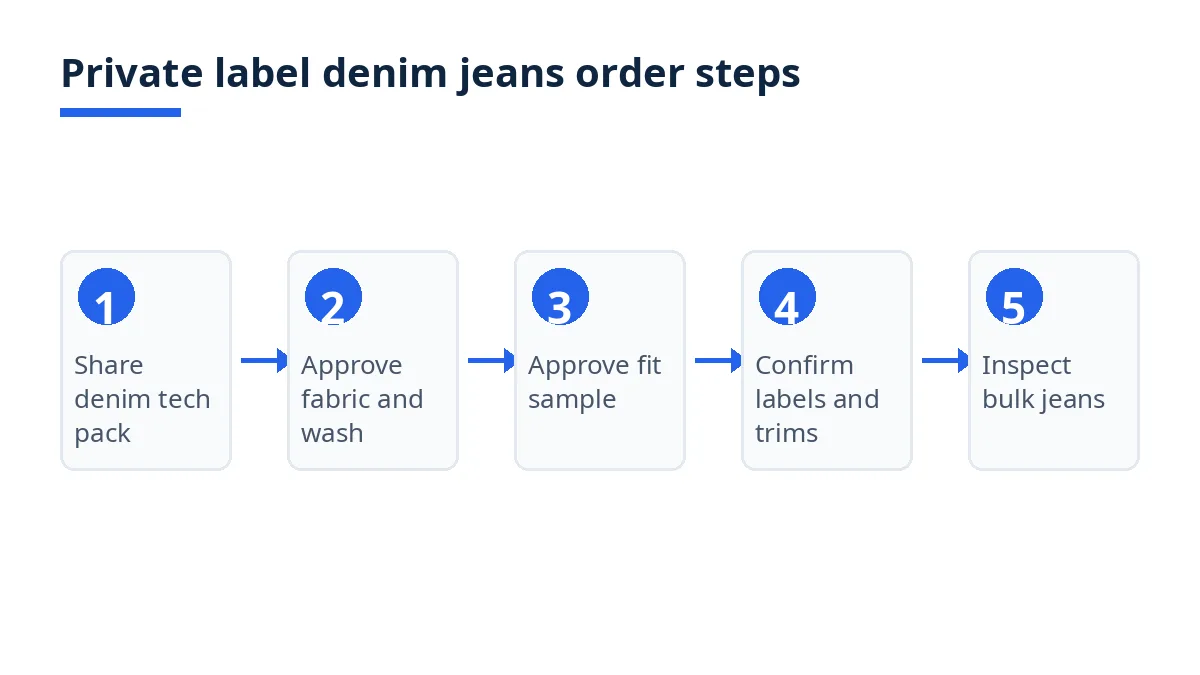
Write a denim tech pack. State the fabric weight in ounces per square yard, the composition, whether the cloth is rigid or stretch, the indigo shade, the wash you want, the five-pocket pattern, rise, inseam, leg opening, waist measurements, fly type, rivet and button finish, patch label material and artwork, and packing. Name the size curve and the quantity per size.
Select the cloth and confirm its source. Ask whether the denim is stocked or woven to order, and record the mill, weight, composition and shade reference. Local mills meet around 70 per cent of denim fabric demand in Bangladesh, with the remainder imported, so an imported cloth can carry a different lead time from a local one.1
Develop the indigo shade and wash together. Approve a fabric swatch for shade, then a laundry sample for the wash. Judge the wash on a finished, dried pair, not on a wet one, and record the recipe reference, the shade tolerance and the measurements after washing.
Develop fit on washed samples. Order a fit sample in your cloth and wash, measure it after laundering, and grade it across your size curve. Check waist, hip, thigh, knee, leg opening and inseam on more than one size, and confirm how much stretch recovery the cloth shows after wear and washing.
Approve labels, trims and hardware in hand. Hold the patch label, rivets, button and zip against the washed jean. Check that rivet and button finishes survive the wash you chose, and that the care and composition wording matches the cloth you approved.
Confirm the order in writing. Put the fabric, shade, wash reference, size curve, quantity per wash, label and trim specification, inspection plan and delivery term on the purchase order. Approve a pre-production sample in the exact bulk cloth, wash and labels before cutting starts.
Inspect bulk pairs after washing. Check measurements on washed pairs, shade consistency across the lot, wash evenness between legs, rivet and button attachment, stitching at stress points such as pocket corners and the crotch, and label placement. Agree the inspection level and acceptance quality limit (AQL) values before production, following ISO 2859-1, which defines acceptance sampling plans indexed by AQL for lot-by-lot inspection.3
In the Harmonized System, subheading 620342 covers trousers, bib and brace overalls, breeches and shorts, for men or boys, of cotton, not knitted or crocheted.4 Confirm the code for each style with your broker, since the code follows the wearer, the fibre and the construction, and a women's style does not share the men's line.
Costs, timelines and documents
What are the typical costs and timelines?
No guide can state a typical price or lead time for a private-label jean, because each factory prices your cloth weight and source, indigo shade, wash recipe, fit complexity, hardware, label pack and the delivery term you choose. The Incoterms 2020 rules set out 11 rules with a clear allocation of cost, risk and obligations,5 so compare quotations only on the same rule and named place.
Timelines follow the same logic. Cloth availability, wash development rounds, fit corrections, hardware delivery and laundry capacity each add their own stage, and a wash that needs two or three rounds takes longer than a rinse wash approved on the first sample. Ask for separate dates for cloth ready, wash approval, fit approval, pre-production approval, bulk cutting, laundry, inspection and shipment, rather than a single delivery week.
Example figures: a brand orders 1,200 pairs split across four washes at 300 pairs per wash. The total is 1,200 pairs, and each wash run is 300 pairs. If the laundry minimum per wash recipe is higher than 300 pairs, one wash fails even though the order total looks large. The same 1,200 pairs across two washes at 600 pairs per wash clears a 600-pair wash minimum. The example shows structure only, not a typical minimum, price or lead time.
Cost or time driver | What moves it | State in your enquiry |
|---|---|---|
Denim cloth | Weight, composition, stocked or woven to order | Weight, composition, stretch, mill and shade reference |
Indigo and wash | Shade depth, wash recipe, laundry rounds | Shade reference, wash description, tolerance |
Fit development | Pattern, grading, stretch recovery | Measurements, size curve, washed measurements |
Hardware and labels | Patch material, rivet and button finish, label runs | Artwork, material, finish, quantity per item |
Inspection | Sample size, AQL values, washed checks | Inspection level and AQL values in the purchase order |
Which documents are needed?
The order documents are the denim tech pack, the itemized quotation, the purchase order carrying the fabric, shade, wash reference and size curve, the written wash and fit approvals, and the inspection criteria. For shipment clearance, Bangladesh Customs publishes the export-clearance requirements that apply to the Bill of Export.6
Bangladesh-specific rules and tips
Confirm cloth origin and availability before you fix a wash. A cloth woven to order and a stocked cloth behave differently on lead time, and an imported cloth can add a stage that a local cloth does not. Since local mills meet around 70 per cent of denim fabric demand, ask directly whether your cloth is local or imported, and what happens to the wash date if the cloth arrives late.1
Keep one legal name across every paper. The export declaration names the exporter and the foreign buyer,6 so the name on the trade licence, quotation, proforma invoice and payment account should match, and the brand name on the patch label should match the name on the order.
Write the fibre composition from the approved cloth. If you sell into the European Union, Regulation (EU) No 1007/2011 states that a textile product shall be labelled or marked with the name and percentage by weight of all constituent fibres in descending order.7 A stretch jean with elastane in the weft must therefore show that fibre on the label, and the composition on the label must match the cloth actually cut, not the cloth first quoted.
Approve the wash in the season you will sell it. A wash judged on one fabric lot can read differently on the next lot. Keep a sealed washed reference pair, and compare bulk shade and hand feel against it rather than against a photograph.
Mistakes and red flags
What are the most common mistakes?
Approving fit before washing. An unwashed measurement is not the measurement your customer wears. Approve fit on a washed, dried pair in the bulk cloth, and record the measurements after laundering.
Approving a wash from a photograph. Shade, fading and hand feel do not survive a screen. A photograph cannot show whether one leg is lighter than the other or whether the fabric has softened unevenly. Approve a physical washed pair and keep it sealed as the reference.
Splitting one order across too many washes. Each wash recipe is its own run with its own minimum and shade tolerance. Five washes on a small order can leave every wash below its minimum or force a surcharge on each one, while the total still looks acceptable.
Changing hardware after wash approval. A new rivet finish or patch material can react differently in the laundry. Any hardware change after the wash is approved needs a fresh washed sample.
Comparing quotations on different cloths or washes. A lower price on a lighter cloth, a simpler wash, stock labels or a different delivery term is a different offer. Compare only replies to the same tech pack on the same Incoterm.5
Do not read a badge as proof of bulk capability. A profile starts the enquiry; only a washed bulk lot proves the factory and laundry can hold your shade and fit. Treat badges as background, not as a promise on capacity, quality or delivery dates.
Skipping washed bulk inspection to save time. Sampling under ISO 2859-1 checks a lot against an agreed AQL,3 and for jeans the check must happen after washing, when shrinkage, shade and hardware faults are visible.
Checklist
Before you confirm, every line should be answered in writing.
Denim tech pack sent: weight, composition, stretch, shade, wash, pattern, measurements, fly, hardware, labels, packing.
Cloth status recorded: stocked or woven to order, local or imported, shade reference held.
Indigo shade approved on cloth, and wash approved on a physical, dried, finished pair.
Fit approved on washed samples across more than one size, with measurements after laundering.
Size curve and quantity per size and per wash confirmed, with the binding minimum named.
Patch label, rivets, button, zip and care and composition wording approved in hand against the washed jean.
Fibre composition on the label matches the approved cloth.7
Wash reference pair sealed and held for bulk comparison.
Inspection level and AQL values in the purchase order, with checks after washing.3
Quotations compared on the same cloth, wash, label pack and Incoterm.5
How Exportain helps
On Exportain, browse suppliers and post your denim tech pack summary, size curve, wash description and delivery term on the RFQ board, so suppliers quote against the same cloth, shade and wash. Ask each reply for its minimum per wash and per size curve, and for its laundry arrangement. Read the badges for what they record: the trust pages describe a document and photo review, not a factory inspection, and a badge is not a guarantee of capacity, quality or delivery.8 See how supplier verification works on Exportain and the MOQ definition guide before you confirm.
FAQs
What should I know first about private label?
Private label means the jeans carry your brand, labels and packing, made to your specification. Fix the denim weight and composition, the indigo shade, the wash recipe, the fit and the label pack in writing before bulk production, because each is produced in its own run and a late change can restart the others.
What are the typical costs and timelines?
There are no typical figures a buyer can rely on, because each factory sets its price, minimum and lead time for your cloth, shade, wash, fit, hardware and delivery term.5 Cloth availability, wash rounds, fit corrections and laundry capacity drive the timeline, so ask for each stage dated separately.
Which documents are needed?
The order documents are the denim tech pack, itemized quotation, purchase order, written wash and fit approvals, and inspection criteria. For shipment clearance, Bangladesh Customs publishes the export-clearance requirements that apply to the Bill of Export.6
What are the most common mistakes?
The most common mistakes are approving fit before washing, approving a wash from a photograph, splitting a small order across too many washes, changing hardware after wash approval, comparing quotations on different cloths or terms,5 and reading a badge as a guarantee. A badge is not a guarantee of capacity, quality or delivery.8
Next steps on Exportain
Browse denim jeans manufacturers in Bangladesh, compare wholesale terms in the wholesale denim jeans in Bangladesh guide, and check how minimums work in the denim jeans MOQ in Bangladesh guide before you post your tech pack.
Sources
- Bangladesh top denim exporter to US in 2025. New Age (accessed )
- Denim Fabric Manufacturing: A Step-by-Step Guide. Textile Details, (accessed )
- ISO 2859-1:2026 - Sampling procedures for inspection by attributes — Part 1: Sampling schemes indexed by acceptance quality limit (AQL) for lot-by-lot inspection. ISO (accessed )
- UNSD Classification Detail: HS Code 620342. United Nations Statistics Division (accessed )
- Incoterms® 2020. International Chamber of Commerce (ICC) (accessed )
- Customs Clearance Procedures for Export. Bangladesh Customs, National Board of Revenue (accessed )
- Regulation (EU) No 1007/2011 on textile fibre names and related labelling and marking of the fibre composition of textile products. European Union, (accessed )
- Trust & Safety Center. Exportain (accessed )
About the author
Sourcing from Bangladesh?
Post a request for quotation and suppliers on Exportain can send you their quotes directly.
Post an RFQ