Private Label Cotton T-Shirts Manufacturing in Bangladesh: A Brand Owner's Guide
How brand owners source private label cotton t-shirts from Bangladesh: specification and label approval, supplier checks, MOQ and price drivers, quality control, duty and documents.
Short answer
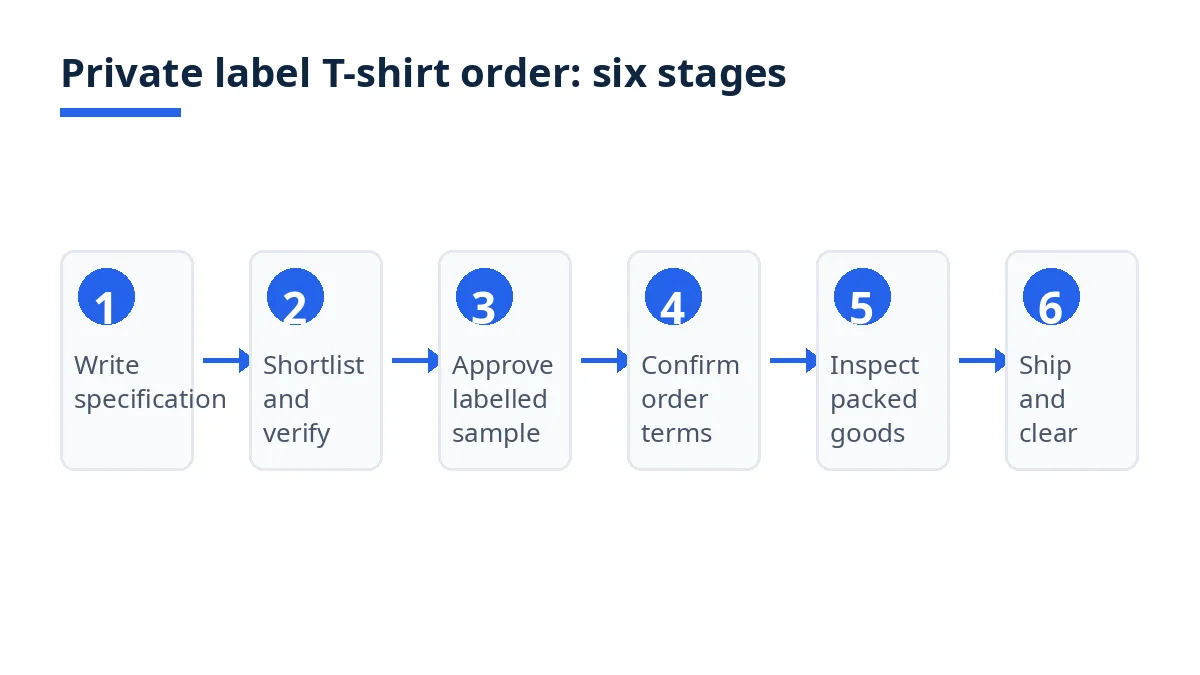
To source private label cotton t-shirts Bangladesh brand owners should fix the garment specification and label artwork first, shortlist knitwear factories that can sew, label and pack under your brand, verify company documents, approve a pre-production sample with the final labels and packaging, agree inspection and delivery terms in writing, and confirm duty and labelling for the destination market before bulk production starts.
On this page
Key takeaways
A private label order has two products: the garment, and the label and packaging set that must be specified, sampled and inspected with it.
There is no single typical MOQ, price or timeline for private label cotton T-shirts, so confirm each one in writing for your exact specification and label set.
Exportain supplier verification is a document and photo review, not a factory inspection, so run your own sample and inspection checks on top of it.
Knitted cotton T-shirts point to HS code 6109.10, and EU fibre composition labelling is compulsory, so confirm duty and label wording before bulk production.
Private label cotton t-shirts Bangladesh sourcing puts your brand on a garment made by someone else, so the order has two products at once: the T-shirt itself, and the label and packaging set that makes it yours. This guide is for brand owners, retailers and online sellers in the United States, the United Kingdom, the European Union and the United Arab Emirates.
Why this matters for buyers and sellers
The Bangladesh Knitwear Manufacturers and Exporters Association (BKMEA) states that it represents the knitwear sector of Bangladesh, was established in 1996, and currently represents approximately 2,540 knitwear member factories.1 The European Commission states that the EU's imports from Bangladesh are dominated by textiles, accounting for almost 94 percent of the EU's total imports from Bangladesh in 2025.2
For a private label buyer, the point is responsibility: your label carries the legal and commercial responsibility at retail, even though a factory made the shirt. You control the specification, the artwork, the claims on the label, and the approval that releases bulk production. A neck label with the wrong fibre wording can hold a finished order that is otherwise well sewn.
Step-by-step: how it works
What should you fix in the specification first?
Write one specification for the garment and the brand elements: fabric composition and weight, fit and size chart with tolerances, colours, stitch requirements, and any print or embroidery position and size, plus neck label wording, care label wording, hang tag content and packaging format, including pieces per pack and per carton.
Add artwork files for every brand element, with sizes and placement measured. A label approved as a screen image can still be wrong at real size, so approve physical label samples at final dimensions. Record who supplies each element: some brand owners supply finished labels and tags, and others ask the factory to produce them from approved artwork. See how to import cotton t-shirts from Bangladesh and the cotton t-shirts quality control checklist.
How do you shortlist and verify a supplier?
Shortlist on the garment first and the label work second. A candidate should already make knitted cotton T-shirts in your weight and fit range, and should apply your labels, tags and packaging in production. Send every candidate the identical specification, including the label set: a quote that ignores label work is not comparable with one that includes it. Browse suppliers on Exportain and use finding suppliers in Bangladesh.
Check the company before the product. Ask for the trade licence, export registration and association membership where applicable, and check that the company name, address and bank account name match across the documents. Never pay a deposit to a personal bank account. Then check capacity for your style and whether printing, label making and packing are in-house or placed with another firm.
On Exportain, supplier verification is a document and photo review. Exportain states that verification is free, that staff review every submission, that approved checks earn badges shown on the company page, product listings and quotations, and that it is a document and photo review, not a factory inspection.3 Read a badge for what it covers, then run your own product checks.
Which samples do you need, and how do you approve them?
Use three stages: a development sample, a pre-production sample made in production fabric with final labels, tags and packaging fitted (the sample you approve for bulk), and a shipment sample taken from packed bulk goods.
Test the pre-production sample as a finished retail product: fabric weight, measurements, shrinkage, colourfastness, seam quality and print position. Then check the brand elements: label wording, position and stitching, care symbols, hang tag content and pack format. Approve it in writing and keep one sealed counter-sample. Most disputes start when the label set was only approved as artwork on a screen.
Costs, timelines and documents
What drives the price of a private label order?
Fabric is usually the largest cost element, followed by sewing, trims, printing or embroidery, testing, packing and the factory margin. A private label order adds neck labels, care labels, hang tags and retail packaging, each with a production or purchase cost, plus handling to apply them. Ask each supplier whether its unit price includes the label set and packaging, and which party supplies them.
Cost element | What to confirm in writing |
|---|---|
Fabric | Composition, weight and who supplies it |
Sewing and finishing | Style, stitch requirements and any print or embroidery |
Label set | Neck label, care label and hang tag: supplier and cost |
Packaging | Pack format, pieces per pack and carton size |
Testing and inspection | Which tests, which stage and who pays |
Freight and duty | Delivery term and who pays each charge |
Record the currency and validity date of each quote. A lower quote built on a lighter fabric or bulk packing instead of your retail pack is a different product, not a saving.
Is there a typical minimum order quantity?
There is no single typical minimum for private label cotton t-shirts Bangladesh orders. The minimum is set per style and usually per colour, because fabric is knitted and dyed in batches. Labels, tags and packaging are separate items, so ask how the minimum works for each element, how it splits by colour and size, and at what quantity the unit price changes. See minimum order quantity and cotton t-shirts MOQ in Bangladesh.
How long does a private label order take?
There is no single typical timeline. Production runs from final approval of the pre-production sample, including its label set, and from receipt of the deposit. If labels are made after garment approval, their production can become the longest element. Approve artwork early.
Shipping time is separate. Sea freight takes weeks rather than days, varying by destination port, routing, transshipment and season. Plan from a forwarder quote for your port pair. T-shirts are light for their volume, so freight may be priced on volume: confirm carton dimensions and gross weight in the specification.
Which delivery term should a first order use?
The Incoterms 2020 rules define the place of delivery, the transfer of risk and the allocation of costs between seller and buyer, and they also specify who is responsible for paying tariffs on export and import.4 Under EXW, the buyer must pay all tariffs and handle all customs duties, while the seller only makes the goods available.4 Under FOB, the factory delivers goods on board at the Bangladeshi port and you arrange the main freight. Under CIF, the factory arranges freight and minimum insurance to your destination port. Under FOB and CIF alike, the seller is responsible for export clearance only, and the buyer handles import duties and clearance.4 For a first order, FOB is a frequent choice. Write the term and named place into the purchase order.
Bangladesh-specific rules and tips
How are cotton T-shirts classified for duty?
Duty follows the classification of your exact garment in your destination market, not the product name, and a private label does not change the code. The Netherlands Chamber of Commerce (KVK), in its worked example for importing cotton T-shirts into the EU, works through chapter 61 and heading 6109, T-shirts, singlets and other vests, knitted or crocheted, then the cotton line, giving the HS code for cotton T-shirts as 6109 10 and the EU import TARIC code as 6109 10 00 10.5 The HS code is the first six digits of the TARIC code.5 Treat 6109.10 as indicative until your broker confirms the full national code for your exact garment: a blended fabric can move the line.
What import duty applies?
Your rate depends on your market, confirmed subheading, origin and any preference in force on the shipment date, so this guide states no single rate. In the European Union, Bangladesh, as a least developed country, benefits from the Everything But Arms arrangement, which grants duty-free, quota-free access to the EU for exports of all products except arms and ammunition, and Bangladesh is the largest beneficiary under that arrangement.2 Claiming it depends on origin rules and proof of origin, so confirm both with your broker. For the United States, the United Kingdom and the United Arab Emirates, read the rate beside your confirmed code in the official tariff for the entry date, or have your broker confirm it in writing. KVK makes the related point that a supplier code is only a guide for your own tariff search, and only the first six digits travel across borders.5
What labelling rules apply to your own label?
Your label is a legal document sewn into the garment. In the European Union, Regulation (EU) No 1007/2011 of 27 September 2011 sets the rules on textile fibre names and the related labelling and marking of fibre composition, and labelling or marking of the fibre composition should be compulsory to ensure that correct and uniform information is made available to all consumers in the Union.6 The fibre names and percentages on your care label must match the fabric in your specification and in the finished garment.
Agree the exact wording at sample stage for every market you will sell in, because fibre wording and care instructions differ by market. Check that no claim appears on the label, tag or packaging that the documents do not support. A claim on a hang tag is your claim at retail, even if the factory printed it.
How should quality be checked on a private label order?
Run the standard T-shirt checks against the approved sample, then add the brand checks: label wording, position and stitching, care label content, hang tag attachment, pack format, size sorting and carton markings. Garment checks cover fabric weight, measurements, stitch quality, neck and hem finish, shade consistency and print quality.
Agree the inspection method and defect limits before production starts. ISO 2859-1 defines a system of acceptance sampling plans for inspection by attributes, and its acceptance quality limit (AQL) is the maximum average percentage of defective items considered acceptable during random sampling, used to determine sample sizes and acceptance and rejection thresholds.7 Inspect in two stages: an inline inspection while sewing and labelling are under way, which can still correct a label error across the order, and a final random inspection on packed goods against the sealed counter-sample. See the pre-shipment inspection guide.
Mistakes and red flags
Approving the garment but not the label set. Artwork on a screen is not an approved label. Approve physical labels, tags and packaging at final size.
Leaving the label supply route unstated. If the order does not say who supplies labels and packaging, the delay appears at packing.
Comparing quotes on different products. A quote without your label set, packaging or testing is a narrower quote, not a cheaper one.
Printing claims the documents do not support. Fibre, origin and care claims must match the fabric and destination rules.
Paying outside the company account. A request to move a deposit to a personal account, or a late change of bank details by email alone, is a stop signal.
Skipping the packed-goods check. Size sorting, label position and pack errors are only visible once goods are packed.
Pricing before the landed cost. Price from the confirmed landed cost, not the factory unit price.
Checklist
Write the specification: fabric, weight, fit and size chart, colours, print or embroidery, plus the full label set and packaging.
Classify every style for duty, confirm the rate and any preference with your broker, and fix label wording for each market.
Shortlist factories that make knitted cotton T-shirts and will apply your labels and packaging, and request quotes on the identical specification.
Verify the chosen supplier: company documents, bank account name and capacity.
Order samples, then approve a pre-production sample with final labels, tags and packaging fitted, and keep a sealed counter-sample.
Confirm the order in writing: purchase order, pro forma invoice, price basis including the label set, delivery term, payment terms, inspection plan and shipment date.
Inspect during production and again on packed goods against the counter-sample.
Ship, clear customs with the confirmed code and documents, and reconcile the actual landed cost.
How Exportain helps
Exportain is a marketplace for sourcing from Bangladesh, not a party to your goods contract, and it does not sew, inspect or ship your order. Exportain sets out an eight-step buying route: search the catalogue, review supplier profiles, understand trust badges, send an order request, post an RFQ, compare and accept quotations, agree and settle payment directly with the supplier, and arrange freight and inspection.8
State your label and packaging requirements inside the RFQ, so every quotation answers the same specification. Exportain states that every quotation is versioned, showing unit price, MOQ, lead time, Incoterm, payment terms and validity, and that accepting a quotation creates an order record with those terms.8 See how supplier verification works on Exportain.
FAQs
What should I know first about cotton t-shirts?
Know the garment and the label as one product. Fix fabric, fit and size chart, and the exact label and packaging set before you request quotes, because each element changes price and minimum. Then confirm classification, duty and labelling for your market, since knitted cotton T-shirts point indicatively to HS 6109.105 and EU fibre labelling is compulsory under Regulation (EU) No 1007/2011.6
What are the typical costs and timelines?
There is no single typical cost or timeline. Cost is built from fabric, sewing, trims, any print or embroidery, the label set, packaging, testing, inspection, freight and duty, each set by your specification. Time runs from written approval of the pre-production sample with its final label set, plus label production, and then sea transit, which takes weeks. Obtain each figure in writing.
Which documents are needed?
For clearance, the standard set is the commercial invoice, packing list, bill of lading or air waybill, and proof of origin where a preference is claimed. For the order itself, keep the specification, written sample approval, purchase order and pro forma invoice. Descriptions, quantities, weights and carton counts must agree across every document, since mismatches are a common cause of customs delay.
What are the most common mistakes?
The most common mistakes are approving the garment without approving physical labels and packaging, leaving who supplies the label set unstated, comparing quotes that cover different items, printing claims the documents do not support, and skipping inspection of packed goods.
Next steps on Exportain
Browse Bangladeshi suppliers whose range covers knitted cotton T-shirts, and read how to import cotton t-shirts from Bangladesh. Then post your requirement through RFQs, stating fabric, label set, packaging and quantity, and review the minimum order quantity guide before comparing quotations.
Sources
- BKMEA at a Glance. BKMEA (accessed )
- EU trade relations with Bangladesh. European Commission, (accessed )
- Supplier verification: Earn trust badges buyers can see. Exportain (accessed )
- Should tariffs be part of Incoterms® training?. ICC Academy (accessed )
- How to find the right HS codes and commodity codes. Netherlands Chamber of Commerce (KVK) (accessed )
- Regulation (EU) No 1007/2011 on textile fibre names and related labelling and marking of the fibre composition of textile products. European Union, (accessed )
- ISO 2859-1:2026 - Sampling procedures for inspection by attributes — Part 1: Sampling schemes indexed by acceptance quality limit (AQL) for lot-by-lot inspection. International Organization for Standardization (accessed )
- How to source and buy from Bangladesh. Exportain (accessed )
About the author
Sourcing from Bangladesh?
Post a request for quotation and suppliers on Exportain can send you their quotes directly.
Post an RFQ